seabird said.. Shaggybaxter said..
HI Seabird,
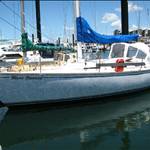
Sorry mate, I am unsure what you mean. Do you mean the chine,where the vertical sides of the hull meet the bottom? Or do you mean the actual mobile steps behind the boat?
The vertical sides.
I thought it might have been a chine but most chines face down to deflect water not up. I guess it's there for structural reasons at the point where the two halves meet.
<div class="forumPostActionsCell">
<div class="forumPostActions">Posted 11 hours ago /images/icons/rate/nothumb.gif /images/icons/rate/0.gif /images/icons/rate/nothumb.gif /images/icons/rate/noflag.gif
<div class="forumPostActionsBox">email quote reply
HI Seabird,
If this what you mean? Finot Conq explained there are few reasonings for the chine, the first is to create a separation point for the water to separate from the hull cleanly and cut down the drag (a rounder hull tends to "grip" the water), the second is when the boat is heeled working to windward, they wanted to minimize the wetted surface area and create the best shape (interestingly it's asymmetrical) that keeps the boat hunting to windward, and third, to increase the RM by increasing the beam , ie: generate more horsepower. A nice rounded edge would either make the boat wider or decrease the wetted surface area available, and being an Open 40 design, they are optimised for planing. I should be able to start planing in 10knots true.

As we all know, wide beamy hull shapes are not the best for pointing to windward, but when you actually see the tank test results,it is surprising as to the wetted surface area.

Pointing really high to windward in big seas will be my worst mode,as the waves will form around the hull as I cut through them, increase drag as it grips the hull. So, to keep up with the canoe style hull shapes to windward in lumpy seas, I have to bear off a few degrees and use horsepower to achieve the same VMG.


 The saildrive sits just behind the keel when it is in its up position, so you can motor effectively, but I cant have sails up when the keel is up of course!
 Have you not sailed centre boarders before??