theDoctor said...the difference between CONtrails and CHEMtrails
pay attention doggie....
Doctor you're obviously not listenning to anything I say.
Now PAY ATTENTION!
Right back at first reply I said;
The length of time a contrail hangs in the air is entirely dependent on the temperature and relative humidity of the air that it is formed in.
Usually, at very high altitude, the relative humidity is very low, thus after the contrail forms, it is quickly reabsorbed into the atmosphere and disappears.
Sometimes, and particularly at lower altitudes, the relative humidity can be much higher. Thus after the contrail is formed it can take a long time to be reabsorbed. In fact it might not be rebsorbed at all. It simply dissipates with the air currents over a wider area until it blends in with whatever wispy clouds might be around.
And now you put up a U choob which demonstrates that perfectly.
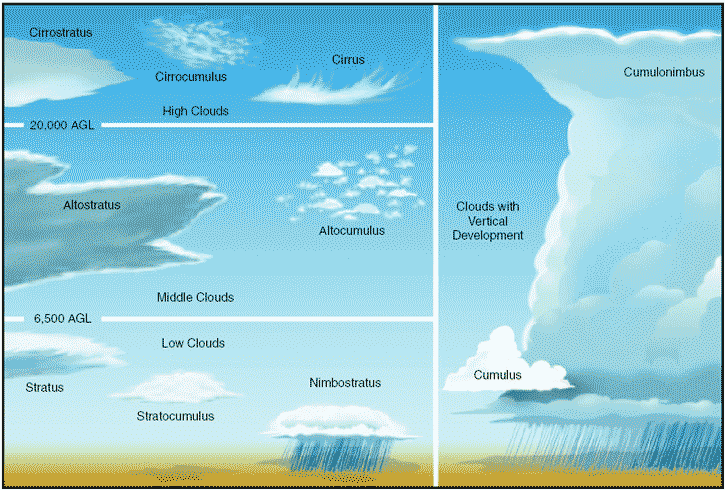
You can plainly see that the contrail which disappears in a few seconds is in the upper atmosphere which would be colder and dryer. The upper atmosphere is almost always dry which is why you don't get cumulous clouds up there unless some huge updraft from a thunderstorm sucks up moist air from the lower atmosphere.
The big contrail which doesn't disappear is clearly in the lower atmosphere which would have a higher relative humidity, probably above 80 percent.
If it's much above that it will hang there indefinitely in the same way that cumulous clouds hang there indefinitely, until they finally blow away.
If the humidity is close to 100 percent they can even increase in the same way that small cumulous clouds, once started, can get bigger and bigger.
You don't need any chemicals to do this, just a bit of water vapour which is blown out the exhaust in much the same way that your car exhaust makes a small coud trail on a cold morning. Only, a big jet makes a big trail.