dachopper forum posts in last 60 days

dachopper
dachopper
WA
1829 posts
WA, 1829 posts
20 Nov 2026 2:38pm
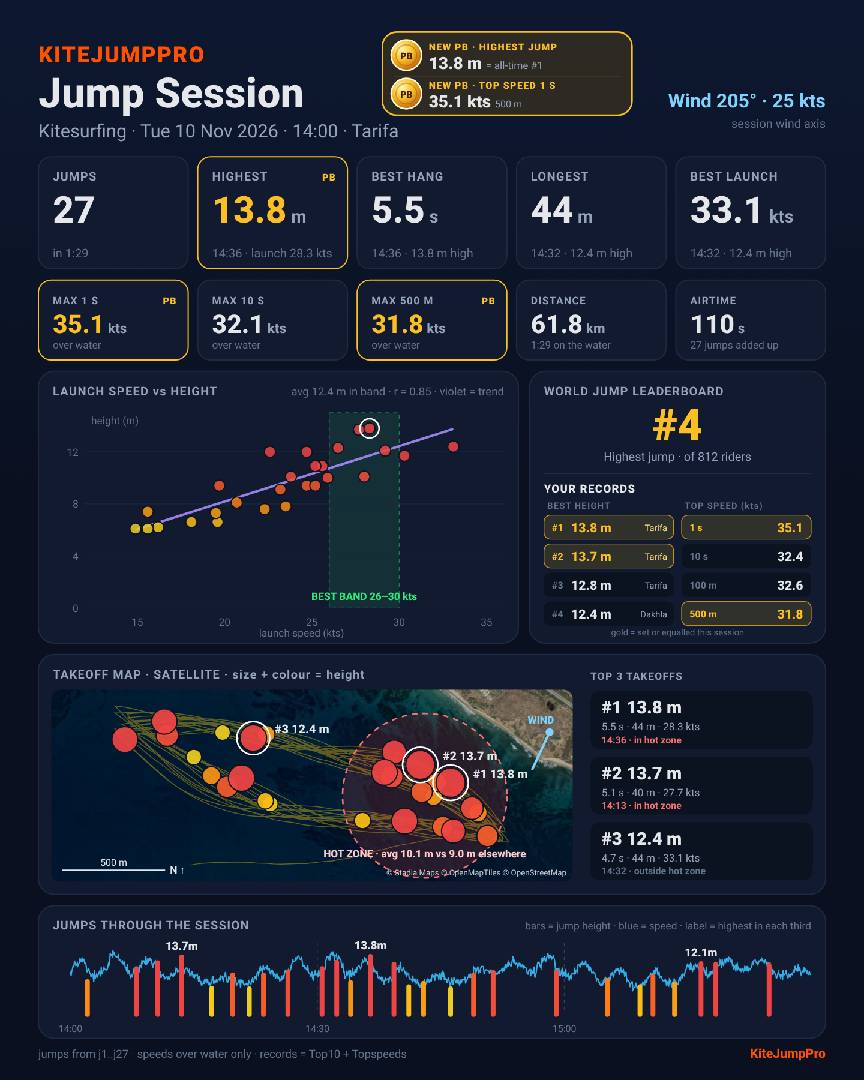
Version 7.0 Released, really keen on your feedback. Particularly people jumping small, and big.


dachopper
dachopper
WA
1829 posts
WA, 1829 posts
18 Nov 2026 5:58pm


Bargain, its a good watch too !.
dachopper
dachopper
WA
1829 posts
WA, 1829 posts
16 Nov 2026 10:59am
Benku said..
I use the WGG app with my Garmin and it works very well. it even shows rotations and Heliloops. I think it works with other watches too.

here the website: windygalaxy.com/get-the-app?watch=apple

they cover other sports like Pumpfoiling or Winging too.


Nice,

How have you found it vs the others?

I'm planning on doing some accuracy testing shortly with a few.
dachopper
dachopper
WA
1829 posts
WA, 1829 posts
15 Nov 2026 10:31pm
Dylan72 said..

mikey100 said..
Now I’m happy to admit that I’m probably the least technologically talented sailor using a GPS, but this upgrade in posting to KA72 is so easy.
One thing I noticed:- when posting by the previous way, my track details also included the green line showing the gps data quality whereas when posting via this shortcut method, that green line graph does not show.
No issue, just an observation.


I had a look at this this morning, and the tl;dr is that when Garmin Connect pushes the fit file to ka72.com, it strips out the information that is used to generate this bar (along with a bunch of other stuff that is considered proprietary or noise.) It's all still there in the original .fit file you can download from the site and upload manually. It's just not provided in the pushed file that lands direct from Garmin.

There is already a bit of annoyance on various forums regarding this from other app developers. See e.g. forum.intervals.icu/t/garmin-fit-fields-not-coming-in-possible-garmin-is-filtering-data-prior-to-sending-to-intervals-icu/124287?u=andreas_schnederle-w
It's not clear if Garmin will ever supply this info for direct posts like this. The moment they do, the bar will come back.

What it means for ka72.com users? Probably nothing. If your bar was always green in the past it will likely be always green in the future.

If you are posting tracks on to gpstc, there may be occasions where this data becomes relevant, and you may be asked to provide the original file from Garmin Connect instead of the pushed one for deeper analysis of a specific result.

The actual GPS data is unaffected as far as I can tell. But what we lose is the record of exactly how accurate your GPS settings were at any given time.

I do feel for professional cyclists who are affected by a whole range of data that Garmin appears to have decided to arbitrarily strip from the original file and they depend on.

See also: forums.garmin.com/developer/fit-sdk/f/discussion/432872/discrepancies-between-fit-files-from-garmin-connect-and-api-api-downgraded/


Question,

Is the green bar indicative of the position.getInfo() .accuracy field reading 0 to 4 ?

Reply in Topic: Going Upwind...Faster!
dachopper
dachopper
WA
1829 posts
WA, 1829 posts
13 Nov 2026 7:13pm
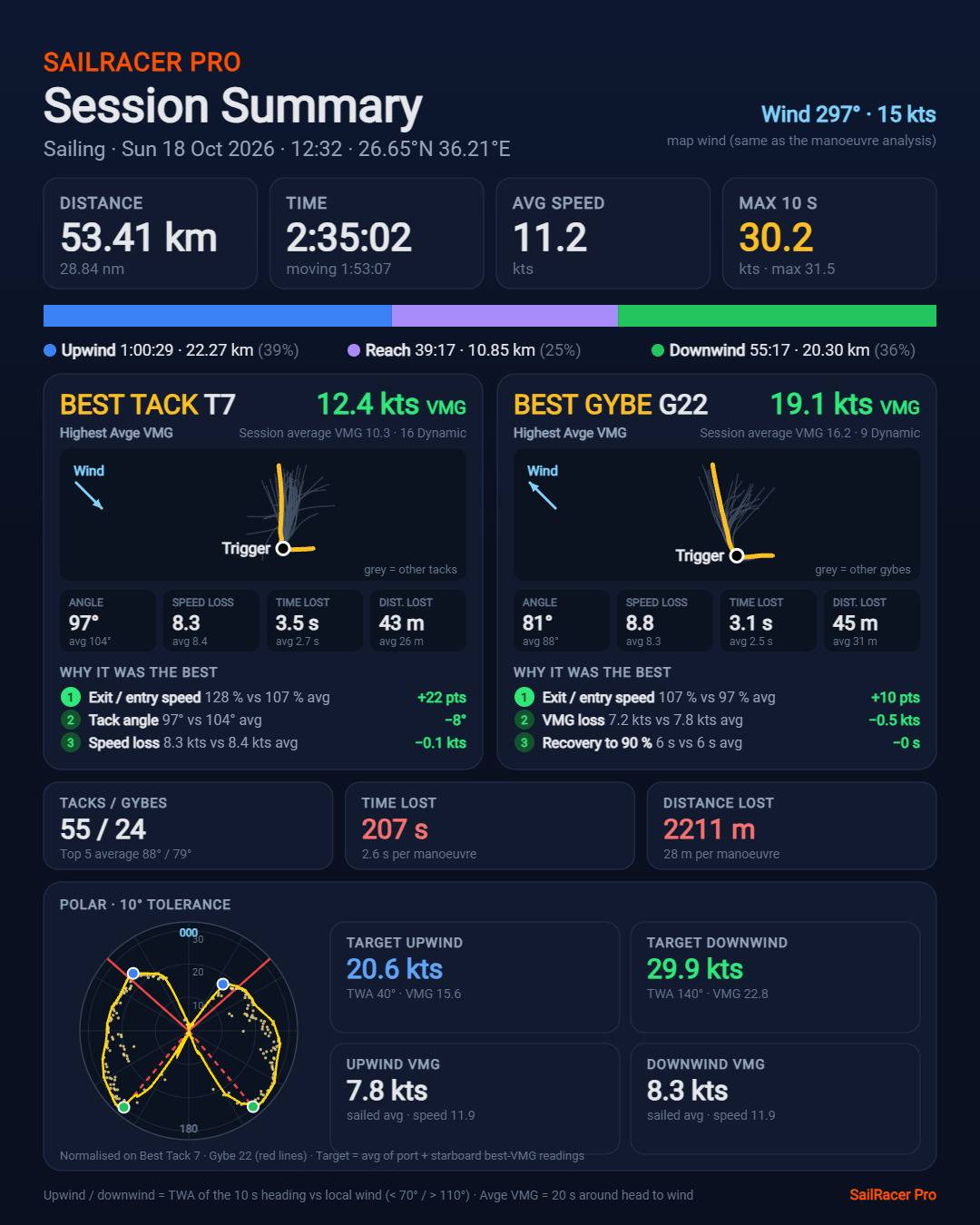
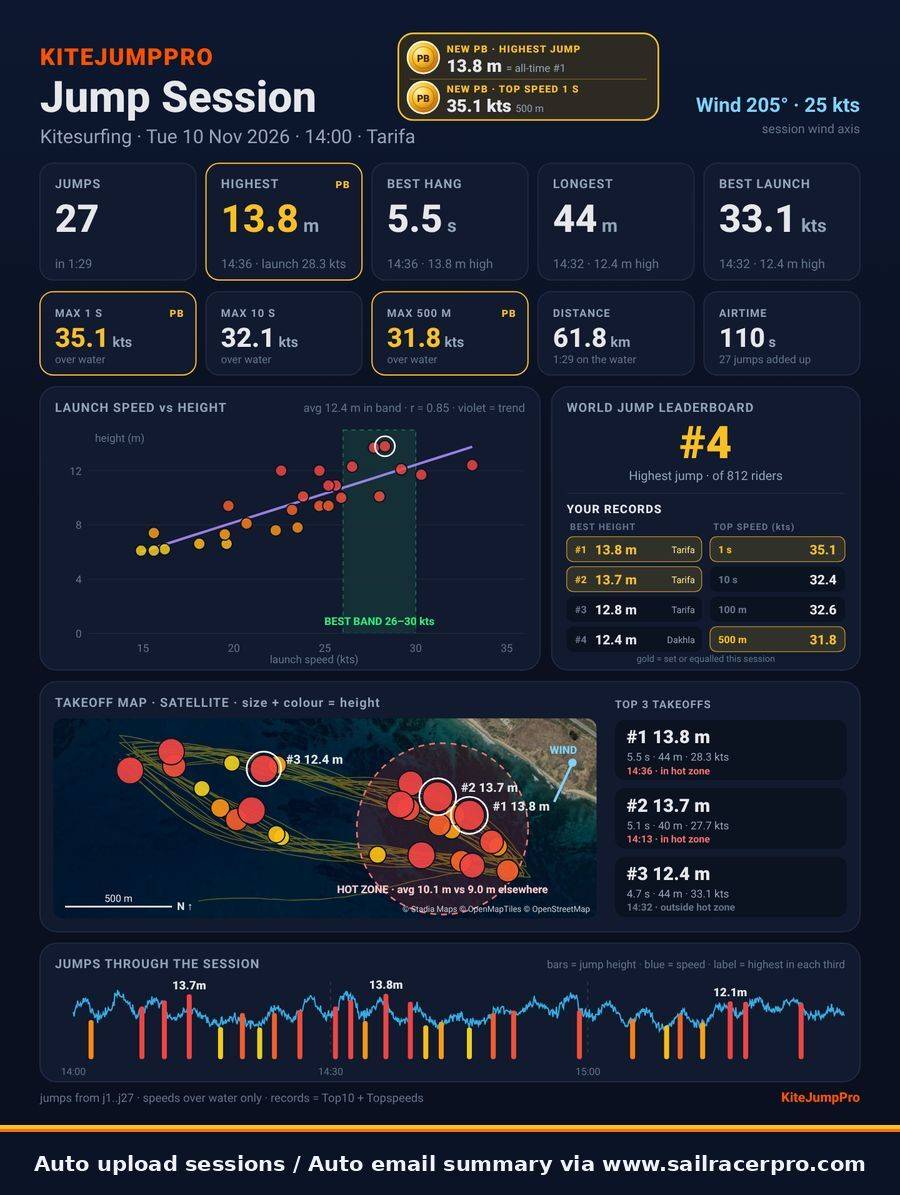
Session summary info auto uploaded from Garmin Kitejumppro watch application now tweeked, with initial replay functionality added.


There is a plan to look into more, but waiting on test equipment to check viability first.
Reply in Topic: Going Upwind.... Faster!
dachopper
dachopper
WA
1829 posts
WA, 1829 posts
13 Nov 2026 6:53pm
shaggybaxter said..
Hi Dachopper,
I was reviewing your dashboard and just wanted to say.. well done!
I'm seeing a lot of 'Vibe coding' at the moment where people are using AI to generate dashboards of all sorts of stuff, like business performance dashboards, system monitoring dashboards, logistics dashboards to name a few.
AI is getting so good it has this propensity to generate a ridiculous amount of cool numbers, counters and graphs. Whilst this might be uber cool for a sys admin, this is far more likely to be a negative for the large majority of users, as it simply overloads your ability to digest.
I can see a lot of thought has gone into your dashboard to parse all of the noise and try and present useful and informative information.
Full credit to you mate, nice work.

One observation, just something that jumped off the page at me.
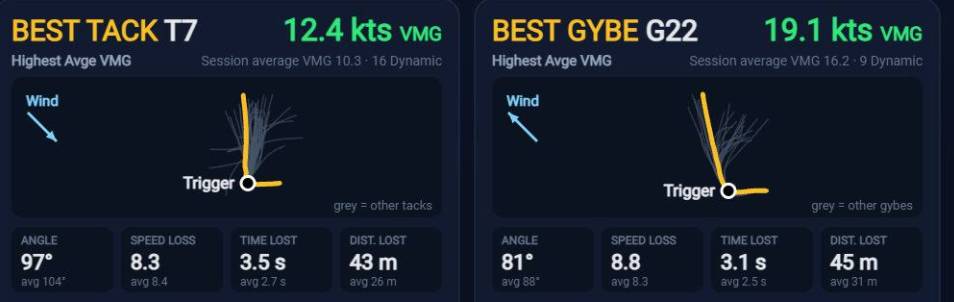
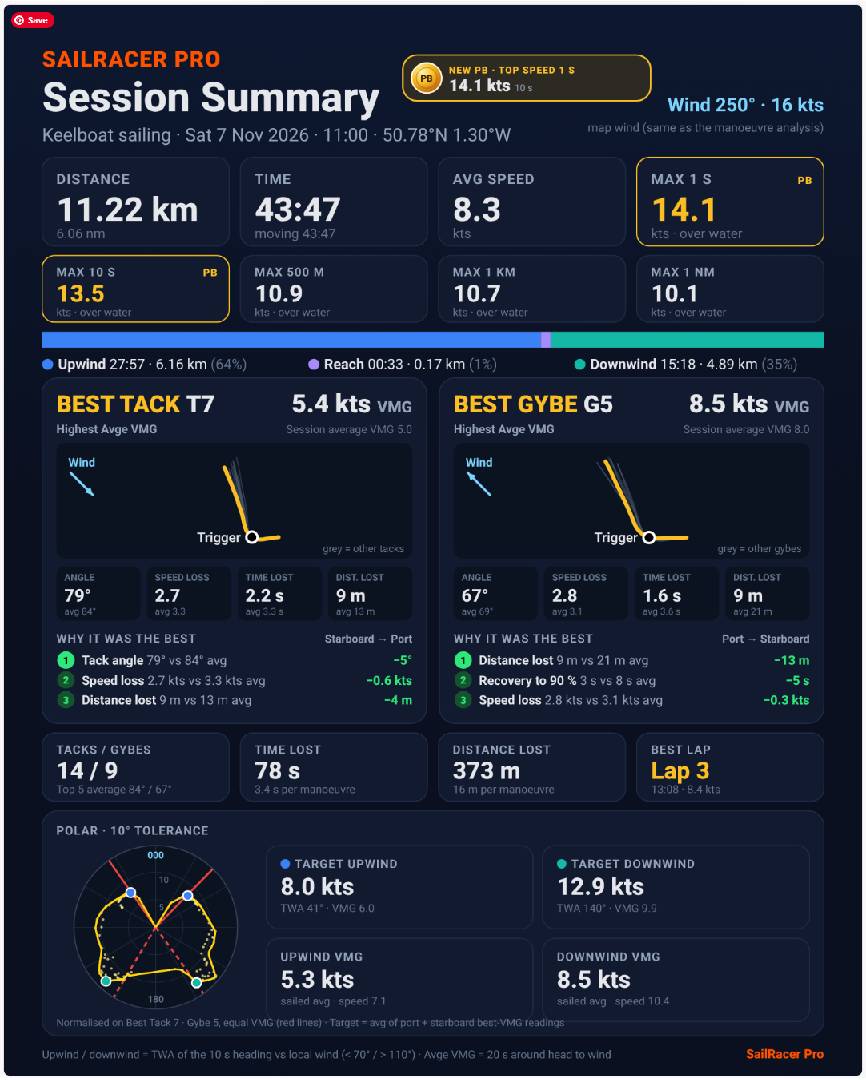
In the 'Best Tack and Best Gybe' section, I noted T7 was the best tack. The my brain went straight to "Hmmm. I wonder what were my Best 5 tacks? Were they all around T7? Were they completely random tacks? Were they all on the right hand side?"

I would find useful a Top 5 list of gybes/tacks. That would be a cool data set to have.
(Apologies if you do already and I'm just ignorant.)


Thanks Shaggy,

It has been an up mountain battle!
I've just uploaded sailracerpro.com 6.0 , probably 6.1 by end of today, and updated all linked Garmin watch apps to support.
However Garmin and Microsoft Servers are down for some odd reason.
I added auto-emailing of the session sumamry as soon as the website recieves it from the watch, but maybe another couple days for the servers to get fixed - everything looks ok on my end.

Hours of iterations to get the displays right for sailing !
There is a seperate one for kitesurf aimed at jumping, and I was thinking about parawinging but I'm not sure what info those guys are after exactly.

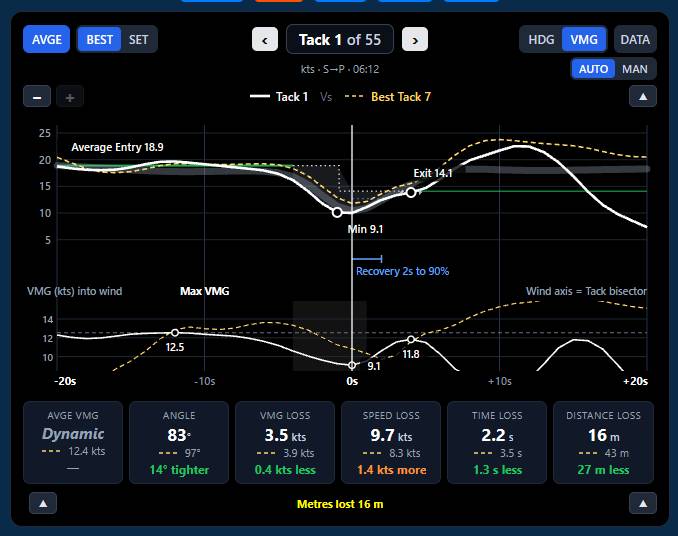
If you click on the sumamry card - it takes you to the Tack analysis sheet and cues up the replay at the selected Tack. At the moment, the view order is the replay order it occured in ( for tack analysis ) ,


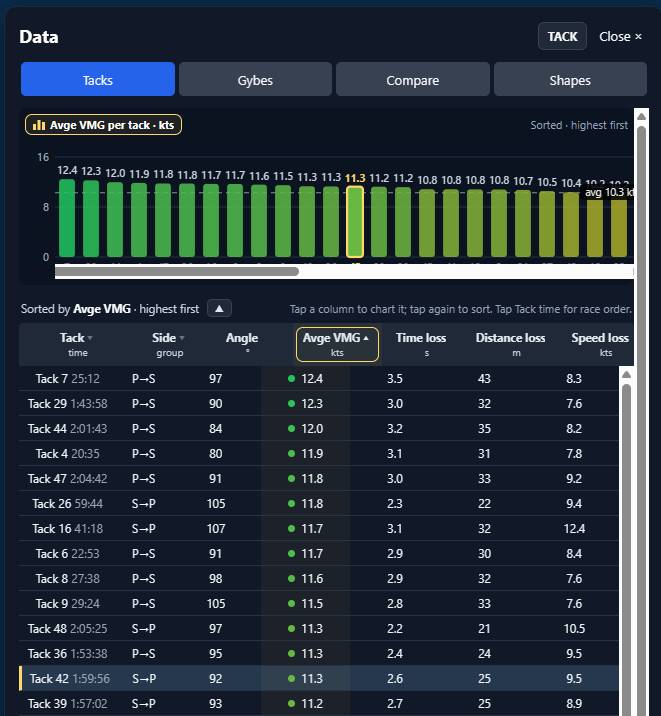
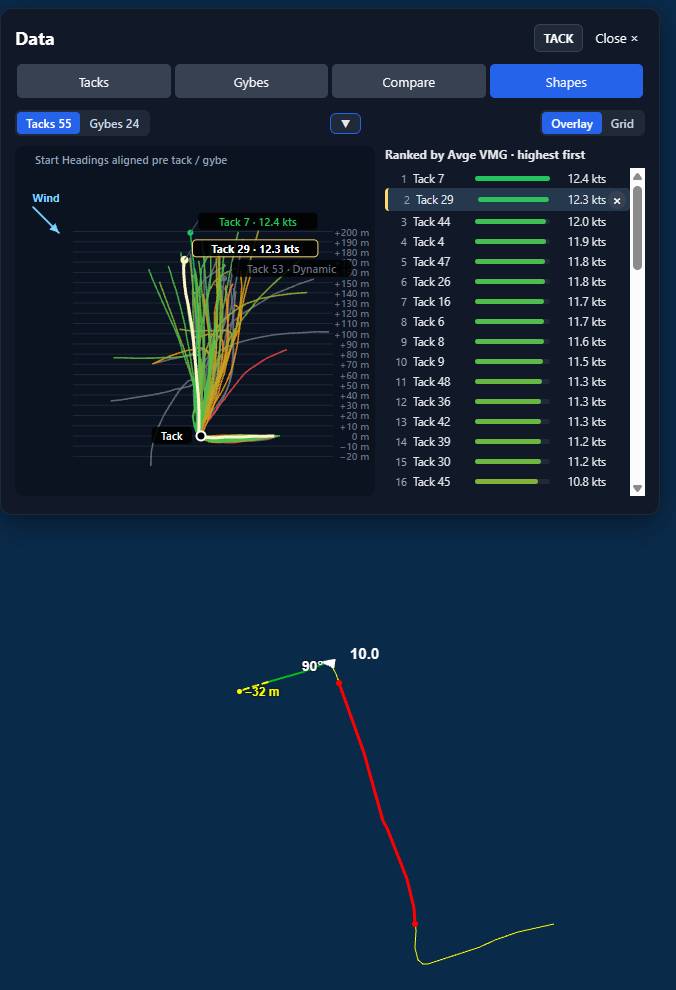
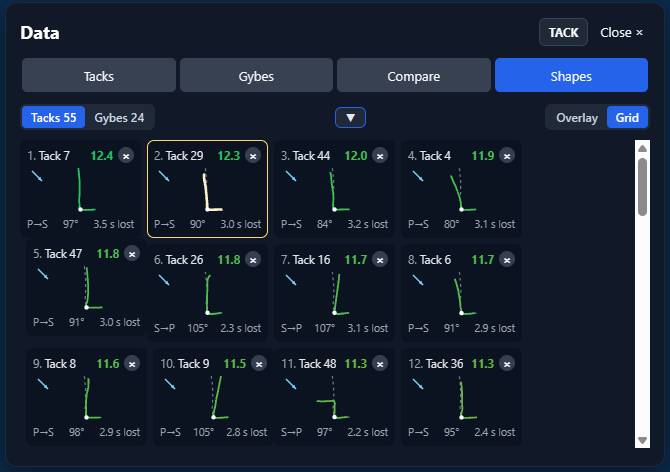
but I also have a Data tab, which ranks all the tacks in order of best to worst, clicking syncs the replay

... also has a shape and grid view of the tack where you can go down the best -> worst list.


finally, I did a few tweeks to the summary colours also, Gold for PB, white otherwise.

Reply in Topic: Going Upwind.... Faster!
dachopper
dachopper
WA
1829 posts
WA, 1829 posts
11 Nov 2026 11:34pm
brady said..
This is an awesome topic - thanks all contributors. A lot of wisdom and experience on display.

I sail a B14 skiff, where instruments are illegal during competiton. But for a while I've been contemplating having some instrumentation I can attach during training sessions so I can really get a better understanding of my best downwind angles (absolutely the key in these things). I'm in a rural area and frequently do not have any similar style boats to compare myself to. Does anyone have any suggestions for something easily mountable/removable, able to get solidly drowned in the inevitable high-speed stacks, and still pretty cheap? Not much to ask really...


Brady,

The simplest and cheapest thing to do , is to record the session on a device you already own that has GPS and then look at the data post session. At the moment, my webapplication will accept any GPX or Garmin FIT recording that you want to manually upload into it, and gives you data based on your best gybe or best tacks, which at their heart are the highest VMG numbers out of all tacks / gybes, and your Polar graph is corrected to these figures. I'm playing with some of the output files this week, and expect them to be in the webapp this weekend version 6.0

Here is an example of what the automatic data you can get looks like - end of session data ( not released verion 5.1 ).


Reply in Topic: Going Upwind.... Faster!
dachopper
dachopper
WA
1829 posts
WA, 1829 posts
8 Nov 2026 3:24pm
shaggybaxter said..
S%$# in, S%$# out.
I loved poring over my GPS plots post race and always had VMG/VMC targets in racing. It was always worthwhile playing back and reviewing your overall race position and strategy and performance against polars.
But I also logged TWA,TWS, Heading, SoW, Heel, Pitch, Heave, Leeway, Barometric pressure and Density Altitude. And used all of that data religiously doing any review. None of those datasets you get with a GPS driven plot alone.

It's fun to use GPS to roughly estimate polars. But no way would I use GPS driven polars in an actual race, it's missing all of the other data that makes sailing to numbers worthwhile. Any decent boat has multiple polars for different sea states/environmentals, the different polars come from all of the data you don't get with just a gps device and a bit of software.
I get it when hydrofoilling at 20knots plus. You're not offshore, flatter water and less tidal influence. But as your speed drops, the higher the propensity in erroneous data.
For keel boats doing a passage race? I'd posit a post race function where you can review a GPS trace on a chart might be more beneficial.

Not trying to diss on you DaChopper. If peeps are doing keelboat racing without electronics, or play in OTB pickleforks or suchlike, then knock yourself out.
But polars derived from a GPS plot would be useless for me in keelboat racing (sans WAGs), especially using that data to affect decisions in the actual race itself. Way too many missing bits of info.
My two cents!


Fair enough.

The softwate has a lot more features than just polars, but as the post mentioned for sailors new to their equipment - assuming they are not handed a set design polars, this is a great staring point before they have thousands of data points., and only requires them to turn on their watch and record.

For smaller watercraft ( windsurf, wing, kitefoil ) there are no polars so again this can help confirm tacking angles, time lost in tacks, and in the replay portion if there are consistent lifts / knocks due permanent environmentals, you learn if i go in this area, i pull ahead 200m vs going in this area. )


Reply in Topic: Going Upwind.... Faster!
dachopper
dachopper
WA
1829 posts
WA, 1829 posts
8 Nov 2026 12:30pm
JonE said..
And it's not VMG to the mark that's CMG.

VMG doesnt tell you when to tack and CMG doesnt until you hit the layline,

VMG just quantifies the best compromise between pointing and boat speed but the GPS can't tell you VMG because it doesnt know where the wind is.

This is why you have to create polars by which you need to rigorously measure VMG at different angles whilst doing maximum boat speed and plot it. Someone cite me one reliable reference to how to create polars without accurately calibrated true wind, STW and heading. I have read everything I can get my hands on and it appears there is no shortcut. Hence my disagreement with this "advertorial" post.


Yes and no...

Lets say you are doing a W/L.

JonE said..
And it's not VMG to the mark that's CMG.

VMG doesnt tell you when to tack and CMG doesnt until you hit the layline,

VMG just quantifies the best compromise between pointing and boat speed but the GPS can't tell you VMG because it doesnt know where the wind is.

This is why you have to create polars by which you need to rigorously measure VMG at different angles whilst doing maximum boat speed and plot it. Someone cite me one reliable reference to how to create polars without accurately calibrated true wind, STW and heading. I have read everything I can get my hands on and it appears there is no shortcut. Hence my disagreement with this "advertorial" post.


Say you do a W/L, and enter the axis from the bottom mark, to the top mark. ( not wind, not cmg) , gps vmg will show you the fastest way to get in the direction of the top mark. Throw a few tacks in pre start to see which tack has higher vmg at the same boat power, and now you know preferred start tack.

Polars are simulated normally by boat / sail designers.
My app simply reverses the process to show you the gps polar you actually achieved in the real world., and has some filters to normailze wind shifts.

Reply in Topic: Going Upwind.... Faster!
dachopper
dachopper
WA
1829 posts
WA, 1829 posts
8 Nov 2026 12:13pm
Trek said..
I dont get why you cant sail to best VMG upwind. I always have in racing. If you get too close to the wind or pinching VMG drops and you need to turn slightly down. I spent time before racing measuring lat and long of each mark so VMG to the mark would be accurate. For example, 15 knots at 45° produces the best VMG to the mark, even though the boat can sail faster at 50° so sail at 45. I won trophies doing exactly that. Choosing when to tack can be tricky. What am I missing?


A few reasons you wouldnt do pure vmg. ( assuming you are hunting for the highest number)
1. There is a forced tack scenario impending, course / port starboard whatever the reason.
2. Theres a wind or current or sea change ahead that you are trying to get into. Dropping to degrees for 10% more boatspeed, to get into the lift / more wind which could be another 10 % boatdpeed might be worth it.
3. If you start focussing on a vmg number ( same with the SOG number) and sail into better conditions, your best vmg /sog will change and might be higher than you are aiming for.

I think once you get a " feel " for best vmg you can sait to it better than following sog, although its still usefull.

Also have a lift tool in the works


dachopper
dachopper
WA
1829 posts
WA, 1829 posts
5 Nov 2026 10:52pm
Dylan72 said..
You can now link your ka72 account to a Garmin Connect account.

This will allow Garmin Connect to post your files direct to ka72 as soon as your session hits the cloud.

The linking is available to all registered users on the site (free and pro.) To set up your account link go to ka72.com/me/settings

Once it is set up, you can also use this page to limit the types of tracks that get posted to ka72.

How it works:
Sail with your watch as normal. When you are finished and save your session on the watch, after a while your device will typically pop up a message saying something like "Your activity is now ready to view"

Soon after this, open up ka72.com and you will see a banner at the top of the page advising you that your track has landed.

Open the link, check the track type and visibility, and hit post.

No more downloading/uploading. No more messing with zip files.

The integration is a work in progress. Please let me know if you hit any snags, or have any questions or suggestions for improvements.

Great work Dylan !


Reply in Topic: Levitas R6 info
dachopper
dachopper
WA
1829 posts
WA, 1829 posts
5 Nov 2026 10:46pm
I've got an R6 for kitefoil racing. I chose that because it was more compact for travel and has adjustable tail trim. I've also heard that the chubunga new version is found to be easier to ride, but also depending how the R6 is setup it can be quicker in certain scenarios....... easier to ride though usually means faster for the average punter.
Reply in Topic: Going Upwind.... Faster!
dachopper
dachopper
WA
1829 posts
WA, 1829 posts
3 Nov 2026 6:38pm
JonE said..
First up, you cant sail to vmg when heading upwind. If you steer the boat (up) to get a higher number, the number goes really high, then the boat stops.

Second you're only getting COG not heading from the GPS.

If meaningful data could be deduced by gps alone and occasionally going head to wind, we would have had it for 20 years.

On a lake with a sub 5 meter mast this might be useful. Everywhere else we have leeway, wind shear, tide, wave direction. So many reasons why you might go faster, or think you're going faster on one tack vs another.

Wanting to judge tacking performance is worthwhile but without having fantastic true wind angle information you cant make those claims about the cost of a tack based on shifts.

true wind is not possible without good STW, realtime wind, heading and calibration tables.

So 15 minutes a week spent on tacking practice with a stopwatch is going to be time better spent?


Thanks JonE, good points and I agree with a few of them.

You're right that you can't steer to VMG upwind. Chase the number and you pinch, and the boat stops. That's why I steer to a target speed (18 kts in that example) and only use the live VMG as a header alarm. If speed holds but VMG drops 15% or more, the breeze has probably shifted.

Also agreed that GPS gives COG, not heading, and I'm not claiming true wind angle, leeway or proper instrument-grade true wind.

Where I'd push back a little is that for racing, the ground is what counts. Leeway, tide and current are all baked into COG and SOG, and they're exactly what decides who gets to the top mark first. Comparing within one session (same boat, same tide state, similar breeze) still shows which tack angle and which speed got you upwind fastest over the ground. The wind axis comes from averaging your own tacks, so it's an estimate, and a tide change or big shift shows up as noise you can see in the track. But what if the shifts tend to be in the same spot, as you approach the shore or between island for example, you see it and take advantage of it.

Same with tack loss. Metres of ground made good lost per tack is a fair relative measure. It won't tell you why one tack was worse, but it tells you which ones were.

15 minutes a week of tacking practice with a stopwatch is great. Or just record it on the app which adds a GPS track, so you can see which of those tacks actually cost less ground rather than which one felt better

Happy to run one of your sessions through tracks through it if you'd like to see where it holds up and where it falls down.
The closing offer is the important part. If he takes you up on it, it turns a sceptic into a public test case.
dachopper
dachopper
WA
1829 posts
WA, 1829 posts
31 Oct 2026 7:26pm
If there's one thing I've noticed consistently over the years, it's how hard everyone finds it to work out the best speed to go upwind, especially on new gear or in a new class. Whether you're new to the sport or a seasoned sailor, getting upwind well is one of the hardest and most time-consuming things to nail. Which sail, which foil, how much power, how high to point, how fast to go? It's easy to spend whole sessions going up and down without knowing whether you actually made ground. On a relaxed sail, an efficient upwind leg means less effort, more fun, and getting there sooner. On the race course, it's the difference between rounding the top mark first and chasing the fleet all the way back to the bar.

One of the funniest races I've ever witnessed was a kitesurfing race with a whole field of novice riders. I'd just come in from my heat in second place when a friend borrowed my kite, and I gave him one piece of advice: "Whatever you do, don't go at top speed when you're heading upwind." Some job that advice did! The start was meant to be a close reach, sailing slightly upwind. Instead, the whole fleet launched and accelerated to top speed, with massive rooster tails, spray and board wakes everywhere. It seemed to start with one rider pulling away out front, and soon the entire fleet was racing at full tilt, legs burning and all. They flew past the reach turning mark, hundreds of metres too low, leaving those of us on shore wondering whether they'd been hit by a 30° wind shift. The real cause showed up when they tacked back to start their "upwind journey". Most of the fleet, rooster tails and all, barely made it back above the start line, all because their VMG at top speed was practically zero 😂😂. That ended up being a looooong race!

VMG stands for Velocity Made Good: your speed directly upwind or downwind, as opposed to the speed you're actually travelling. Sailing apps on watches, phones and tablets can now take the guesswork out of it. Many show live VMG, and some give you polar or radar charts or speed-versus-wind-angle graphs. You can check these while racing, or back on shore to see exactly what worked and what didn't.
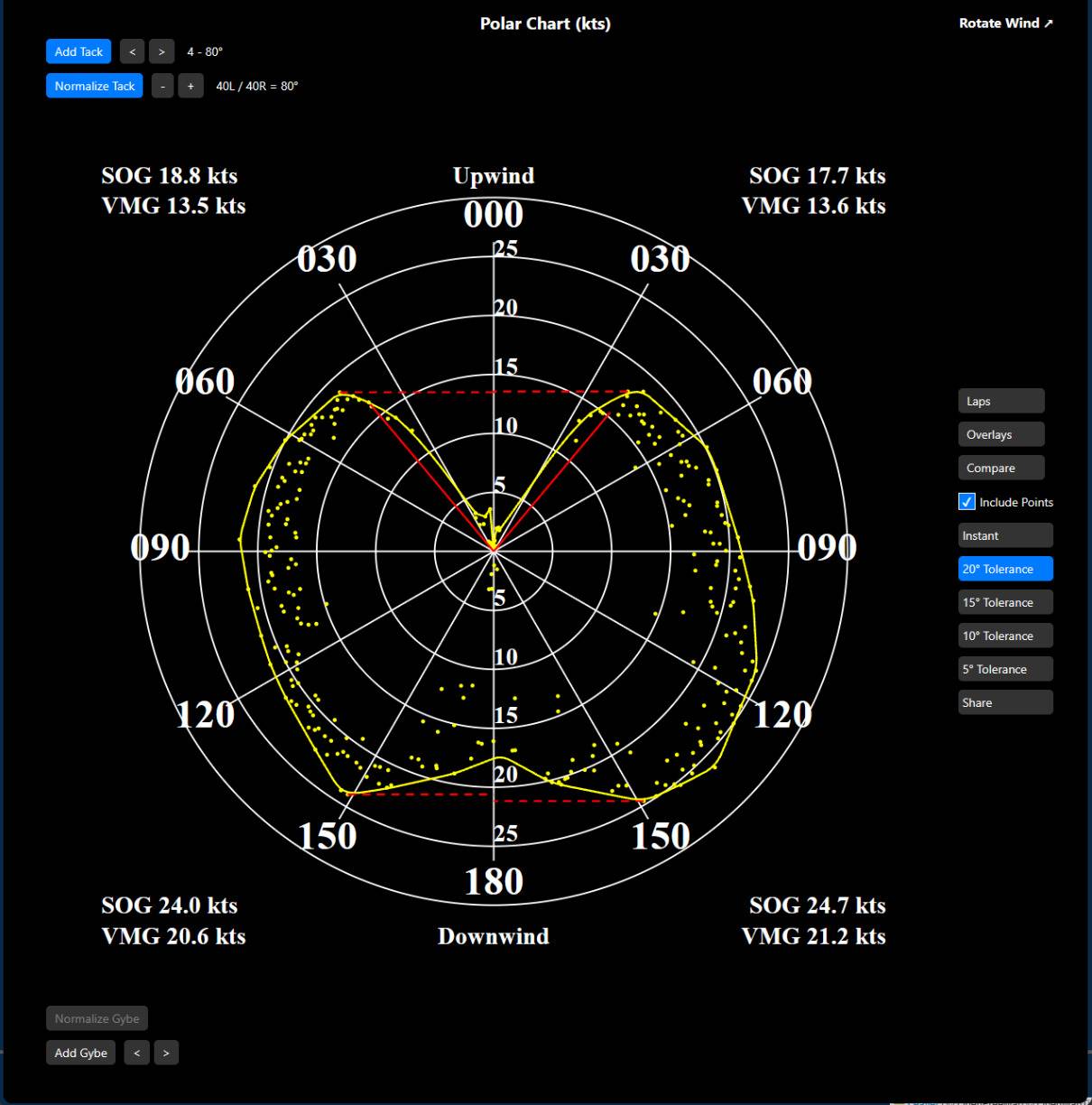


Here's a polar from one of my recorded hydrofoil sessions. The wind comes from the top of the chart. Each dot is a moment in the session, plotted by its angle to the wind and its speed, and the yellow line traces the best speeds at each angle. VMG is the part of that speed going straight into the wind. Pinch too high and your speed collapses; sail too low and you go fast but don't gain much ground. The sweet spot here was about 40° off the wind at around 18 knots of speed over ground (SOG), giving about 13.5 knots of VMG on both tacks. So my upwind target on this gear in these conditions is simple: hold about 18 knots. If I'm slower than that, I bear away to build speed. If I'm well above it, I can point a bit higher.

The red lines show an 80° tack angle, 40° each side of the wind, and that's a little tight for this gear. Port tack holds its speed well, but on starboard I couldn't quite reach 18 knots that high. Sailing about 85° tack to tack would have kept my speed up and my VMG closer to its best, and less speed would have been lost in each tack.

You can also use the VMG number on the water. If your watch app lets you set the wind direction, point the wind axis accurately into the wind and it will read out a live VMG. There are a couple of ways to do this, but as a guide using the numbers from above: target speed 18 kts, VMG should be 13 - 14kts. When my VMG drops by more than 15% and it's a real header, if it looks like it will hold for more than 35 to 40 seconds and I'm not near the layline, it's worth a tack.
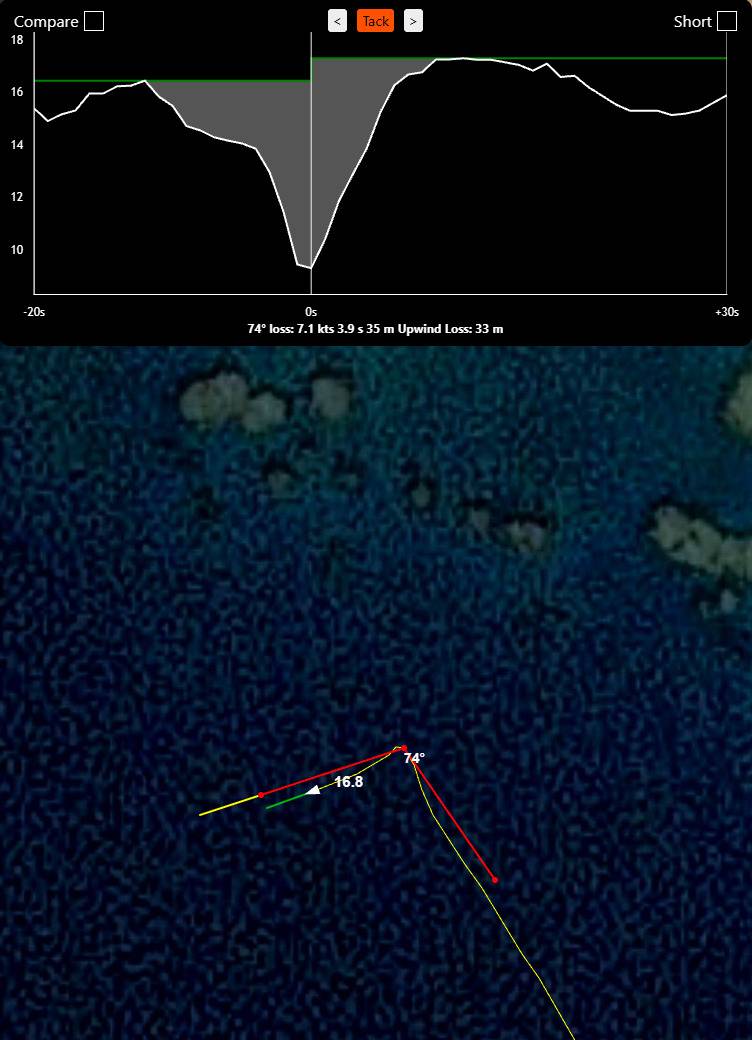


Every tack costs time and distance. The easiest way to measure it is in seconds: how many seconds of progress you give away. On my foil, a good 88° tack dropped me from 18 to about 10 knots and cost about 23 m upwind, which is around 3.3 seconds. A sloppier 74° tack in the same session cost 33 m, or about 4 seconds. Displacement boats lose fewer metres because they're slower, but about the same in seconds or more. A keelboat typically loses about one boatlength per tack in flat water and up to three in chop.
In one measured example, a 6 knot keelboat took 15 seconds to complete its tack but lost only about 5 seconds of upwind progress because it keeps moving towards the wind as it turns.

When should you tack on a header?
A header forces you further from the wind, so your VMG drops. Tacking onto the lift gets it back, but it only pays off if the shift lasts long enough to cover the cost of potentially 2 extra tacks.

Rough guide (when not close to the layline )
Multiply your tack loss in seconds by 11 for a 10 degree shift.
If you think the header will last at least that long in seconds, it's worth tacking into and out of again.

On my foil, a 10° header that costs me two extra tacks needs to last about 35 to 40 seconds before it pays off. Boats ahead and upwind can be a good indicator of what is to come. A keelboat in flat water needs about a minute, and one in chop needs 2 to 3 minutes. A dinghy with a slick roll tack in light air can profit from shifts of only 10 to 20 seconds. Smooth tacks and flat water let you use more shifts, while chop and stalled tacks mean only the big, long ones are worth chasing.

The best part is that you don't need to guess your numbers. A GPS debrief will show your target upwind speed, your VMG on each tack, and exactly how much each tack cost you.

*Full disclosure: I'm the developer of SailRacerPro, which does polar, VMG and tack-loss debriefs from any GPX or FIT file, plus Garmin watch apps for sailing, kite, windsurf and wing. Happy to run anyone's track through it if you'd like to see your own upwind numbers, or try it out for free yourself at www.sailracerpro.com

Reply in Topic: Parawing VMG
dachopper
dachopper
WA
1829 posts
WA, 1829 posts
31 Oct 2026 7:25pm
If there's one thing I've noticed consistently over the years, it's how hard everyone finds it to work out the best speed to go upwind, especially on new gear or in a new class. Whether you're new to the sport or a seasoned sailor, getting upwind well is one of the hardest and most time-consuming things to nail. Which sail, which foil, how much power, how high to point, how fast to go? It's easy to spend whole sessions going up and down without knowing whether you actually made ground. On a relaxed sail, an efficient upwind leg means less effort, more fun, and getting there sooner. On the race course, it's the difference between rounding the top mark first and chasing the fleet all the way back to the bar.

One of the funniest races I've ever witnessed was a kitesurfing race with a whole field of novice riders. I'd just come in from my heat in second place when a friend borrowed my kite, and I gave him one piece of advice: "Whatever you do, don't go at top speed when you're heading upwind." Some job that advice did! The start was meant to be a close reach, sailing slightly upwind. Instead, the whole fleet launched and accelerated to top speed, with massive rooster tails, spray and board wakes everywhere. It seemed to start with one rider pulling away out front, and soon the entire fleet was racing at full tilt, legs burning and all. They flew past the reach turning mark, hundreds of metres too low, leaving those of us on shore wondering whether they'd been hit by a 30° wind shift. The real cause showed up when they tacked back to start their "upwind journey". Most of the fleet, rooster tails and all, barely made it back above the start line, all because their VMG at top speed was practically zero 😂😂. That ended up being a looooong race!

VMG stands for Velocity Made Good: your speed directly upwind or downwind, as opposed to the speed you're actually travelling. Sailing apps on watches, phones and tablets can now take the guesswork out of it. Many show live VMG, and some give you polar or radar charts or speed-versus-wind-angle graphs. You can check these while racing, or back on shore to see exactly what worked and what didn't.


Here's a polar from one of my recorded hydrofoil sessions. The wind comes from the top of the chart. Each dot is a moment in the session, plotted by its angle to the wind and its speed, and the yellow line traces the best speeds at each angle. VMG is the part of that speed going straight into the wind. Pinch too high and your speed collapses; sail too low and you go fast but don't gain much ground. The sweet spot here was about 40° off the wind at around 18 knots of speed over ground (SOG), giving about 13.5 knots of VMG on both tacks. So my upwind target on this gear in these conditions is simple: hold about 18 knots. If I'm slower than that, I bear away to build speed. If I'm well above it, I can point a bit higher.

The red lines show an 80° tack angle, 40° each side of the wind, and that's a little tight for this gear. Port tack holds its speed well, but on starboard I couldn't quite reach 18 knots that high. Sailing about 85° tack to tack would have kept my speed up and my VMG closer to its best, and less speed would have been lost in each tack.

You can also use the VMG number on the water. If your watch app lets you set the wind direction, point the wind axis accurately into the wind and it will read out a live VMG. There are a couple of ways to do this, but as a guide using the numbers from above: target speed 18 kts, VMG should be 13 - 14kts. When my VMG drops by more than 15% and it's a real header, if it looks like it will hold for more than 35 to 40 seconds and I'm not near the layline, it's worth a tack.


Every tack costs time and distance. The easiest way to measure it is in seconds: how many seconds of progress you give away. On my foil, a good 88° tack dropped me from 18 to about 10 knots and cost about 23 m upwind, which is around 3.3 seconds. A sloppier 74° tack in the same session cost 33 m, or about 4 seconds. Displacement boats lose fewer metres because they're slower, but about the same in seconds or more. A keelboat typically loses about one boatlength per tack in flat water and up to three in chop.
In one measured example, a 6 knot keelboat took 15 seconds to complete its tack but lost only about 5 seconds of upwind progress because it keeps moving towards the wind as it turns.

When should you tack on a header?
A header forces you further from the wind, so your VMG drops. Tacking onto the lift gets it back, but it only pays off if the shift lasts long enough to cover the cost of potentially 2 extra tacks.

Rough guide (when not close to the layline )
Multiply your tack loss in seconds by 11 for a 10 degree shift.
If you think the header will last at least that long in seconds, it's worth tacking into and out of again.

On my foil, a 10° header that costs me two extra tacks needs to last about 35 to 40 seconds before it pays off. Boats ahead and upwind can be a good indicator of what is to come. A keelboat in flat water needs about a minute, and one in chop needs 2 to 3 minutes. A dinghy with a slick roll tack in light air can profit from shifts of only 10 to 20 seconds. Smooth tacks and flat water let you use more shifts, while chop and stalled tacks mean only the big, long ones are worth chasing.

The best part is that you don't need to guess your numbers. A GPS debrief will show your target upwind speed, your VMG on each tack, and exactly how much each tack cost you.

*Full disclosure: I'm the developer of SailRacerPro, which does polar, VMG and tack-loss debriefs from any GPX or FIT file, plus Garmin watch apps for sailing, kite, windsurf and wing. Happy to run anyone's track through it if you'd like to see your own upwind numbers, or try it out for free yourself at www.sailracerpro.com
dachopper
dachopper
WA
1829 posts
WA, 1829 posts
31 Oct 2026 7:23pm
If there's one thing I've noticed consistently over the years, it's how hard everyone finds it to work out the best speed to go upwind, especially on new gear or in a new class. Whether you're new to the sport or a seasoned sailor, getting upwind well is one of the hardest and most time-consuming things to nail. Which sail, which foil, how much power, how high to point, how fast to go? It's easy to spend whole sessions going up and down without knowing whether you actually made ground. On a relaxed sail, an efficient upwind leg means less effort, more fun, and getting there sooner. On the race course, it's the difference between rounding the top mark first and chasing the fleet all the way back to the bar.

One of the funniest races I've ever witnessed was a kitesurfing race with a whole field of novice riders. I'd just come in from my heat in second place when a friend borrowed my kite, and I gave him one piece of advice: "Whatever you do, don't go at top speed when you're heading upwind." Some job that advice did! The start was meant to be a close reach, sailing slightly upwind. Instead, the whole fleet launched and accelerated to top speed, with massive rooster tails, spray and board wakes everywhere. It seemed to start with one rider pulling away out front, and soon the entire fleet was racing at full tilt, legs burning and all. They flew past the reach turning mark, hundreds of metres too low, leaving those of us on shore wondering whether they'd been hit by a 30° wind shift. The real cause showed up when they tacked back to start their "upwind journey". Most of the fleet, rooster tails and all, barely made it back above the start line, all because their VMG at top speed was practically zero 😂😂. That ended up being a looooong race!

VMG stands for Velocity Made Good: your speed directly upwind or downwind, as opposed to the speed you're actually travelling. Sailing apps on watches, phones and tablets can now take the guesswork out of it. Many show live VMG, and some give you polar or radar charts or speed-versus-wind-angle graphs. You can check these while racing, or back on shore to see exactly what worked and what didn't.


Here's a polar from one of my recorded hydrofoil sessions. The wind comes from the top of the chart. Each dot is a moment in the session, plotted by its angle to the wind and its speed, and the yellow line traces the best speeds at each angle. VMG is the part of that speed going straight into the wind. Pinch too high and your speed collapses; sail too low and you go fast but don't gain much ground. The sweet spot here was about 40° off the wind at around 18 knots of speed over ground (SOG), giving about 13.5 knots of VMG on both tacks. So my upwind target on this gear in these conditions is simple: hold about 18 knots. If I'm slower than that, I bear away to build speed. If I'm well above it, I can point a bit higher.

The red lines show an 80° tack angle, 40° each side of the wind, and that's a little tight for this gear. Port tack holds its speed well, but on starboard I couldn't quite reach 18 knots that high. Sailing about 85° tack to tack would have kept my speed up and my VMG closer to its best, and less speed would have been lost in each tack.

You can also use the VMG number on the water. If your watch app lets you set the wind direction, point the wind axis accurately into the wind and it will read out a live VMG. There are a couple of ways to do this, but as a guide using the numbers from above: target speed 18 kts, VMG should be 13 - 14kts. When my VMG drops by more than 15% and it's a real header, if it looks like it will hold for more than 35 to 40 seconds and I'm not near the layline, it's worth a tack.


Every tack costs time and distance. The easiest way to measure it is in seconds: how many seconds of progress you give away. On my foil, a good 88° tack dropped me from 18 to about 10 knots and cost about 23 m upwind, which is around 3.3 seconds. A sloppier 74° tack in the same session cost 33 m, or about 4 seconds. Displacement boats lose fewer metres because they're slower, but about the same in seconds or more. A keelboat typically loses about one boatlength per tack in flat water and up to three in chop.
In one measured example, a 6 knot keelboat took 15 seconds to complete its tack but lost only about 5 seconds of upwind progress because it keeps moving towards the wind as it turns.

When should you tack on a header?
A header forces you further from the wind, so your VMG drops. Tacking onto the lift gets it back, but it only pays off if the shift lasts long enough to cover the cost of potentially 2 extra tacks.

Rough guide (when not close to the layline )
Multiply your tack loss in seconds by 11 for a 10 degree shift.
If you think the header will last at least that long in seconds, it's worth tacking into and out of again.

On my foil, a 10° header that costs me two extra tacks needs to last about 35 to 40 seconds before it pays off. Boats ahead and upwind can be a good indicator of what is to come. A keelboat in flat water needs about a minute, and one in chop needs 2 to 3 minutes. A dinghy with a slick roll tack in light air can profit from shifts of only 10 to 20 seconds. Smooth tacks and flat water let you use more shifts, while chop and stalled tacks mean only the big, long ones are worth chasing.

The best part is that you don't need to guess your numbers. A GPS debrief will show your target upwind speed, your VMG on each tack, and exactly how much each tack cost you.

*Full disclosure: I'm the developer of SailRacerPro, which does polar, VMG and tack-loss debriefs from any GPX or FIT file, plus Garmin watch apps for sailing, kite, windsurf and wing. Happy to run anyone's track through it if you'd like to see your own upwind numbers, or try it out for free yourself at www.sailracerpro.com
Reply in Topic: Parawing VMG
dachopper
dachopper
WA
1829 posts
WA, 1829 posts
28 Oct 2026 1:41pm
If you like, I can run your gpx through my software, and see if there are differences to the vmg numbers you have.
Reply in Topic: Parawing VMG
dachopper
dachopper
WA
1829 posts
WA, 1829 posts
27 Oct 2026 3:27pm
Sorry that was a race kitefoil, but the software accepts any gpx files, or automatically uploads if using one of my Garmin aps.

Yeah, my vmg upwind at 18kts is about 13 kts from that graph
Reply in Topic: Parawing VMG
dachopper
dachopper
WA
1829 posts
WA, 1829 posts
27 Oct 2026 1:31pm
Hey everyone,

I noticed your discussion about VMG, and thought my app might be able to help out.

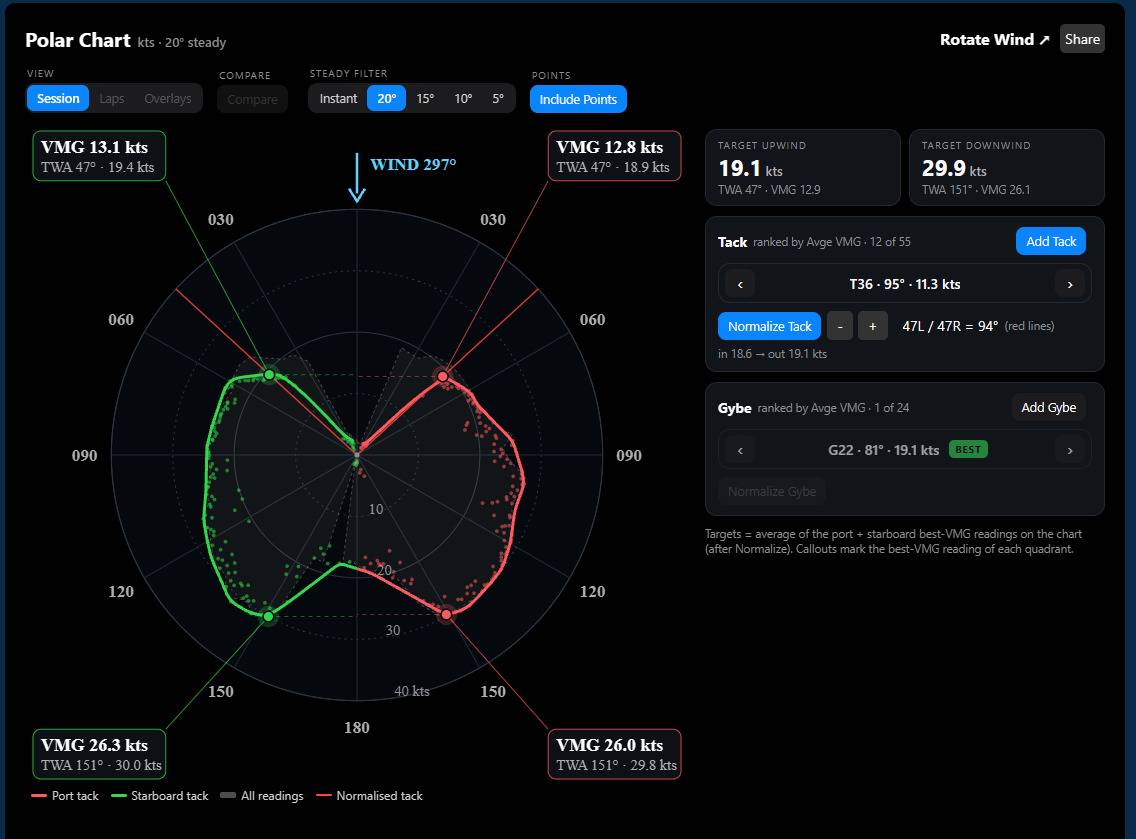
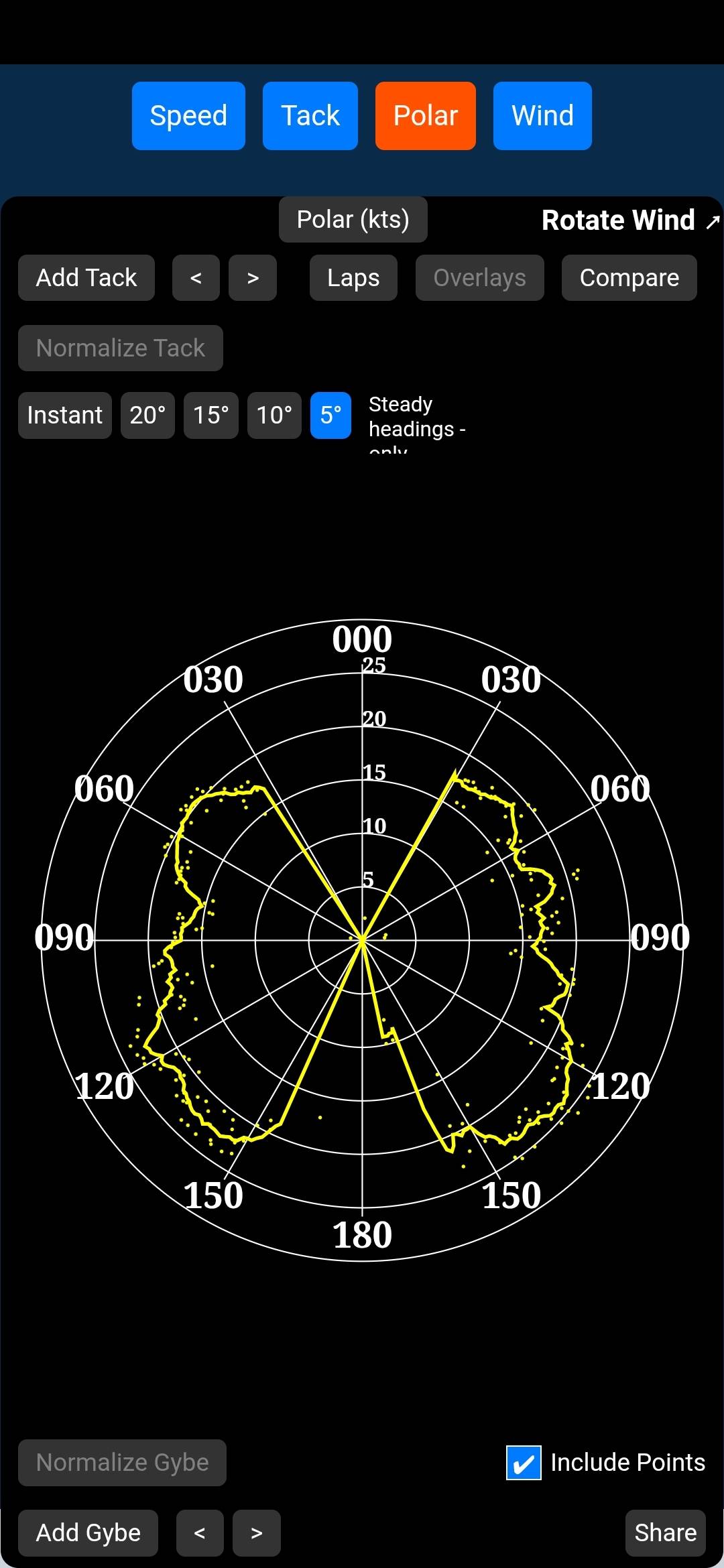
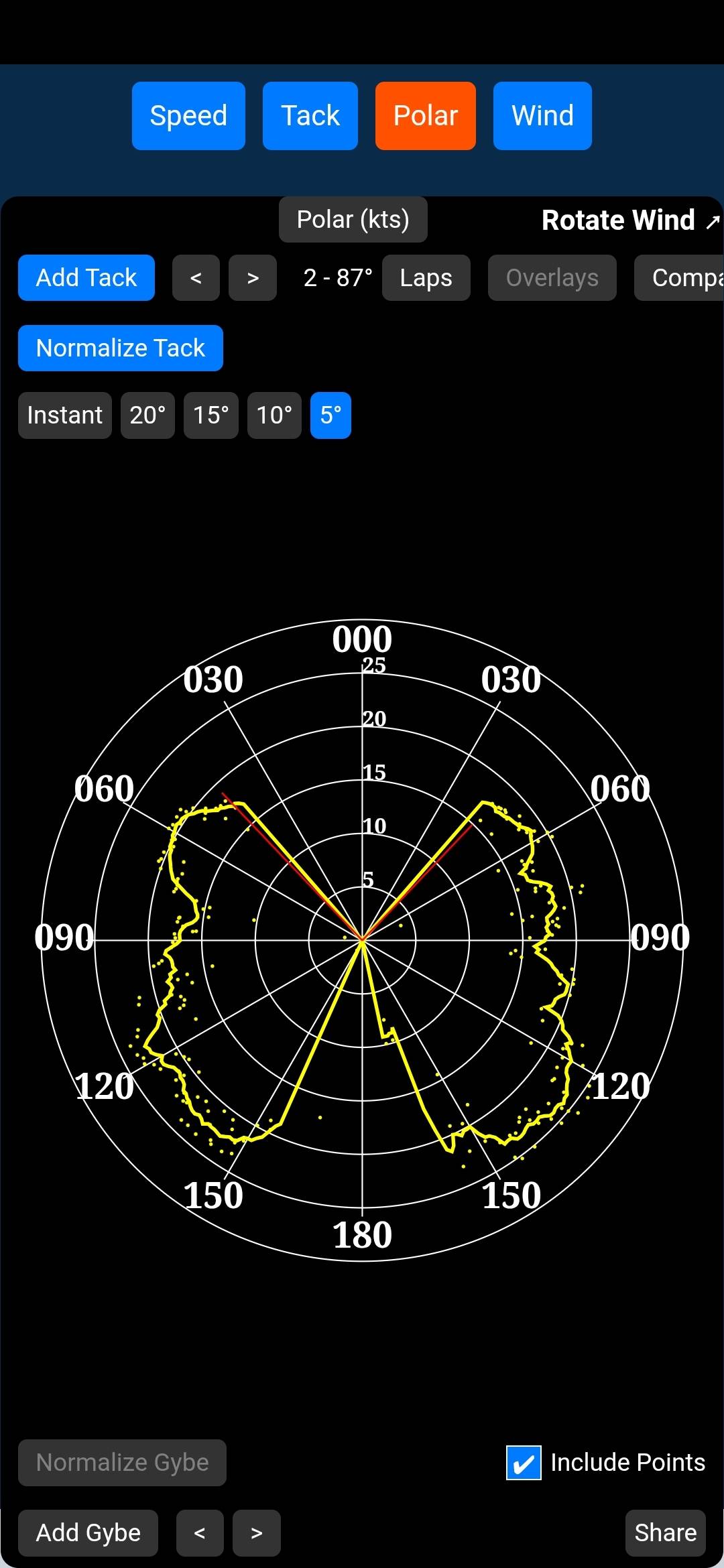
I developed a polar generater that calculates the average wind, but then lets you manipulate the graph to compensate for wind shifts. It alliws you to resize the upwind or downwind vmg portion to match any of your tacks.

Lets say the polar shows a 60 degree tacking angle ( because the wind shifted up to 30 degrees during your session ) but 80% of your tacks were through about 90 degrees. You can select a 90 degree tack, click normalize, and the graph will re-shape to base the data off your actual achieved tack, removing almost all the wind change effects.

You can see in the first polar, the tack angle appears to be 60 degrees, which is false ( only due to wind shifts )

The second diagram I selected one of my 87 degree tacks, and resized the data, and also had a 5 degree steady filter on, which only records speeds where the heading remains within a 5 degree sector for a period of time after ( to ignore manouvres ) . In this case best vmg was about 18kts, as over 20kts there was quite an agle change.

Reverse engineering the polar is never going to be perfect though as you have actual effects like current and wave direction, and wind strength changes that will skew data in particusl areas of the graph.


dachopper
dachopper
WA
1829 posts
WA, 1829 posts
26 Oct 2026 1:00pm


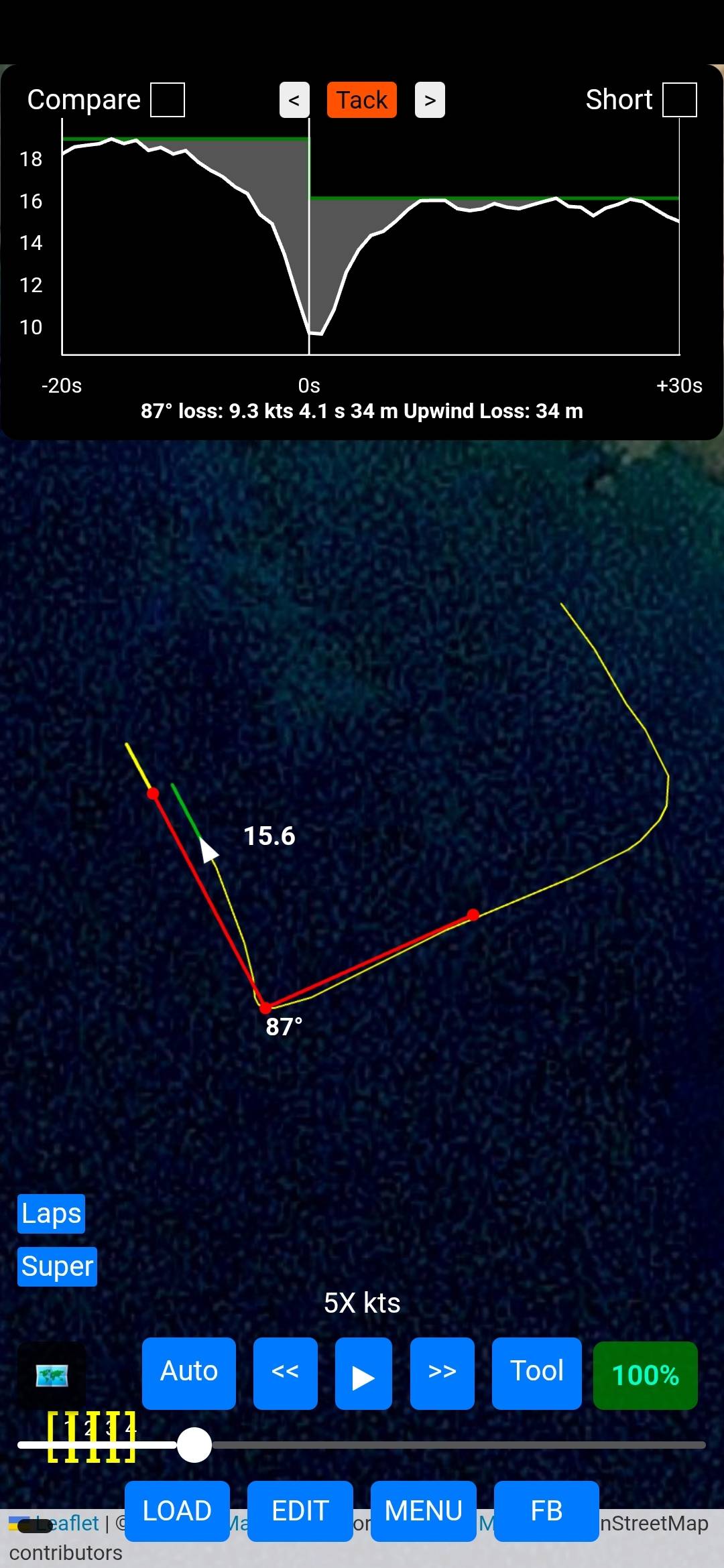
Here is one of my Tacks from last week.

87 degree angle tacked through,
4.1 seconds lost
34m upwind lost due to the tack
9.3kt lost in the manouvre
dachopper
dachopper
WA
1829 posts
WA, 1829 posts
23 Oct 2026 3:24pm
G'day all, dachopper here, developer of the Sail Racer pro, Kitesurf Racer, Windsurf Racer and Wingfoil Racer Garmin apps.
(These apps give live speed, waypoint/route steering cues, race countdown with time, speed and distance cues, VMG and VMC cues, tack and gybe angle feedback, top speed alerts and best 250/500m. And record a gps file for replay.)

It's been a while since my last update, so here's what I've been working on since making those;

All of the above apps will now automatically share and upload your session to the web replay / debrief tool I built called SailRacerPro (sailracerpro.com (sailracerpro.com)).

All that is required is to install one of the garmin watch apps , and create a trial accout on sailracerpro.com ( no payment details needed ). Once in the web app click on sync Garmin and follow the prompts, with the watch app open, press menu, scroll down to sync and add the code provided from sailracerpro.com to authorise your watch to upload the sessions automatically.

Have Garmin Connect Mobile open on your phone + bluetooth and data enabled to support the auto transfer. Files appear in your library in debrief mode.

You can still manually Upload a FIT or GPX file from any watch app (mine, Waterspeed, Surfr or Garmin's own) and you get polars, VMG and a breakdown of every tack and gybe straight after your session.

There's a 14-day free trial. I'd really value blunt feedback from this crowd, especially on what's missing or what you'd want to see from your sessions.

The online replay will let you replay the session, look at manouve entry/exit speed, distance lost and angles turned through. Add laps, superimpose several laps at the same time, superimpose several sessions at the same time, generate polar graphs an it does a lot more.

Garmin apps
apps.garmin.com/apps/1980c826-844a-47f7-9ca8-ffc0e09ba2ba

Webapp
Www.sailracerpro.com
dachopper
dachopper
WA
1829 posts
WA, 1829 posts
1 May 2022 9:46pm
Hey people, is anyone keen for an app that measures kitesurf jump heights using a smartwatch - not requireing anything else apart from the watch?

I know a few of the manufacturers have various " altitude " readouts, but these are pretty much useless for the purpose of jump heights.

Nick