Parawing VMG

1 month ago
Reply
Register to post, see what you've read, and subscribe to topics.
AnyBoard
AnyBoard
NSW
530 posts
NSW, 530 posts
25 Oct 2026 10:15am
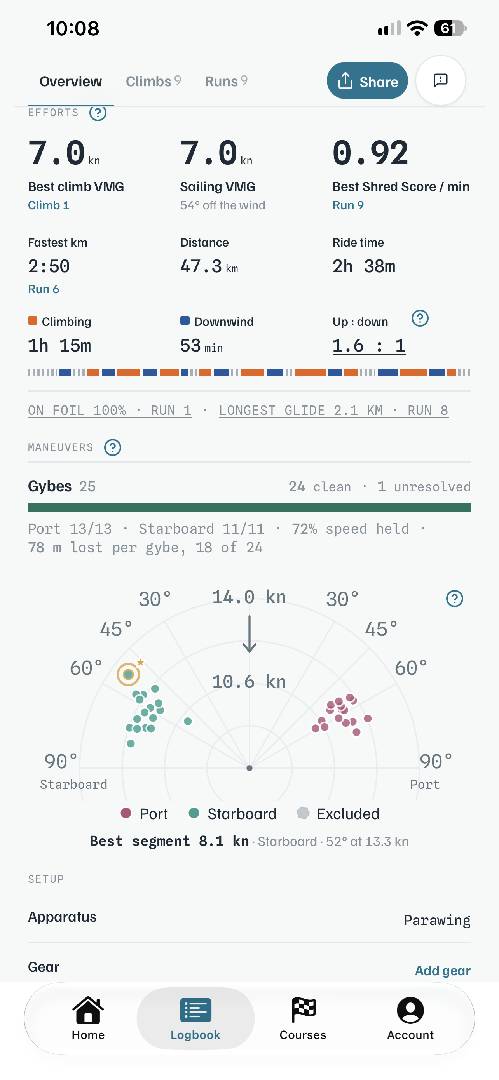
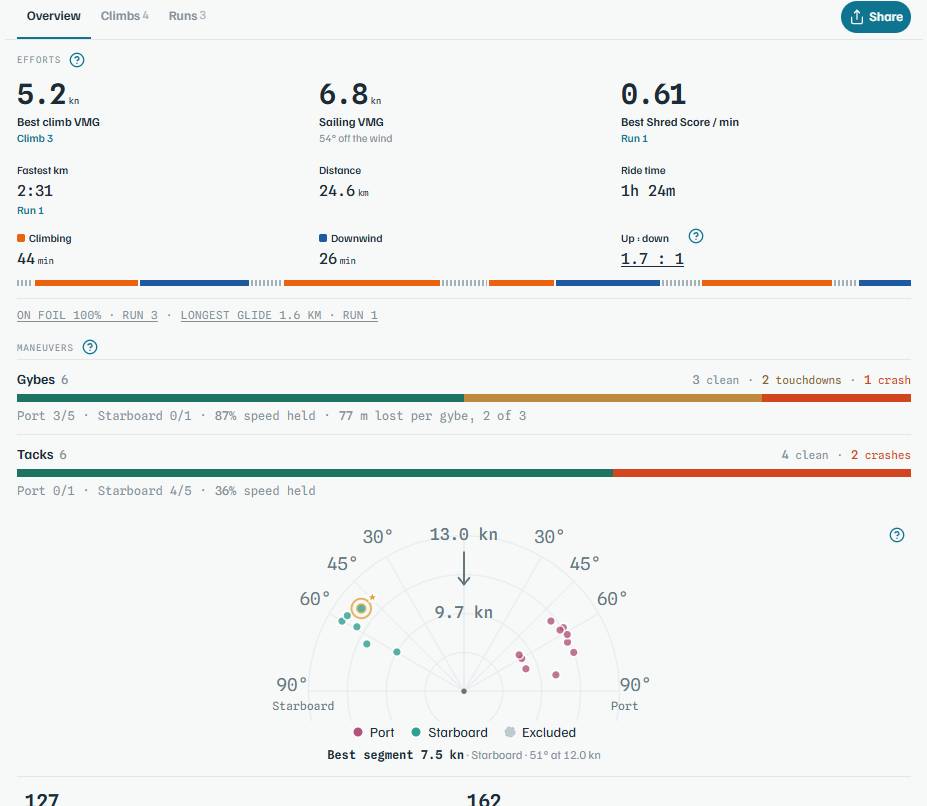
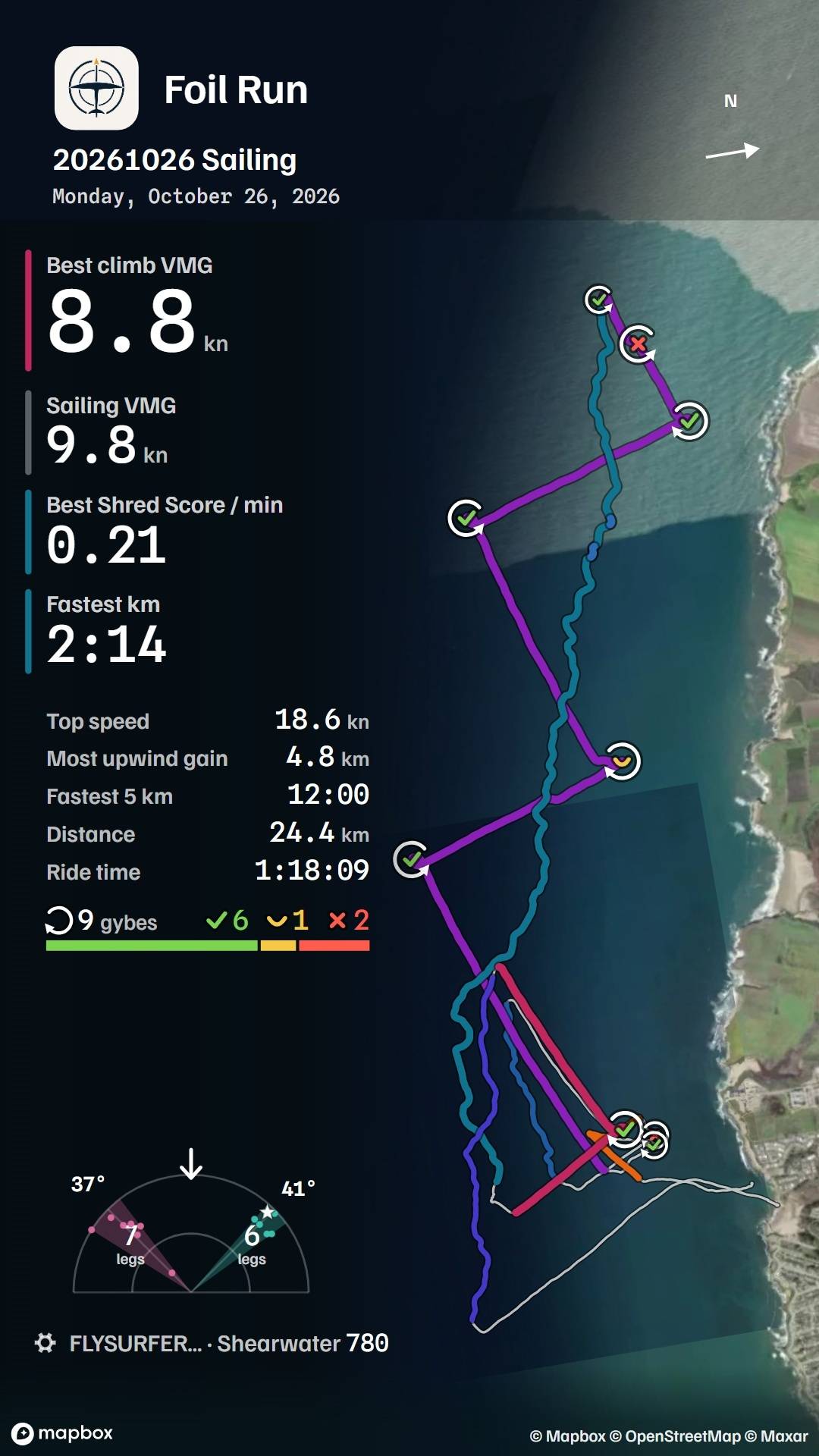
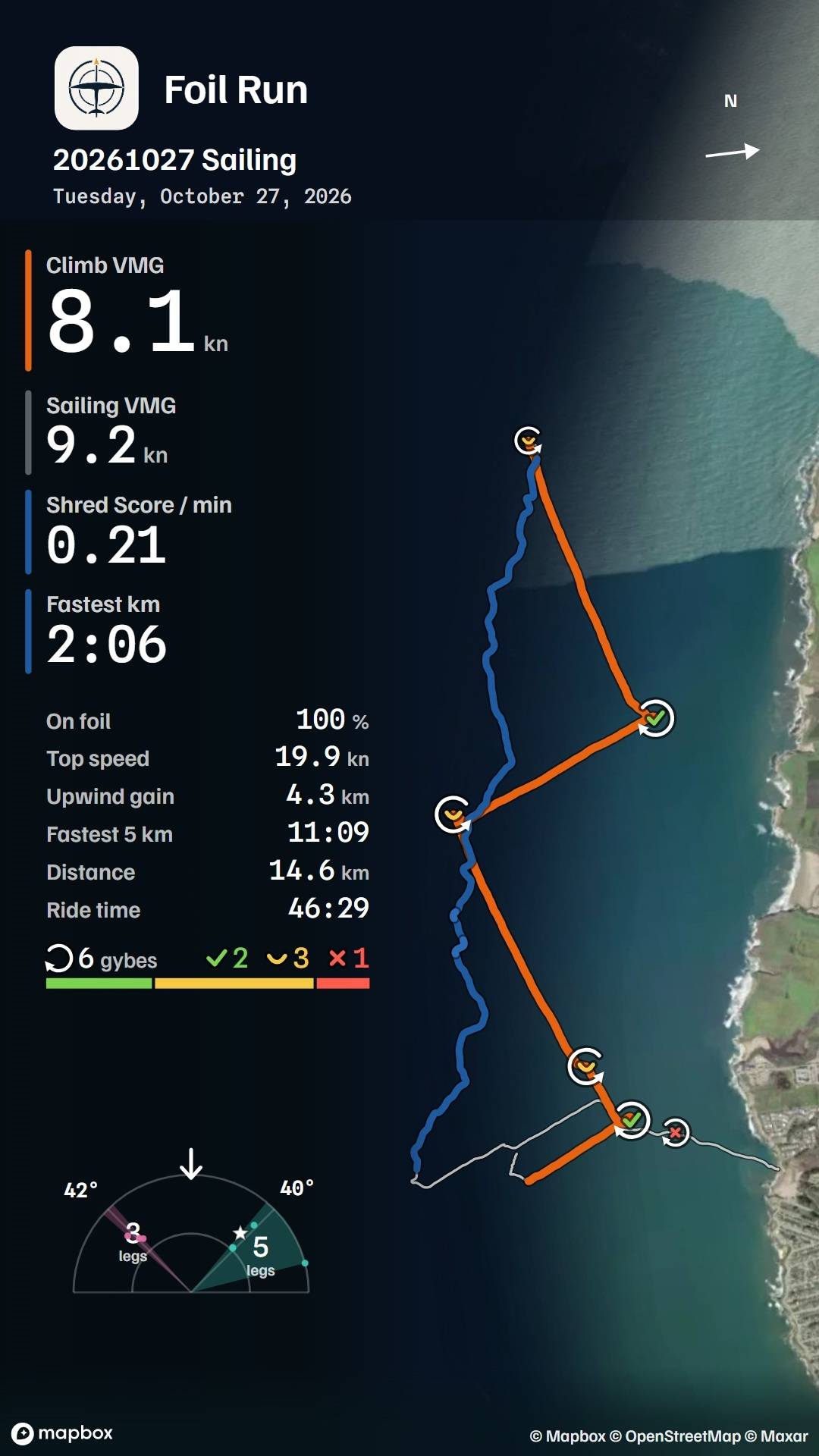
My attention was drawn to the app foil run for measuring upwind and down wind performance. Below is an example of where my Vmg seems to consistently top out using my Toyota PW.
i have some Ferrari’ in the form of an orbit and a afterburner to see how much better they are at going up wind for me
7 effective VMG Prv2 but I have seen others with obviously more skill than me push the same wing to 7.6 kt vmg.
it would be great if some of you could upload your gpx files to foil run and we can compare some of these PW’s
eppo
eppo
WA
9891 posts
WA, 9891 posts
25 Oct 2026 8:32am
so have you VMG’d your sports cars yet?

All i know is we had 10 crew out yesterday with varying parawing brands and types and everyone of them was getting ripped downwind, struggled to start getting pulled off the board … and I hadn’t even reached the top end of my 4.5 frigate and was happily ripping upwind on the downwind run to come back to the strugglers to ride with them.
Retina
Retina
143 posts
143 posts
25 Oct 2026 7:35pm
I have to start tracking my sessions.

I find being powered up with a parawing with good top end helps me alot when going upwind.
scheggia
scheggia
100 posts
100 posts
26 Oct 2026 3:43am
I have a Google Form where you can upload your session, and I’ll do some VMG performance analysis, similar to what I used to do with sailing boats. Obviously, it’s a lot less precise because we don’t have reliable data on currents or wind speed and direction. That’s why the form has quite a few questions about gear and weather conditions. They’re optional, but the extra information really helps with the overall analysis.
So far, I have almost all my sessions with my 777 parawings, one with an Afterburner (hope for more soon), and a bunch with the PRv2. Unfortunately, I can’t post the link here—I think the forum flags it as spam.
Anyway, if you send me your email address or another way to share files with you, I can send you some of my GPX files.
JonahL
JonahL
108 posts
108 posts
26 Oct 2026 4:46am

Toyota (PRv2 5.0)
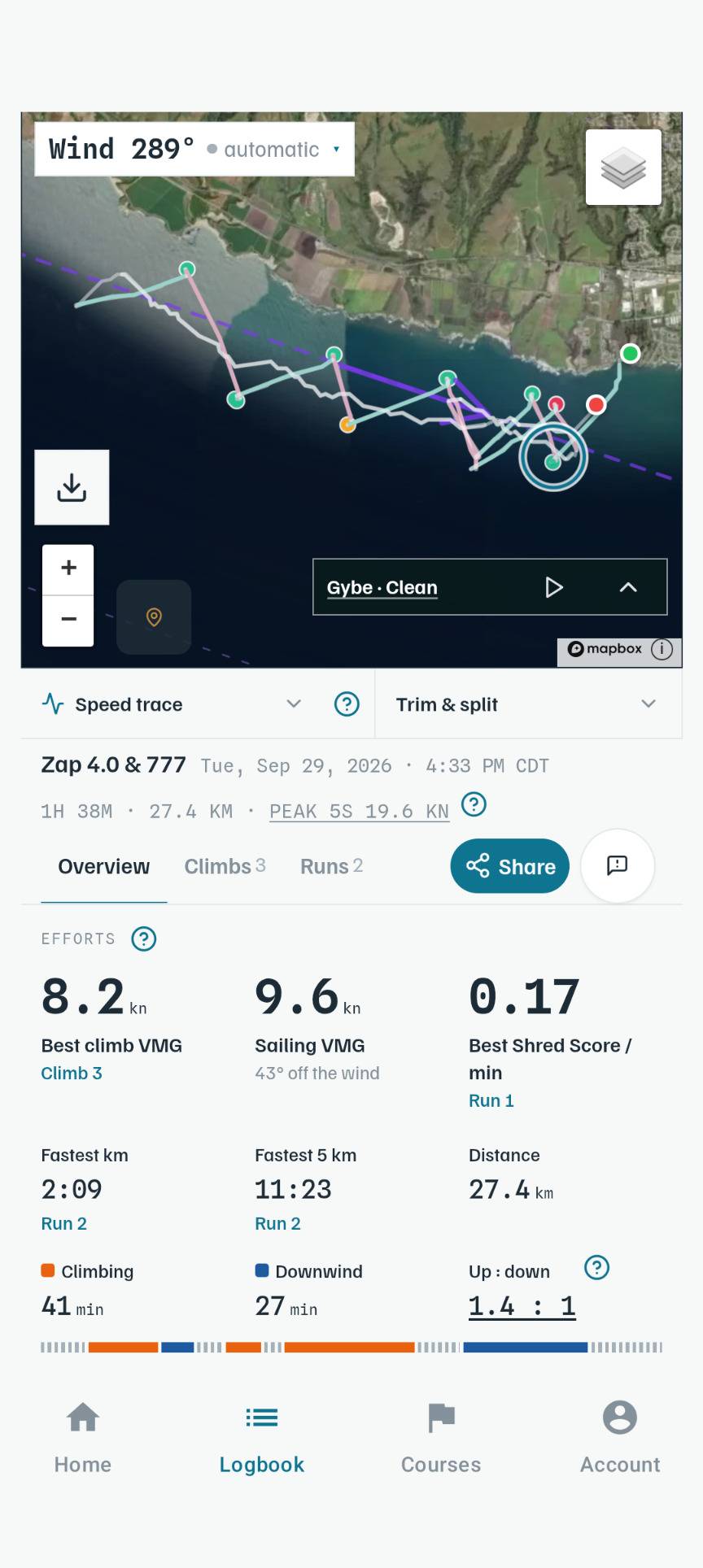
Ferrari (Zap 4.0)


AnyBoard
AnyBoard
NSW
530 posts
NSW, 530 posts
26 Oct 2026 9:49am
scheggia said..
I have a Google Form where you can upload your session, and I’ll do some VMG performance analysis, similar to what I used to do with sailing boats. Obviously, it’s a lot less precise because we don’t have reliable data on currents or wind speed and direction. That’s why the form has quite a few questions about gear and weather conditions. They’re optional, but the extra information really helps with the overall analysis.
So far, I have almost all my sessions with my 777 parawings, one with an Afterburner (hope for more soon), and a bunch with the PRv2. Unfortunately, I can’t post the link here—I think the forum flags it as spam.
Anyway, if you send me your email address or another way to share files with you, I can send you some of my GPX files.


Hi Scheggia,
Be great if you could dump some GPX files in "foil run" if your willing as then we are all looking at the same data.
Thanks
AnyBoard
AnyBoard
NSW
530 posts
NSW, 530 posts
26 Oct 2026 9:56am
JonahL said..

Toyota (PRv2 5.0)
Ferrari (Zap 4.0)


Amazing numbers. Nice.
Have you given any thought to if you can improve even more on the same equipment? I feel like ocean state is one for me. In the limited fetch scenarios the bumps are so tight and they seem to be coming at me way too quick for my nerve.
AnyBoard
AnyBoard
NSW
530 posts
NSW, 530 posts
26 Oct 2026 10:01am
Second session on the after burner and first with strong enough wind although crazy on and off.

JonahL
JonahL
108 posts
108 posts
26 Oct 2026 8:51am
AnyBoard said..

JonahL said..

Toyota (PRv2 5.0)
Ferrari (Zap 4.0)


Amazing numbers. Nice.
Have you given any thought to if you can improve even more on the same equipment? I feel like ocean state is one for me. In the limited fetch scenarios the bumps are so tight and they seem to be coming at me way too quick for my nerve.


I feel like that's about as good as I can get on the PR2 at least in decent bumps. On the Zap I'm definitely limited by sea state, I had a couple good stacks doing 15 knots nearly straight into 4' bumps and just blowing the foil out the back when I couldn't pitch down the backside quickly enough. Now when I see a big/steep bump that I have to go through I'll pinch really high to slow down a bit so I can keep the foil in the water. The zap is quite a bit less tiring than the single skins as well as faster but really is a specialist pw for long upwinders with long downwind legs without redeploying. I love it but wouldn't want it to be my only pw
Thatspec
Thatspec
470 posts
470 posts
26 Oct 2026 1:37pm
Finally, somebody else with a ZAP. I've also the 4M and feel like I'm just scratching the surface of the performance. I'll know more in a month or so when I get it powered up out in the ocean.
I used it in the Gorge for maybe 10 sessions and it clearly blows away my PR V2 3.6M upwind but the reaches are too short and the wind quality sucks. It's no light wind solution but the it makes up for it on the high end.
Interestingly starting was never much of an issue but the technique is a bit different.
scheggia
scheggia
100 posts
100 posts
26 Oct 2026 4:14pm
777 Hybrid 4.3 (20kts)


Prv2 5.7 (13-15 kts)


777 LTX 5.5 (15-17 kts)


777 Hybrid 5.7 (15-20)


AB 5.0 (20 kts)


I tried to upload sessions where I felt I had roughly the same amount of power across all the parawings — nicely powered, but nowhere near the top end of their wind range. I always used the same foil, the Code 850S, to keep the comparison as consistent as possible.
Where I live, the wind is generally pretty light, so I rarely get the chance to test them in stronger conditions.
AnyBoard
AnyBoard
NSW
530 posts
NSW, 530 posts
26 Oct 2026 7:58pm
Very nice. Thanks heaps scheggia for supplying so many models. Plenty to digest.
Wow 5m afterburner in 20 knots. What did you think of that?
Goofy?
scheggia
scheggia
100 posts
100 posts
26 Oct 2026 5:26pm
I've only had that one session on the AB, and there was still plenty of room at the top end of its range. Really easy to fly! I still need to figure out how to pack it efficiently, but it was a long upwind session and I only packed it a couple of times. We haven't had a decent windy day for an upwind/downwind mission in three months now...
I'm regular-footed, but the shape of our coastline creates a right shift as you go upwind. I think that's why my best VMG is almost always on port tack. The session with the Hybrid 5.7 is the only one with wind coming from the opposite direction, and in that case my best tack was starboard.
That's the problem with using a fixed average wind direction for the entire session: it can really distort the data.
My calculations actually use a moving average for wind direction rather than a fixed value for the whole session, and the results are a bit different.
I also like to calculate the 90th percentile of the 5-second moving average VMG. From my experience in sailing, that's a good indicator of the achievable performance. Anything measured over longer periods (like the "Sailing VMG" in Foil Run) takes into account too many other things that can happen during an upwind leg.
I'll try to share some of my calculations in another post and overlay the results from these same sessions to compare them directly.
I just noticed that Jonah uploaded one of his PRv2 sessions through my Google Form, so I'll try to include that one in the comparison too!
AnyBoard
AnyBoard
NSW
530 posts
NSW, 530 posts
26 Oct 2026 8:57pm
Very nice. Thanks heaps for supplying so many models. Plenty to digest.
Wow 5m afterburner in 20 knots. What did you think of that?

scheggia said..
I've only had that one session on the AB, and there was still plenty of room at the top end of its range. Really easy to fly! I still need to figure out how to pack it efficiently, but it was a long upwind session and I only packed it a couple of times. We haven't had a decent windy day for an upwind/downwind mission in three months now...
I'm regular-footed, but the shape of our coastline creates a right shift as you go upwind. I think that's why my best VMG is almost always on port tack. The session with the Hybrid 5.7 is the only one with wind coming from the opposite direction, and in that case my best tack was starboard.
That's the problem with using a fixed average wind direction for the entire session: it can really distort the data.
My calculations actually use a moving average for wind direction rather than a fixed value for the whole session, and the results are a bit different.
I also like to calculate the 90th percentile of the 5-second moving average VMG. From my experience in sailing, that's a good indicator of the achievable performance. Anything measured over longer periods (like the "Sailing VMG" in Foil Run) takes into account too many other things that can happen during an upwind leg.
I'll try to share some of my calculations in another post and overlay the results from these same sessions to compare them directly.
I just noticed that Jonah uploaded one of his PRv2 sessions through my Google Form, so I'll try to include that one in the comparison too!

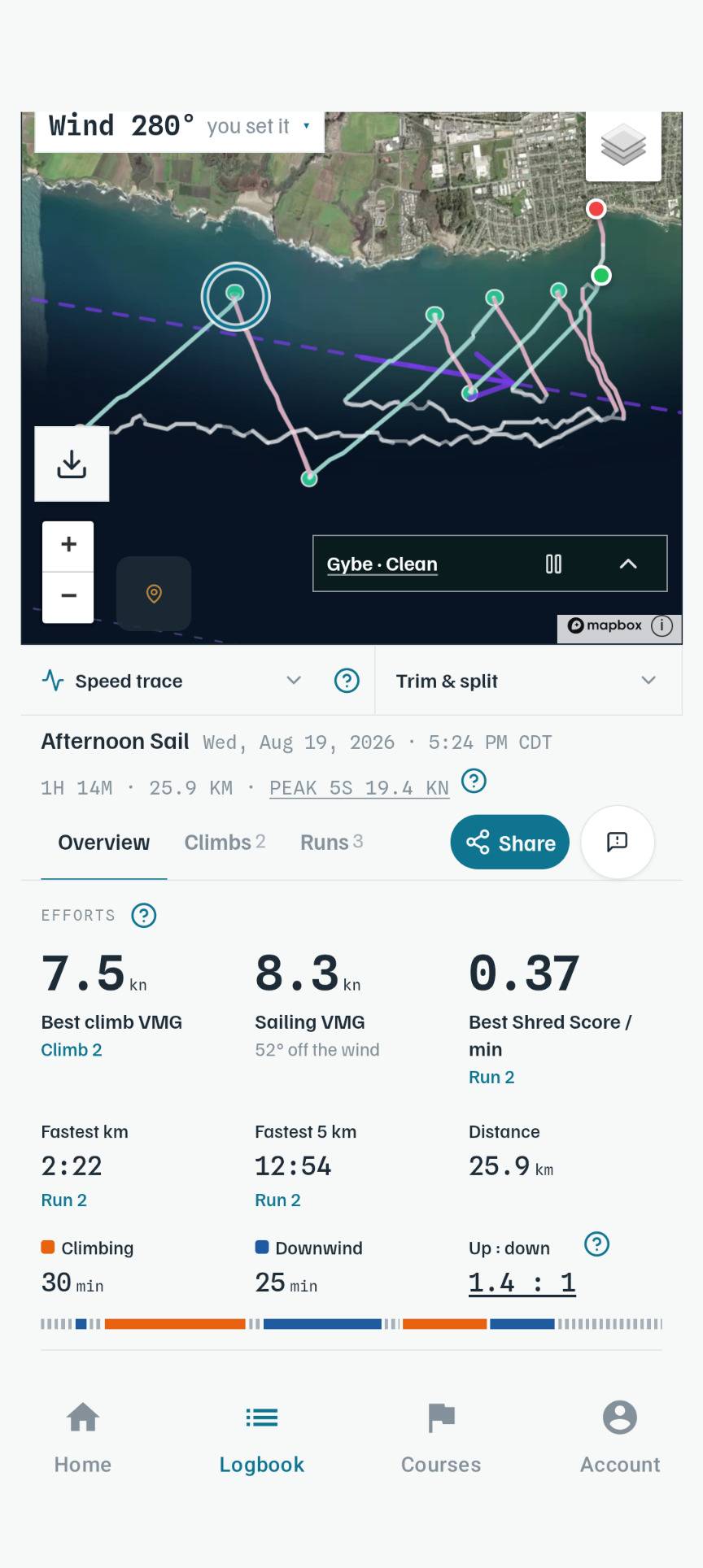
You can see on my AB graphic a 10 kt vmg outligher but i know the exact tack and the wind shifted 5 to 10 degrees for a minute. I can see it on the satellite MAP trace view.


I feel like the direction changes average themselves out but the range in wind strength is what has been killing me this week testing the wing. We have had frontal winds all week and in the middle of a very good climb you can see the angle just peel off as the lull comes. I guess that is the reality of climbing upwind with the wind always going up and down to some degree and shifting angles just a little where I live. This analysis is just for interest sake but yesterday i was surprised. I came in from my AB session a little underwhelmed but the angles on the graphic were much better than i realized. It out pointed the orbit sessions so far and i didn't really know but i guess that is the point in that it was doing that pretty easy and fooled me.

I feel like the afterburner for me will do a total effective climb of 8. I think the orbit will sit just below 8 but with much more comfort and can probably be pushed another few knots VMG in that top 15% of its range for those that are game. We will see hopefully.

scheggia
scheggia
100 posts
100 posts
26 Oct 2026 6:05pm


Here's a quick summary of my "Max VMG" calculations. Sessions 2–3 and 4–5 are the only ones that could really be considered valid for a direct comparison, as I was going back and forth with two different parawings in almost identical conditions. Everything else is just for the sake of the analysis.
scheggia
scheggia
100 posts
100 posts
26 Oct 2026 6:18pm
AnyBoard said..
Very nice. Thanks heaps for supplying so many models. Plenty to digest.
Wow 5m afterburner in 20 knots. What did you think of that?


scheggia said..
I've only had that one session on the AB, and there was still plenty of room at the top end of its range. Really easy to fly! I still need to figure out how to pack it efficiently, but it was a long upwind session and I only packed it a couple of times. We haven't had a decent windy day for an upwind/downwind mission in three months now...
I'm regular-footed, but the shape of our coastline creates a right shift as you go upwind. I think that's why my best VMG is almost always on port tack. The session with the Hybrid 5.7 is the only one with wind coming from the opposite direction, and in that case my best tack was starboard.
That's the problem with using a fixed average wind direction for the entire session: it can really distort the data.
My calculations actually use a moving average for wind direction rather than a fixed value for the whole session, and the results are a bit different.
I also like to calculate the 90th percentile of the 5-second moving average VMG. From my experience in sailing, that's a good indicator of the achievable performance. Anything measured over longer periods (like the "Sailing VMG" in Foil Run) takes into account too many other things that can happen during an upwind leg.
I'll try to share some of my calculations in another post and overlay the results from these same sessions to compare them directly.
I just noticed that Jonah uploaded one of his PRv2 sessions through my Google Form, so I'll try to include that one in the comparison too!


You can see on my AB graphic a 10 kt vmg outligher but i know the exact tack and the wind shifted 5 to 10 degrees for a minute. I can see it on the satellite MAP trace view.


I feel like the direction changes average themselves out but the range in wind strength is what has been killing me this week testing the wing. We have had frontal winds all week and in the middle of a very good climb you can see the angle just peel off as the lull comes. I guess that is the reality of climbing upwind with the wind always going up and down to some degree and shifting angles just a little where I live. This analysis is just for interest sake but yesterday i was surprised. I came in from my AB session a little underwhelmed but the angles on the graphic were much better than i realized. It out pointed the orbit sessions so far and i didn't really know but i guess that is the point in that it was doing that pretty easy and fooled me.

I feel like the afterburner for me will do a total effective climb of 8. I think the orbit will sit just below 8 but with much more comfort and can probably be pushed another few knots VMG in that top 15% of its range for those that are game. We will see hopefully.


Wind speed is the key, of course! In sailing, we always associate VMG with a specific wind speed to define a target performance value. As wind speed changes, so does the target VMG. Wind direction isn't really an issue on a sailing boat because you have continuous TWD readings.
But as you pointed out, it's really interesting to play around with these numbers because sometimes the feeling you get when going upwind doesn't tell the whole story. For example, I tend to prefer parawings with a lot of bar pressure because they make me feel like I'm going faster, but that doesn't necessarily show up in the data...


dachopper
dachopper
WA
1829 posts
WA, 1829 posts
27 Oct 2026 1:31pm
Hey everyone,

I noticed your discussion about VMG, and thought my app might be able to help out.

I developed a polar generater that calculates the average wind, but then lets you manipulate the graph to compensate for wind shifts. It alliws you to resize the upwind or downwind vmg portion to match any of your tacks.

Lets say the polar shows a 60 degree tacking angle ( because the wind shifted up to 30 degrees during your session ) but 80% of your tacks were through about 90 degrees. You can select a 90 degree tack, click normalize, and the graph will re-shape to base the data off your actual achieved tack, removing almost all the wind change effects.

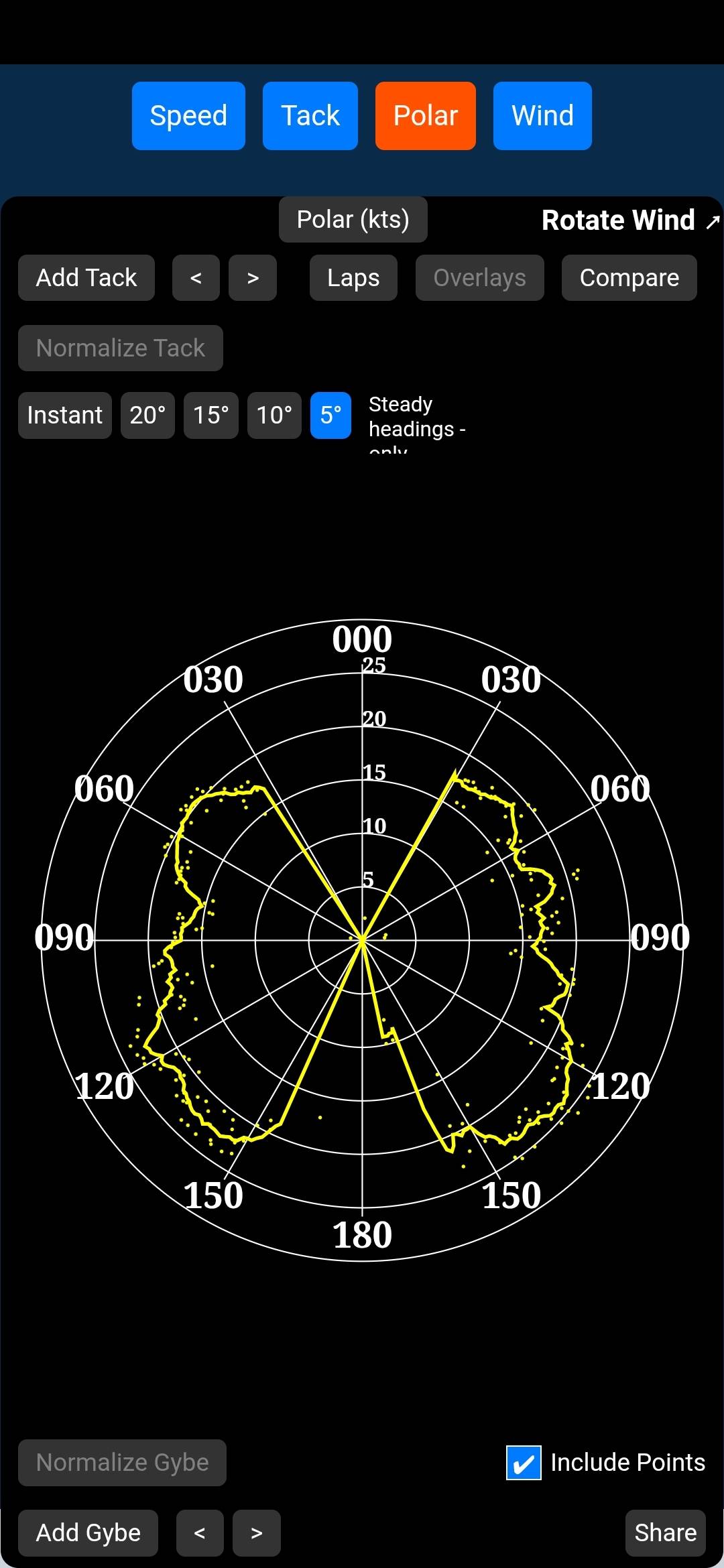
You can see in the first polar, the tack angle appears to be 60 degrees, which is false ( only due to wind shifts )

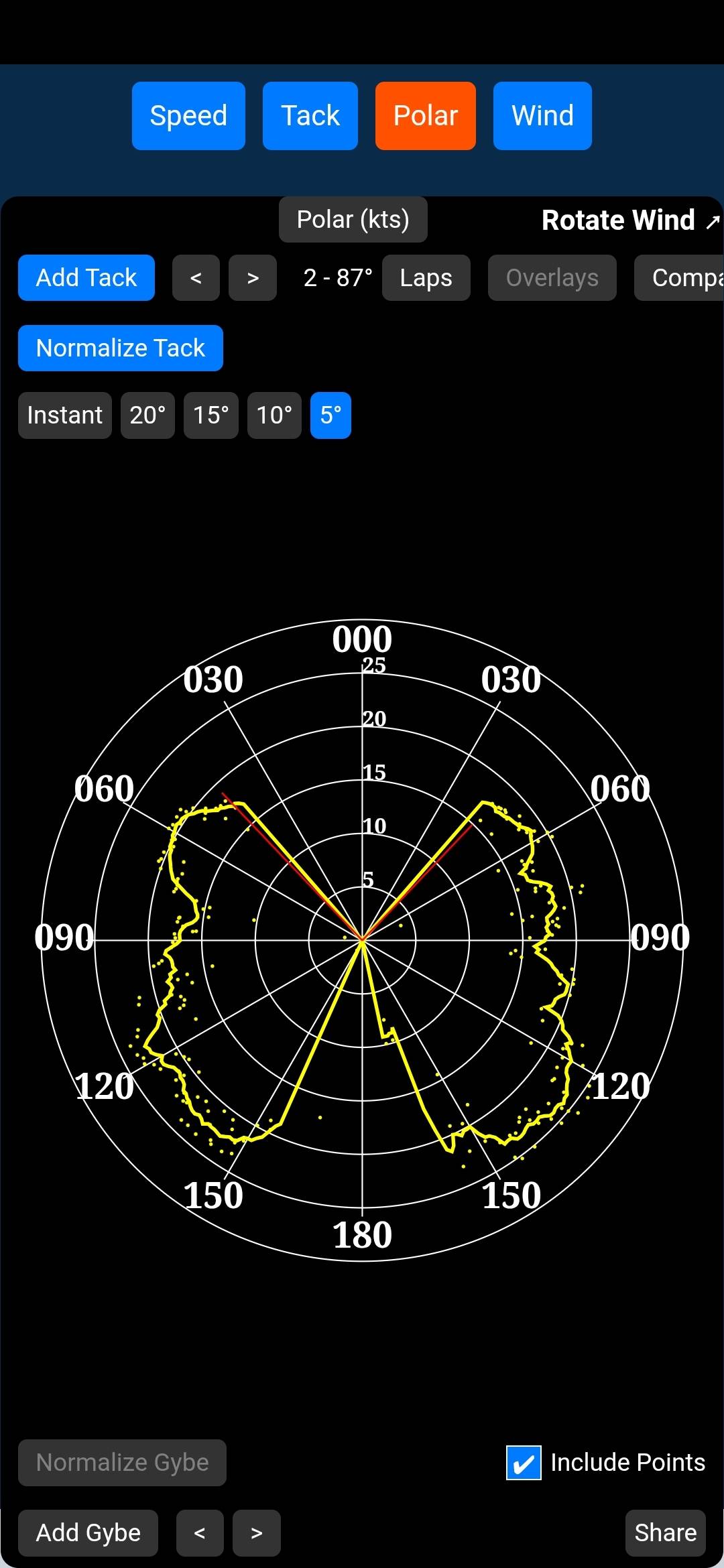
The second diagram I selected one of my 87 degree tacks, and resized the data, and also had a 5 degree steady filter on, which only records speeds where the heading remains within a 5 degree sector for a period of time after ( to ignore manouvres ) . In this case best vmg was about 18kts, as over 20kts there was quite an agle change.

Reverse engineering the polar is never going to be perfect though as you have actual effects like current and wave direction, and wind strength changes that will skew data in particusl areas of the graph.


scheggia
scheggia
100 posts
100 posts
27 Oct 2026 2:29pm
what are you riding there.... 18kts of VMG at 30 degrees is something that goes really really fast....
dachopper
dachopper
WA
1829 posts
WA, 1829 posts
27 Oct 2026 3:27pm
Sorry that was a race kitefoil, but the software accepts any gpx files, or automatically uploads if using one of my Garmin aps.

Yeah, my vmg upwind at 18kts is about 13 kts from that graph
JonahL
JonahL
108 posts
108 posts
28 Oct 2026 10:50am
Afterburner 4.3 vs Zap 4.0, same day swapped on the water 25 gusting 30 or so. Borrowed the AB from a friend, really nice wing, lots of depower available and douse is really good. Zap about a knot more vmg. Zap is smoother and silent and a little less tiring, AB a little more bar pressure and has a little flutter at the top end. Both great PW, but I would prefer the AB if that were my only wing for the handling and nice douse/stash.


JonahL
JonahL
108 posts
108 posts
28 Oct 2026 10:51am


Retina
Retina
143 posts
143 posts
28 Oct 2026 12:56pm
Nice breakdown! A 1-knot VMG advantage only saves about 10–11 minutes in a 2-hour session, so double-skin definitely isn't a dealbreaker for me.
​Does anyone know the actual bridle line length on the larger Afterburners (5.0m–6.5m)?
​The Afterburner price tag is pretty steep though ($1,600+). Holding out for 777 upcoming release and hopefully 777 drops some info vs hybrid.
dachopper
dachopper
WA
1829 posts
WA, 1829 posts
28 Oct 2026 1:41pm
If you like, I can run your gpx through my software, and see if there are differences to the vmg numbers you have.
AnyBoard
AnyBoard
NSW
530 posts
NSW, 530 posts
28 Oct 2026 8:10pm
JonahL said..
Afterburner 4.3 vs Zap 4.0, same day swapped on the water 25 gusting 30 or so. Borrowed the AB from a friend, really nice wing, lots of depower available and douse is really good. Zap about a knot more vmg. Zap is smoother and silent and a little less tiring, AB a little more bar pressure and has a little flutter at the top end. Both great PW, but I would prefer the AB if that were my only wing for the handling and nice douse/stash.


Those angles are extraordinary for a single skin and lookbetter than the VMG numbers indicate.


JonahL
JonahL
108 posts
108 posts
28 Oct 2026 9:55pm
AnyBoard said..

JonahL said..
Afterburner 4.3 vs Zap 4.0, same day swapped on the water 25 gusting 30 or so. Borrowed the AB from a friend, really nice wing, lots of depower available and douse is really good. Zap about a knot more vmg. Zap is smoother and silent and a little less tiring, AB a little more bar pressure and has a little flutter at the top end. Both great PW, but I would prefer the AB if that were my only wing for the handling and nice douse/stash.


Those angles are extraordinary for a single skin and lookbetter than the VMG numbers indicate.


Yesterday was pretty rough and I was on my AR 17 -650 foil that isn't as easy to drive upwind so speeds were limited. I think the angles are close to the best I can do but a less spanny foil and smaller bumps I think I can go a fair bit faster. The day before on the Zap and my AR 11.5-780 foil nearly identical conditions (maybe slightly less wind):


dachopper
dachopper
WA
1829 posts
WA, 1829 posts
31 Oct 2026 7:25pm
If there's one thing I've noticed consistently over the years, it's how hard everyone finds it to work out the best speed to go upwind, especially on new gear or in a new class. Whether you're new to the sport or a seasoned sailor, getting upwind well is one of the hardest and most time-consuming things to nail. Which sail, which foil, how much power, how high to point, how fast to go? It's easy to spend whole sessions going up and down without knowing whether you actually made ground. On a relaxed sail, an efficient upwind leg means less effort, more fun, and getting there sooner. On the race course, it's the difference between rounding the top mark first and chasing the fleet all the way back to the bar.

One of the funniest races I've ever witnessed was a kitesurfing race with a whole field of novice riders. I'd just come in from my heat in second place when a friend borrowed my kite, and I gave him one piece of advice: "Whatever you do, don't go at top speed when you're heading upwind." Some job that advice did! The start was meant to be a close reach, sailing slightly upwind. Instead, the whole fleet launched and accelerated to top speed, with massive rooster tails, spray and board wakes everywhere. It seemed to start with one rider pulling away out front, and soon the entire fleet was racing at full tilt, legs burning and all. They flew past the reach turning mark, hundreds of metres too low, leaving those of us on shore wondering whether they'd been hit by a 30° wind shift. The real cause showed up when they tacked back to start their "upwind journey". Most of the fleet, rooster tails and all, barely made it back above the start line, all because their VMG at top speed was practically zero 😂😂. That ended up being a looooong race!

VMG stands for Velocity Made Good: your speed directly upwind or downwind, as opposed to the speed you're actually travelling. Sailing apps on watches, phones and tablets can now take the guesswork out of it. Many show live VMG, and some give you polar or radar charts or speed-versus-wind-angle graphs. You can check these while racing, or back on shore to see exactly what worked and what didn't.
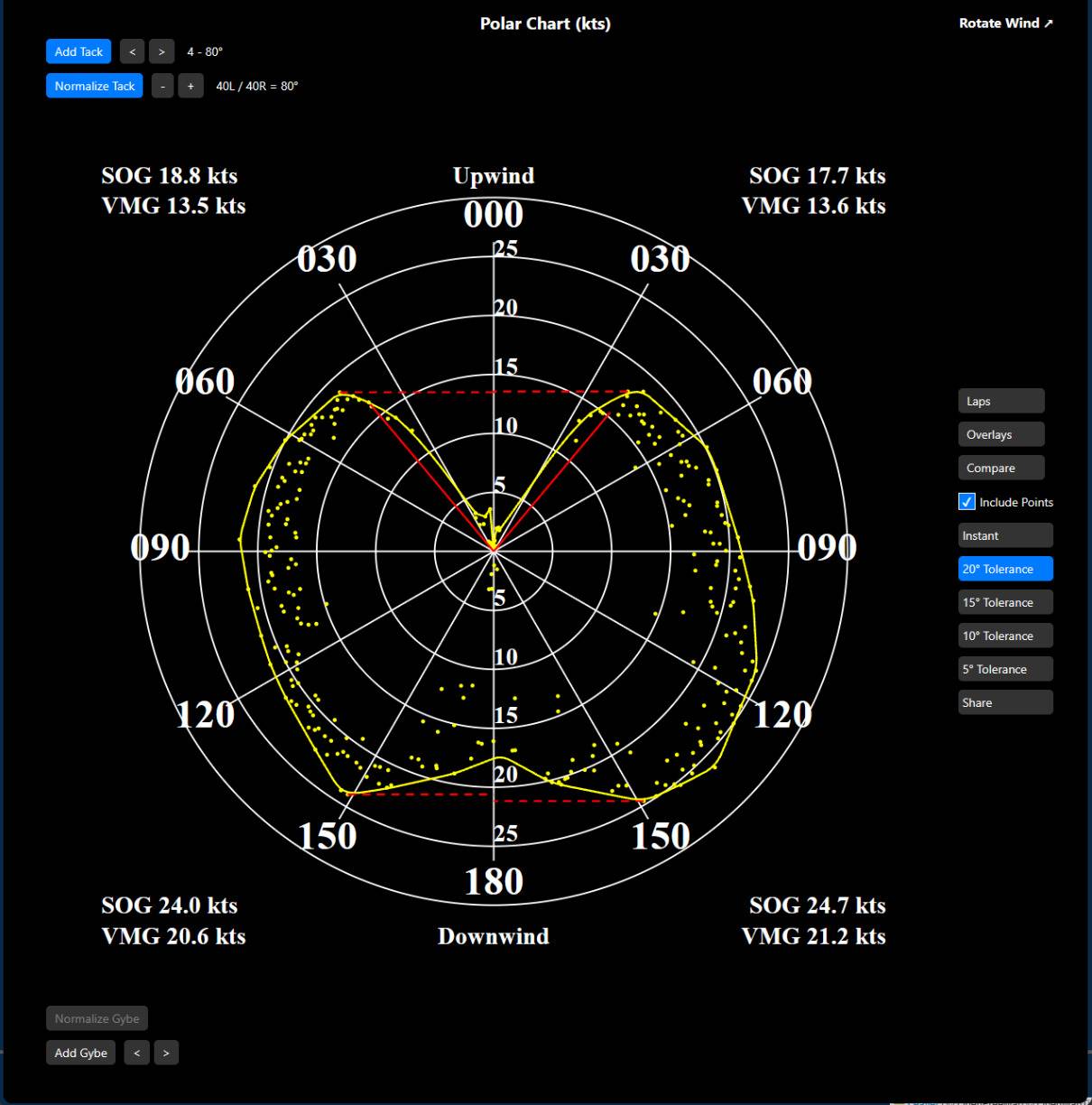


Here's a polar from one of my recorded hydrofoil sessions. The wind comes from the top of the chart. Each dot is a moment in the session, plotted by its angle to the wind and its speed, and the yellow line traces the best speeds at each angle. VMG is the part of that speed going straight into the wind. Pinch too high and your speed collapses; sail too low and you go fast but don't gain much ground. The sweet spot here was about 40° off the wind at around 18 knots of speed over ground (SOG), giving about 13.5 knots of VMG on both tacks. So my upwind target on this gear in these conditions is simple: hold about 18 knots. If I'm slower than that, I bear away to build speed. If I'm well above it, I can point a bit higher.

The red lines show an 80° tack angle, 40° each side of the wind, and that's a little tight for this gear. Port tack holds its speed well, but on starboard I couldn't quite reach 18 knots that high. Sailing about 85° tack to tack would have kept my speed up and my VMG closer to its best, and less speed would have been lost in each tack.

You can also use the VMG number on the water. If your watch app lets you set the wind direction, point the wind axis accurately into the wind and it will read out a live VMG. There are a couple of ways to do this, but as a guide using the numbers from above: target speed 18 kts, VMG should be 13 - 14kts. When my VMG drops by more than 15% and it's a real header, if it looks like it will hold for more than 35 to 40 seconds and I'm not near the layline, it's worth a tack.
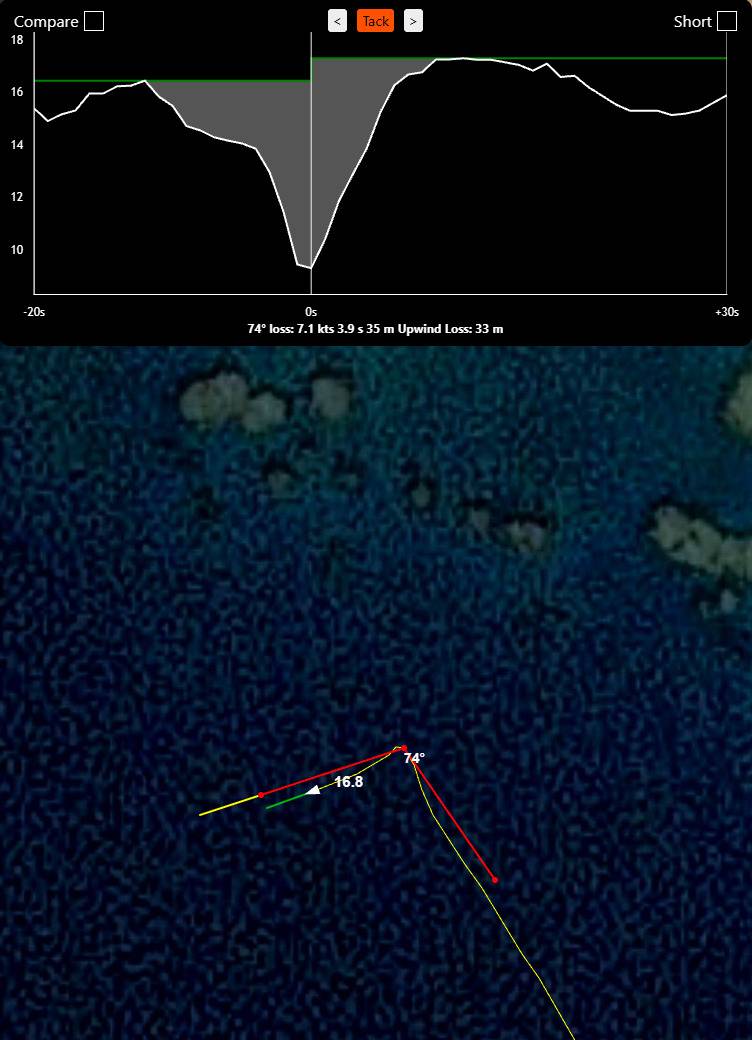


Every tack costs time and distance. The easiest way to measure it is in seconds: how many seconds of progress you give away. On my foil, a good 88° tack dropped me from 18 to about 10 knots and cost about 23 m upwind, which is around 3.3 seconds. A sloppier 74° tack in the same session cost 33 m, or about 4 seconds. Displacement boats lose fewer metres because they're slower, but about the same in seconds or more. A keelboat typically loses about one boatlength per tack in flat water and up to three in chop.
In one measured example, a 6 knot keelboat took 15 seconds to complete its tack but lost only about 5 seconds of upwind progress because it keeps moving towards the wind as it turns.

When should you tack on a header?
A header forces you further from the wind, so your VMG drops. Tacking onto the lift gets it back, but it only pays off if the shift lasts long enough to cover the cost of potentially 2 extra tacks.

Rough guide (when not close to the layline )
Multiply your tack loss in seconds by 11 for a 10 degree shift.
If you think the header will last at least that long in seconds, it's worth tacking into and out of again.

On my foil, a 10° header that costs me two extra tacks needs to last about 35 to 40 seconds before it pays off. Boats ahead and upwind can be a good indicator of what is to come. A keelboat in flat water needs about a minute, and one in chop needs 2 to 3 minutes. A dinghy with a slick roll tack in light air can profit from shifts of only 10 to 20 seconds. Smooth tacks and flat water let you use more shifts, while chop and stalled tacks mean only the big, long ones are worth chasing.

The best part is that you don't need to guess your numbers. A GPS debrief will show your target upwind speed, your VMG on each tack, and exactly how much each tack cost you.

*Full disclosure: I'm the developer of SailRacerPro, which does polar, VMG and tack-loss debriefs from any GPX or FIT file, plus Garmin watch apps for sailing, kite, windsurf and wing. Happy to run anyone's track through it if you'd like to see your own upwind numbers, or try it out for free yourself at www.sailracerpro.com

AnyBoard
AnyBoard
NSW
530 posts
NSW, 530 posts
4 Nov 2026 8:17pm
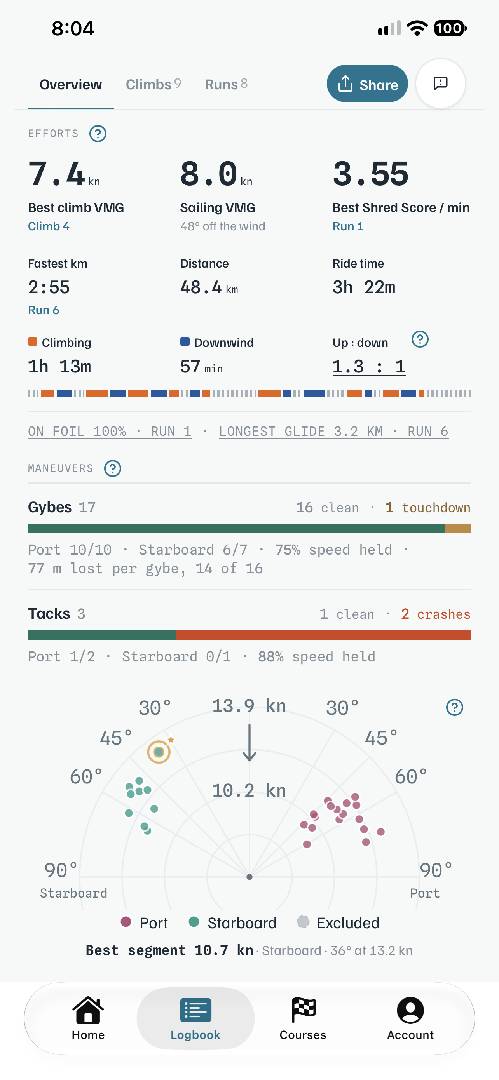
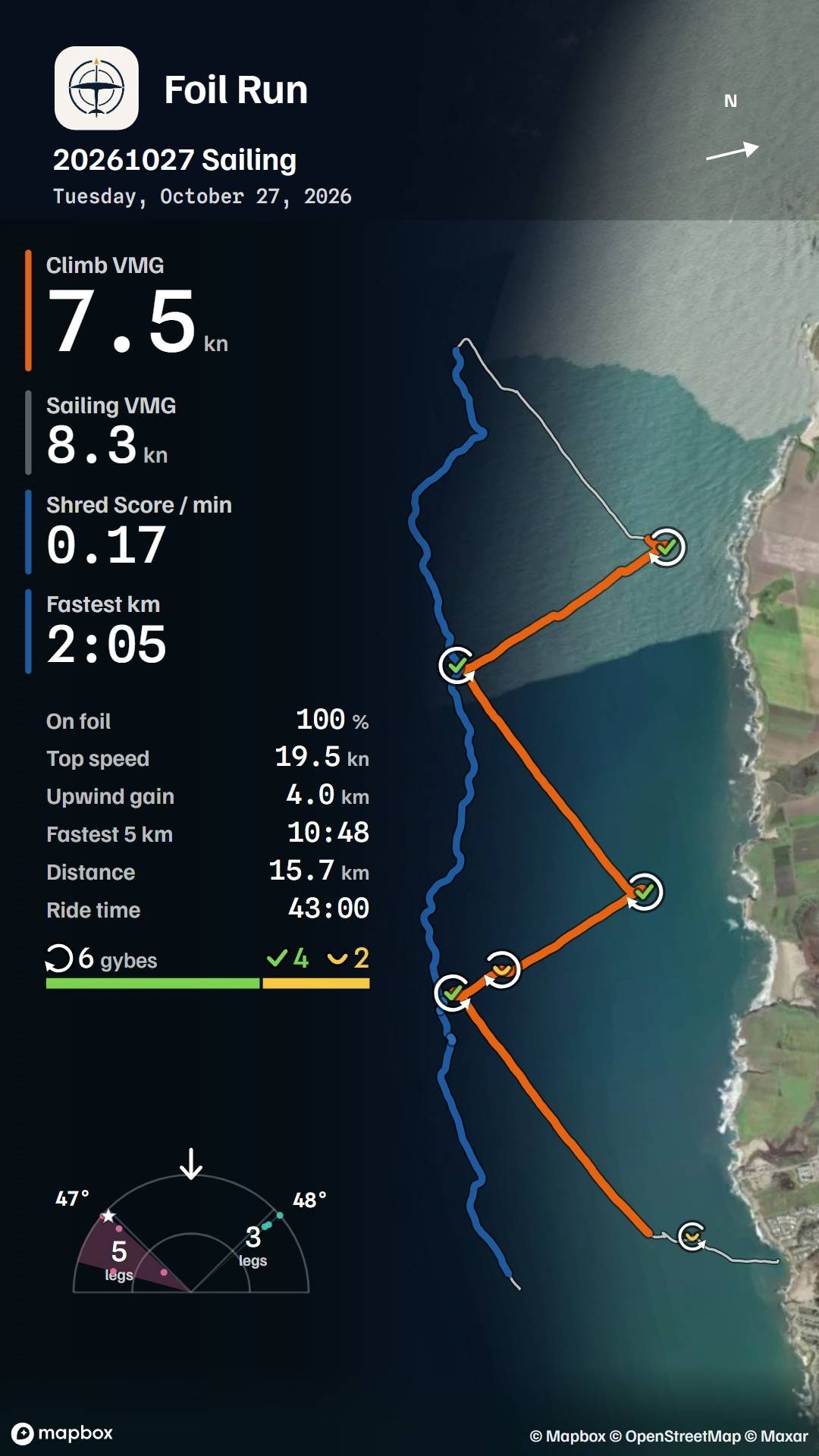
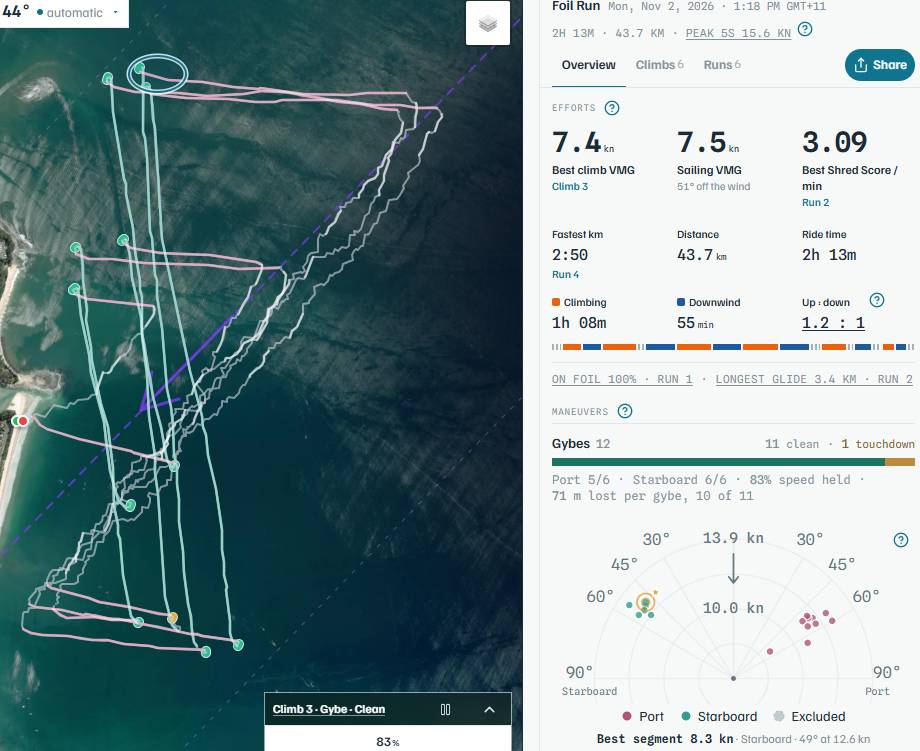
Another afterburner session below.
The light wind at the end of the run is not helping my first tack on the climb. 8 knot VMG seems to be where the AB is locking in for me and my ability when the wind is good. It doesn't need to be over powering like I needed to post high PRV2 VMG.


Cool to see the 68 minutes of climbing for the 55 minutes of surfing. My best result.
scheggia
scheggia
100 posts
100 posts
5 Nov 2026 3:30pm
Had a short session on the AB 5.7 in super light wind, around 10-12 knots. The thing is massive and the lines are really long! My first jibe ended in a massive crash, leaving a complete mess of tangled lines. After that, I decided to just tack, and it worked fine.
I was also really surprised by how well it packs compared to the PRv2. Not smaller, but easier and faster to pack.
My LTX is much more enjoyable to fly in light wind, thanks to the much shorter lines and lighter canopy. It also packs faster and smaller.
Now, the AB is 1 knot faster in VMG!
I had planned to compare it with the Hybrid 5.7, but the wind completely died... However, my friend was riding the Hybrid at the same time (I was on the 1130S and he was on the 960R), and the differences seem smaller here. Still, the AB had the best sustained VMG by 0.3 knots.
I don't know if it makes sense for the bigger sizes and light-wind conditions, where, at the end of the day, I'm unlikely to do long upwind/downwind runs. But the performance difference is starting to become significant...


LTX


AB


Hybrid 5.7

Please Register, or first...
Topics Subscribe Reply