Going Upwind.... Faster!

25 days ago
Reply
Register to post, see what you've read, and subscribe to topics.
dachopper
dachopper
WA
1829 posts
WA, 1829 posts
31 Oct 2026 7:23pm
If there's one thing I've noticed consistently over the years, it's how hard everyone finds it to work out the best speed to go upwind, especially on new gear or in a new class. Whether you're new to the sport or a seasoned sailor, getting upwind well is one of the hardest and most time-consuming things to nail. Which sail, which foil, how much power, how high to point, how fast to go? It's easy to spend whole sessions going up and down without knowing whether you actually made ground. On a relaxed sail, an efficient upwind leg means less effort, more fun, and getting there sooner. On the race course, it's the difference between rounding the top mark first and chasing the fleet all the way back to the bar.

One of the funniest races I've ever witnessed was a kitesurfing race with a whole field of novice riders. I'd just come in from my heat in second place when a friend borrowed my kite, and I gave him one piece of advice: "Whatever you do, don't go at top speed when you're heading upwind." Some job that advice did! The start was meant to be a close reach, sailing slightly upwind. Instead, the whole fleet launched and accelerated to top speed, with massive rooster tails, spray and board wakes everywhere. It seemed to start with one rider pulling away out front, and soon the entire fleet was racing at full tilt, legs burning and all. They flew past the reach turning mark, hundreds of metres too low, leaving those of us on shore wondering whether they'd been hit by a 30° wind shift. The real cause showed up when they tacked back to start their "upwind journey". Most of the fleet, rooster tails and all, barely made it back above the start line, all because their VMG at top speed was practically zero 😂😂. That ended up being a looooong race!

VMG stands for Velocity Made Good: your speed directly upwind or downwind, as opposed to the speed you're actually travelling. Sailing apps on watches, phones and tablets can now take the guesswork out of it. Many show live VMG, and some give you polar or radar charts or speed-versus-wind-angle graphs. You can check these while racing, or back on shore to see exactly what worked and what didn't.
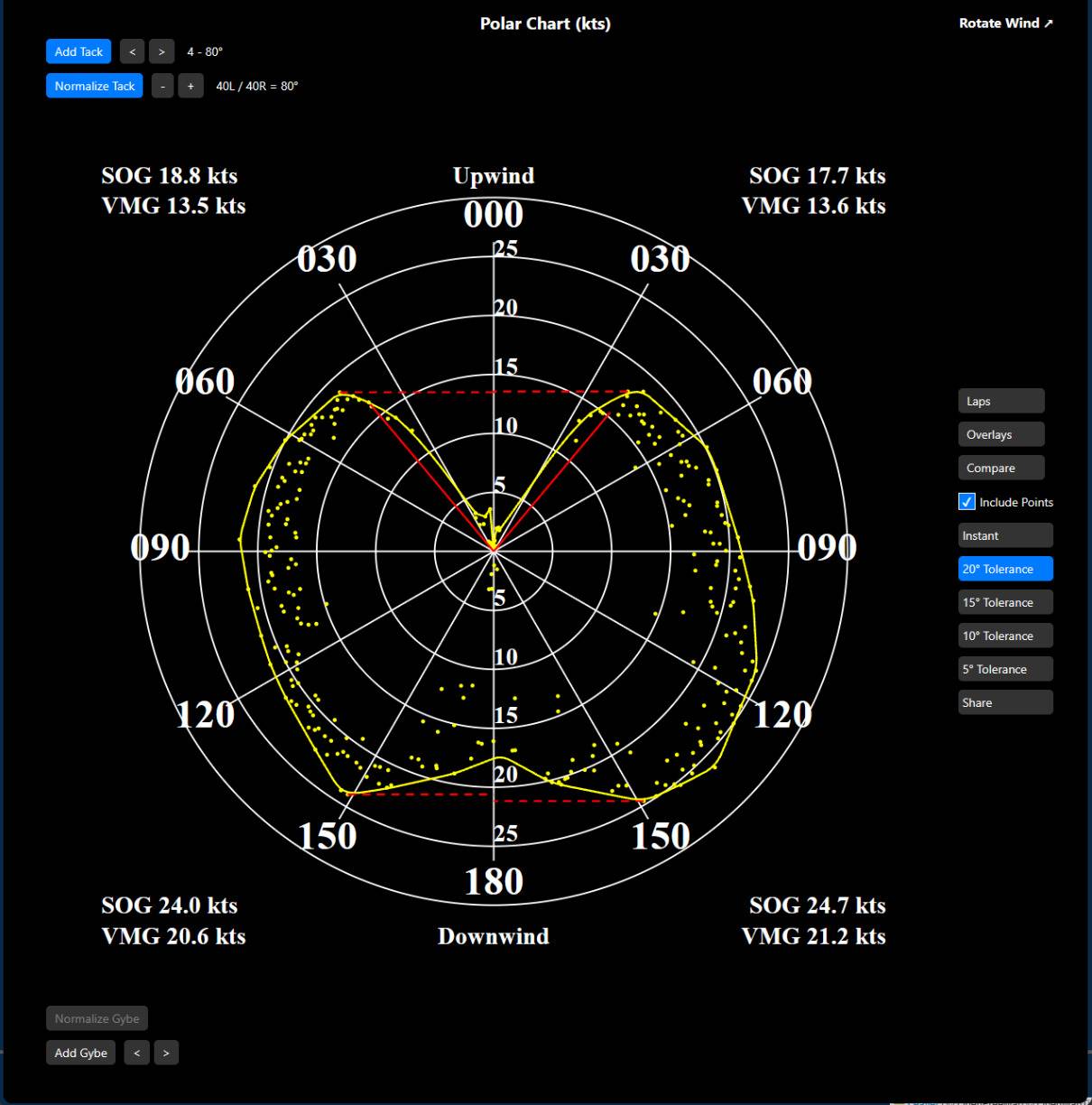


Here's a polar from one of my recorded hydrofoil sessions. The wind comes from the top of the chart. Each dot is a moment in the session, plotted by its angle to the wind and its speed, and the yellow line traces the best speeds at each angle. VMG is the part of that speed going straight into the wind. Pinch too high and your speed collapses; sail too low and you go fast but don't gain much ground. The sweet spot here was about 40° off the wind at around 18 knots of speed over ground (SOG), giving about 13.5 knots of VMG on both tacks. So my upwind target on this gear in these conditions is simple: hold about 18 knots. If I'm slower than that, I bear away to build speed. If I'm well above it, I can point a bit higher.

The red lines show an 80° tack angle, 40° each side of the wind, and that's a little tight for this gear. Port tack holds its speed well, but on starboard I couldn't quite reach 18 knots that high. Sailing about 85° tack to tack would have kept my speed up and my VMG closer to its best, and less speed would have been lost in each tack.

You can also use the VMG number on the water. If your watch app lets you set the wind direction, point the wind axis accurately into the wind and it will read out a live VMG. There are a couple of ways to do this, but as a guide using the numbers from above: target speed 18 kts, VMG should be 13 - 14kts. When my VMG drops by more than 15% and it's a real header, if it looks like it will hold for more than 35 to 40 seconds and I'm not near the layline, it's worth a tack.
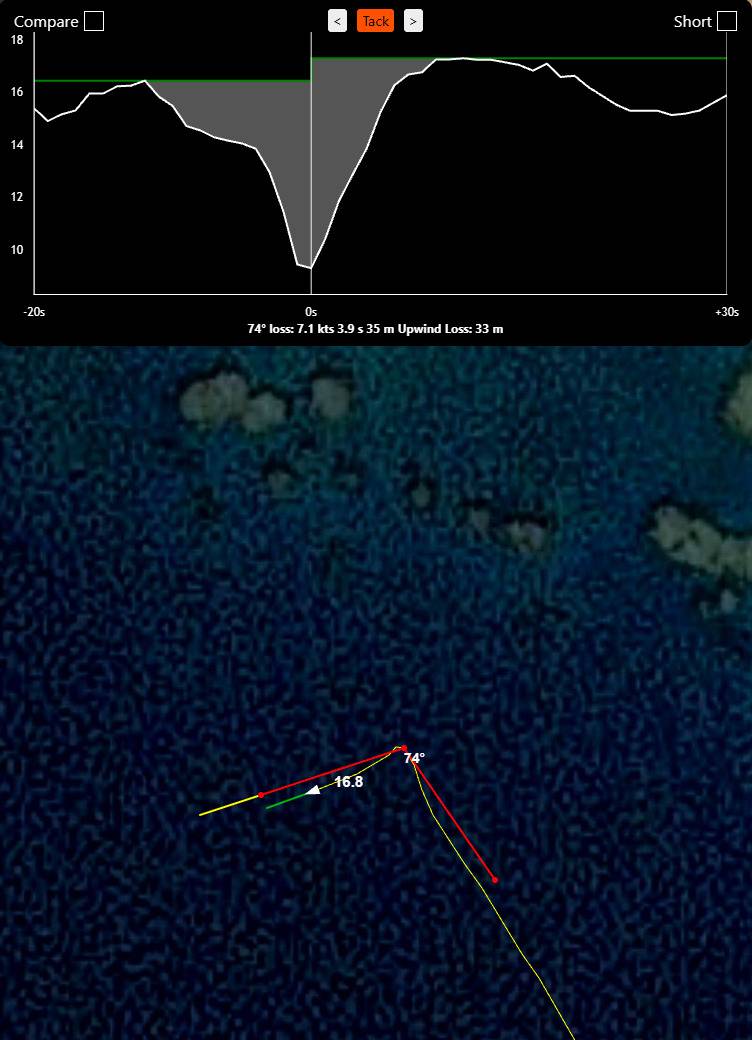


Every tack costs time and distance. The easiest way to measure it is in seconds: how many seconds of progress you give away. On my foil, a good 88° tack dropped me from 18 to about 10 knots and cost about 23 m upwind, which is around 3.3 seconds. A sloppier 74° tack in the same session cost 33 m, or about 4 seconds. Displacement boats lose fewer metres because they're slower, but about the same in seconds or more. A keelboat typically loses about one boatlength per tack in flat water and up to three in chop.
In one measured example, a 6 knot keelboat took 15 seconds to complete its tack but lost only about 5 seconds of upwind progress because it keeps moving towards the wind as it turns.

When should you tack on a header?
A header forces you further from the wind, so your VMG drops. Tacking onto the lift gets it back, but it only pays off if the shift lasts long enough to cover the cost of potentially 2 extra tacks.

Rough guide (when not close to the layline )
Multiply your tack loss in seconds by 11 for a 10 degree shift.
If you think the header will last at least that long in seconds, it's worth tacking into and out of again.

On my foil, a 10° header that costs me two extra tacks needs to last about 35 to 40 seconds before it pays off. Boats ahead and upwind can be a good indicator of what is to come. A keelboat in flat water needs about a minute, and one in chop needs 2 to 3 minutes. A dinghy with a slick roll tack in light air can profit from shifts of only 10 to 20 seconds. Smooth tacks and flat water let you use more shifts, while chop and stalled tacks mean only the big, long ones are worth chasing.

The best part is that you don't need to guess your numbers. A GPS debrief will show your target upwind speed, your VMG on each tack, and exactly how much each tack cost you.

*Full disclosure: I'm the developer of SailRacerPro, which does polar, VMG and tack-loss debriefs from any GPX or FIT file, plus Garmin watch apps for sailing, kite, windsurf and wing. Happy to run anyone's track through it if you'd like to see your own upwind numbers, or try it out for free yourself at www.sailracerpro.com

JonE
JonE
VIC
681 posts
VIC, 681 posts
1 Nov 2026 10:11pm
First up, you cant sail to vmg when heading upwind. If you steer the boat (up) to get a higher number, the number goes really high, then the boat stops.

Second you're only getting COG not heading from the GPS.

If meaningful data could be deduced by gps alone and occasionally going head to wind, we would have had it for 20 years.

On a lake with a sub 5 meter mast this might be useful. Everywhere else we have leeway, wind shear, tide, wave direction. So many reasons why you might go faster, or think you're going faster on one tack vs another.

Wanting to judge tacking performance is worthwhile but without having fantastic true wind angle information you cant make those claims about the cost of a tack based on shifts.

true wind is not possible without good STW, realtime wind, heading and calibration tables.

So 15 minutes a week spent on tacking practice with a stopwatch is going to be time better spent?
dachopper
dachopper
WA
1829 posts
WA, 1829 posts
3 Nov 2026 6:38pm
JonE said..
First up, you cant sail to vmg when heading upwind. If you steer the boat (up) to get a higher number, the number goes really high, then the boat stops.

Second you're only getting COG not heading from the GPS.

If meaningful data could be deduced by gps alone and occasionally going head to wind, we would have had it for 20 years.

On a lake with a sub 5 meter mast this might be useful. Everywhere else we have leeway, wind shear, tide, wave direction. So many reasons why you might go faster, or think you're going faster on one tack vs another.

Wanting to judge tacking performance is worthwhile but without having fantastic true wind angle information you cant make those claims about the cost of a tack based on shifts.

true wind is not possible without good STW, realtime wind, heading and calibration tables.

So 15 minutes a week spent on tacking practice with a stopwatch is going to be time better spent?


Thanks JonE, good points and I agree with a few of them.

You're right that you can't steer to VMG upwind. Chase the number and you pinch, and the boat stops. That's why I steer to a target speed (18 kts in that example) and only use the live VMG as a header alarm. If speed holds but VMG drops 15% or more, the breeze has probably shifted.

Also agreed that GPS gives COG, not heading, and I'm not claiming true wind angle, leeway or proper instrument-grade true wind.

Where I'd push back a little is that for racing, the ground is what counts. Leeway, tide and current are all baked into COG and SOG, and they're exactly what decides who gets to the top mark first. Comparing within one session (same boat, same tide state, similar breeze) still shows which tack angle and which speed got you upwind fastest over the ground. The wind axis comes from averaging your own tacks, so it's an estimate, and a tide change or big shift shows up as noise you can see in the track. But what if the shifts tend to be in the same spot, as you approach the shore or between island for example, you see it and take advantage of it.

Same with tack loss. Metres of ground made good lost per tack is a fair relative measure. It won't tell you why one tack was worse, but it tells you which ones were.

15 minutes a week of tacking practice with a stopwatch is great. Or just record it on the app which adds a GPS track, so you can see which of those tacks actually cost less ground rather than which one felt better

Happy to run one of your sessions through tracks through it if you'd like to see where it holds up and where it falls down.
The closing offer is the important part. If he takes you up on it, it turns a sceptic into a public test case.
lydia
lydia
1955 posts
1955 posts
5 Nov 2026 4:40am
Wrong way around d, easy upwind where as modern boats downhill where very smaller difference in apparent wind amplify boat speed far more.
Trek
Trek
NSW
1244 posts
NSW, 1244 posts
6 Nov 2026 6:48pm
I dont get why you cant sail to best VMG upwind. I always have in racing. If you get too close to the wind or pinching VMG drops and you need to turn slightly down. I spent time before racing measuring lat and long of each mark so VMG to the mark would be accurate. For example, 15 knots at 45° produces the best VMG to the mark, even though the boat can sail faster at 50° so sail at 45. I won trophies doing exactly that. Choosing when to tack can be tricky. What am I missing?
JonE
JonE
VIC
681 posts
VIC, 681 posts
6 Nov 2026 8:37pm
Trek said..
I dont get why you cant sail to best VMG upwind. I always have in racing. If you get too close to the wind or pinching VMG drops and you need to turn slightly down. I spent time before racing measuring lat and long of each mark so VMG to the mark would be accurate. For example, 15 knots at 45° produces the best VMG to the mark, even though the boat can sail faster at 50° so sail at 45. I won trophies doing exactly that. Choosing when to tack can be tricky. What am I missing?


You're doing 7 knots upwind. Lets say vmg is 5 knots. It's perfect, you're at the optimal
angle.

Start to luff up (shoot). What happens to your VMG?
JonE
JonE
VIC
681 posts
VIC, 681 posts
6 Nov 2026 8:45pm
And it's not VMG to the mark that's CMG.

VMG doesnt tell you when to tack and CMG doesnt until you hit the layline,

VMG just quantifies the best compromise between pointing and boat speed but the GPS can't tell you VMG because it doesnt know where the wind is.

This is why you have to create polars by which you need to rigorously measure VMG at different angles whilst doing maximum boat speed and plot it. Someone cite me one reliable reference to how to create polars without accurately calibrated true wind, STW and heading. I have read everything I can get my hands on and it appears there is no shortcut. Hence my disagreement with this "advertorial" post.


Trek
Trek
NSW
1244 posts
NSW, 1244 posts
7 Nov 2026 6:02am
Quote from Sailing World:

America's Cup yachts race primarily to achieve the best VMG (Velocity Made Good), rather than maximum boat speed.
This applies both upwind and downwind.
1. Upwind sailing
The AC75 foiling yachts balance pointing angle against speed to maximise progress.
2. Downwind sailing
The same principle applies downwind.
AC75 yachts sail at angles to the true wind rather than directly downwind because their foiling speed generates strong apparent wind. They gybe between angles that maximise downwind VMG.

From David Dellenbaugh, tactician aboard the winning America³ team in the 1992 America's Cup.
“One combination of pointing and speed will maximize your VMG (your velocity-made-good) to windward.”

From Peter Isler — America's Cup winner - explaing his success “I experimented with sailing deeper angles downwind and finding the best downwind VMG.”

From Tom Slingsby's actual race communication, “Happy sailing VMG,”
cammd
cammd
QLD
4667 posts
QLD, 4667 posts
7 Nov 2026 8:05am
JonE said..
And it's not VMG to the mark that's CMG.

VMG doesnt tell you when to tack and CMG doesnt until you hit the layline,

VMG just quantifies the best compromise between pointing and boat speed but the GPS can't tell you VMG because it doesnt know where the wind is.

This is why you have to create polars by which you need to rigorously measure VMG at different angles whilst doing maximum boat speed and plot it. Someone cite me one reliable reference to how to create polars without accurately calibrated true wind, STW and heading. I have read everything I can get my hands on and it appears there is no shortcut. Hence my disagreement with this "advertorial" post.


Predict wind data hub claims it will create AI polars for your boat over time based on actual performance of your boat.
Chris 249
Chris 249
NSW
3635 posts
NSW, 3635 posts
7 Nov 2026 10:58am
I like the ready reckoner for calculating tacking time lost and the shift required to make up for it. We do that based on feel but it could be interesting to formalise it a bit.

I do share the reservations about the fact that you can’t take into account chop, wind shear, etc.


Trek said..
I dont get why you cant sail to best VMG upwind. I always have in racing. If you get too close to the wind or pinching VMG drops and you need to turn slightly down. I spent time before racing measuring lat and long of each mark so VMG to the mark would be accurate. For example, 15 knots at 45° produces the best VMG to the mark, even though the boat can sail faster at 50° so sail at 45. I won trophies doing exactly that. Choosing when to tack can be tricky. What am I missing?


VMG is determined by the wind direction and not the placement of any mark.

Even ignoring every other factor, choosing when to tack depends enormously on the wind strength, because that changes optimum pointing angle dramatically - polars for lots of boats show that they change their optimum pointing angle by up to 8 degrees (even more in some cases) depending on wind strength. Add in chop etc and any pre-determined tacking point becomes extremely problematic.

If the wind is skewed say 5 degrees to the right of the course axis, your "VMG to the mark" will be better on starboard tack than on port tack. However, if you therefore sail on starboard tack initially you may be sailing in two knots of extra adverse current, five knots less wind, etc and therefore end up miles behind the boats that take a hitch on port and sail into better wind, less tide and a better angle.

The ideal time to tack changes down to the second and depends on exactly where the opposition is placed, how the mean wind direction is shifting, what the strength is doing in different areas of the course, what the chop is doing, which part of each individual puff you're in, whether you're knocking or lifting and how much, how long that's going to last and how far back it will shift, what powerboat wakes are coming, etc etc etc. Almost none of that can be calculated beforehand.

Local club handicap events are normally run on PHS, so they don't actually measure who is sailing better. I'm not saying that you weren't sailing well, just that winning trophies in such events is in itself not meaningful.


shaggybaxter
shaggybaxter
QLD
2714 posts
QLD, 2714 posts
7 Nov 2026 10:21am
S%$# in, S%$# out.
I loved poring over my GPS plots post race and always had VMG/VMC targets in racing. It was always worthwhile playing back and reviewing your overall race position and strategy and performance against polars.
But I also logged TWA,TWS, Heading, SoW, Heel, Pitch, Heave, Leeway, Barometric pressure and Density Altitude. And used all of that data religiously doing any review. None of those datasets you get with a GPS driven plot alone.

It's fun to use GPS to roughly estimate polars. But no way would I use GPS driven polars in an actual race, it's missing all of the other data that makes sailing to numbers worthwhile. Any decent boat has multiple polars for different sea states/environmentals, the different polars come from all of the data you don't get with just a gps device and a bit of software.
I get it when hydrofoilling at 20knots plus. You're not offshore, flatter water and less tidal influence. But as your speed drops, the higher the propensity in erroneous data.
For keel boats doing a passage race? I'd posit a post race function where you can review a GPS trace on a chart might be more beneficial.

Not trying to diss on you DaChopper. If peeps are doing keelboat racing without electronics, or play in OTB pickleforks or suchlike, then knock yourself out.
But polars derived from a GPS plot would be useless for me in keelboat racing (sans WAGs), especially using that data to affect decisions in the actual race itself. Way too many missing bits of info.
My two cents!


Trek
Trek
NSW
1244 posts
NSW, 1244 posts
7 Nov 2026 11:34am
Chris 249 said..
I like the ready reckoner for calculating tacking time lost and the shift required to make up for it. We do that based on feel but it could be interesting to formalise it a bit.

I do share the reservations about the fact that you can’t take into account chop, wind shear, etc.


Trek said..
I dont get why you cant sail to best VMG upwind. I always have in racing. If you get too close to the wind or pinching VMG drops and you need to turn slightly down. I spent time before racing measuring lat and long of each mark so VMG to the mark would be accurate. For example, 15 knots at 45° produces the best VMG to the mark, even though the boat can sail faster at 50° so sail at 45. I won trophies doing exactly that. Choosing when to tack can be tricky. What am I missing?


But 15 knots at 45 degrees doesn't produce the best VMG to the mark unless the mark is exactly upwind and the wind strength and tide are uniform across the course. The ideal time to tack changes down to the second and depends on exactly where the opposition is placed, how the mean wind direction is shifting, what the strength is doing, what the chop is doing, which part of each individual puff you're in, whether you're knocking or lifting and how much, how long that's going to last and how far back it will shift, what powerboat wakes are coming, etc etc etc. Almost none of that can be calculated beforehand.

If the wind is skewed say 5 degrees to the right of the course axis, your "VMG to the mark" will be better on starboard tack than on port tack. However, if you therefore sail on starboard tack initially you may be sailing in two knots of extra adverse current, five knots less wind, etc and therefore end up miles behind the boats that take a hitch on port and sail into better wind, less tide and a better angle.

Local club handicap events are normally run on PHS, so they don't actually measure who is sailing better.


Quite right, one tack to the mark is usually better. VMG tells you that immediately. If you tack and find VMG to the mark is slower bad decision. Theres a thing called TakTik or similar that theoretically tells you when to tack. Has anyone used one?
Chris 249
Chris 249
NSW
3635 posts
NSW, 3635 posts
7 Nov 2026 11:37am
Trek said..
Quote from Sailing World:

America's Cup yachts race primarily to achieve the best VMG (Velocity Made Good), rather than maximum boat speed.
This applies both upwind and downwind.
1. Upwind sailing
The AC75 foiling yachts balance pointing angle against speed to maximise progress.
2. Downwind sailing
The same principle applies downwind.
AC75 yachts sail at angles to the true wind rather than directly downwind because their foiling speed generates strong apparent wind. They gybe between angles that maximise downwind VMG.

From David Dellenbaugh, tactician aboard the winning America³ team in the 1992 America's Cup.
“One combination of pointing and speed will maximize your VMG (your velocity-made-good) to windward.”

From Peter Isler — America's Cup winner - explaing his success “I experimented with sailing deeper angles downwind and finding the best downwind VMG.”

From Tom Slingsby's actual race communication, “Happy sailing VMG,”


But that's VMG to the wind direction, not the course to the mark.
Chris 249
Chris 249
NSW
3635 posts
NSW, 3635 posts
7 Nov 2026 11:54am
Trek said..


Quite right, one tack to the mark is usually better. VMG tells you that immediately. If you tack and find VMG to the mark is slower bad decision. Theres a thing called TakTik or similar that theoretically tells you when to tack. Has anyone used one?


But with respect, just working the tack that gives you better VMG to the mark will rarely give the optimum choice. Take the example of a mark set directly to the north, and a wind at 10 degrees true. If you tack from starboard to port your velocity to the mark will drop - but that has very little to do with whether the tack is a good decision or not. If taking that port tack reduces your velocity to the mark for five minutes (or ten seconds) but takes you out to a different wind that's three knots stronger, in half a knot less tide and is blowing from 30 degrees true then the port tack may well turn to be the better decision. And of course if the wind over the longer term shifts to 330 degrees, that port tack may turn into a loss. There's no way of knowing well in advance which is the best option for a day race, especially when the boat's optimum tacking angle will often change by about 16 degrees depending on the wind strength.

I've raced with navigators who have won the America's Cup, had multiple Fastnet wins etc and they haven't used pre-determined tacking points before the start of a day race. They may calculate lay lines but only as a warning in case they get close to them.
Trek
Trek
NSW
1244 posts
NSW, 1244 posts
7 Nov 2026 1:09pm
Quite right. But for the technical discussion of VMG Im considering wind and speed to the mark only. Of course there are wind shifts, currents, dirty air, swell, chop and competitors boats in the way.
Chris 249
Chris 249
NSW
3635 posts
NSW, 3635 posts
7 Nov 2026 1:38pm
The confusion seems to arise because the term VMG customarily is about true wind, not about the mark.

That's the way it's used on polars; sas.orc.org/sasapi/cc/261059

en.wikipedia.org/wiki/Velocity_made_good
JonE
JonE
VIC
681 posts
VIC, 681 posts
7 Nov 2026 4:44pm
Shaggy,

I haven't got my **** together with true wind yet, despite having h3000 and good quality, if dated, gear that will do it.

for mine, and everyone else's edification- roughly how many minutes would you guess you spent tuning in order to get a decent true wind number? From what I've read, it looks like a solid few hours recording and tweaking plus a good 10-15 minutes before every race to tune it for conditions.
Quixotic
Quixotic
ACT
267 posts
ACT, 267 posts
7 Nov 2026 5:17pm
I’m not a racer’s left elbow, and I also don’t know the inner workings of the calcs that underlie the numbers on my display that aren’t direct outputs (eg depth). But to calculate TW on a moving boat with an angled and moving mast in a swell, there has to be a fair bit of vector math going on and there has to be inputs that give basis for corrections for boat speed, heel, pitching and current etc. and it must be averaged over at least a short period to remove noise.


For mine, you sail to apparent, not true, as that’s what the sails’ experience.

But maybe I’m talking through my hat -as per the disclaimer at the start, I don’t race.
Chris 249
Chris 249
NSW
3635 posts
NSW, 3635 posts
7 Nov 2026 9:36pm
Quixotic said..
I’m not a racer’s left elbow, and I also don’t know the inner workings of the calcs that underlie the numbers on my display that aren’t direct outputs (eg depth). But to calculate TW on a moving boat with an angled and moving mast in a swell, there has to be a fair bit of vector math going on and there has to be inputs that give basis for corrections for boat speed, heel, pitching and current etc. and it must be averaged over at least a short period to remove noise.


For mine, you sail to apparent, not true, as that’s what the sails’ experience.

But maybe I’m talking through my hat -as per the disclaimer at the start, I don’t race.


Very true, and not only that, there's also the whole calibration issue. I still remember eons ago, Grant Simmer stepping aboard the world's latest and greatest 52. The first thing he asked the trimmers (who were both America's Cup/Volvo guys from his own loft) was "when did you last calibrate the instruments?" The message was that even the top level pro programmes needed to work hard not only to get it right, but to keep it right.

One only has to look at the number of You Tube videos that show people claiming to be sailing in 60 knots under 2 reefs and a No 2 headsail to know that most wind instruments have never been calibrated properly. :-)

I haven't sailed with AC level guys for eons because now I just race small one designs, but it's interesting that they had fantastic information from VPPs, sail design programmes etc to set their baselines from - and then they just used experience, gut feel and observation to tweak the finer details from that baseline, applying the fundamental rules of twist, draft etc to the particular conditions of the moment. So there's this strange mix of being exact while also accepting "noise" and other messy realities.

In fast craft, you often have to sail to true and apparent at the same time, because the AIM of your trim and technique must change dramatically as you change your course with respect to the true wind angle, even when the apparent changes very little.

It's probably easiest to see on fast spinnaker cats where there may only be (at a guess) 17 degrees difference between the apparent wind when sailing upwind and the apparent wind on a square run, but during the bear away every available string would have been adjusted, the spinnaker would have been hoisted, the boards pulled up and the crew weight moved to leeward and aft. You would have changed from trying to use power to get high while reducing aero drag, to using power to bear away and increasing power while accepting a moderate amount of extra aero drag. Mind you, I'm not exactly a great downwind fast-cat sailor!

In some windsurfers in some winds, you'll work to the top mark and for the run you'll bear away 90 degrees and change nothing apart from easing the sheeting angle maybe 10 degrees and shift the weight balance on your feet (while still leaving them in the same position) - but your aim has still changed from trying to reduce drag or depower while working to point as high as your sail and foils can handle, to trying to increase drag (a bit) and trying to point as low as you can. So in fast craft your sailing aims can change enormously depending on the TWA, even when your apparent wind angle changes very little. And that, in turn, can lead to critical changes in sheeting angle, twist, depth, and even the type and number of sails.

Even in slower craft, the true wind angle is critical - in a Laser if you're aiming to a mark that is almost dead downwind but which can be made in one gybe, your technique and trim will be different than if you are sailing the same apparent wind angle but trying to soak down to a mark that is dead downwind or to leeward of you; your vang may be looser so you can go by the lee more, your heel may vary more do you can roll the rig to windward to power you down waves by the lee, your centreboard may be down less, etc etc etc.
shaggybaxter
shaggybaxter
QLD
2714 posts
QLD, 2714 posts
8 Nov 2026 6:14am
JonE said..
Shaggy,

I haven't got my **** together with true wind yet, despite having h3000 and good quality, if dated, gear that will do it.

for mine, and everyone else's edification- roughly how many minutes would you guess you spent tuning in order to get a decent true wind number? From what I've read, it looks like a solid few hours recording and tweaking plus a good 10-15 minutes before every race to tune it for conditions.


Hiya JohnE,
Honestly, not long at all, maybe 20-30 minutes per set?
TWA/TWS/TWD needs the paddlewheel and compass as well as AWA/AWS. So calibrating your paddlewheel and compass is just as important as your anemometer.

-- SoW. Everytime we pass the Measured Mile on the main shipping channel. Trundle one direction for 1nm, reverse and repeat on reciprocal heading. Compare to SOG. 30 mins.
-- Compass offset. Do a couple of circles at a steady rate. 10 mins.
-- TWA. (TWA is a derivative of AWA/AWS with a minimum addition of SoW). So we'd do AWA, not TWA, offset anytime I found slack water. Roughly once a month and before any big race. 4 tacks as a minumum, 8 is better. Approx 30 mins.

The AWA offset calibration is the one I would try and do all the time, whenever we found slack water. Wind direction shear (angle, not wind speed) is more pronounced on a warm stable day compared to a cold air/warm water day. Calibrating for masthead misalignment is easy, it's a constant error and never changes. But AWA between port and starboard tacks can change a few degrees on wind shear alone, so this is the one you try and do before every race. (I say try, loads of times I'd be in too much of a rush and forget).

B&G and NKE style electronics can also use heel, pitch/roll rates and leeway to help improve the TWA/TWS calculation. So before every race clean your paddlewheel. Once every blue moon, make sure any accelerometers/gyros are calibrated too (you're not showing 5 degree of heel at the dock or a lateral g of .2 degrees).

Wind correction tables are different, they take a long time (many races and all angles) to build up an accurate picture of boat related impairments . Example: I had a big fat headed roach, it created a lot of upwash which changed with the heel and wind angle . So I had a wind correction table/s to factor in these sort of offsets, usually plotted every 10 degrees.

Hope this helps!
SB


shaggybaxter
shaggybaxter
QLD
2714 posts
QLD, 2714 posts
8 Nov 2026 6:52am
Just another plug for calibration.
The value of having accurate TWA/TWS data is a force mutliplier in coolness.
Expedition and Adrena (aka B&G and NKE nav software) use sail crossover charts that, with good TWA/TWS data, give you awesome sail planning.
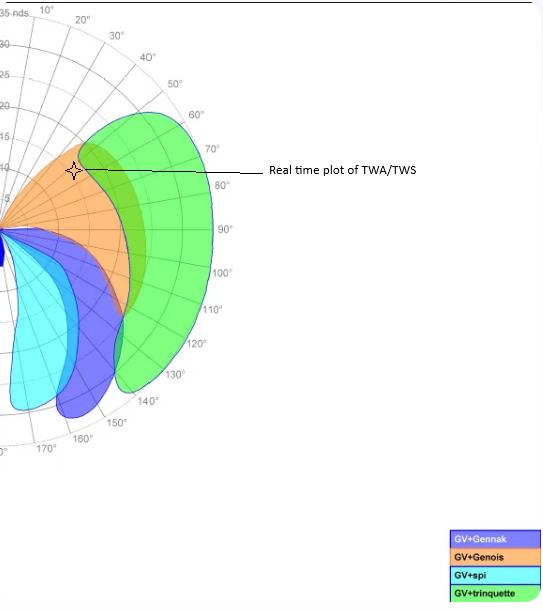
You get a sail wardrobe as a graphic that overlays your TWA/TWS in both real time and historical. It makes for a great second opinion when deciding when to change up and down, and which sail you go for when you have an overlap in sail choices. Often the decider when the crew can't agree on say the jib or the staysail for example. Amazingly accurate (with good calibration!) and a great race tool.

You can also use it when routing. If you are naviguessing, you can move along any predicted routes you are playing with and see what routes need what sail changes. So cool ...when it is accurate.


lydia
lydia
1955 posts
1955 posts
8 Nov 2026 11:26am
There you go, take out the guess work.
Polars for the First 40 in offshore (eg hobart) trim.

Wind Velocity 4 kt 6 kt 8 kt 10 kt 12 kt 14 kt 16 kt 20 kt 24 kt
Beat Angles 42.7° 42.7° 40.7° 39.1° 37.7° 37.0° 37.0° 36.8° 37.4°
Beat VMG 2.70 3.74 4.57 5.16 5.50 5.66 5.75 5.84 5.83
52° 4.20 5.67 6.73 7.37 7.70 7.87 7.96 8.06 8.09
60° 4.46 5.96 6.97 7.55 7.87 8.06 8.16 8.29 8.34
75° 4.62 6.14 7.16 7.71 8.01 8.26 8.46 8.69 8.82
90° 4.73 6.32 7.37 7.93 8.27 8.54 8.74 9.04 9.33
110° 4.45 6.10 7.32 7.97 8.42 8.81 9.16 9.74 10.36
120° 4.30 5.93 7.16 7.86 8.33 8.77 9.21 10.10 10.85
135° 3.78 5.31 6.59 7.50 8.05 8.51 8.98 10.01 11.65
150° 3.12 4.49 5.72 6.77 7.55 8.06 8.50 9.42 10.68
Run VMG 2.70 3.88 4.95 5.87 6.65. 7.28 7.77 8.59 9.44
Gybe Angles 142.6° 142.6° 148.3° 152.1° 157.4° 164.6° 170.5° 174.5° 166.2°
Wind Velocity 4 kt 6 kt 8 kt 10 kt 12 kt 14 kt 16 kt 20 kt 24 kt


Trust the numbers on the screen (if you have calibrates properly which is the real trick)
lydia
lydia
1955 posts
1955 posts
8 Nov 2026 11:48am
This might do a few heads in (except Shaggy).
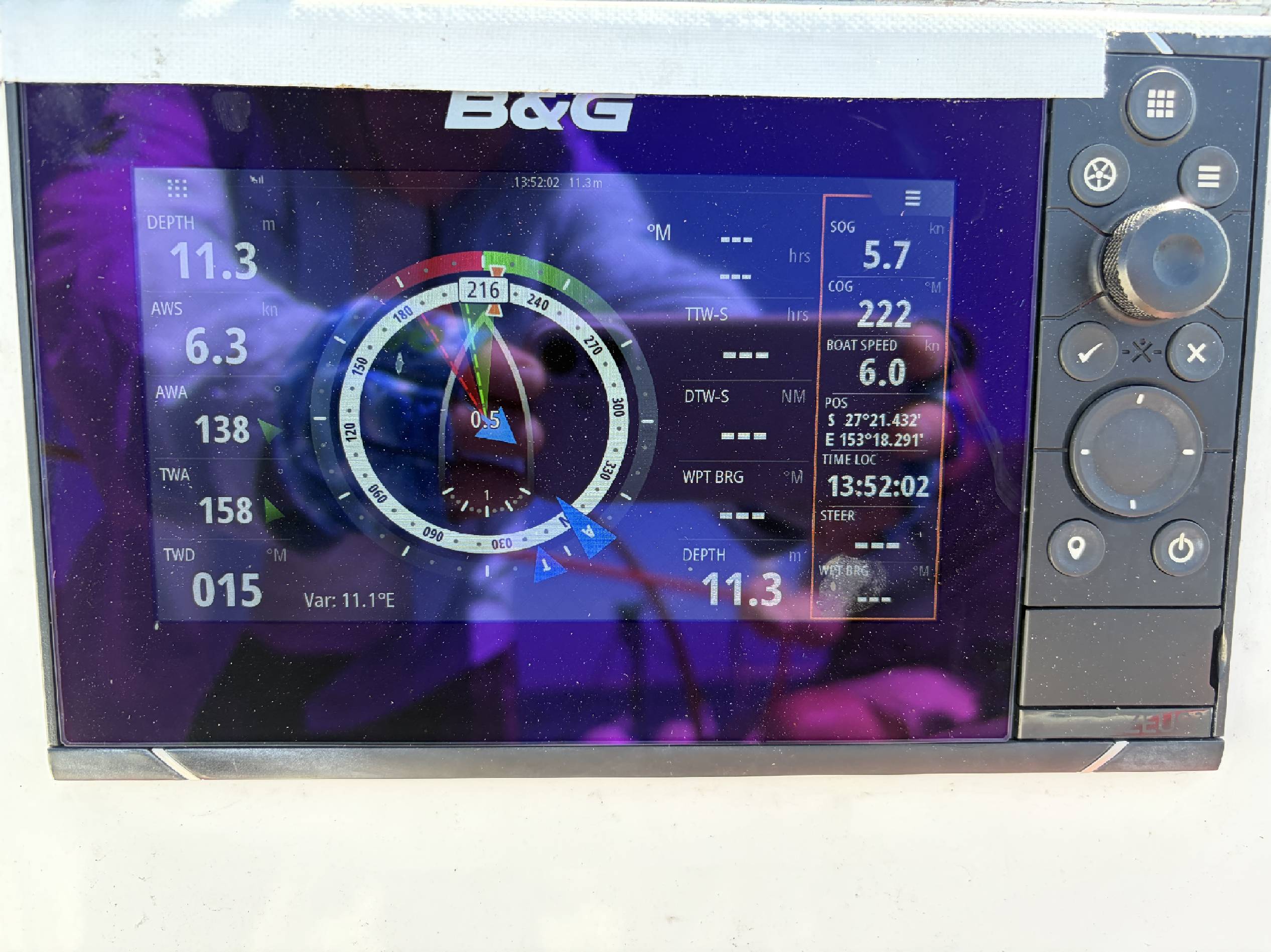
”tuning the autopilot” yesterday.
So getting the settings to allow it to steer firstly downhill with S 2 in sloppy water then by the lee heeled in to windward in sloppy water.


lydia
lydia
1955 posts
1955 posts
8 Nov 2026 11:58am


I should say after about 30 min of the kite not collapsing and the pilot keeping pressure in the rig, it got boring and we went and handsteered for a while.

And yes out was very close to the polars.

So we did not have an Exocet.
H3000 processor driving a raymarine drive.
Having got everything working properly and calibrated, the B&G Sailsteer is a pretty handy piece of kit.
lydia
lydia
1955 posts
1955 posts
8 Nov 2026 12:08pm
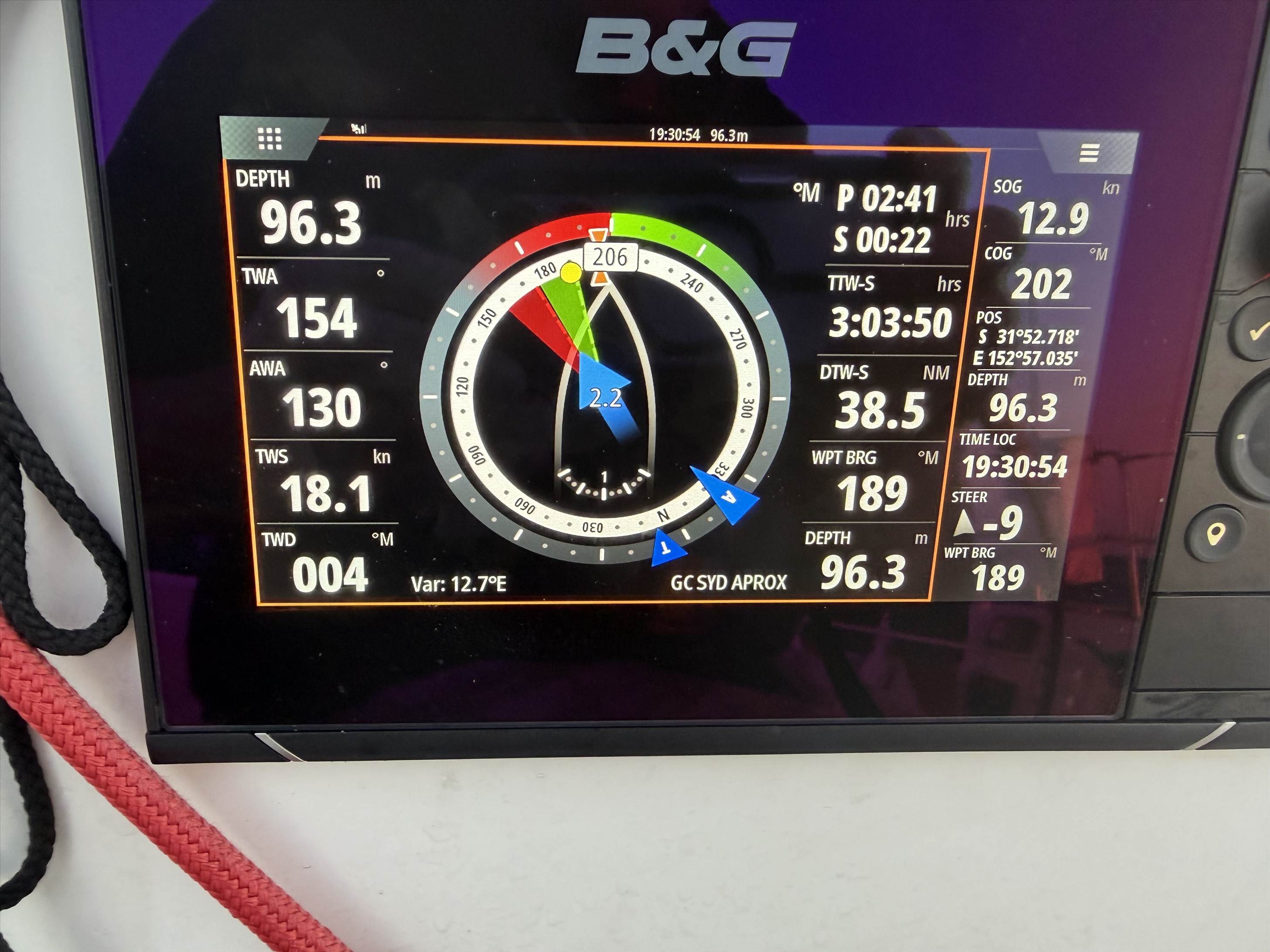
For those who have seen a sailsteer system before.


Boat heading is 216
Brown arrows is heading over ground
Blue arrow in centre is Tide at 0.5 and Angie to bow
Red shading is gybing angle
A and T arrows are true and apparent wind
last number is pilot sensitivity.
dachopper
dachopper
WA
1829 posts
WA, 1829 posts
8 Nov 2026 12:13pm
Trek said..
I dont get why you cant sail to best VMG upwind. I always have in racing. If you get too close to the wind or pinching VMG drops and you need to turn slightly down. I spent time before racing measuring lat and long of each mark so VMG to the mark would be accurate. For example, 15 knots at 45° produces the best VMG to the mark, even though the boat can sail faster at 50° so sail at 45. I won trophies doing exactly that. Choosing when to tack can be tricky. What am I missing?


A few reasons you wouldnt do pure vmg. ( assuming you are hunting for the highest number)
1. There is a forced tack scenario impending, course / port starboard whatever the reason.
2. Theres a wind or current or sea change ahead that you are trying to get into. Dropping to degrees for 10% more boatspeed, to get into the lift / more wind which could be another 10 % boatdpeed might be worth it.
3. If you start focussing on a vmg number ( same with the SOG number) and sail into better conditions, your best vmg /sog will change and might be higher than you are aiming for.

I think once you get a " feel " for best vmg you can sait to it better than following sog, although its still usefull.

Also have a lift tool in the works


dachopper
dachopper
WA
1829 posts
WA, 1829 posts
8 Nov 2026 12:30pm
JonE said..
And it's not VMG to the mark that's CMG.

VMG doesnt tell you when to tack and CMG doesnt until you hit the layline,

VMG just quantifies the best compromise between pointing and boat speed but the GPS can't tell you VMG because it doesnt know where the wind is.

This is why you have to create polars by which you need to rigorously measure VMG at different angles whilst doing maximum boat speed and plot it. Someone cite me one reliable reference to how to create polars without accurately calibrated true wind, STW and heading. I have read everything I can get my hands on and it appears there is no shortcut. Hence my disagreement with this "advertorial" post.


Yes and no...

Lets say you are doing a W/L.

JonE said..
And it's not VMG to the mark that's CMG.

VMG doesnt tell you when to tack and CMG doesnt until you hit the layline,

VMG just quantifies the best compromise between pointing and boat speed but the GPS can't tell you VMG because it doesnt know where the wind is.

This is why you have to create polars by which you need to rigorously measure VMG at different angles whilst doing maximum boat speed and plot it. Someone cite me one reliable reference to how to create polars without accurately calibrated true wind, STW and heading. I have read everything I can get my hands on and it appears there is no shortcut. Hence my disagreement with this "advertorial" post.


Say you do a W/L, and enter the axis from the bottom mark, to the top mark. ( not wind, not cmg) , gps vmg will show you the fastest way to get in the direction of the top mark. Throw a few tacks in pre start to see which tack has higher vmg at the same boat power, and now you know preferred start tack.

Polars are simulated normally by boat / sail designers.
My app simply reverses the process to show you the gps polar you actually achieved in the real world., and has some filters to normailze wind shifts.

Trek
Trek
NSW
1244 posts
NSW, 1244 posts
8 Nov 2026 6:18pm
Semantics semantics!

The International Hydrographic Organization (IHO) defines CMG as:
"The actual TRACK MADE GOOD over the ground (seabed); the direction of the point of arrival from the point of departure." CMG is therefore a direction expressed in degrees, not a speed. Also called track.No use to get upwind speed because its after the event and a course, not speed.

VMG — Velocity Made Good
VMG is a speed expressed in knots, but its reference direction matters.In sailing, two meanings are commonly encountered:
Windward VMG: The component of boat velocity directly towards or away from the true wind direction.

Waypoint VMG: The component of boat velocity directly towards a destination or waypoint, often more precisely called VMC (Velocity Made on Course). It includes the result of every influence on speed. Including negative VMG such as stuck in an over riding current.

My very successful use of VMG is Waypoint VMG. Same as used in aviation. I think some mix up of who defines what as what here!!


dachopper
dachopper
WA
1829 posts
WA, 1829 posts
8 Nov 2026 3:24pm
shaggybaxter said..
S%$# in, S%$# out.
I loved poring over my GPS plots post race and always had VMG/VMC targets in racing. It was always worthwhile playing back and reviewing your overall race position and strategy and performance against polars.
But I also logged TWA,TWS, Heading, SoW, Heel, Pitch, Heave, Leeway, Barometric pressure and Density Altitude. And used all of that data religiously doing any review. None of those datasets you get with a GPS driven plot alone.

It's fun to use GPS to roughly estimate polars. But no way would I use GPS driven polars in an actual race, it's missing all of the other data that makes sailing to numbers worthwhile. Any decent boat has multiple polars for different sea states/environmentals, the different polars come from all of the data you don't get with just a gps device and a bit of software.
I get it when hydrofoilling at 20knots plus. You're not offshore, flatter water and less tidal influence. But as your speed drops, the higher the propensity in erroneous data.
For keel boats doing a passage race? I'd posit a post race function where you can review a GPS trace on a chart might be more beneficial.

Not trying to diss on you DaChopper. If peeps are doing keelboat racing without electronics, or play in OTB pickleforks or suchlike, then knock yourself out.
But polars derived from a GPS plot would be useless for me in keelboat racing (sans WAGs), especially using that data to affect decisions in the actual race itself. Way too many missing bits of info.
My two cents!


Fair enough.

The softwate has a lot more features than just polars, but as the post mentioned for sailors new to their equipment - assuming they are not handed a set design polars, this is a great staring point before they have thousands of data points., and only requires them to turn on their watch and record.

For smaller watercraft ( windsurf, wing, kitefoil ) there are no polars so again this can help confirm tacking angles, time lost in tacks, and in the replay portion if there are consistent lifts / knocks due permanent environmentals, you learn if i go in this area, i pull ahead 200m vs going in this area. )


Chris 249
Chris 249
NSW
3635 posts
NSW, 3635 posts
8 Nov 2026 7:51pm
Trek said..
My very successful use of VMG is Waypoint VMG. Same as used in aviation. I think some mix up of who defines what as what here!!


Aviation language isn't the same as sailing. Surely in normal sailing talk, the people who define what are the sailors. The people who use VMG in sailing with the most success - ie world titles, ACs, etc - use VMG as meaning TWA using the boat as reference. That's why there's terms like "VMG runner" for spinnakers, which would be utterly meaningless if the "VMG" referred to anything but TWA using the boat as reference.

brady
brady
TAS
457 posts
TAS, 457 posts
9 Nov 2026 1:39pm
This is an awesome topic - thanks all contributors. A lot of wisdom and experience on display.

I sail a B14 skiff, where instruments are illegal during competiton. But for a while I've been contemplating having some instrumentation I can attach during training sessions so I can really get a better understanding of my best downwind angles (absolutely the key in these things). I'm in a rural area and frequently do not have any similar style boats to compare myself to. Does anyone have any suggestions for something easily mountable/removable, able to get solidly drowned in the inevitable high-speed stacks, and still pretty cheap? Not much to ask really...

Please Register, or first...
Topics Subscribe Reply