Southern Bluefin Tuna: Winter Trolling

Quick summary
From late May, southern bluefin tuna move from deepwater to the 40m line off southwest Victoria - Apollo Bay, Port Fairy, and Portland become the main departure points.
Trolling speed of 7-8 knots with a 5-lure spread, matched to the temperature break between 16-18 degrees Celsius, puts you on fish consistently.
The how-to
After reading this, you'll be able to set a productive spread, read an SST chart for the temperature break, and diagnose the four most common reasons trollers miss fish.
You don't find southern bluefin tuna.
You find their food - and you put your lures where the bait concentrates.
That distinction changes how you approach a session off southwest Victoria, and it's the first thing that separates anglers who consistently land fish from those who spend a day dragging lures through empty water.

When to go and where to launch
From late May through July, SBT move from the deep Southern Ocean onto the 40m to 70m line off Victoria's southwest coast.
Apollo Bay, Port Fairy, and Portland are the three main departure points.
Apollo Bay Fishing Charters runs dedicated 8-hour bluefin sessions from April through September, and captain Daniel Kent - born and raised locally with tournament competition experience - describes June and July as consistently the most productive window.
The fish haven't gone deep yet and they haven't pushed into the bays.
They're sitting on the shelf edge, chasing the same schools of slimy mackerel and jack mackerel that pushed inshore with the cooling water.
Understanding the temperature break
The temperature break is where warm eddy water meets the colder Southern Ocean water pushing north along the shelf.
Baitfish school on this boundary because the upwelling brings nutrients to the surface - and that's where the tuna sit.
An SST chart before departure shows you where the break is tracking - look for the transition from deep blue (12-14 degrees) to the greener water (16-18 degrees) on the SST overlay.
The productive water is usually 200m to 500m wide.
Work along the edge, not across it.
"You're looking for the colour change in the water and the birds - both are telling you the same thing about where the bait is sitting."
A 14-degree differential might look small on a chart, but a tuna sitting below a school of mackerel sees that boundary as a wall.
They work along it; your lures should too.
Check current conditions and wind forecasts for the Victorian coast before you head offshore - the shelf break is 15-25 nm out from Apollo Bay, and a building southwest change can make for a rough return.
Setting the spread
Five lure positions is the standard trolling spread for SBT.
From shortest to longest distance behind the boat: short corner, long corner, short rigger, long rigger, and shotgun.
Stagger the distances so lures don't cross on tight turns.
A typical spread off Apollo Bay starts at 20m for the short corner position and extends to around 60m for the shotgun.
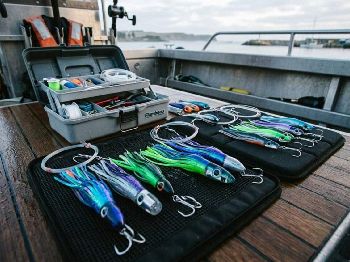
Skirted lures in the 5-6 inch range are the workhorses in the cold green water off Victoria.
Richters 502 and 506 in UV/Blue and soft grassy patterns produce consistently here - the dark back and UV-reactive finish works well in the low-angle winter light.
Bibbed minnows like the Yo-Zuri Hydro Magnum 140 and 180 can be dropped back further on the long rigger and shotgun positions when fish are feeding subsurface and ignoring surface lures.
Speed is where most setups fail
Troll at 7-8 knots.
This is faster than most people expect, and slower than a few push it.
Below 6 knots, skirted lures lose their action and run slightly below the surface - SBT key in on the splash pattern at the surface and a lure that stops smoking and bubbling gets ignored.
Above 9 knots, bibbed minnows spin or come to the surface, and you start losing action on the shorter rigger positions as the boat wake flattens the spread.
In a following sea, where the boat surfs down waves and slows in the trough, watch the GPS speed constantly and throttle to keep the spread stable.
The boat's speed over ground matters - not your throttle position.
When you find the school
Do not drive straight through it.
When you see birds working or your sounder lights up with bait, make a wide circle around the outside so your lures pull through the edge of the school.
Driving over active fish pushes them down - sometimes for the rest of the morning.
The most productive approach is a loose figure-eight, keeping the boat on the fringe and the lures tracking through the densest part of the bait ball.
When a fish hooks up, don't stop - throttle back to 3-4 knots and maintain direction until the second rod (if it fires) is cleared or it's clear nothing else is chasing.
Stopping dead in a school of feeding fish is the fastest way to lose the other strikes.
Drag and line class
Set your drag at 30 percent of line breaking strain before you get on the water - not after a fish is hooked.
For 50lb braid (the most common setup for Victorian SBT), that's around 7kg of drag at strike.
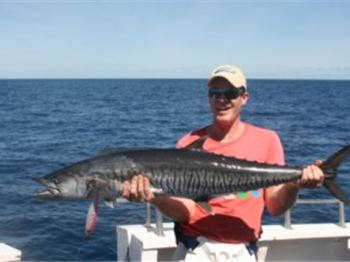
Winter fish off Apollo Bay typically run 30-80kg, with bigger fish regularly reported off Portland and Port Fairy.
A rod that bottoms out its drag range at 8kg is going to lose every fish over 50kg that has any run in it.
80lb class outfits with 80lb braid are the minimum recommendation for targeting large fish over the 40m line.
Common mistakes and their fixes
Lures waving in the wake: The spread is too wide for the boat speed. Drop the short corner position by 5m and reduce the stagger on the rigger positions until lures are tracking clear of the wake turbulence.
Follows but no strikes: Fish are inspecting lures at the surface but not committing. Switch one short rigger lure to a bibbed minnow running at 1-2m depth. Inspection without commitment usually means they want something below the surface chop.
Hooks pulled on the run: Drag is too light or hooks are too small for the lure head. SBT run fast on the strike and a light drag allows them to shake the hook before it sets. Re-check drag settings before the next pass.
Fish found but gone in 20 minutes: You drove over the school.
Mark your GPS position, run out 500m, and circle back onto the temperature break from a different angle.
Fish pushed down usually come back up in 30-45 minutes if the bait hasn't scattered.
Safety and regulations
The 40m line is 15-25 nm offshore from Apollo Bay - this is not inshore fishing.
A minimum 5-6m vessel with a reliable engine and full safety kit is the starting point.
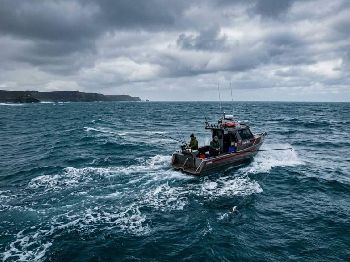
Southern Ocean swells in winter can build quickly through the Bass Strait corridor, and bar crossings at Apollo Bay and Portland require careful timing against tide and swell.
Check Victorian tide times and the current marine weather before committing to a departure.
The Victorian Fisheries Authority sets a bag limit of 2 southern bluefin tuna per person per day, with a possession limit of 2 whole fish statewide.
Confirm current regulations at vfa.vic.gov.au before your first trip of the season - limits can change ahead of season.
Questions for the next session
What happens when fish are surface feeding but ignoring lures? Try replacing one skirted lure in the short corner position with a small (3-inch) feather jig on a short drop-back.
Feeding fish ignoring troll lures are often keyed on a specific bait size - go smaller.
Can you target SBT with jigs? Yes - once you locate a school, backing down and dropping 200g jigs to the 30m mark can produce fish when the trolling bite slows mid-morning. Knife jigs in chrome and blue work best in the cold green water.
Do conditions in Bass Strait affect where fish are? Consistently.
A strong westerly for several days builds a cold upwelling along the western shelf edge off Portland - fish push east toward Apollo Bay when this happens.
Watch the SST chart shift over 2-3 days before your trip, not just the morning of.
What's the right boat for this fishery? A trailered 5.5-6m runabout can do the job on a calm June day.
A 7m+ centre console or cabin boat with twin engines is the setup most local charter operators recommend for consistent safe offshore work in the Southern Ocean swell.