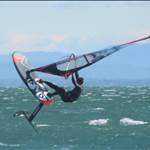


Had a quick blast before work at manly on the 5.9m and 92L board... was light at first but filled in to about 15kts enough to cruise around.
http://forum.weatherzone.com.au/ubbthreads.php?ubb=showflat&Number=494493#Post494493

i liked sausages car/bike analogy, i think that explained it for me. 
i'm up to speed with temp and pressure relationship. so agree if temp is the same wind will be the same between highs and lows. now just need some wind!
Swoosh,
When I went to Uni, density was a function of mass and volume.
So the real question here is "does a equivalent volume of air" have more or less mass when it is hotter or colder and if it does vary will it be significant - assuming the force we feel on a sail is a function of mass.
A wise man I met said one day the answer to any question is 'it depends'
Some preliminary calc's I've done show that for 'dry air' the difference really is very small. I got a 0.1% increase in force for warm air at higher pressure (1030 Hpa vs 995 HPa). For air moving at a constant velocity.
If we add temp into the equation and add humidity I wonder what we will get.?
- J
2 bobs worth... because I'm bored
A knot is a unit of measurement for speed whereby 1 knot = 1 nautical mile per hour. 1 nautical mile is also a fixed unit whereby 1 nautical mile = 1 minute of longitude on a map (therefor the circumference of the earth at the equator = 360 (deg) x 60 (min) or 21,600nm).
Since these are fixed units they cannot be affected by any other factor.
The old question "which is heavier? 1 tonne of lead or 1000kg of feathers. Of course, they are both the same. You could argue that lead is denser and therefor weighs more per unit mass than a feather but this is not the question.
As is with the question of 15 knots of wind speed and whether it is affected by temp, density, pressure etc. I would think not. 15 knots will always be 15 knots. 
what if I have a red sail,spray it with teflon,and wear speedos(without a potato) and get a haircut??? will I be able to duck jibe ??
then I'll just stick to my triple forward loop ,flucka uppa ,no clue, borg, spin jibes..... ...(looks like a crash to the unknowing)

dr J, yes density by definition is a function of mass per unit volume. but the mass of air in a given volume varies with temperature and pressure. you need to revisit ideal gas laws.
Here comes the calculator...
L=0.5*density*v^2*A*Cl
density from ideal gas laws is = pressure/ (R*T)
so say its 15kts, about 7.7m/s, 20deg, 101.3kPa outside, i'm on a 5.9m sail with an arbitrary lift coefficient of 1. Note because of the arbitrarily chosen lift coefficient, the magnitude of the result may be incorrect, but the relative difference between results is correct.
Lift force is 211.26N
if we maintain the pressure
@ 10deg outside, that number is 218.7N
@ 35deg outside, that number is 200.97N
, so a 25 degree temperature difference results in about 9% difference in lift.
if we keep temp the same,
@ 100kPa, lift = 208.50 N
@ 102.5kPa, lift = 215.71 N
, so the difference here is only about 2-3%.
If we vary both,
@10deg, 102.5Kpa, = 221.26 N
@35deg, 100Kpa = 198.35 N,
, so almost 12% difference, between a hot day under a low pressure system, and a cold day under a low.
Out of interest I calculated what would the affect of sail area be.
@ 10deg 102.5KPa, with a 5.3m sail, lift = 198.76kN
,so on a cold day under a high, a 5.3m generates as much lift as a 5.9 on a hot day under a low for the same wind velocity.
conclusion, temperature variations has a greater affect on available lift then pressure variations. So much so that there may be a sail size difference for the same amount of wind.
throw out the anemometers, you guys need to be packing a mobile weather station, and a calculator :P
good stuff swoosh, not that i unsderstood it.
my questions.
does the wind gauge take into account density? if so wouldn't 15 knots on a cold day still read as 15 knots on a hot day. sure the real velocity on the cold day may be less but the additional density due to lower temps makes the effect on the gauge higher.
hope that made sense
Good Stuff Swoosh,
Checked my numbers and got similar results to you. I modelled it differently assuming moving parcel of air pushing on static surface, with a linear relationship to velocity which gives me lower % variations in force vs your lift calculation.
I have included humidity into the calculations and this does have an effect as well.
- J
P.S. - I know just a little a little bit about the gas laws ! - LOL

What about sail fabric friction ??? and the potato itchieness coefficient ??? Come on guys, be serious !!
yes, that's my question sausage,
as swoosh has proven there is more lift associated with the lower pressure.
more lift and or lower pressure will also mean more velocity in his equation. so the wind gauge will read higher.
i think the limiter is the area. the gauge only has a small area so will not translate the percentage difference as much as a sail will.
Hi KenHo,
no worries!
next time you sail brissy just say high. those that know me know i am always up for a chat, before a sail, after a sail, during a sail. 
p.s. yes the wind feels less powerfull to me on hot days.
no helmet,
i use KA Kults usually orange but i also have a grey one.
what sails r u on?