Tried a few of the step 1 & 2 with a 6.4 and 112 skate last night - its actually harder than it looks doing the low speed ones - the semi planing one was easier - my kids were paying me out saying "dad why do you keep falling off" - must say I must've looked like a gumby from the beach.
Off subject slightly - i am coming to the conclusion that SUPing in surf is having a huge +ve affect on my windsurfing (duck gybes, SB tacks, No wind gybes) - or maybe it's all psychological. any one else finding this?
mofo said... If I go for ... or a full day I take enough gear to cover all conditions.You all know where this is going .3 boards , 5 sails ,3 masts ,3 booms and a collection of fins universals etc.
Also: - The Cold War is over. - Video didn't kill cinema. - Nobody plays Trivial Pursuit anymore. - And Michael Jackson is dead!!! *edit - And a black man is president of US!!!
Didn't try any totally stacked last night, but tonight got fully into step 3 on my second outing. Aim is to throw a step 4 before the end of the month...
BRING IT!!!!! Totally fired up for this... took 18 months off the water and forgot how to do them (having only tried a few and landed one before then).... been back on the water nearly 2 years and having trouble growing the minerals ... this is really helping.
With the wind on Monday night I was trying to do some of the first steps... I think I got up to step 0.5 I went around OK ...but my board won't let go of the water...it just stayed there!
After re looking at the video I think I was not starting the gybe first and thats why my feet kept on getting ripped out of the straps.
I think I need to put this vid on my phone so I can review it on the beach.
Roll on Steps 2, 3 & ...4 Just need the wind again.
had a lash at steps 1/2 on Sunday in a 15-20knot SE at Botany Bay. very keen to try it with a bit of a wave to try and get the board out of the water a bit. basically just doing a half gybe, trying to move the back hand down the boom and falling in at the moment. tried about 20 and out of that 2-3 felt like i was doing the right thing. the others were purely for the entertainment of the other windsurfers and the people on the beach.
With the wind on Monday night I was trying to do some of the first steps... I think I got up to step 0.5 I went around OK ...but my board won't let go of the water...it just stayed there!
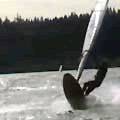
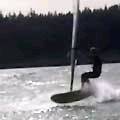
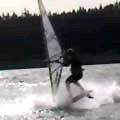
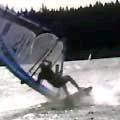
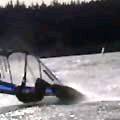
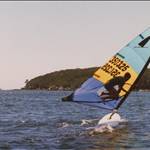
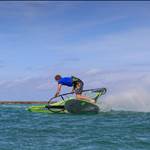
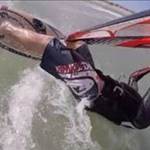
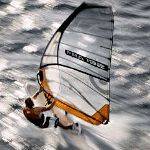
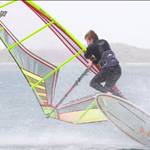
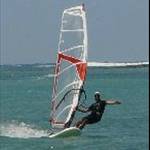
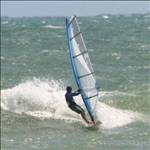
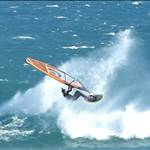
I have found that for steps1-2 you really really need to lean back and get the board up on its tail and throw the sail to windward to get the rotation, otherwise the board will stick and wont spin around. I'm still a way off doing a loop, but I figure once you can comfortably do step 3 with the board in the air, you could then 'not' lean back so far and infact try a small nose first chop hop to actually do a 'forward' loop (such as these pics).
knee deep in water in both straps pumping like hell for some speed to try steps 1 .. didnt quite work out .. i dont think thier was enough wind .. i was moveing back hand as far as i could doping wind down to windward and almost in the water .. NOTHING..
What a great vid! Finally I got round (without the board, but hey you've got to start somewhere)...
All quite safe and controlled. Now all we need is some more wind and a bit of swell
Hey Nebs. Don't forget the board! I've been stuck for ages being able to get the rotation but without the board. The first one I did was actually in the backyard a few years ago. Doesn't hurt if you keep tight to the boom.
Now I'm too used to not rotating with the board that it's hard to work up to staying in the straps.
Stopped windsurfing and took up kiting 10 years ago but this thread makes me want to pick up a board & sail and get back out there. I never got the forward down and hurt myself trying.
Here is another vid that shows the need to really throw the mast into the wind and lean back for the initial learning stages.
http://broadbandsports.com/node/5564
This is the accompanying text:
Sail at 90?? to the wind, depower the sail and bring your weight over the center line of the board. The sail should be nearly perpendicular to the board and balanced. (This position in fact is the start position for everything you want to do in windsurfing) Now put the sail as far over towards the wind as possible with out engaging power. Once it is over as far as you can get it , you will find that your back hand is near your head. Now to sheet in just move the mast forwards a little and engage the power and lean back. The board will do a very fast turn down wind and jibe. What you should be looking for is that when you move the mast forwards the power comes into the sail quickly and the power is in you front hand not the back hand. Also the board turns very quickly. If you just get pulled forwards you have not put the sail far enough over towards the wind. If you get pulled forwards before you can get the rig over you have not depowered the sail enough. When done correctly you will either just float around the front of the board and land in the water or the board will turn 180?? and you land in the water. The further over the rig is the more horizontal the float will be. Because of the light wind it will only be a float, not hard.
The next exercise is to do this in the straps. Again the lighter the wind the better as we are still wanting to concentrate on getting the power onto the front hand and learning to float around pivoting on the tail. Notice we are not throwing yourself or the rig forwards but looking for the rig to pull you AROUND and turn the board. When you are comfortable with this and are being pulled at least 180?? you can go onto the next stage. Again exercises 1&2 the board only just has to be moving forwards.
The next exercise can be done just planning. You have found the position needed to make the board rotate. So you just have to do this a lot faster. The difference now is that you no longer lean back but allow the rig to pull you forwards AROUND the front. Make sure your back foot is well into the strap. You are aiming to slide around on your back so no jump is needed. Also it is important to get the rig as far over towards the wind as possible. This in fact can be done at very high speed and is an excellent way to control a high-speed catapult, in or out of the straps.
By now you have found the power needed to do a forward and it is important from now on to never release that power during rotation. Sheeting out is no longer an option. You will also find sometimes you stay in the straps some times not, it is not important, keeping the power is. Now it is time to work on timing and releasing the board from the water. This is not a jump, you are just taking your weight of the board. You do not need to be planning fast just comfortably.
First we will look at flat water.
Sail at 90?? to the wind.
Step 1: Transfer your weight onto the back foot and release.At the same time move the rig as fast as you can over towards the wind. Timing: The release of pressure on the back foot should coincide with the rig being at its furthest point. You can practice this by letting go with your back hand. It stops you rotating to fast at this point and is very good for a Volcan exercise.
Step 2: The release of pressure and movement of the rig will have lifted the board of the water and it will be starting to turn down wind. Now engage the power and lift the back leg. Remember the pull is on the front hand and it is pulling you around the front. The nose of the board will turn down wind very fast and go down. Do not worry about it touching as most of the time it will and it is not a problem, in some cases it helps. Timing: The moment the nose starts to go down wind you must try and get as much power in the rig as possible.
Step 3: After the initial pull the rotation seams to slow down. It is because your body is overtaking your equipment so you have to extend your front hand more and make sure that the sail is sheeted in (back hand near your face). Also make sure that your back leg is tucked up under you. This is when it can help to look back but is not necessary. You will find that you have rotated 3/4 of the way round and will be sliding on your back. Timing: You must be very sensitive to the slow down and react as fast as you can.
Step 4: Now all you have to do is extend your front hand the same as a water start and you have completed a wet forward.
that is where it came from. i bought the video some years back and found it on the end as a bonus section. the best and easiest way to learn i found, worked for me anyway......


 [}:)]
[}:)]


 [}:)]
[}:)]