New Batteries

> 10 years ago
Reply
Register to post, see what you've read, and subscribe to topics.
LooseChange
LooseChange
NSW
2140 posts
NSW, 2140 posts
24 Aug 2013 7:18pm
You mean the mob up in Browns Road? Hardly what I would call specialists, more like a fly by night organisation.
2 posts
1 Sep 2013 1:17pm
If you want to get serious about some decent reliable batteries get yourself some lithium iron batteries which are half the size and half the weight of lead acid or AGM batteries. Lithium iron batteries have a flat discharge curve till 80% of discharge which means there is more amp hours available from a 100 amp hour battery, where a 100 amp hour AGM reaches 11volts @ 40% of its capacity which means you get almost twice the amp hours out of the same amp hour battery. If you want to do some research Google EV WORKS and there you will find all the information you will need but take into consideration the price over along period as my 160 amp batteries are expect to drop to 130 amp hours in about 15 yrs which means over a long period they are no dearer than AGMs
Charriot
Charriot
QLD
880 posts
QLD, 880 posts
2 Sep 2013 7:38pm
Be aware, LiPo vs Li Iron.Completely different characteristics.
LiIron are common for low current only.
Both need special charger. Keep them in good conditions
Individual cells are charged separately.
Don't believe they are friendly for the boat.
torvie
torvie
5 posts
5 posts
6 Sep 2013 12:56am
LiFePO batteries can be used on boats and work extremely well, provided you understand them. My 160AH LiFePO provides the effective capacity of about 300AH of LA, but weighs 22kg and is physically smaller. It will charge rapidly until completely full then shut off to virtually zero charge. However, they need a good charge system, I have a good 100A Balmar alternator but even it overheats this at times on full setting and has to be regulated back a little (make sure you have a good external regulator that also senses alt temp and backs off if it overheats). The charge parameters are not much different from an AGM, an AGM setting will charge them OK, but the parameters can be modified if you wish for best performance.

Secondly, you must realise that they need protection from overcharging (ie above 15v or so) and running flat (below 10%) and the cells need to be balanced as they charge. This requires some solid state electronics between the cells (should be epoxy potted for long life) and a battery charge regulator that will disconnect it if the voltage goes to high or low. The battery will work without this, it is just a (essential) safety feature.

Once set up, the battery will discharge at rates above an AGM if you need it to, and charge rapidly and completely. It maintains a good voltage until almost flat. There is almost no Peukert effect (ie reduced capacity at higher discharge rates) and the self discharge during storage is a lot lower than AGM. They are great start batteries, our 40AH start battery weighs only 6 kg, if you want to get extreme you can start an engine with one weighing only about 3kg (they are popular as aircraft start batteries).

They cost a bit more but perform much better. Supposedly a much longer lifespan, but I can't personally vouch for this. I can vouch for the service and quality provided by EV Works.
Ramona
Ramona
NSW
7754 posts
NSW, 7754 posts
6 Sep 2013 8:43am
There may need to be a slight pause here for a reality check. Its quite easy to over capilatise with batteries and charging systems. The original poster inquiring probably does not want to spend the same for batteries and a charging system as he paid for his vessel. There is usually not a problem having a heavy battery or batteries in the bilge, need more stored power, add another lead acid battery. The earlier poster with his $500 Hood 23 would be perfectly happy with a 100 amp hour deep cycle lead acid battery and appropriate solar panel etc off eBay.
spongeblob
spongeblob
NSW
218 posts
NSW, 218 posts
6 Sep 2013 12:50pm
Spot on Ramona, couldn't be more happy with the 100amp battery, very easy to over capitalise a $50 Hood.... and now for the panel.
torvie
torvie
5 posts
5 posts
6 Sep 2013 3:00pm
I quite agree for those with small boats/limited budgets, and we had drifted off the initial topic of a cost effective battery for a Hood 23. But the fact remains that if you need performance, the LiFePo delivers. 100 miles offshore the equation is often a bit different. As for weight, even low down it does affect performance and many racers strive to reduce 2kg let alone 50-100kg. Some don't even paint their boats to save weight! A few hundred dollars extra to save >50kg is a bargain for those guys. For cruisers it is battery not boat performance that counts.

In terms of cost, 200-300AH of top quality AGM that would perform & last the distance would have cost close to the $1300 I spent on the LiFePO, and still not have performed as well. If the LiFePO outlasts it as promised I will be ahead on cost.

In the context of a $500 boat sailing on the river it's not worth it. For a several $100k boat going offshore it is, and certainly not over capitalising to keep the electrics performing well and reduce many hours of charge time. It is horses for courses I think re batteries. I would think twice before advising these batteries over an AGM for a weekend trailer sailor.
southace
southace
SA
4798 posts
SA, 4798 posts
29 Sep 2013 2:58pm
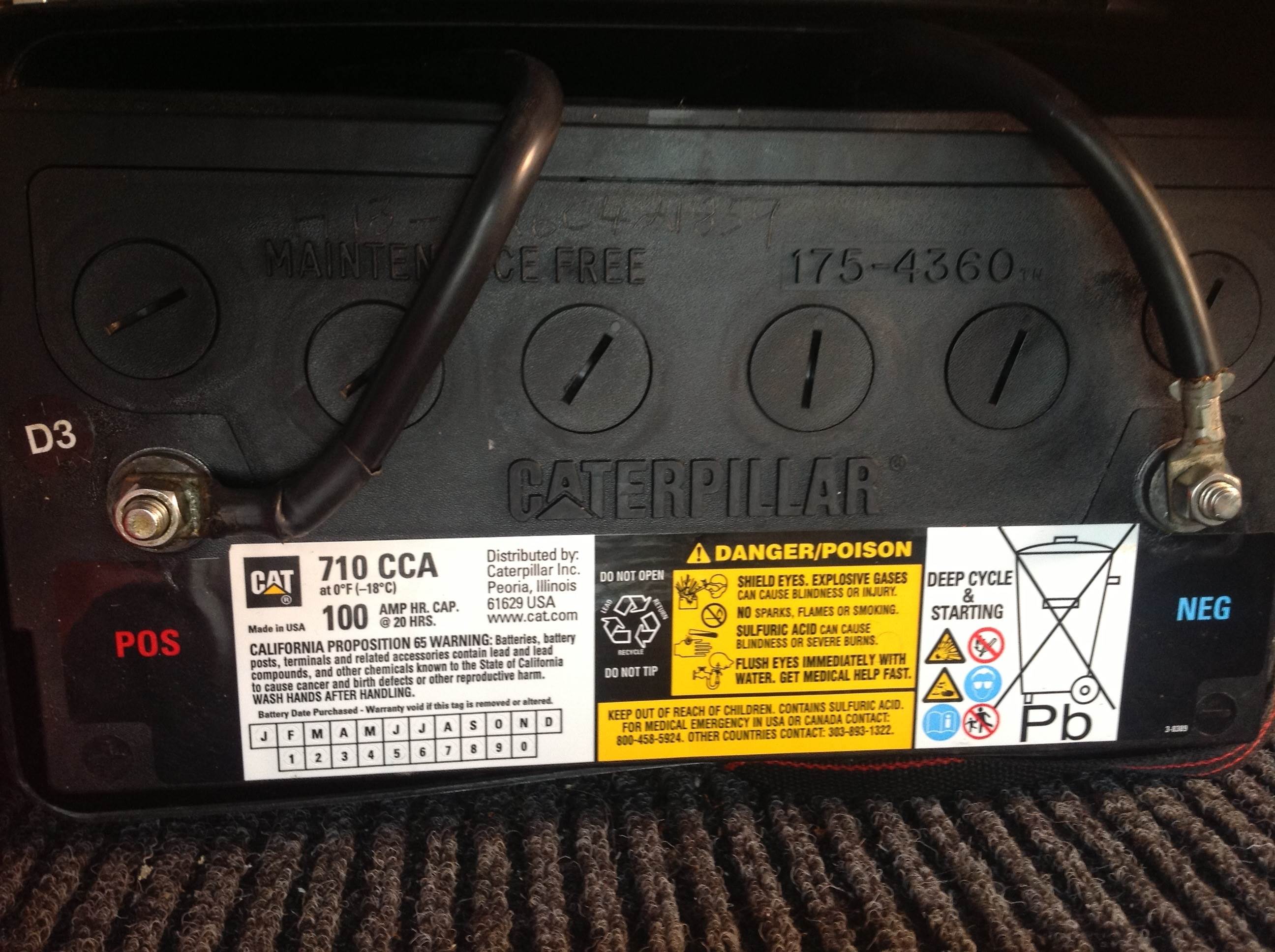
I have to recommend these new cat batterys again! $160 each. Live aboard solar disconnected and fridge on shore power after 5 days still showing 12.6 volts! A 3 day trip away running fridge and all systems return to dock and battery's floating on 12.7! after another 2 days without solar or shore charger still 12.7! Amazing difference from my old marine pro 720 retailing at $220 they would be showing 12.4 after that sort of testing!


cisco
cisco
QLD
12365 posts
QLD, 12365 posts
29 Sep 2013 11:52pm
^^ +1

I haven't ever had them but I reckon they have to be the duck's nuts as boat batteries, especially for well less than $200.

Have always had a good run (5 years +) out of Marshall (Exide) batteries which are still made in Aus. They have a 3 year warranty and the guy I buy mine from said "If that battery fails on you in the next 3 years, bring it back to me and I will give you a new one."

That is hard to beat. Century and Yuasa are good too but with only 2 year warranty.

The date marker on the Cat battery is good.
Jedibrad
Jedibrad
NSW
527 posts
NSW, 527 posts
1 Oct 2013 12:55pm
Thanks.. good timing ^^

Sunseeker39
Sunseeker39
WA
71 posts
WA, 71 posts
1 Oct 2013 3:52pm
Awesome - just priced them $147.50 each and in stock in Perth.
Fantastic value.
Many thanks for the tip Southace
southace
southace
SA
4798 posts
SA, 4798 posts
1 Oct 2013 8:28pm
Super cheap if only I had room for 2 more!
2 posts
11 Oct 2013 10:52pm
the best battery technology at the moment are lithium iron not ion available from ev works in WA. I have 2 systems on my 14M yatch 12v and 24v both 160 AH The batteries are half the weight and half the size of AGM. They expect that my batteries will have down graded to about 130 AH in about 15 years all the information is available on their website. Initial outlay quite substantial but taken on a yearly basis cheap. They have much more storage capability than AGM or lead acid of the same amp hour.
Ramona
Ramona
NSW
7754 posts
NSW, 7754 posts
12 Oct 2013 8:39am
adventureous100 said..

the best battery technology at the moment are lithium iron not ion available from ev works in WA. I have 2 systems on my 14M yatch 12v and 24v both 160 AH The batteries are half the weight and half the size of AGM. They expect that my batteries will have down graded to about 130 AH in about 15 years all the information is available on their website. Initial outlay quite substantial but taken on a yearly basis cheap. They have much more storage capability than AGM or lead acid of the same amp hour.


If the Caterpillar battery lasts 5 years at $150 and yours last 15 years, just exactly how do they compare cost wise? Apart from hurting my back the actual weight of the battery is not really a problem. If I have to I'll get someone else to lift it.
torvie
torvie
5 posts
5 posts
24 Oct 2013 5:41pm
Ramona said..

adventureous100 said..

the best battery technology at the moment are lithium iron not ion available from ev works in WA. I have 2 systems on my 14M yatch 12v and 24v both 160 AH The batteries are half the weight and half the size of AGM. They expect that my batteries will have down graded to about 130 AH in about 15 years all the information is available on their website. Initial outlay quite substantial but taken on a yearly basis cheap. They have much more storage capability than AGM or lead acid of the same amp hour.


If the Caterpillar battery lasts 5 years at $150 and yours last 15 years, just exactly how do they compare cost wise? Apart from hurting my back the actual weight of the battery is not really a problem. If I have to I'll get someone else to lift it.


The
Ramona said..

adventureous100 said..

the best battery technology at the moment are lithium iron not ion available from ev works in WA. I have 2 systems on my 14M yatch 12v and 24v both 160 AH The batteries are half the weight and half the size of AGM. They expect that my batteries will have down graded to about 130 AH in about 15 years all the information is available on their website. Initial outlay quite substantial but taken on a yearly basis cheap. They have much more storage capability than AGM or lead acid of the same amp hour.


If the Caterpillar battery lasts 5 years at $150 and yours last 15 years, just exactly how do they compare cost wise? Apart from hurting my back the actual weight of the battery is not really a problem. If I have to I'll get someone else to lift it.


The cost comparison is: My battery say $1400 for 15 years, you will need at least 3x100AH for the same performance, so about the same. Having said that, you don't buy these batteries to save money, but for the superior performance and reduced weight. If you don't need the performance and the weight isn't an issue then stick with the AGM. For me the 70kg weight saving contributes to winning races, the smaller size frees up storage on a fairly small boat and I have far less time spent charging from the engine. Overall for me it makes sense, but for others especially coastal cruisers it may well not.
cisco
cisco
QLD
12365 posts
QLD, 12365 posts
25 Oct 2013 12:19am
torvie said..
The cost comparison is: My battery say $1400 for 15 years, you will need at least 3x100AH for the same performance, so about the same. Having said that, you don't buy these batteries to save money, but for the superior performance and reduced weight. If you don't need the performance and the weight isn't an issue then stick with the AGM. For me the 70kg weight saving contributes to winning races, the smaller size frees up storage on a fairly small boat and I have far less time spent charging from the engine. Overall for me it makes sense, but for others especially coastal cruisers it may well not.


OK if you are going to be keeping the boat for that long. If it was me I would be pulling them out and replacing with $150 specials before sale,........or just running with minimal batteries for racing. If the racing is inshore, how many batteries do you need???

torvie
torvie
5 posts
5 posts
24 Oct 2013 10:57pm
You could do that. For inshore racing you don't need much. We keep the power demands down, but we still need to run instruments, AIS (most people would fit transponders these days not just receivers), computer, nav lights, HF+/-VHF radio, interior lights and frig. After a couple of day's racing it all adds up. And 50 miles offshore you don't want a dodgy power system. A new sail is say $5k so $1500 on batteries that could last 10+ years is not a major expense by comparison. If you have a trailer sailor or purely inshore racer the equation would be quite different.
cisco
cisco
QLD
12365 posts
QLD, 12365 posts
25 Oct 2013 1:28am
OK. So offshore racing is a different deal and weight saving is an issue.

I do have to question where the offshore racers concentrate their weight saving though.

I had a Peterson 42 a while ago with 13 winches on deck all with alloy drums. The drums were flogged out, not through use but by corrosion. Bronze bases and gears, stainless bearings and alloy drums. I had thought of hooking a couple of wires up to them and running my lighting off them.

I had all the drums bored out and plastic bearing sleeves made up to substitute for the roller bearings.

The boat still went like a rocket and could win races.
Ramona
Ramona
NSW
7754 posts
NSW, 7754 posts
25 Oct 2013 9:23am
torvie said..

You could do that. For inshore racing you don't need much. We keep the power demands down, but we still need to run instruments, AIS (most people would fit transponders these days not just receivers), computer, nav lights, HF+/-VHF radio, interior lights and frig. After a couple of day's racing it all adds up. And 50 miles offshore you don't want a dodgy power system. A new sail is say $5k so $1500 on batteries that could last 10+ years is not a major expense by comparison. If you have a trailer sailor or purely inshore racer the equation would be quite different.


A racer with a fridge!

My yacht has done 5 Sydney Hobarts with a previous owner, 3 Lord Howe races and the usual offshore series. Had two 105 amp hour batteries and that ran Hf, vhf and a laptop. One race was 5 days! Now has solar panels. Heaviest drain is the laptop. I still run old incandescent lights.
Karsten
Karsten
NSW
331 posts
NSW, 331 posts
26 Oct 2013 1:51am
torvie said..

LiFePO batteries can be used on boats and work extremely well, provided you understand them. My 160AH LiFePO provides the effective capacity of about 300AH of LA, but weighs 22kg and is physically smaller.
... I can vouch for the service and quality provided by EV Works.


I am keen on trying out a LifePO house bank - for three reasons:

1) My battery compartment has limited space (Lifepo's are much smaller); this is the main reason
2) They do not self-discharge - you can leave them alone for months
3) In use, they can be discharged much, much deeper than lead-acid

Trovie, I note that EV Works sells two brands of LifePO cells - "Sky Energy" and "Winston".

I am thinking of getting a 100AH bank (ie. 4 cells). Any advice from you or Adventureous100 (or anyone else) on whether Sky Energy is to be preferred over Winston, and whether there are any other brands in Australia?

torvie
torvie
5 posts
5 posts
28 Oct 2013 11:52pm
Dear Karsten,
I bought mine from EV Power not EV Works. I think they were the same business originally but the partners split and set up individual businesses. I think mine were Sky, but am not 100% sure. I did find that Rod Dilkes at EV Power gave very personal service and answered all my stupid questions, plus returned a charger for a refund when I found I had bought one too large to fit (my fault not his). The batteries certainly have performed well, as advertised. Mine is 180AH at 22.5kg. This gives about 145 AH of repeatedly usable power, up to 162AH if you push it to the limit. You would need around 300AH of LA battery for similar performance. It also charges rapidly (enough to push my alternator to it's limit) until virtually full, then shuts off in a few minutes. You can never really get a LA battery more than about 90% charged from the alternator as the charge tapers off so much as it gets close to full.

I bought them mainly for the performance and weight savings, not price, although over the long run they probably don't cost much more than LA. We do indeed race with a frig (we have one, it doesn't weigh any more than a weekend's worth of ice so why not use it), but these days electronics usually is as great or more power draw than a small frig. If you charge at 50-80A you will recharge the battery in 1-2 hours max just from the engine.

It's not that LA batteries can't perform, it's just that the new ones do the same job better, weigh a lot less and take up less space. Other than some largely short term cost saving, why would you use anything else?

Hope this helps.
Karsten
Karsten
NSW
331 posts
NSW, 331 posts
3 Nov 2013 6:18pm
torvie said..

Dear Karsten,
I bought mine from EV Power not EV Works. I think they were the same business originally but the partners split and set up individual businesses. I think mine were Sky, but am not 100% sure. I did find that Rod Dilkes at EV Power gave very personal service and answered all my stupid questions, plus returned a charger for a refund when I found I had bought one too large to fit (my fault not his). The batteries certainly have performed well, as advertised. Mine is 180AH at 22.5kg. This gives about 145 AH of repeatedly usable power, up to 162AH if you push it to the limit. You would need around 300AH of LA battery for similar performance. It also charges rapidly (enough to push my alternator to it's limit) until virtually full, then shuts off in a few minutes. You can never really get a LA battery more than about 90% charged from the alternator as the charge tapers off so much as it gets close to full.

I bought them mainly for the performance and weight savings, not price, although over the long run they probably don't cost much more than LA. We do indeed race with a frig (we have one, it doesn't weigh any more than a weekend's worth of ice so why not use it), but these days electronics usually is as great or more power draw than a small frig. If you charge at 50-80A you will recharge the battery in 1-2 hours max just from the engine.

It's not that LA batteries can't perform, it's just that the new ones do the same job better, weigh a lot less and take up less space. Other than some largely short term cost saving, why would you use anything else?

Hope this helps.


Certainly helps - thanks for the detail Torvie. I'll check out EV Power as well.

I've had a few LA batteries die over the years due to chronic under-charging, while these lithiums don't care at all when being under-charged. So I'm going the lithium path.
Please Register, or first...
Topics Subscribe Reply

Return To Classic site 😭
Or... let us know if a problem, so we can tweak! 😅