

This year's Sydney to Hobart saw 4 boats retire with damaged rudders. Discussion on what was required by way of an emergency rudder started on another thread with several really useful posts. Many thanks to those who have contributed so far. And thanks to Julesmoto for suggesting a new thread to avoid a possible thread hijack.
So, what do people carry? What have people used? How successful were they? Pictures would be great.
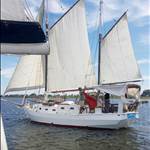
To start the conversation, my experience was a 6' length of 2" galvanised pipe threaded into the rudder stock of a 45' wooden hulled schooner running downwind in 20 kts of trade wind. A swage fitting failed on the wheel steering. It was hard work while it lasted.

There's a socket on the windvane's paddle, to accept the fitting I welded up. I think the ropes would be tightened to stop the normal movement of the rudder (yawing?), to the normal movement.
I've never had to use it though.
This video from Sailing Triteia cited in this forum a few months ago, shows the stress and ingenuity of losing the rudder with 1000 miles further to sail:
Thanks Cammd.
I have looked at those on a couple of the occasions but always baulked at the price.
Is anyone aware of a source for one which looks strong and well made but cheaper?
Interesting that he deploys the bridle from amidships.
Just use a small tyre and a length of nylon rope. A 13" radial would suit your boat.
Select to expand quoteRamona said..
Just use a small tyre and a length of nylon rope. A 13" radial would suit your boat.
Thanks :)
My girlfriend and I are planning offshore adventures and we often talk about and try to practise emergency procedures. One of them is an emergency heave to, to stop the boat asap in case of a mob. With only two of us onboard we both need to be able to react instantly and correctly by just knowing what to do.
Going to try some emergency steering techniques now, will try a tyre and chain I think first and work out what works for Wapiti. It's good to know exactly what to do on the event of a problem and practising in benign conditions has to make it easier to do a real life emergency.
Select to expand quotejulesmoto said..
Thanks Cammd.
I have looked at those on a couple of the occasions but always baulked at the price.
Is anyone aware of a source for one which looks strong and well made but cheaper?
Interesting that he deploys the bridle from amidships.
More width amidships than at the stern, more turning moment for the same drag?
Many thanks for the videos, FabulousPhill and cammed. I appreciate all the comments here and in other threads. They make me think and that, I hope, makes me a better and safer sailor.
There used to be a plastic milk bottle crate on Kinora. I took it off but that would have worked quite well as a drogue.
Cheers,
Kinora
Select to expand quoteRamona said..
Just use a small tyre and a length of nylon rope.
Nylon rope as opposed to a sheet to ensure that it floats well away from the prop or for it's stretch characteristics?
I presume you have used tyres to good effect. Their shape doesn't cause them to constantly want to rise up despite any weights?
I'm wondering whether a tyre would also serve the alternate drogue function of preventing surfing down big waves. If the primary purpose is to assist steering then too much drag would presumably be a liability in light winds. Not enough drag on the other hand would not be very helpful with following breaking seas.
Select to expand quoteKinora said..
More width amidships than at the stern, more turning moment for the same drag?
There used to be a plastic milk bottle crate on Kinora. I took it off but that would have worked quite well as a drogue.
That's good thinking about the milk bottle crate and one came with my boat in the lazarette and houses the spare anchor. I would just be a little concerned about it not being strong enough and perhaps falling apart. Especially the old one on my boat.
There is probably a case for a secondary light duty solution in case you need to sail in fairly light winds as you don't want to impede forward progress too much.
If used for the more traditional drogue function in severe conditions however I have my doubts that the crate would hold up to the task.
As for the point of attachment to the boat the midships position seems to make sense for boats with pinched in sterns. In the test as per the video the rudder of the boat was removed entirely which would make it pivot around the keel much easier. In practise of course some or all of the rudder may still be there and indeed possibly jammed so as to create substantially more drag on one side than the other. This seems to have been the case in the video of the guy 1000 miles short of Hawaii hence the need for the spinnaker pole to transfer the point of attachment to starboard laterally outboard of the transom
Be very interested to see the results of your test together with details of what type of boat you have. Please report back :).
Select to expand quotecammd said..
My girlfriend and I are planning offshore adventures and we often talk about and try to practise emergency procedures. One of them is an emergency heave to, to stop the boat asap in case of a mob. With only two of us onboard we both need to be able to react instantly and correctly by just knowing what to do.
Going to try some emergency steering techniques now, will try a tyre and chain I think first and work out what works for Wapiti. It's good to know exactly what to do on the event of a problem and practising in benign conditions has to make it easier to do a real life emergency.
I would suggest something like this. Use it as a drogue or use it to control the boat steering by adjusting on the stern. If you prepare like this then you will never need it!
www.facebook.com/marketplace/item/2954706301496184/?hoisted=false&ref=saved&referral_code=null
I remember seeing 2 tyres on Mark Sinclair's GGR boat recently and thinking they would be used as a drogue, in an emergency..
When I first bought my boat and had it surveyed, the Shipwright said to get to know your boat and have emergency plans in place.He suggested using the ply cut out under my main bunk storage area and fashion my Spinnaker pole to it.
That's an idea or call Sea Rescue if in local coastal area's..Lol
Select to expand quoteFabulousPhill said..
Nylon sinks and stretches well. Silver rope floats.
Thanks
Interesting topic. On the old training boat we typically use a sea anchor to demonstrate emergency steering, the milk crate is worth an investigation, as its associated bridle etc can be stowed in it. I have to add it's not a very direct way of steering, ok to get you back close enough to harbour to call for assistance.
Select to expand quoteRamona said..
I would suggest something like this. Use it as a drogue or use it to control the boat steering by adjusting on the stern. If you prepare like this then you will never need it!
www.facebook.com/marketplace/item/2954706301496184/?hoisted=false&ref=saved&referral_code=null
Interesting multiple tests of various iterations of this product here. It's on a catamaran but pretty comprehensive.
dragdevicedb.com/drogues-on-catamarans/dc-8-catamaran-crowther
Hi Kinora, I have one of those Burke SeaBrake drogues: www.burkemarine.com.au/pages/seabrake It's set up with a bridle system and sitting in a tub in the lazarette ready for quick deployment. I've never had to use it for emergency steering or as a drogue, but it's nice to know it's there just in case. What I do often use it for, is as a flopper stopper in rolly anchorages, it works pretty well and can be the diffence between a nightmare night and an ok night. It's certainly paid for itself as a flopper stopper.
Select to expand quote2bish said..
Hi Kinora, I have one of those Burke SeaBrake drogues...
Wow the recommended tow rope length is pretty long at 3 x boat length plus 30%. 16 mm double braid will end up costing as much as the device! Jib or spinnaker sheet is not going to cut it!
Interesting that it is useful as a flopper stopper. Not that cheap but if it serves as a drogue, emergency steering and a flopper stopper that's triple purpose so maybe worth the cost and not too bulky either.
Meanwhile I have got myself a milk crate and a 13 inch tyre to test. Just have to work out the length of chain necessary wait for big blow.
Burke don't seem to recommend much chain which is good from a cost perspective although I'm thinking that perhaps the tyre might require more weight in the chain.
Back in the late 80s my brother stupidly steered a Dubois 1/2 tonner into a sunfish which snapped the rudder shaft like a carrot. We then had to get the boat to Eden (about 30-40 miles west).
We tried the washboard on the kite pole trick to steer like a surf boat cox but that was useless. We then stood the pole up, tied it onto the backstay and turned the pole and washboard. It worked a little but only 3 of us could steer the boat, about 3- degrees each side of west, we put a warp astern as well. We were in great conditions and the bosat was barely in control. If conditions had worsened we would have been in a real pickle.
So much depends on the boat. A classic SS 34 would probably be fine with a drogue but a Hanse, Bavaria or Beneteu are goinjg to be absolutlely useless without a proper rudder. Go out sailing your boat and see if it can steer with no rudder input. If it can nicely then maybe the drogue could work. If it doesn't behave, and cannot sail downhill, then I would recommend putting spare gudgeons on the stern and making a simple ridder out of thick ply - nowhere near as big as your proper one - and storing it under a bunk. Use it as a workbench or vice base but drogues and bridles are ineffective for most of the modernm boats sold today. It would take 2 hours to install spare gudgeons and about 3 hours to make a rudder blank out of 3 layers of 12mm ply from Bunnings. two large clamps and a length of hardwood for a tiller and you are set up. Then sleep muc better. And don't run over sunfish. To install, in a seaway only bolt 1 bolt into top pintle with rudder pivoted back. Then push down and quickly bolt lower pintle on (oversize hole). Then bolt second holes to make permanent.
My emergency tiller was a 7' stainless steel tube that was bent at 90 degrees at approx 1/3rd of the length and clipped against the forrard bulkhead in the lazarette. It and the top of each rudder post were keyed. Inspection hatches were installed in the cockpit floor over each rudder post. If you lost steering you can whip off the inspection hatch and snug the emergency tiller straight onto the post. It had the same length as the normal tiller, so there wasn't any loss in helming or performance.
For an emergency rudder, well that was a side benefit of dual rudders, if you lost one you still had another... at least on one tack .

Select to expand quoteKankama said..
Back in the late 80s my brother stupidly steered a Dubois 1/2 tonner into a sunfish which snapped the rudder shaft like a carrot. We then had to get the boat to Eden (about 30-40 miles west).
We tried the washboard on the kite pole trick to steer like a surf boat cox but that was useless. We then stood the pole up, tied it onto the backstay and turned the pole and washboard. It worked a little but only 3 of us could steer the boat, about 3- degrees each side of west, we put a warp astern as well. We were in great conditions and the bosat was barely in control. If conditions had worsened we would have been in a real pickle.
So much depends on the boat. A classic SS 34 would probably be fine with a drogue but a Hanse, Bavaria or Beneteu are goinjg to be absolutlely useless without a proper rudder. Go out sailing your boat and see if it can steer with no rudder input. If it can nicely then maybe the drogue could work. If it doesn't behave, and cannot sail downhill, then I would recommend putting spare gudgeons on the stern and making a simple ridder out of thick ply - nowhere near as big as your proper one - and storing it under a bunk. Use it as a workbench or vice base but drogues and bridles are ineffective for most of the modernm boats sold today. It would take 2 hours to install spare gudgeons and about 3 hours to make a rudder blank out of 3 layers of 12mm ply from Bunnings. two large clamps and a length of hardwood for a tiller and you are set up. Then sleep muc better. And don't run over sunfish. To install, in a seaway only bolt 1 bolt into top pintle with rudder pivoted back. Then push down and quickly bolt lower pintle on (oversize hole). Then bolt second holes to make permanent.
Hi Jules, yes it's pretty darn long isn't it. I believe that's to allow for worst case scenarios though, monster swell & seas and heavy winds, it's so there's enough rope length that the Seabrake doesn't pull out of the following waves too. I'm ok if it's a bit over engineered, it's no use having something that'll break when it's really used in anger, so I assume they got that right if they're selling it as a safety product. I baulked at the cost of 16mm sailing braid and got hold of some 16mm Arborists braid, which is strong enough but cheaper and the cover is a bit thicker which is good for wear resistance, so probably a better choice for the use. It was $265 for 100 meters. Hey there's a really old low res video from 2010 that is interesting, even though it takes a few liberties with the stock vision to try to get the message across. It outlines some of the tank testing etc. so it's worth a look. Read the description on the vid too:
Select to expand quote2bish said..
Hi Jules, yes ... Let me know what you think of the vid.
Thank you for that.Yes it does seem impressive. Presumably folds into a relatively small package too.
Any idea what they mean by the predetermined maximum speed set by the owner at 1 minute 40 seconds? Is there some sort of adjustability.
The thing that always scares me about drouges is actually slowing the boat down enough to deploy them without ripping a winch or cleat out or snapping the rope.
Presumably the size ordered is fairly critical as well. My boat isn't that far above the limit for the smaller one but I noticed the next size up is said to be appropriate for boats a hell of a lot bigger at the upper end. Wouldn't want to get pooped regularly because it was too large.
Can't really test these things (as a sea brake) until you desperately need them so it is nice to know that they have tested them rather than relying on a home made tyre or milk crate that has never been tested in anger. The guidance as to the length and thickness of rope as well as weight of chain might be applicable to other homemade solutions.
Select to expand quoteKankama said..
Back in the late 80s my brother ...
Thank you very much for that. Nothing like real life experience.
Yes I certainly didn't fancy wielding a giant spinnaker pole rudder whilst single handing although I have bought some 85mm u bolts just in case.
Would have been interesting attaching a tiller to a vertical spinnaker pole lashed to the backstay :-).
Unfortunately the pintle idea wouldn't suit my boat as it has a swim platform and no relatively vertical transom path.
My boat doesn't have a really wide transom like most modern dinghy style Beneteaus etc. but I initially thought that the wide transom would have helped steering via a drogue. Now that I think about it properly however I can see not.
Select to expand quote2bish said..
I have one of those Burke SeaBrake drogues: www.burkemarine.com.au/pages/seabrake
Just looking at an appropriate tow rope to use and using the guide set out by Burke my 38 foot boat should be using a 16 mm polyester line which I assume means double braid of the type used for halliards, sheets...
As their drogue utilises what I assume is webbing akin to seatbelt webbing it would probably have a maximum breaking strain of 6000 pounds as per the attached screenshot. It is probable that the bits in between the webbing are substantially less robust although I guess as there would be at least 4 straps of webbing one could argue that the breaking strain of the wedding might be up to 24000 lbs.
In any event Donaghys double braid at 16 mm has a breaking strain of 3600 kg. Even the 12 mm is 2900 kg which is more than 6000 lbs. It would seem therefore that 12 mm will be adequate although if the drag of 100ft of rope adds to the effectiveness then obviously 16mm rope will present more drag.
Ramona suggested using nylon rope and it is quite interesting that the breaking strain of 12mm nylon rope is not that different to 12 mm double braid (but much more expensive) although by the time you get to 16 mm nylon appears to be far far superior along with a far far greater price.
Perhaps most of the additional thickness with double braid is in the sheath not the core.
Of course it is a moot point weather my cleats,blocks and winch mountings would rip out at greater than 2,900kg anyway.


The nylon will give some stretch and recovery. I would be inclined to use a tyre with holes drilled around the middle of the tread area. Splice some nylon rope to it and rig it as you would a fender. Toss it in a locker and use it as a fender if required. Then if you ever have to use it in anger, attach some chain to trail off the back of the tyre and toss it off the stern or wherever.
Select to expand quoteRamona said..
The nylon will give some stretch and recovery. I would be inclined to use a tyre with holes drilled around the middle of the tread area. Splice some nylon rope to it and rig it as you would a fender. Toss it in a locker and use it as a fender if required. Then if you ever have to use it in anger, attach some chain to trail off the back of the tyre and toss it off the stern or wherever.
Thanks; do you reckon 12mm nylon is adequate? Not sure how easy it will be to drill sufficiently large holes in a radial that will actually pass much water. What type of drill bit would you use to deal with the steel reinforcement? Can't get much diameter with a twist type drill bit.
Select to expand quotejulesmoto said..Ramona said..
The nylon will give some stretch and recovery. I would be inclined to use a tyre with holes drilled around the middle of the tread area. Splice some nylon rope to it and rig it as you would a fender. Toss it in a locker and use it as a fender if required. Then if you ever have to use it in anger, attach some chain to trail off the back of the tyre and toss it off the stern or wherever.
Thanks; do you reckon 12mm nylon is adequate? Not sure how easy it will be to drill sufficiently large holes in a radial that will actually pass much water. What type of drill bit would you use to deal with the steel reinforcement? Can't get much diameter with a twist type drill bit.
Use a hole saw but very carefully. If it grabs it hurts
Select to expand quotetroubadour said...
Use a hole saw but very carefully. If it grabs it hurts
:) Thanks. Have to see if I've got one with smallish teeth. I am envisioning a mess with wire strands hanging out everywhere :-(.
Select to expand quotejulesmoto said..troubadour said...
Use a hole saw but very carefully. If it grabs it hurts
:) Thanks. Have to see if I've got one with smallish teeth. I am envisioning a mess with wire strands hanging out everywhere :-(.
The mess is nothing compared to the black s**t that will be on your topsides if you ever use it as a fender. 
Select to expand quotejulesmoto said..Ramona said..
The nylon will give some stretch and recovery. I would be inclined to use a tyre with holes drilled around the middle of the tread area. Splice some nylon rope to it and rig it as you would a fender. Toss it in a locker and use it as a fender if required. Then if you ever have to use it in anger, attach some chain to trail off the back of the tyre and toss it off the stern or wherever.
Thanks; do you reckon 12mm nylon is adequate? Not sure how easy it will be to drill sufficiently large holes in a radial that will actually pass much water. What type of drill bit would you use to deal with the steel reinforcement? Can't get much diameter with a twist type drill bit.
I recommend spade drills for drilling into rubber. They will make nice, big, 30mm holes (or whatever size the spade is), lots of rubber flakes and very little smoke. Not sure how they would go with the steel reinforcement in tyres, though.
If you are just looking at it from an emergency steering point of view you don't need the long line and a big drogue. Watch the vid cammd posted again. It's not a sea anchor.
You could get away with a small drogue. You just want to create some drag not stop the boat.
What size boat? Can't remember if you mentioned.