Thanks for posting but those links didn't help at me at all. Should it be presumed that other people on this forum understood the equation in it's entirety

You used the above links in these forums too.
www.scam.com/showthread.php?t=129359&page=2www.physicsforums.com/showthread.php?t=270041www.physorg.com/news194851568.htmlAs I mentioned initially, there's alot of talk about what was done and where, but lacking detail on how it works. Your design is controversial all over the web and you and spork prefer to pick apart posters comments (see previous post example) instead of putting forward a reasoned summarised explanation of the device.
It's frustrating.
If the intention is to confuse people to keep blackbird controversial then you have been doing a great job! Full marks...
For the benefit of the readers here on seabreeze, I have found a thorough and reasonable explanation from a poster on the following forum:
skepticblog.org/2010/05/27/sailing-directly-downwind%E2%80%A6-faster-than-the-wind/Fred Nurk says: October 27, 2010 at 10:13 am
Here's my guess:
Three phases:
1. Slower than wind speed (relative wind coming from behind)
2. At wind speed (no relative wind)
3. Faster than wind speed (relative wind from in front)
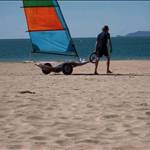
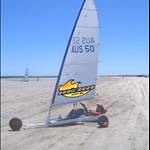
1. At first, the prop is acting like a sail on a boat running downwind - the wind pushes on it, and moves the vehicle forward. Because the vehicle moves forward, the wheels turn the prop, actually increasing forward speed a fraction. As the cart gets faster, the prop moves faster, and is actually beginning to propel the cart. The faster the cart goes, the greater effect the prop has as a propelling force.
So to start with, the wind pushes the cart forward, but then the turning wheels drive the prop, which then pulls the cart forward. The wind is needed here to offset the inefficiency. At this stage the wheels are driving the prop, which then pulls the cart forward, helped by a pushing wind, until it reaches wind speed.
2. When the cart is going the same speed as the wind, then the wind is no longer pushing. However, the wheels are spinning at say 15mph. This drives the prop. The prop is then like an aircraft standing still, and it will pull the cart forward through the apparently still air - just like an aircraft can move forward from rest. The propulsion is supplied by the momentum of the wheels only at this point. If the cart is light enough, and the ratio worked out nicely, then the cart continues to accelerate. This is only possible because of the wind - creating a no airspeed yet fast groundspeed situation that allows the wheels to drive the prop.
In this stage, the wheels are driving the prop, and it is the prop that is providing the forward acceleration. This phase only lasts a short while until.
3. Once there is a headwind, then the prop stops acting as the propulsion, and instead acts as a windmill. The wind moves the prop, which then turns the wheels. More forward speed = more apparent wind to windmill the prop to drive the wheels = more forward speed. And the whole thing happily accelerates until it reaches its efficiency limits.
The cool thing about this is how the prop and wheels interact. At first the prop is being pushed, then it's the wheels driving the prop, then the wind driving the prop that then drives the wheels.



 [}:)]
[}:)]