monster said...were does one place back foot after taking said foot out of stap

I have read all this thread but I was reluctant to comment because according to all the 'expert' instructors I do it all wrong.

OK. So here is my method (all wrong) which works for me: (slalom board powered up)
Enter gybe with a much speed as possible by bearing away slightly as already mentioned by Mr No-One.
Remove back foot from strap and place
just behind the opposite front strap (first thing I do wrong :-) ) This keeps the weight forward and the rail engaged and driving. Knees bent and pull sail
briefly in against leg.
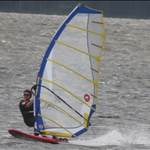
Just before the board has reached the downwind position I am opening up the sail trying to keep the mast vertical and have moved my front hand to just behind the mast on the boom. I let go with my back hand and allow the rig to swing on my front hand, reaching under with my other hand to grasp the other side of the boom at the front. At this stage I am flattening out the board with my feet to reduce the carve radius, aiming to have the rig back in my hands at about 120 off the wind on the new tack. By now I have let go of the old front hand and grabbed the boom in the new sailing position.
Only now do I move my feet.
On a slalom board I usually move my old back foot first by pivoting it close to the centre of the deck just behind the front straps and I support myself on that one until I get the back foot in. On a wave board I pivot it straight into the new front strap. Note that in this case I briefly have both feet in the front straps!
The leeward foot is removed and either goes straight into the back strap or just in front of it briefly depending on how well the board is running. Now the turn is completed the last 30 degrees and I am going back where I came from.
In some instructional manuals this is called a 'strap to strap' gybe and is much more commonly done in quick gybes on wave boards. (and is the technique of choice for duck gybes). However, this is the technique I have always used and taught for slalom gybing and has always worked exceptionally well for me and those I have instructed.
A possible downside is that it sometimes does not work as well as the common, clew first 'slalom step' gybe when using very large sails and when underpowered in marginal planing conditions.