Hi All,
Tasty conversation and also educational for me hearing about some boards I have not had the pleasure of working on yet after nearly 20yrs out of the repair game!
What I can say about construction is that really, nothing much has changed, and not least how to make a durable board.
Firstly I would like to say that there is no 'best way' to deal with compression damage, it all depends on the stage of disintegration you catch it at and also specifically the construction, which unfortunately you can't always rally on documentation for and there are often QC variables as you all have discovered doing your own repairs.
Ref Spokas well intended advice, injecting is not bad and in fact it is the best way to tackle a minor delam where the PCV or other sandwich media has separated from the core.core compressed and slightly disintegrated. This is best when the PVC and the light glass substrate, usually 4oz glass cloth, and the deck laminates have not fractured significantly. Tis usually is found in flat areas of the deck in front of the front straps inboard of the rails. The more curvature and compound curvature on the rails and tail will be tougher by nature of the curve, and as you go down the rail you will traditionally find overlap of fibre laminate. Some of the lighter boards, be they 'comp'/'pro' or custom boards, or entry level ie glass(not necessarily woven cloth either) directly onto EPS(styrene) with foaming epoxy, rely almost entirely on the strength of the rails to prevent them creasing or snapping..straying from the point here so will get back on track..
A similar impact on the rail likely result in no damage at all. Curved areas usually require sharp blow , piercing or blunt force trauma..eg mast across nose, rocks, carpark/roofrack end, door frame..
Spokas, read the board lady's instructions very carefully, they are good. careful injection of a slow curing and low viscosity epoxy is part of the procedure. Injection of EPU foam is to fill any voids and to bind any larger cracks in the delaminate/disintegrated EPS core. The new PVC inserts(pads) should ideally have a ply of 4oz woven glass or similar. This holds the resin where it needs to be so it doesn't absorb into the core and into the open cells of the PVC and ultimately mitigates against dry spots and future delams. The rest of the board ladys instructions are clear.
A little tip for custom board construction..pre-inject the EPS core with low viscosity epoxy under the heals and stomp zones. I am talking 30grams under each foot..it soaks right in between the cells and if you get it right with practice, it is great for dispersing the energy evenly into the core and reducing the 'shear' effect of the deck returning to normal after a compression and leaving the foam core behind(it has a poor 'memory', so to speak)
I would add that if injecting into small areas, also drill beyond the effected area by about 50mm. I space my holes in a 25-40mm grid and I inject from the outer holes working towards the centre. MOST importantly, if there is no resistance on the syringe and the resin goes right in, DON"T keep adding in..there could be a void. If there is a void, generally its best advised to open her up and go to the next level of surgery. Thats where the EPU goes after the injection has cured.
I have a board in the shop right now with exactly this problem and the owner has done the first repair himself without managing to get right under the effected areas, so the problem has continued to grow.
Show of hands who wants to see a step by step remediation

Regarding modern board construction in my opinion one of the biggest variables is the type of epoxy being used and the ratio of fibre/resin. I will not stick my neck out and criticise any manufacturers as experimentation and value engineering is always going to be going on. Decorative use of exotic fibre does turn me on as much as the next punter!
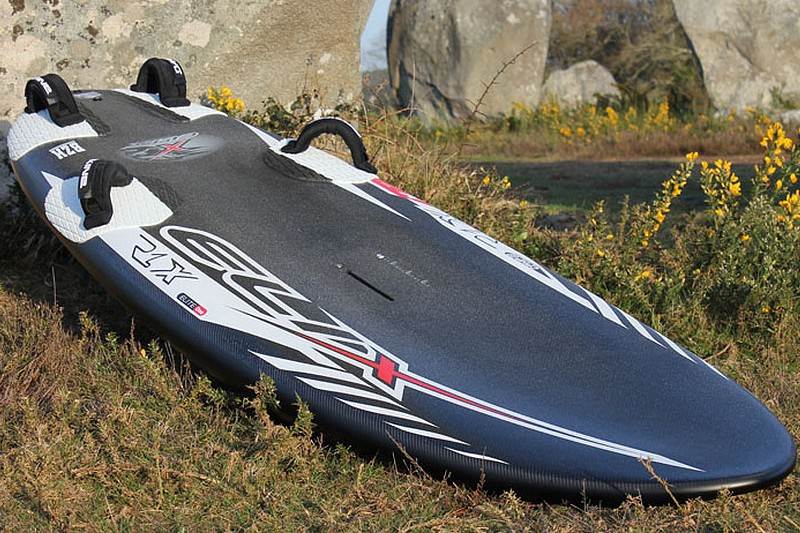
I will however say this. I have recently dissected a Torquay Fin Company slalom board and a Windtech slalom board, both of which were well used and 20yrs old. Both on 14kg/m2 EPS cores with 4oz under a 3mmPVC sandwich, only layer of 6oz on the bottom and 2 x 6oz on the deck and with carbon patches approx 170-220gsm from behind back of mast track to the tail with light glass over. Both circa 9' and 6kg dry weight. Both tough as nails and no repairs other than under the heals on the windtech. This had a repair probably by Wayne Winchester(strong as hell)
Wave, Freestyle, Freeride..go to 5mm PVC and another ply of glass or two..slightly higher resin/glass ratio and good QC.
Purely my honest opinion only and no way gospel or the rule.
Cheers!