Chris 249 said...
>>>>>>>
I'm not saying that you are wrong, but it's hard (from my non expert viewpoint) to see how twist would reduce induced drag. Sure, twist can possibly reduce the difference in downwash/upwash and freestream directions between the windward and leeward airflow - but it's that difference that creates lift itself.
I don't class myself as an expert either! It would be nice to do some wind tunnel tests, but this is the way my reasoning goes.
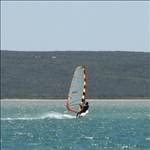
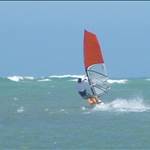
Modern windsurfing sails have a flat head, no foil, very little lift, more twist than any stayed sail.
(yachties with stayed sails, are after twist because of the different wind strengths at top and bottom of the sail.)
a windsurfing sail needs lots of twist in the flat head so that the leading edge angle is similar over the height of the sail.
The head on a stayed sail doesn't flap around in the breeze, doing almost nothing, but look at the head of a windsurfing sail and you'll see how much lift it has, almost 0.
So the head is very close to the apparent wind direction, it is producing no high or low pressure, it's purely in the way of air in the high pressure zone lower in the sail getting to the adjacent low pressure area.
If the sail doesn't have enough downhaul, it will feel heavy and slow, could be because top of sail is stalling, (not enough twist) or because of the onset of induced drag?