

Select to expand quotejbarnes85 said..
I don't believe I would need runners (or am I thinking of check stays) as the attachment is near enough the top of the mast so the backstay will oppose the forces.
You might be able to get away without runners. On my HR40 the solent stay attaches above the 3rd spreader a couple of metres below the backstay, so runners definitely needed. The runners are about 5-10cm above the solent stay.
On my UFO 34 I was running a staysail off the baby stay and it had lower for and aft checkstays, which a rigger assessed as sufficient and not needing runners.
Ilenart
If you get a No 4 when would you use the Solent? 30+.Maybe one or the other. Don't want to end up with too many sails. Unless you are racing Do? Do you intend to do long passages?
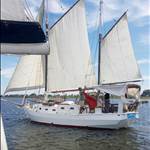
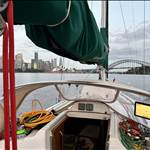
In the pic with the line running back to the cockpit it looks like there is a block on the foredeck with a purchase already. I think this would get in the way and you could trip on it. Especially if you are doing headsail changes often.
How often will you really use it. Clipping something on doesn't take long and you have to go up there to hank the sail on anyhow.
Select to expand quoteJolene said..Ramona said..
Cav 32s are not a big boat. They will go to windward with just a bit of headsail unfurled. If you have a hanked on headsail on a Cav 32 and down size to a staysail either fixed stay or flying, you still have to go forward and either remove the headsail or frap it down on the deck with a shock cord /hook arrangement to the toe rail. Left on deck it will still create a lot of drag and collect water. The halyard will need to be tensioned to keep clear of the staysail as you attempt to set it.
Ramona has several staysail deck points and an off the wind staysail. I stitched up a storm staysail and gave it a go in fresh conditions and came to the conclusion the best place for it was the sail room. My go-to heavy weather configuration is a couple of feet of headsail or none and the third reef in the main. Don't leave the cockpit and don't get wet.
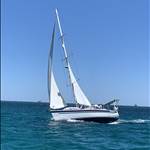
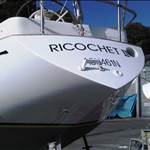
Ricochet it's 50% of the headsail. If in doubt just think, what would Jessica Watson do?

If you understand her circumstances at the time when that photo was taken , you know why she has only that scrap of sail out. The picture is in no way depict how she sailed the boat in rough weather or her sail choice,, I guess it is her sail choice for going nowhere.
The photo was taken when Jessica was killing time South of Tasmania. I read her blog and bought her book. I am inclined to believe there is plenty to be learned from her experience.
I used the same configuration last Thursday night and managed 4.6 knots to windward.
Yeah, Jethrow, I am aware of that possibility, however far fetched it might be on a well designed and set up yacht, this is a remote possibility, nevertheless a possibility. Point taken.
On Rhapsody only the removable stay had hanked sails, far away from any lines which might catch the Wichard hanks. The head sail was furled.
I used this set up for years and years single handed and not once had any mishaps, ever.
I did not mind going forward, wearing a life west with a PLB and always clipped on to the jack line when I stepped out of the cockpit, most of the time wearing same while inside of the cockpit.
As far as the problem with the narrow gap btwn fore stay and staysail-stay (call it what you might like), on my tub there was just adequate space to tack or wear the head sail. Using bowlines on the clew - working end tied in! - seldom gave me trouble, like catching the baby-stay, but on the bowline knot the working end had to be tied-in! not out! [see pics]
However, having inadequate space btwn sails, when sailing in low to moderate winds, I used the following method regularly to tack my huge non-furling assimetric with a spectra luff-line, running the sheets on the outside of the forestay. One could not do this with a sail on a furler or hanked to the fore-stay, of course.
When sailing in low winds I used the above method on as a matter of course to tack my assimetric which was set outside of the fore-stay from the bow-sprit to the mast-head and there was not enough space btwn the luff and the fore-stay to pull the huge canvas over but running the sheet outside not btwn the two sails, as it would be traditionally run. I used the 'outside sheet-method' with two sails and with three sails as a trial when I had crew aboard, as this was too much for a single hand. It worked fine in low winds.
Tacking the assimetric with the sheets running on the outside became the way of tacking the sail but it needed precise coordination and a quick hand having 60+ feet of sheet to handle. It had to be done handsomely. Would have been much easier with a furler, thou.
The assy was used up to 10-12 knot winds max, above that the wind was overpowering the boat.
THIS NEW CONSTANTLY RUNNING ADVERT ON THE BOTTOM OF THE PAGE SUUUUUX, SUUUUX, SUUUX! BIG TIME!


Select to expand quoteBananabender said..
Inner forestay attached to block ( red rope) leading back to cockpit?Release from toe rail and pull on when required?


Send pics of Bob Buchanans power boat moored next door to you so people can see the piece of art.
Select to expand quotesirgallivant said....., but on the bowline knot the working end had to be tied-in! not out!
... or you could tie a Yosemite Bowline, a knot I learned in the State Emergency Services, which we use to secure our lines before getting up on a roof. It starts as a "normal" Bowline, but you feed the tail end back through the knot. It keeps the tail end out of trouble, and provides an extra lock.


Select to expand quoteAchernar said..sirgallivant said....., but on the bowline knot the working end had to be tied-in! not out!
... or you could tie a Yosemite Bowline, a knot I learned in the State Emergency Services, which we use to secure our lines before getting up on a roof. It starts as a "normal" Bowline, but you feed the tail end back through the knot. It keeps the tail end out of trouble, and provides an extra lock.
Or you could tie the Yosemite in the bight through the headsail tack and have one bowline instead of two. There are better knots for this job though.
I am honestly not trying to be cantankerous but could you explain the benefit of 'your' knot versus the 'tied in' bowline, because I can't see any!
While both of the 'tied out' working ends are going to catch, either, when the line is pulled in the direction of the green arrow or in the other example in the other direction, while the sail is back-winded, no matter what.
The 'tied in' version was used on the racers I was racing on and my own tub for years with great success.
All sails are going to be difficult to tack in low winds or when the wind is not used cleverly to help to clear the clew of the head sail away from the standing rigging and other low obstractions on deck but - in my experience the 'tied in' bowline reduces the number of mishaps considerably as the working end is not 'cathing', neither on the pull of the sheet, nor while it is back-winded.
This missive is not to take away the possible benefits
of your worthy knot however, in this situation the 'tied in' bowline, I think, is the forward thinking sailors solution.


Happier New Year, fair winds
Select to expand quotesirgallivant said..
I am honestly not trying to be cantankerous but could you explain the benefit of 'your' knot versus the 'tied in' bowline, because I can't see any!
Not cantankerous at all. We all have our "go to" knots, and this is one of mine, because I am familiar with it. I thought it might solve the problem of the meddlesome tail, but I had not thought of the back-winded situation. It is actually a climber's knot, adapted to use in the SES because of its additional redundancy over a "simple" bowline, but it is also designed for a static situation, not trying to tack the foresail without the sheets catching on the standing rigging.
Ach , that's a nice extra tuck on the good ol boline if I've ever felt the need for more security from the king by of knots I've generally put a half hitch on the tail about the standing part or in three strand just tuck the tail through, but that's the ducks nuts, thanks
Yep, all the above is agreeable bar the 'never go back' statement. Really? Hmmm...
Well, "Never say never again!"
The most important function of the simple bow line is the undeniable fact, that it is - as far as I am aware of knots - the only knot which can be easily, after a bit of practice, tied around one's own waistline, single handed! And this is the peccant part!
This fact is seldom mentioned in the days of fashionable, well advertised space age equipment flogged left, right and center, soft shackles included, nevertheless it remains perhaps the most important knot in the sailing world.
In a MOB situation, if one is able to grab a line thrown from the deck could be a life saver as long as the hapless patient is able to hang on to it while the vessel is at speed. However, if the unfortunate is able to tie the line around his own body, when the strength ran out of his arms in a few minutes, the line tied around his waist or chest most likely going to save him. The most secure knot one is able to tie around one's own body with relative ease is the simple bowline. Tied in or tied out. Period.
I am actually surprised, that this simple knot and method of tiying it one handed around ones waist is not taught far and wide by the safety experts.
"It is far better to render Beings in your care competent than to protect them!"
(J. Peterson)
Select to expand quotesirgallivant said..
Yep, all the above is agreeable bar the 'never go back' statement. Really? Hmmm...
Well, "Never say never again!"
The most important function of the simple bow line is the undeniable fact, that it is - as far as I am aware of knots - the only knot which can be easily, after a bit of practice, tied around one's own waistline, single handed! And this is the peccant part!
This fact is seldom mentioned in the days of fashionable, well advertised space age equipment flogged left, right and center, soft shackles included, nevertheless it remains perhaps the most important knot in the sailing world.
In a MOB situation, if one is able to grab a line thrown from the deck could be a life saver as long as the hapless patient is able to hang on to it while the vessel is at speed. However, if the unfortunate is able to tie the line around his own body, when the strength ran out of his arms in a few minutes, the line tied around his waist or chest most likely going to save him. The most secure knot one is able to tie around one's own body with relative ease is the simple bowline. Tied in or tied out. Period.
I am actually surprised, that this simple knot and method of tiying it one handed around ones waist is not taught far and wide by the safety experts.
"It is far better to render Beings in your care competent than to protect them!"
(J. Peterson)
The one handed bowline around the waist. One of my party tricks when I was a climber. Also the one handed clove hitch was actually handy when climbing. Climbers dont use the bowline. There is the double bowline some use for tying in to the end of a rope but heaps have people have died using this so a threaded figure of eight is the common way to tie onto the end of a rope.
Select to expand quotejbarnes85 said..sirgallivant said..
Yep, all the above is agreeable bar the 'never go back' statement. Really? Hmmm...
Well, "Never say never again!"
The most important function of the simple bow line is the undeniable fact, that it is - as far as I am aware of knots - the only knot which can be easily, after a bit of practice, tied around one's own waistline, single handed! And this is the peccant part!
This fact is seldom mentioned in the days of fashionable, well advertised space age equipment flogged left, right and center, soft shackles included, nevertheless it remains perhaps the most important knot in the sailing world.
In a MOB situation, if one is able to grab a line thrown from the deck could be a life saver as long as the hapless patient is able to hang on to it while the vessel is at speed. However, if the unfortunate is able to tie the line around his own body, when the strength ran out of his arms in a few minutes, the line tied around his waist or chest most likely going to save him. The most secure knot one is able to tie around one's own body with relative ease is the simple bowline. Tied in or tied out. Period.
I am actually surprised, that this simple knot and method of tiying it one handed around ones waist is not taught far and wide by the safety experts.
"It is far better to render Beings in your care competent than to protect them!"
(J. Peterson)
The one handed bowline around the waist. One of my party tricks when I was a climber. Also the one handed clove hitch was actually handy when climbing. Climbers dont use the bowline. There is the double bowline some use for tying in to the end of a rope but heaps have people have died using this so a threaded figure of eight is the common way to tie onto the end of a rope.
That's intriguing how does a climber come to grief from a boline to boline ? I would of thought achs extra turn would of added excess security , I ask the question as I use the boline as my mast climbing backbone ?
Select to expand quotewoko said..jbarnes85 said..sirgallivant said..
Yep, all the above is agreeable bar the 'never go back' statement. Really? Hmmm...
Well, "Never say never again!"
(J. Peterson)
The one handed bowline around the waist. One of my party tricks when I was a climber. Also the one handed clove hitch was actually handy when climbing. Climbers dont use the bowline. There is the double bowline some use for tying in to the end of a rope but heaps have people have died using this so a threaded figure of eight is the common way to tie onto the end of a rope.
That's intriguing how does a climber come to grief from a boline to boline ? I would of thought achs extra turn would of added excess security , I ask the question as I use the boline as my mast climbing backbone ?
As a climber I was always taught a figure 8 or a double fisherman was a stronger more reliable knot than a bowline. When your life depends on a knot and there is shockloading, a bowline is not seen as a good knot for climbing. It's also easy to accidentally tie a false bowline that unravels easily.
A
The key-words to you: I am writing about sailing and resque in water!
Single handed knot;
Sailing;
MOB;
Try to secure yourself in WATER;
No climbing, no falling, no absailing, no bull****...please! Strewth! 
Select to expand quoteAndrew68 said..
As a climber I was always taught a figure 8 or a double fisherman was a stronger more reliable knot than a bowline. When your life depends on a knot and there is shockloading, a bowline is not seen as a good knot for climbing. It's also easy to accidentally tie a false bowline that unravels easily.
A
The bowline is a good knot but it can come undone easy too. If your using a bowline to climb a mast make sure you have a long tail. This makes it safer.
I see now we are not discussing horses for courses, stopper knots , line joining knots & tying off around things knots. I use the boline as I ascend the mast to attach a safety to various points along the way, hence I commented on the variation ach put up, also see that I could employ a figure 8 stopper knot at the attachment of the halyard to the climbing tackle & gain a few more inches