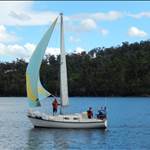
We are getting a bit of rain lately which is welcome and overdue but it does slow me down a bit getting work done on the boat.
The engine has been stripped of external bits, alternator, starter motor, water pump, hoses, fuel lines etc.
I then scraped the old paint off and wire brushed the rusty areas of the engine. A good degreasing followed as preparation for a coat of Kill Rust Rust Eeter. It is phosphoric acid based and therefore turns the cured rust black. The acid in this product is carried in a plastic medium which when cured forms an impervious coating.
The engine after rust treatment.

The red on the front of the engine is International PA 10 etch primer and is on the governor housing which is alloy. PA 10 is probably the best etch primer for aluminium.
The other red parts are in Kill Rust delicious red enamel which I chose to highlight the areas for regular maintenance.

I am not really fussed on flexible engine mounts. They make it almost impossible to maintain good engine alignment. I have the stbd rear mount out and have measured it's dimensions so I can fabricate solid engine mounts. They will consist of a quarter inch base plate drilled for the coach screws into the beds with a length of 5/8 inch UNF high tensile threaded rod in the middle with a welded nut on the upper and lower sides of the base plate.
The base plate will sit on a hard plastic slab 30 to 40 mm thick, recessed for the nut on the underside of the base plate. These mounts will allow engine alignments to be done the same way as now by adjusting nuts on the thread rather than using shims.


I have fairly good access to my engine as you can see. Unfortunately though there is not enough room on the exhaust side to get the manifold off nor is there enough room above the rear of the engine to remove the cylinder head with out unmounting the engine from the beds. For this reason I am doing everything possible maintenance wise to the engine short of taking the head off.
The injectors have been reconditioned and one nozzle replaced with new. I am leaving the injector pump alone for the time being. If the engine runs well and smoothly when I get it going again, I will be happy enough with that. Based on what I know of the yacht's history of 32 years, I am punting that the engine will only have about 6,000 hours on it. These Yanmar 2QM 15s are hardy little engines and should be good for 10,000 hours before a major rebuild is needed.
These shots are of the engine after painting with Kill Rust Heavy Duty Primer and views of my cockpit locker/lazarette area. The Lotus carries almost her full beam right to the transom. I have taken the 100 litre bladder water tank from under the fwd Vee berth as she was sitting in the water with her head down. That improved her a bit but she still has her head down. Somehow I need to get more weight into the stern.

The partition to the left of the fuel tank is where I can store up to four 20 litre fuel drums and they with the 50 litre fuel tank giving me a fuel capacity of 130 litres. This gives me a motoring range of about 360 miles.

That spikey looking thing sticking up just behind the rib is the glass encased root of the "P" bracket. Just behind that is where I store my spare Danforth anchor, chain and warp. I secure it with a piece of lashing from the end of the shank to around the cockpit drain with a slip knot for rapid deployment.







 Just kidding.