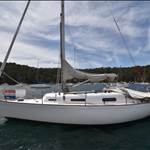
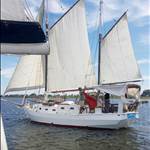
An excellent presentation from Yachting Monthly U.K. He really covers everything that needs to be done. Enjoy.
P.S. That Contessa 32 is a real performer.
Yes, I saw this one and it is a cracker.
Most heave-to videos are shot in less than ten knots - this is the real thing!
I watched the video and thought it was better than most. Most of the action shots where in just over 30 knots of wind from his commentary. The Contessa would have been just as comfortable with a fully reefed main and the headsail furled to about a third. He rigged the storm headsail in harbour but that's entirely different to at sea in poor conditions. In reality that whole video could have been made with no one leaving the cockpit!
This article about Jon Sanders has been circulating a bit lately on Facebook. Jon makes some very interesting comments on actions to take in survival conditions. His point on ignoring the old tactics is worth noting. particularly lying a hull.
www.yachtingmonthly.com/cruising-life/jon-sanders-the-way-of-the-world-75202?utm_medium=social&utm_source=facebook.com&utm_campaign=socialflow&utm_content=ym&fbclid=IwAR1hzcmPxWhRREhN5-Wz9QH74TxpdhblI5P6_pWxpX_nbE8Rq3QQPf0j18g
The main shortcoming of that video for many Australian sailors is the lack of sea. The video was probably done in the protected waters of the Solent. In our exposed oceans you will obviously have big seas to go with the wind in 30kts and above.
One of the best things I did on Morning Bird was install an inner forestay. I would set the storm jib as we left the harbour and we would sail all the way to and from Lord Howe with the storm jib up as a 'cutter' rig.
As the weather deteriorated we would furl the heady until all we had left was the storm jib and with the main reefed right down we would be set with no need for anyone to go forward.
The only shortcoming of this rig was tacking the heady through the narrow gap between the inner and the outer forestay. Only tacking every few hours or a couple of times a day we would furl the heady in to tack.
We did experience very heavy weather most years and this rig was very good.
We did heave to a few times when it got over 30kts, especially on the first run out there in 2014. We missed the tide on arrival on Friday afternoon and had over 40kts all night at the island. Peak was 55kts during the night. The boat handled it superbly, better than Have Fun and I did. S&S34s do heave to well, just trim the main to lay about 40-50 degrees off the wind. Rather than pull the heady across with the sheets to heave to we would tack and leave the heady in its old position.
We (I) managed to break the boom at the gooseneck the next morning, a big contributor to my cockup was the massive seas after the fourteen or so hours of intense winds.
We came home from Lord Howe with the trysail and cutter rig. Again, the boat didn't have a problem with it and we got home in good time.
One significant problem I see with his heave-to setting is that the storm jib sheets are outside the shrouds and will chafe rapidly during a storm. Larry Pardy (and many others ) was adamant that one must eliminate all sources of chafe when setting for storm sailing. My dream set-up would be to have the inner forestay far enough aft that the natural sheeting would be inside the stays.
My 2 cents, not that I have any experience heaving to in a storm... yet. They still had way on when hoved to, I thought the idea of heaving to is to bring the boat to a stop so that it slips sideways leaving a "slick" to windward staying downwind of the slick is the the whole idea, its the slick that reduces the severity of the waves. They didn't demonstrate that at all which seemed to me like they missed the most important bit.
Heaving too you will still sail at about 2 knots. With a Currawong and an SS34 just fully reefing the mainsail and hauling the sheet tight, headsail fully furled you have the same effect. Easing the mainsheet slightly and set the windvane to steer the boat on a close reach is particularly comfortable. All done from the cockpit.
The Fastnet is underway. Some hull shapes there in the pictures I would not like to experience in a seaway!
www.livesaildie.com/50th-rolex-fastnet-race-sporty-start-leads-to-a-number-of-retirements/?fbclid=IwAR0I_sISJdxHuRBoKCKTeHfHRoFwar4hyfTXx61smi8Q6XqyRxlsdeZ05vI
Excellent video of the start of the Fastnet. Force 9 with wind over the tide. Very unpleasant weather as they clear the Solent. That out going tide sorts them out! Check the choices of rigs. Some sailing under main only and some just a headsail.
Select to expand quoteRamona said..
Excellent video of the start of the Fastnet. Force 9 with wind over the tide. Very unpleasant weather as they clear the Solent. That out going tide sorts them out! Check the choices of rigs. Some sailing under main only and some just a headsail.
The swan ketch at 12:30 looks to be in its element.
Select to expand quotejbarnes85 said..Ramona said..
Excellent video of the start of the Fastnet. Force 9 with wind over the tide. Very unpleasant weather as they clear the Solent. That out going tide sorts them out! Check the choices of rigs. Some sailing under main only and some just a headsail.
The swan ketch at 12:30 looks to be in its element.
Maybe Galiana. One of the boats getting ready for the Globe race. Some of those old Swan ketches are such great boats.
Kialoa II looking the goods at the start (4.10), sailed with a guy who has done some racing on her, apparently races are not measured in the amount of days it takes to finish but rather the number of roast dinners to the finish
Select to expand quotetarquin1 said..jbarnes85 said..Ramona said..
Excellent video of the start of the Fastnet. Force 9 with wind over the tide. Very unpleasant weather as they clear the Solent. That out going tide sorts them out! Check the choices of rigs. Some sailing under main only and some just a headsail.
The swan ketch at 12:30 looks to be in its element.
Maybe Galiana. One of the boats getting ready for the Globe race. Some of those old Swan ketches are such great boats.
I read tapios swan was dissmasted!
Select to expand quotetarquin1 said..
Loads of Skip Novak vids about heavy weather sailing.
The key words from Kim Novak, "every boat is different"
If you want to hove to, just tack and leave the headsail cleated off. Or, employ a few crew to do all the winching! For people with yachts under 40 foot is to just get out there and find what suits your vessel. Some hove to easily, some don't. I personally am in the Jon Sanders camp and take what he says as gospel.
Whats he say? I am preparing my boat for extended cruising and interested in hearing all the different tactics for dealing with foul weather.
The variation in how well the boats are being sailed in the Fastnet vid is very interesting. Some of the smaller Bennies etc are carrying quite a lot of sail (two or three reefs and a #4 etc) and going very well, being actively trimmed and well driven. Some of the bigger boats are struggling and flopping around under small sails. It shows the same thing we see in dinghy racing - that the difference in the skills of keeping the boat in the groove are more important than the details of what sails one is carrying a lot of the time.
It is surprising to see some of the boats struggling. Yes, it's bouncy with that vicious wind against tide, but if you can't get the boat snugged down in those conditions in daylight, with no swell and when no one is tired, then something's wrong. It's probably related to the huge fleet and the fact that many of them don't seem to be racing offshore much for the rest of the year.
Also interesting to see the famous old Imp with some scary looking inversion/reverse bend in the mast, which is a problem with some masthead rigs. Kialoa II was looking good but now she's about 200 miles behind Stormvogel, another maxi ketch of the same era, which is a regular contender on IRC rating. Funny that back in the day Kialoa II was the classic and Stormvogel was the radical ultralight. The Australian J/99 Disko Trooper is running fourth in class.
From looking at the standings it seems that the fleet is extremely mixed up, with many theoretically faster boats way behind, and from a quick scan there's no real pattern in the designs that have done well and the designs that have dropped out.
Select to expand quoteChris 249 said..
The variation in how well the boats are being sailed in the Fastnet vid is very interesting. Some of the smaller Bennies etc are carrying quite a lot of sail (two or three reefs and a #4 etc) and going very well, being actively trimmed and well driven. Some of the bigger boats are struggling and flopping around under small sails. It shows the same thing we see in dinghy racing - that the difference in the skills of keeping the boat in the groove are more important than the details of what sails one is carrying a lot of the time.
I guess it depends on what type of offshore sailing your doing
As someone with short handed cruising aspirations I think a boat set up to require minimal active inputs from crew is more important.
Select to expand quotecammd said..
Whats he say? I am preparing my boat for extended cruising and interested in hearing all the different tactics for dealing with foul weather.
I recently read an article about an Australian sailor who circumnavigated 11 times but couldn't remember his name. Wikipedia suggests it may have been Jon Sanders. As I recall, in heavy weather, he favoured a conservative sail plan and getting prepared early. In very heavy weather, he used a drogue rather than heaving to or lying a-hull and on one occasion, a tyre when the drogue fittings broke. I can't remember clearly whether he deployed the drogues from the stern or the bow. I'll try and remember where I read the article. It may have been Yachting Monthly.
Cheers,
Kinora
Horses for courses. I know it doesn't look it, recently 20 - 30 kts wind over tide Whitsunday passage double reef & most of the head sail accidentally rolled out, beating to windward. The Catalina 350 was dry as a chip. We made good 5.6kts from Stonehaven to north molle. No swell of course but some nasty chop


Select to expand quoteKinora said..cammd said..
Whats he say? I am preparing my boat for extended cruising and interested in hearing all the different tactics for dealing with foul weather.
I recently read an article about an Australian sailor who circumnavigated 11 times but couldn't remember his name. Wikipedia suggests it may have been Jon Sanders. As I recall, in heavy weather, he favoured a conservative sail plan and getting prepared early. In very heavy weather, he used a drogue rather than heaving to or lying a-hull and on one occasion, a tyre when the drogue fittings broke. I can't remember clearly whether he deployed the drogues from the stern or the bow. I'll try and remember where I read the article. It may have been Yachting Monthly.
Cheers,
Kinora
Jon Sanders. I take what ever Jon says as gospel. When he mentions it's unsafe to lay a hull with a modern hull,1970's onward and keep the boat moving he is speaking from experience. He is in favour of steaming a drogue astern.
I had forgotten Stormvogel was built from cold moulded plywood! I was fascinated by early stories of her construction. It seems she suffered some damage to the outer skin during the Fastnet. I guess someone got off the side with a battery screwdriver and attach the patches!
www.yachtingworld.com/extraordinary-boats/extraordinary-boats-stormvogel-139120

I have found this site to be a great resource, lots of real life accounts of things that worked and didn't work
dragdevicedb.com/
Select to expand quoteKinora said..cammd said..
Whats he say? I am preparing my boat for extended cruising and interested in hearing all the different tactics for dealing with foul weather.
I recently read an article about an Australian sailor who circumnavigated 11 times but couldn't remember his name. Wikipedia suggests it may have been Jon Sanders. As I recall, in heavy weather, he favoured a conservative sail plan and getting prepared early. In very heavy weather, he used a drogue rather than heaving to or lying a-hull and on one occasion, a tyre when the drogue fittings broke. I can't remember clearly whether he deployed the drogues from the stern or the bow. I'll try and remember where I read the article. It may have been Yachting Monthly.
Cheers,
Kinora
I think most of us would struggle to find a tyre onboard if the circumstances required this. =)
Select to expand quoteRamona said..
I had forgotten Stormvogel was built from cold moulded plywood! I was fascinated by early stories of her construction. It seems she suffered some damage to the outer skin during the Fastnet. I guess someone got off the side with a battery screwdriver and attach the patches!
www.yachtingworld.com/extraordinary-boats/extraordinary-boats-stormvogel-139120
In the same category as Windward Passage and numerous others - will never age.
www.facebook.com/1174957636/videos/186012850964287?idorvanity=165878070095321
lenboseyachts.blogspot.com/2013/11/notes-from-my-tour-of-windward-passage.html
Select to expand quotecammd said..Chris 249 said..
The variation in how well the boats are being sailed in the Fastnet vid is very interesting. Some of the smaller Bennies etc are carrying quite a lot of sail (two or three reefs and a #4 etc) and going very well, being actively trimmed and well driven. Some of the bigger boats are struggling and flopping around under small sails. It shows the same thing we see in dinghy racing - that the difference in the skills of keeping the boat in the groove are more important than the details of what sails one is carrying a lot of the time.
I guess it depends on what type of offshore sailing your doing
As someone with short handed cruising aspirations I think a boat set up to require minimal active inputs from crew is more important.
IMHO the setup and skills that allow you to keep a boat in the groove are the same ones that allow you to set up a boat so that it requires minimal active input. At around 14:15 in the Fastnet start vid, for example, there's the two-handed J/99 Axe Sail with probably three reefs and a #4, both trimmed trimmed flat and beautifully and giving the boat good gust and wave response and minimal helm movement from what can be seen - and that's reflected in her performance. In the clip and on the water she's with much bigger boats using storm gear but struggling or running for home. She's still way up in her class, 3rd ahead of many fully-crewed boats, so she's obviously going very well without a huge amount of active input. There's a similar rival, also going beautifully in the clip and in the current results, at 16:50.
Shortly after that first clip, around 14:30, there's a pic of a fully-crewed boat of almost the same size and rating but more of a heavy-weather specialist, with smaller sails but (IMHO) way too much twist and way too much ease (and therefore low-down depth) on the jibsheet, and it's staggering around from flat to too heeled, as are many of the other boats. There's some boats that look good (crew stacked, flat sails, etc) but have reefed the main way down and left up a fairly big jib, and interestingly none of them seem to be going well in the current results; arguably that setup gives many boats a very narrow groove compared to a smaller jib and bigger, slightly twisted but flat main.
I'm betting (and I think the 2H results show) that the boats that are set up with flat sails and nice twist are not just faster, but also have a better groove and therefore would require less active input.
As an analogy, it's like when you're tired and trying to get home upwind after a hard day of raceboarding; if you have lots of downhaul and outhaul and the CB and mast track in the right place, you'll sit in the groove naturally, using little effort and going fast while chilling most of the time. If you have the outhaul bagged out, no downhaul and the mast back in the track you'll struggle and go slow no matter how big or small the sail.
Select to expand quotecisco said..
An excellent presentation from Yachting Monthly U.K. He really covers everything that needs to be done. Enjoy.
P.S. That Contessa 32 is a real performer.
"Assent" Is probably one of the most famous Contessa 32's around. It was originally Willy Ker's Contessa the one Contessa 32 with a proven high Latitude Sailing record. I always remember reading about Willy's incredible sailing trips in YM and the great performance of the Contessa 32. I seem to recall that Assent was also on Charter down in Chile doing some incredible sailing down there. Tough boat for sure. You will struggle to find a similar sized yacht with such an incredible limit of positive stability, one of the main reasons given for its survival in the infamous Fastnet 79. The Contessa 32 was exhaustively analysed by the Wolfson Unit for seaworthiness and became the reference standard for factors that affected survival in breaking waves.
It's interesting, though, that while the C32 has become a reference point, their actual record in that race for capsizing seems to have been the same as that of the other boats in Class V (about 32-28ft). Years ago I went through old mags and books and analysed Class V knockdowns in the '79 Fastnet. Forty seven percent of the boats in the whole class were knocked down. Fifty percent of the 12 "unsafe" Grimalkin-style boats were knocked down. Forty five percent of the 11 Contessa 32s were knocked down. There's therefore NO statistical evidence that Contessas were less likely to be knocked down than an "unsafe" boat of the same class (the 5% difference isn't statistically significant).
The C32s were theoretically less likely to be inverted or get close to it - but in the '79 Fastnet they would have been in a different area than the "unsafe" boats so maybe that is the reason they were less likely to invert in reality. Or maybe the C32s copped the worst of the storm - we'll never know.
However, in the '98 Hobart the old-style boats were statistically MORE likely to be inverted than modern boats, and yet that's often ignored. Similarly, in '98 and, I think, in '79, inversion was far from the main cause of death. Flashlight, a slender RORC-style hull similar to the C32, lost multiple crew in a knockdown in '79 but that was largely ignored. Cole 43s, a boat with an extremely high LPS, have rolled more than once in the Hobart and Solo Globe Challenger was lucky to survive. A very good S&S 34 inverted in the Hobart. One of the most stable boats in the race was badly knocked down and lost a man overboard and could not recover him - miraculously he was saved by a helicopter that was overhead on its way to another mission. A heavy Swanson 42 sank. So in the real world, the actual safety advantages of a boat like the C32 can arguably be said to be a heck of a lot less than the Wolfson Unit states.
It's arguably like saying that a certain Mercedes car is safer in a 120kmh roll-over than a certain Hyundai. It may be true, but it's also an incredibly minor risk among all the other risks in life and in driving. There's a known human tendency to over-rate the potential danger of exceptional risks, and under-rate the potential danger of more mundane risks. In the real world of other trade-offs, the average person is almost certainly safer if they buy a Hyundai and spend the price difference in going to the gym/getting less work stress/a health check up/etc, and it could well be the same in sailing.
PS - it's also interesting that the highest death rate by far among sailing craft around Fastnet during that storm came from cruising boats and a multi, yet for some reason the '70s IOR boats were singled out despite the fact that they statistically had fewer deaths than older boats.