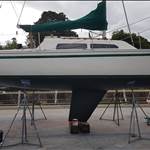


So I have built a support structure to support two house size 330 watt 24 volt panels (arriving tomorrow) which will double as a Bimini. I have three batteries on board one of which which is a fair way from the panel up the front of the boat to power the anchor winch. All 3 lead acid batteries are different brands and ages. Thinking of charging the two rear ones of one panel and the front one of the other panel via 3 different cheapy charge controllers as I don't want the charge controller to stop charging once the first battery gets to full charge.
2 questions.
Firstly is there any reason why I could not use the cheap charge controllers on eBay as follows which don't seem to have any heatsink capability but claim MPPT which I believe is necessary to go from a 24 volt panel to a 12-volt battery?
www.ebay.com.au/itm/284062092832
Second question. How do I size the wire type and diameter which must travel about 11 m from the rear of the boat to near the front battery where I plan to put the third controller?
There is an existing cable that goes to that battery and it would be great if I could use the same one to avoid complex threading through bulkheads and cupboards etcetera. As this cable would now be at 24 volts from the solar panel presumably it doesn't need to be as thck as the existing one which hopefully is sized for 12 volts although I am considerably upsizing the size of the panel vs the old one (don't know what the alternator puts out but won't be using the engine enough to matter).
Blue Seas Ststems app - get it on your phone. It has a wire calculator. Good luck
Select to expand quotetroubadour said..
Blue Seas Ststems app - get it on your phone. It has a wire calculator. Good luck
Blue Seas Systems - Fat fingers today
Select to expand quotetroubadour said..
Blue Seas Ststems app - get it on your phone. It has a wire calculator. Good luck
Thanks for that. Brings up a load more questions. I read somewhere that where a full circuit is involved as presumably there would be between a controller and a panel one has to double the length between the components which obviously makes a considerable difference. Also the default acceptable voltage drop which the app uses is 3% which then tells me I need a 5 mil diameter wire which seems enormous but if I increase this to 10% then the wire diameter goes down to 2 mm which is more normal. As I am using 24-volt panels to charge a 12 volt battery I'm assuming that a 10% drop in voltage would be fine. Can anyone confirm this? I guess in the final analysis I could use the wire that is already there and then check it on a sunny midday with a partially discharged battery to check that it is not getting hot. I have also ordered one of those hoop style current and voltage detectors which might be interesting.
Select to expand quotejulesmoto said..troubadour said..
Blue Seas Ststems app - get it on your phone. It has a wire calculator. Good luck
Thanks for that. Brings up a load more questions. I read somewhere that where a full circuit is involved as presumably there would be between a controller and a panel one has to double the length between the components which obviously makes a considerable difference. Also the default acceptable voltage drop which the app uses is 3% which then tells me I need a 5 mil diameter wire which seems enormous but if I increase this to 10% then the wire diameter goes down to 2 mm which is more normal. As I am using 24-volt panels to charge a 12 volt battery I'm assuming that a 10% drop in voltage would be fine. Can anyone confirm this? I guess in the final analysis I could use the wire that is already there and then check it on a sunny midday with a partially discharged battery to check that it is not getting hot. I have also ordered one of those hoop style current and voltage detectors which might be interesting.
Hi, I would suggest a long conversation with either a very knowledgeable person that has some experience with solar, or a solar vendor that can set out the preferred install methods and materials and offer the reasons for their recommendations.
Even if it costs a few sheckles it will be cheap in the end.
Select to expand quotejulesmoto said..troubadour said..
Blue Seas Ststems app - get it on your phone. It has a wire calculator. Good luck
Thanks for that. Brings up a load more questions. I read somewhere that where a full circuit is involved as presumably there would be between a controller and a panel one has to double the length between the components which obviously makes a considerable difference. Also the default acceptable voltage drop which the app uses is 3% which then tells me I need a 5 mil diameter wire which seems enormous but if I increase this to 10% then the wire diameter goes down to 2 mm which is more normal. As I am using 24-volt panels to charge a 12 volt battery I'm assuming that a 10% drop in voltage would be fine. Can anyone confirm this? I guess in the final analysis I could use the wire that is already there and then check it on a sunny midday with a partially discharged battery to check that it is not getting hot. I have also ordered one of those hoop style current and voltage detectors which might be interesting.
Google and Youtube is your friend.
Hi julesmoto, just reading your post. Diameter of of the wires are related to current only. See spec. of your panels and select diameter of wires accordingly.
My suggestion is, sorry it hurts, install new wires all the way to batteries and controller as close as possible to battery.
Reason, the wires have 24v from panels and any small voltage drop is negligible.
Hi julesmoto, just reading your post. Diameter of of the wires are related to current only. See spec. of your panels and select diameter of wires accordingly.
My suggestion is, sorry it hurts, install new wires all the way to batteries and controller as close as possible to battery.
Reason, the wires have 24v from panels and any small voltage drop is negligible.
Select to expand quotejulesmoto said..
So I have built a support structure to support two house size 330 watt 24 volt panels (arriving tomorrow) which will double as a Bimini. I have three batteries on board one of which which is a fair way from the panel up the front of the boat to power the anchor winch. All 3 lead acid batteries are different brands and ages. Thinking of charging the two rear ones of one panel and the front one of the other panel via 3 different cheapy charge controllers as I don't want the charge controller to stop charging once the first battery gets to full charge.
2 questions.
Firstly is there any reason why I could not use the cheap charge controllers on eBay as follows which don't seem to have any heatsink capability but claim MPPT which I believe is necessary to go from a 24 volt panel to a 12-volt battery?
www.ebay.com.au/itm/284062092832
Second question. How do I size the wire type and diameter which must travel about 11 m from the rear of the boat to near the front battery where I plan to put the third controller?
There is an existing cable that goes to that battery and it would be great if I could use the same one to avoid complex threading through bulkheads and cupboards etcetera. As this cable would now be at 24 volts from the solar panel presumably it doesn't need to be as thck as the existing one which hopefully is sized for 12 volts although I am considerably upsizing the size of the panel vs the old one (don't know what the alternator puts out but won't be using the engine enough to matter).
I would review the cheaper controllers on the basis of what input voltage they will accept. Yes MPPT operation will be also be suspect. Why voltage? My thinking is that (given the more distant location of the third battery) the solar panels in series (48 volt) running to a charge controller local to the remote battery might be an idea. The high voltage will mean lower current over this cable run and thus keep the wire gauge down. But again - the cheaper controllers may not "like" the voltage from panels in series and MPPT WILL be required. In addition non house grade solar panels are labelled not to be run in series . . . but this is not likely for house grade panels as they are run in series on a house roof. Local to the existing twin batteries you can use a second charge controller and a smart FET based switch to switch the charge from one to both batteries when the first is charged but in this case it is better for both batteries to be similar in age and capacity - maybe a third controller is the option as you suggest above - then the battery technology / capacity / age will not matter for any of the batteries. I would also recommend in all cases a charge controller with Lithium (LIFEPO) charging support - future proof the investment in the controller/s.
I have just bought two of these.
www.ebay.com.au/itm/Renogy-Rover-Li-20A-MPPT-Solar-Charge-Controller-Auto-12V-24V-Battery-Regulator/292679691107?_trkparms=aid%3D1110006%26algo%3DHOMESPLICE.SIM%26ao%3D1%26asc%3D20201210111314%26meid%3D94d0695492904b3fb7a0e8248d8b0e58%26pid%3D101195%26rk%3D2%26rkt%3D12%26mehot%3Dpf%26sd%3D292380004885%26itm%3D292679691107%26pmt%3D1%26noa%3D0%26pg%3D2047675%26algv%3DSimplAMLv9PairwiseUnbiasedWeb%26brand%3DRenogy&_trksid=p2047675.c101195.m1851
I believe to get a real MPPT charger you will have to invest a bit more. They are pretty big but well constructed and they come with a good manual.
Good pick. An MPPT solar controller is definitely better than PWM, and Renogy have better than average quality.
Buy Nigel Calder's book
www.booktopia.com.au/boatowners-mechanical-and-electrical-manual-nigel-calder/book/9780071790338.html?source=pla&gclid=CjwKCAjw6fCCBhBNEiwAem5SO0d28-vMwjzO1yuC7-_LV9fdQVLofNjLvtxRAIfjSU9sf9Gd_5lGwxoC6poQAvD_BwE
Best $62 you can spend. You really need to stop before you wire things up. If you have different batteries all connected bad things will happen (although I don't get how the system can be 24V and you only have one battery up front for the windlass)I have used the book to help update my system. Many owner maintained older boats have pretty awful electrics.
Select to expand quoteRamona said..
I have just bought two of these.
www.ebay.com.au/itm/Renogy-Rover-Li-20A-MPPT-Solar-Charge-Controller-Auto-12V-24V-Battery-Regulator/292679691107?_trkparms=aid%3D1110006%26algo%3DHOMESPLICE.SIM%26ao%3D1%26asc%3D20201210111314%26meid%3D94d0695492904b3fb7a0e8248d8b0e58%26pid%3D101195%26rk%3D2%26rkt%3D12%26mehot%3Dpf%26sd%3D292380004885%26itm%3D292679691107%26pmt%3D1%26noa%3D0%26pg%3D2047675%26algv%3DSimplAMLv9PairwiseUnbiasedWeb%26brand%3DRenogy&_trksid=p2047675.c101195.m1851
I believe to get a real MPPT charger you will have to invest a bit more. They are pretty big but well constructed and they come with a good manual.
Thanks for that so have you got 24-volt panels and 12-volt battery system? In the end I just went for the cheapest controller that said it was MPPT and will have one for each battery. I have bought all sorts of electronic test gadgetry so if things get hot or don't work properly I should know straight away. The controllers don't seem to have any proper heatsink like yours but then I'm only charging One 12 volt battery with each controller. Fingers crossed. if a batteries get fried it's not a disaster as they came with the boat and don't seem all that new. None of the components are on the boat yet except the batteries so I might bring a battery home and try the whole setup in the back yard first last monitoring what's happening with my new electronic testing equipment
Select to expand quoteKankama said..
Buy Nigel Calder's book
www.booktopia.com.au/boatowners-mechanical-and-electrical-manual-nigel-calder/book/9780071790338.html?source=pla&gclid=CjwKCAjw6fCCBhBNEiwAem5SO0d28-vMwjzO1yuC7-_LV9fdQVLofNjLvtxRAIfjSU9sf9Gd_5lGwxoC6poQAvD_BwE
Best $62 you can spend. You really need to stop before you wire things up. If you have different batteries all connected bad things will happen (although I don't get how the system can be 24V and you only have one battery up front for the windlass)I have used the book to help update my system. Many owner maintained older boats have pretty awful electrics.
Thanks for that. No my battery system is 12 volt although I have 3 batteries sorry if I was unclear about that . I have 24 volt panels and I will have 3 MPPT controllers reducing this to 12 volts, One controller for each battery. That way it doesn't matter if one battery is old or requires less of a charge than another. I now have all the components and leads but I'm waiting to pick up a couple of new hoops Monday to support it all because the two 330 kW Jinko house size panels are 18.5 kg each.
Select to expand quotejulesmoto said..Ramona said..
Thanks for that so have you got 24-volt panels and 12-volt battery system? In the end I just went for the cheapest controller that said it was MPPT and will have one for each battery. I have bought all sorts of electronic test gadgetry so if things get hot or don't work properly I should know straight away. The controllers don't seem to have any proper heatsink like yours but then I'm only charging One 12 volt battery with each controller. Fingers crossed full stop if a batteries get fried it's not a disaster as they came with the boat and don't seem all that new
I have two 200w solar panels that are 24v max. Two controllers. Each panel has a controller connecting to a battery. The controllers are actually more expensive than a panel!
Hmm, good luck with your project..... 12v panels are cheap as chips, the reg that Ramona pointed to looks the goods, doey batteries aren't going to improve, actually they will collapse quicker than it takes to wire it up. stand alone power has never been cheaper / easier than it is now. Save your self time &$ ie 24v panels 24v system or 12v panels 12v system etc. remember KISS
cheaping out is not a good idea with this stuff. fires on a boat are really not fun.
Select to expand quotewoko said..
Hmm, good luck with your project..... 12v panels are cheap as chips, the reg that Ramona pointed to looks the goods, doey batteries aren't going to improve, actually they will collapse quicker than it takes to wire it up. stand alone power has never been cheaper / easier than it is now. Save your self time &$ ie 24v panels 24v system or 12v panels 12v system etc. remember KISS
The panels I have are actually 12v panels. They have a maximum of 24 volts and that is obviously when they are not connected. Most panels of this type will be around 19v when not connected.
So is there a bit of a misunderstanding going on here with regards to the max open circuit voltage of the panel and the boats battery bank 12v or 24v?!. Along with the maximum voltage input of a solar controller and it's voltage output??
All seems a little confusing
Select to expand quoteJolene said..
So is there a bit of a misunderstanding going on here with regards to the max open circuit voltage of the panel and the boats battery bank 12v or 24v?!. Along with the maximum voltage input of a solar controller and it's voltage output??
All seems a little confusing
There is a good read here: www.solar4rvs.com.au/buying/buyer-guides/choosing-the-right-solar-charge-controller-regulat/
This reference explains the difference between MPPT and PWM controllers and the optimum panel types (operating voltage) for each.
Let me add or clarify some confusion.
..Higher voltage creates higher current..ohm law
..Wire size depends on current current only.
...24v panels charge 12v system, dropping voltage or current creates heat
regardless using passive or electronic way
Just return from 2 months trip running 190l fridge,freezer on 12v.
In qld heat, unit was running 90% of time.
Manual shows 1000W per 24 hours in ideal conditions.
Sure I was worried, our fridge is always full.
2 cheap 200w panels already installed, purchased 2 140amh Giant bat.
and cheap regulator. Voltage was 12.9v to 14.2v ....success...
this is my reg. believe I pay $40
Panels&controller were cheap, 2 Giant delivered was $560.
..don't make it more complex or expensive, doesn't have to be

Select to expand quoteCharriot said..
Let me add or clarify some confusion.
..Higher voltage creates higher current..ohm law
..Wire size depends on current current only.
...24v panels charge 12v system, dropping voltage or current creates heat
regardless using passive or electronic way
Just return from 2 months trip running 190l fridge,freezer on 12v.
In qld heat, unit was running 90% of time.
Manual shows 1000W per 24 hours in ideal conditions.
Sure I was worried, our fridge is always full.
2 cheap 200w panels already installed, purchased 2 140amh Giant bat.
and cheap regulator. Voltage was 12.9v to 14.2v ....success...
this is my reg. believe I pay $40
Panels&controller were cheap, 2 Giant delivered was $560.
..don't make it more complex or expensive, doesn't have to be
I agree. I only spent all that money on regulators because I'm tossing money at this boat. I bought the panels just because of their dimensions, I did not want them too big. Don't have fridge and have more than enough power. This size panel just happens to be the ideal size to use as the sliding hatch cover. The second one which I don't really need fits across the top of the pushpit and wont foul the windvane self steering gear. I could have probably got away with 100w total.
Yes there could be some confusion a 24v panel would be in the 32v - 46v range. Old Heavy house panels might fit in here. Not long ago Pv panels cost $100 / 10w now it's More like $10 / 10w. No need to cut corners. I have 300w solar with an old school reg 140ah battery, 12v fridge elec toilet, led lights, car stereo
etc ( no tv) no engine charging, that's all good stooging around in harbours, but pulls up a shy for coastal work, vhf, sounder etc
That's how you do it, keep it straight, simple, cheap, get it working to your satisfaction and later you can add more fancy gadgets later.
My 200w solar cost $79 and controller $31.80.
Cutting corners, don't follow me . Fat wires especially for panels are expensive.
having need for lot of wiring on the boat and caravan
I purchased 4 mm dual core 100m. Sure it's ok for most of the stuff but not good to wire up solars. Soooou I use 2 wires for for each polarity, meaning 4 core
for plus , 4 for minutes, guarantee it works.
The video is interesting but not really necessary for the average installation. Once you have decided what size regulator you need then the handbook will tell you what the maximum sized wire that can be connected to the reg. In the case of a Renology 20amp reg the wire size is 8 AWG. No point buying wire thicker than that. Also no real advantage of buying thinner wire either apart from the one off cost.
Damn controllers from eBay haven't arrived yet. Meanwhile I'm getting the physical structure in place to support the house size panels. With only my 4 year old to help today I floated the hoops out to the boat astride my dinghy using cut up foam noodles to stop them dragging on the bottom and to guard against them sinking in the event they slipped overboard. Unfortunately progress stopped when I discovered that I had the wrong size metal cutting discs for the the cordless angle grinder I just bought. At least I got one of the hoops pretty stable using dyneema stays transversely to the pushpit and longitudinaly to the base of the first stauncheon


Interesting read. Especially about cheap MPPT controllers off eBay.
marinehowto.com/mppt-vs-pwm-solar-controllers/
Yes it does thanks. I have cross-braced the rear hoop to the pushpit either side already with dyneema and will sort something out with the front hoop hopefully when I see how the complete structure hangs together. Bit annoyed that I allowed the stainless steel guy to talk me into smaller top corner bracing than what I originally specified on the front hoop. Spent all day on it again today. Not fun drilling holes in the circular section stainless pretty high off the deck especially when it needs to be dead straight to carry bolts into a like drilled circular section perpendicular stainless tube.
Select to expand quoteMysticCastle said..julesmoto said..
So I have built a support structure to support two house size 330 watt 24 volt panels (arriving tomorrow) which will double as a Bimini. I have three batteries on board one of which which is a fair way from the panel up the front of the boat to power the anchor winch. All 3 lead acid batteries are different brands and ages. Thinking of charging the two rear ones of one panel and the front one of the other panel via 3 different cheapy charge controllers as I don't want the charge controller to stop charging once the first battery gets to full charge.
2 questions.
Firstly is there any reason why I could not use the cheap charge controllers on eBay as follows which don't seem to have any heatsink capability but claim MPPT which I believe is necessary to go from a 24 volt panel to a 12-volt battery?
www.ebay.com.au/itm/284062092832
Second question. How do I size the wire type and diameter which must travel about 11 m from the rear of the boat to near the front battery where I plan to put the third controller?
There is an existing cable that goes to that battery and it would be great if I could use the same one to avoid complex threading through bulkheads and cupboards etcetera. As this cable would now be at 24 volts from the solar panel presumably it doesn't need to be as thck as the existing one which hopefully is sized for 12 volts although I am considerably upsizing the size of the panel vs the old one (don't know what the alternator puts out but won't be using the engine enough to matter).
I would review the cheaper controllers on the basis of what input voltage they will accept. Yes MPPT operation will be also be suspect. Why voltage? My thinking is that (given the more distant location of the third battery) the solar panels in series (48 volt) running to a charge controller local to the remote battery might be an idea. The high voltage will mean lower current over this cable run and thus keep the wire gauge down. But again - the cheaper controllers may not "like" the voltage from panels in series and MPPT WILL be required. In addition non house grade solar panels are labelled not to be run in series . . . but this is not likely for house grade panels as they are run in series on a house roof. Local to the existing twin batteries you can use a second charge controller and a smart FET based switch to switch the charge from one to both batteries when the first is charged but in this case it is better for both batteries to be similar in age and capacity - maybe a third controller is the option as you suggest above - then the battery technology / capacity / age will not matter for any of the batteries. I would also recommend in all cases a charge controller with Lithium (LIFEPO) charging support - future proof the investment in the controller/s.
Thank you for this reply and all the others that people have given. Excuse my ignorance but what is an FET switch? I am kind of back to square one now because the cheap solar controllers that I ordered three of, one for each battery, turned out not to be MPPT at all despite being advertised on eBay as such. Obviously they are going back. After that experience I think I will go with Renogy or Victron at considerably more expense. When the controller is rated at a certain amperage does this mean the amperage between the solar panel and the controller or the panel and the battery? The theoretical maximum amperage is of course double between the panel and the battery as compared to the panel to controller when the battery bank is 12 volts and the panel 24 volts. Presumably however the controller knows this and as long as it is not fed in excess of it's maximum rating it knows not to exceed this rating when dishing out to the battery??
Also presumably no matter how good the controller is it can't distinguish between two different parallel connected batteries at different states of charge??