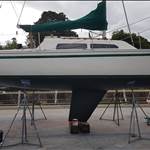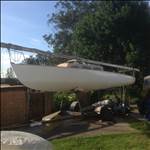


He makes a lot of good points about the skeg rudders and keel design. Unfortunately, when he gets on to boats that have generators he is catering for the handful of very rich people and not your average Joe.
Totally agree , I'm on my second Bluewater yacht without Bolt on keel , a skeg hung rudder and encapsulated keel is peace of mind and less leaking holes to worry about.
Kraken yachts are built in china !
Although Im bias to Aussie built ,Aussie designed Blue Water yachts!
www.bwcy.com.au
Not all bolt on keels are the same, depends what the are bolted onto. Compare Tally Ho the 1910 pilot cutter currently being rebuilt (on youtube) with a bolt on ballast keel vs a modern production yacht with a keel bolted onto a grid that is only glued into a thin hull.
I don't disagree with the above but generalising about all bolt on keels might be as much about selling a point of difference as it is about safety.
Using Cheeki Rafiki as an example is bad. The boat was never designed to do what they did with it. It was run on a budget. It was poorly maintained and had run aground several times. Had repairs done badly in front of the keel due to a bad grounding. They knew work needed doing to the keel bolts but it was going to be cheaper to get it done in the UK. There are plenty of reports on the incident.
I listened to bob perry being interviewed in a podcast - I think it's this one, but i could be wrong: podtail.se/podcast/59-north-sailing-podcast/bob-perry-legendary-yacht-designer/
He rubbished some of these fixed ideas, I think one quote was "I can build a spade rudder that'll pull the transom out of the boat"...
I hope that some of the people who are so against bolts don't drive cars, fly planes or drive over bridges with bolts securing them together.
This whole "this guy has done 100,000 miles so he is an expert" thing is pretty illogical. For a start, sailing is safe, so plenty of people can make mistakes and still do 100,000 miles and survive. We all know people who have been driving for 40 years and are still crap at it, and racers know people who have been racing 40 years and are still crap at it. Just logging miles is no proof of expertise at all.
The other thing is that people who say "X has 100,000 miles so must be right" ignore the fact that there are many people who have done MORE miles who say the opposite. If adding miles added expertise, then the most experienced sailor MUST be right - and the guys who have done the most offshore miles are probably French round the world racers who sail ultralight fin keelers.The most experienced cruising sailors I have sailed with have well over 200,000 miles and they have a bolt on keel, so if more miles = more expertise then bolt on keels are better. The second-most experienced cruising couple I've met were on a stripped-out fin-keel flush-deck IOR boat with runners, so again if more miles = more expertise then IOR raceboats are great cruisers.
His claim that losing a rudder in a collision sinks a boat is not true; several boats have had rudders snap and got home (including one I was on). I have heard of many boats that have stopped dead, probably after hitting whales, and not lost their spade rudder.
Basically when someone says that boats that have sailed happily around the world are "not blue water boats" because HE says so, it can be argued that he's on a massive ego trip.
It's well known that humans are really,really bad at assessing risks. We hugely over-estimate the problem of extraordinarily unlikely problems (like losing keels in a properly designed boat) and dramatically under-estimate real dangers. A while back I sat down and ran through the numbers of the deaths associated with long ocean races in Australia and it turned out there was ZERO extra danger, compared to just spending the time at home or in the office. Sure, some people had died - but given that many thousands of people, over that many total days a bunch of them would have died anyway, from cancer to car crashes to suicide.
Let's face it, the chances of anyone here dying from a keel loss is microscopic, and if we don't sail on post '85 boats with certain keel types it's less than that. The chances that we will die from heart disease and cancer are incomparably higher, so any logical assessment of actual risk would see us basically ignoring keel issues and going out for a jog instead, which will increase our life expectancy far more. Ironically, I'd say the "expert" in that video is in far, far, far greater danger from his weight problem than any sailor is from losing a keel.
Finally, on several occasions I've asked the "bolt on keels are bad" people to give us examples of pre 1985 boats that have lost keels. So far, not a single person has done so.
If people can't show any evidence then it is not reasonable to believe that there is a big problem.
My keel was only held on with only one bolt and it seemed to work fine. Finot Conq have been doing these since the late 80's/early 90's and have not had a failure to date.

You don't hear people saying those dodgy old Swans with their bolt on keels. I'd never go offshore in one of those. The Swan 65 ketch, not a blue water cruiser because it has a bolt on keel? Plenty of very safe boats with bolt on keels out there.
Chris 249 why do you say pre 85? Drum was 85. So not pre 85.
Select to expand quoteIronically, I'd say the "expert" in that video is in far, far, far greater danger from his weight problem than any sailor is from losing a keel.
We all know about crevice corrosion and have pulled all sorts of bolts from our boats such as staunchin bolts, chain plate bolts... and observed serious rust eating into the stainless steel. Why would we expect keel bolts to be any different?
The problem with keel bolts of course is that they are not at all easy to remove and inspect so it usually isn't done EVER! I guess we just have to hope that if the bolts fail we will get some warning as hopefully they won't all fail at once without some weird noises.
Chilling thoughts still enter my mind however in conditions where I repeatedly drop off waves badly enough to cause bad reverberations through the hull. (I once sold a boat for this very reason although its still around 25 years later - mind you probably little used ofshore).
As I have mentioned on here previously the rudder on my current boat separated from its skeg in heavy weather and skewed to the extent that serious amounts of battery deadening water were coming in necessitating a quick rescue with pumps and a tow 35 miles offshore.
Fortunately this was in the hands of a previous owner and was nicely repaired when I got the boat but the first thing I did after purchace was extend the aft bulkhead right across the boat to make the area above the skeg and rudder watertight.
Just because you have a skeg doesn't solve all potential deadly rudder problems.
Select to expand quotetarquin1 said..
You don't hear people saying those dodgy old Swans with their bolt on keels. I'd never go offshore in one of those. The Swan 65 ketch, not a blue water cruiser because it has a bolt on keel? Plenty of very safe boats with bolt on keels out there.
Chris 249 why do you say pre 85? Drum was 85. So not pre 85.
Yep, the Swan 65 is a classic example of a great bluewater boat with bolt on keel, as is the S&S 34.
I put the limit at "pre '85" specifically to keep 1985 vintage boats like Drum out. It was from '85 that there was a move to even higher aspect fins and MME elliptical keels, and only then did they start falling off.
Select to expand quotejulesmoto said..
We all know about crevice corrosion and have pulled all sorts of bolts from our boats such as staunchin bolts, chain plate bolts... and observed serious rust eating into the stainless steel. Why would we expect keel bolts to be any different?
The problem with keel bolts of course is that they are not at all easy to remove and inspect so it usually isn't done EVER! I guess we just have to hope that if the bolts fail we will get some warning as hopefully they won't all fail at once without some weird noises.
Chilling thoughts still enter my mind however in conditions where I repeatedly drop off waves badly enough to cause bad reverberations through the hull. (I once sold a boat for this very reason although its still around 25 years later - mind you probably little used ofshore).
As I have mentioned on here previously the rudder on my current boat separated from its skeg in heavy weather and skewed to the extent that serious amounts of battery deadening water were coming in necessitating a quick rescue with pumps and a tow 35 miles offshore.
Fortunately this was in the hands of a previous owner and was nicely repaired when I got the boat but the first thing I did after purchace was extend the aft bulkhead right across the boat to make the area above the skeg and rudder watertight.
Just because you have a skeg doesn't solve all potential deadly rudder problems.
We can expect keel bolts to be different because in pre '85 boats they basically DON'T fail and let keels fall off. Up until 1985 there were many tens of thousands of boats; in fact probably hundreds of thousands; built with bolt-on keels. So far not a single person here has been able to provide details of ONE such failure.
If keel bolt failure was such a big issue, we would have had many keels drop off the tens (or hundreds) of thousands of boats with bolted keels. In fact it is so rare that NO ONE here has been able to provide a single example of it in a pre '85 boat. Being scared of something that is so vanishingly rare is an example of the fact that, as many studies have shown, human beings are terrible at calculating risks.
I had the keel bolts pulled out of my previous boat. One had issues, the rest were fine, and the issue was probably caused by the fact that the bolt on the damaged keelboat had not been properly sealed from the water. I may get a keel bolt check on the current boat later this year, so I'm not ignoring the issue. But things that basically NEVER happen in well over a century, when there are hundreds of thousands of examples of the issue out there, simply are not serious risks.
You tube is getting to be a bit of a problem. Shock jock radio aims at a particular point of view and lampoons any dissenting opnions. Youtube is getting similar with some quite stupid and heavily biased channels having thousands of subscribers - getting their slightly warped views reinforced. The linked video is of two rather narrow minded people talking up their own choices. It reminds me of the conversations I used to have in the 80s and 90s with other multihullers, where all monohullers were stupid and ready for mockery.
Of course bolts are great - if done well and bad if done poorly. Even the idea of calling some keels bolt on is really a smokescreen. It is very hard to get a modern shaped narrow section, high aspect foil into an encapsulated fibreglass moulding. The keel shapes the "expert" likes in the video have wide bases, long chords and slack garboard areas - leading to easy engineering. The stresses on such old style keels are much lower than narrow keels. It may not be the keel but the type of design.
In my Hal Roth (50 000 miles) book he likes the idea of externally bolted on ballast. He cited the problems encoutered when encapsulated keels hit the bottom and are damaged - with almost no easy access to the inner sections of the glass keel at the damaged area. He preferred the traditional bolt on keel for its ruggedness and ability to take knocks wit metal, rather than more fragile glass.
So be careful conflating low chord/high aspect keels and the type of attachment. Read more Bob Perry - he designs different style boats and so can debate the merits dispassionately.
Whilst I would not want to lose a rudder on a big arsed Beneteau or similar, with their lack of directional stability, I could also easily make a transom hung emergency rudder for the potential time it fails. Built out of ply and with gudgeons bolted on the stern it would serve well for getting me home. Every boat has its limitations, you just have to know them and cater for them. Saying that their is only one way to fix an issue is pretty stupid.
There is such a wide variety of bolt-on keel designs that generalizations do not apply.
Modern high aspect ratio slim designs obviously have higher stress levels than more traditional designs.
The problem is for us moderate/low income oldies, the cost of pulling the keel bolts often exceeds the value of our boat, so it makes sense to avoid critical designs. Many of the older boats also had cast-in bolts, so you cannot just pull them to inspect.
I like the S&S designs with stub keel and bronze keel bolts, but they are rare.
Select to expand quoteshaggybaxter said..
My keel was only held on with only one bolt and it seemed to work fine. Finot Conq have been doing these since the late 80's/early 90's and have not had a failure to date.
I wouldn't like the repair bill if you had a brush with the bricks in a full flight reach. Hydraulic relief lets the fin pivot, but you can get some big side forces. Common trailer-sailer problem.
On the other hand you have good access to check the pin bolt for corrosion.
Have the failures with bolted on keels been a failure of all bolts at once or have the failures been the material the bolts are going into.
Select to expand quotecammd said..
Have the failures with bolted on keels been a failure of all bolts at once or have the failures been the material the bolts are going into.
In my experience the failures I have seen have been due to the structure not the bolts. Keels found in shallow water with the bolts, backing plates and nuts intact with the fibreglass laminate still sandwiched between them. I saw one where the laminate was less than 10mm thick and only washers under the nuts. I won't name the brand but it is French.
Depends on the specifics of each event. Plenty of on line links including good reports as at second last link and good background fatigue analysis at last link.
www.practical-sailor.com/sails-rigging-deckgear/a-quest-for-keel-integrity
www.sailingscuttlebutt.com/2014/06/10/seeking-learn-keel-failures/
www.sailing.org/tools/documents/YRDTS2013Presentation-%5b17113%5d.pdf
www.sailing.org/tools/documents/SRSC7diKeelFailures-[17111].pdf
www.sailing.org/tools/documents/SRSC7diKeelFailuresdatav2-[17112].pdf
www.sail-world.com/Australia/ISAF-highlights-Keel-failure-safety-concerns/-43211?source=google
crew.org.nz/forum/index.php?/forums/topic/17436-kerr-40-keel-loss/
www.maritimenz.govt.nz/commercial/safety/accidents-reporting/accident-reports/documents/Time-To-Burn-081486-mnz-accident-report2008.pdf
www.kj-engineering.com.au/yacht-design-composites/keel-fatigue-analysis
There is plenty of info about the Cheeki Rafiki incident that quite often has links or info about other keel failure.
Troubadour,Please do name the brand so people know.
Chris 249, maybe there is one before 85? This was after the Cheeki Rafiki incident.

This is the design of Wapiti's keel, looks like two sets of bolts. One set holding the lead ballast onto the keel frame and another set bolting the frame to the hull. Not sure how you could check the ballast bolts. Posted the pics cause I thought it could be of interest.


Select to expand quotetarquin1 said..
Troubadour,Please do name the brand so people know.
My Beneteau has washers under the bolt head. They are substantial but far from a plate. I am not in the slightest concerned about it. Designers are experts and I am not.
Insurance companies are great at assessing risk and they are still insuring fin keel boats.
Select to expand quoteYara said..
I wouldn't like the repair bill if you had a brush with the bricks in a full flight reach.
HI Yara,
Yep. But to be fair I wouldn't want to drive any keel into the rocks on a full flight reach. I had long chats with FC about this, as the top half of the keel was all composite, the bottom half was lead. So I was worried about this exact issue,
When we hit the whale, Structures calculated the load from the impact, it was well over 1G, where 0.25G is considered to be accepted as a general threshold for damage to a yacht to occur. FC confirmed this was well within their design spec, so there were no issues from a structural point of view from 12 knots to a dead stop in a boat length or two.
The lateral force is provided by the keel head, construction and the socket. It's a massive socket, measuring a good three ft tall and 3ft long. This gives it a huge area to both absorb and dissipate lateral loads. The keel box isn't glassed on, it's part of the hull and moulded in one piece.
Cheers,
SB
,
Thanks Shags, I followed your Pogo build here on SB with much interest. I find these extra little details that pop up occasionally quite fascinating, and only increases my respect for the thought the designers and builders put into it.
Select to expand quotetarquin1 said..
Troubadour,Please do name the brand so people know.
Chris 249, maybe there is one before 85? This was after the Cheeki Rafiki incident.
Fair call, there was one boat in 1984; the next one was Drum (1985) and then there was two more in the '80s.
The list doesn't include Planet X, a Goddard half tonner that lost its keel in 1989 (IIRC) off the Gold Coast after what was alleged to be a weld failure on the MME elliptical keel.
The 1984 one I didn't know about and it may not have been in earlier reports. It was a Castro Jeanneau Sunfast in the Figaro which must have been one of the very limited-edition Sunfast half tonners like Balthazar (IIRC) which had a high aspect keel with no bulb and was not an elliptical. The cause of keel loss is unknown so there is no reason to assume it was keel bolt failure. The Sunfast 30 was a leading-edge stripped out IOR machine with the emphasis on light wind performance.
After 1990, when keels changed, the toll becomes stupidly high IMHO. But the physics of a bulbed high-aspect short-root narrow-section keel are very different to those of the standard pre '85 keel, and the latter just do not come off.
I'm morbidly interested in the danger of sailing since my father was killed sailing when I was three. My collection of sailing magazines dates back to 1893 (yes, 1893 not 1983) and they do not include reports of keels falling off until that 1984 Sunfast one.
As an actual risk, it's vanishingly small.
Select to expand quotecammd said..
Have the failures with bolted on keels been a failure of all bolts at once or have the failures been the material the bolts are going into.
Normally the frames the bolts go into.
Quite a few boats these days are built with bolts that go into hollow 'glass sections that are then just bogged on, I believe. Given designs like that and the fact that they are allied to high aspect bulbs, the loss of "modern" keels is not surprising.
The coroner's report on Rising Farrster is particularly depressing, as an example of horrific "workmanship" that saw the structure fail.
The issue is conflating that sort of high-stress design with older-style lower-stress designs.
I drive my car with bolt on wheels at 110km/hr down the Bruce highway etc. to Mooloolaba marina. The drive is the most dangerous part of going for sail on my boat, held upright by its bolt on keel, the mast kept standing with riveted on fittings and bolted in chainplates.
Fortunately the engineers that designed my car and my boat know how to do some quite fancy sums and usually get it right with a large safety margin.
Webb Chiles did a full lap in a Drascombe Lugger. So I think most of our boats will be fine. The vulnerable part is the people sailing them not the engineering, despite the claims of YouTubers trying to sell us something.
www.facebook.com/sampsonboatco/videos/1580842048944665
Speaking of youtubers, I think Dick Beaumont would have a hard time convincing Leo Gooldwin the keel bolts being installed in his boat in the above clip are unsafe.
About 15 years ago I did the inquest ( and the subsequent suit) into the deaths of 2 women when the bolt on keel of Rising Farrster fell off about 8 ks off Ballina in Force 1-2 conditions late at night. The boat sank without any prior warning in a matter, literally, of seconds, according to the survivors. I think 4 or 5 occupants were asleep, and 2 did not have time to get out. One of the dead was an SAS member, so they were fit! No one had time to get life jackets and the survivors had to swim maybe 15ks ( with currents) to get to shore. They were all fit and young.
The keel failed , the Coroner found, because of inadequate keel washers,compared to the floor frames as built which caused a series of calamatous failures , ultimately leading to a full peeling of the laminate as the keel,came off. I will not go into any questions of fault here, or cast any aspersions on anyone, but raise it only to show that bolt on keels rely upon a number of critical factors and that failure may be lurking unknown and unwarned without any visible signs. This keel had been flexing the hull imperceptibly in way of the floor frames, till it reached a critical failure mode in calm conditions. I no longer have the brief obviously, but I seem to recall that the failure actually sheered at least one of the bolts which was solidly anchored through a frame, and that it was a stress overload failure , not a corrosion fracture. Of course a Farr 40 is not a particularly big boat nor is the keel particularly heavy compared to some modern boats utilizing bolt on keels.
Modern composite construction often leaves little choice but to utilise a bolt on keel. Luckily failures are rare, but when they happen are catestrophic. Had there been any sea running when Rising Farrster was lost, all would surely have perished that far out.
i do not know what the answer is other than significant over-engineering. Andy Dovell said that it was then usual to allow ( this from my fading memory) well over a 200% margin of safety in design . I do apologise to Andy if my memory is wrong. The problem seems to me that issues can be lurking within a composite structure that looks perfect upon inspection, the latent failure being well within the structure. Maybe x ray-ing as they do with welds?? I dont know if that is even possible.
Just my 2 cents.
Cheers Keith.