Sail design

> 10 years ago
Reply
Register to post, see what you've read, and subscribe to topics.
bazl
bazl
WA
704 posts
WA, 704 posts
25 Apr 2010 6:33pm
Is it a disadvantage to have a boom pocket on the sail? Saw an older sail today with this feature but wonder about lack of adjustment to 'belly' the sail, especially in light wind.
Hiko
Hiko
1229 posts
1229 posts
25 Apr 2010 7:17pm
All the yachts I have seen have loose footed sails and adjustable outhauls at the
clew to shape the sail except for the very simple yachts
I use this feature a lot when sailing and imagine it would be quite a disadvantage
not to be able to do this for a racing yacht
I would like to fit this arrangement on my mini some time
aus230
aus230
WA
1660 posts
WA, 1660 posts
25 Apr 2010 7:40pm
Another question in the same area, the pros and cons of a floating boom. All aus yachts apear to favour a rowlock, but the kiwies and european class5 seem to prefer a floating boom.
cheers
aus230
Hiko
Hiko
1229 posts
1229 posts
25 Apr 2010 7:58pm
As you say the preference here is for the floating boom
Not sure of the pros and cons but it is simpler
Ohope beach looking its best Hope to give it another workout tomorrow


landyacht
landyacht
WA
5921 posts
WA, 5921 posts
25 Apr 2010 8:12pm
from a class 5 point of view a boom pocket laid flat measures say 1600mm x120mm=0.192 msq. that you have lost as doubled up sail area.
I did notice in Jan just how much the leading club 88s were letting out the foot- up to 250mm on the upwind legs where the wind was iffy.
the theory in the eighties was that you had a flexible boom which bent and flattened the sail as you sheeted in.
Ive always been disapointed with the floating boom, particularly upwind IF you dont have the sheeting JUST right. I prefer to have a rowlock loosly tied and only touching the mast on its sides when sheeted. this allows you to pull the boom back and off the mast so you can push it forward on the lee side to make a full sail for starting
Hiko
Hiko
1229 posts
1229 posts
26 Apr 2010 4:50pm
Sailing around today I realised another good reason not to have a boom pocket
I often lift the foot to peer out to leeward ![ on the mini]
Cheers Hiko
landyacht
landyacht
WA
5921 posts
WA, 5921 posts
26 Apr 2010 5:12pm
Oh no you dont you can see perfectly , just like the rest of us
kiwi307
kiwi307
488 posts
488 posts
26 Apr 2010 5:53pm
The original idea of the floating boom was that you adjust it down to the leeward side with your non sheeting hand ALL THE TIME. This then was a constant adjustment, braced your hand over the top of your helmet, and changed hands each time you tacked.
The original rules for Class 5 specified that the mast and the boom be located by means of "a pocket on the luff for the mast, and a pocket on the foot for the boom" so you had no option.
Foot adjustment is an area of constant discussion with proponents and oponents!
kiwi307
kiwi307
488 posts
488 posts
26 Apr 2010 5:55pm
Hiko said...

Sailing around today I realised another good reason not to have a boom pocket
I often lift the foot to peer out to leeward ![ on the mini]
Cheers Hiko


If you have to do that it's not really legal The boom should not be able to be sheeted that low if you read the rules!
Hiko
Hiko
1229 posts
1229 posts
26 Apr 2010 6:56pm
Is that for minis too ? Damn
The seagulls didnt seem to mind
landyacht
landyacht
WA
5921 posts
WA, 5921 posts
27 Apr 2010 6:37pm
Promos have a rule regarding the boom being above the head , and that it must extend behind the head.
for class 5 , the lowest point of the boom must never come below
-45cm from the ground
-eye level
whichever is the highest.there must be a device that makes it impossible to sheet any part of the boom below this level.
so part of the challenge in designing your yacht is to get your eyes below 45cm, then bring your boom down to your eyes.
it can be tricky and when you do , you can bet there will be somebody with a tape measure checking you .
I dont recall any such life complicating rule for the lefroy mini
Clemco
Clemco
430 posts
430 posts
28 Apr 2010 11:59am
aus230 said...

Another question in the same area, the pros and cons of a floating boom. All aus yachts apear to favour a rowlock, but the kiwies and european class5 seem to prefer a floating boom.
cheers
aus230


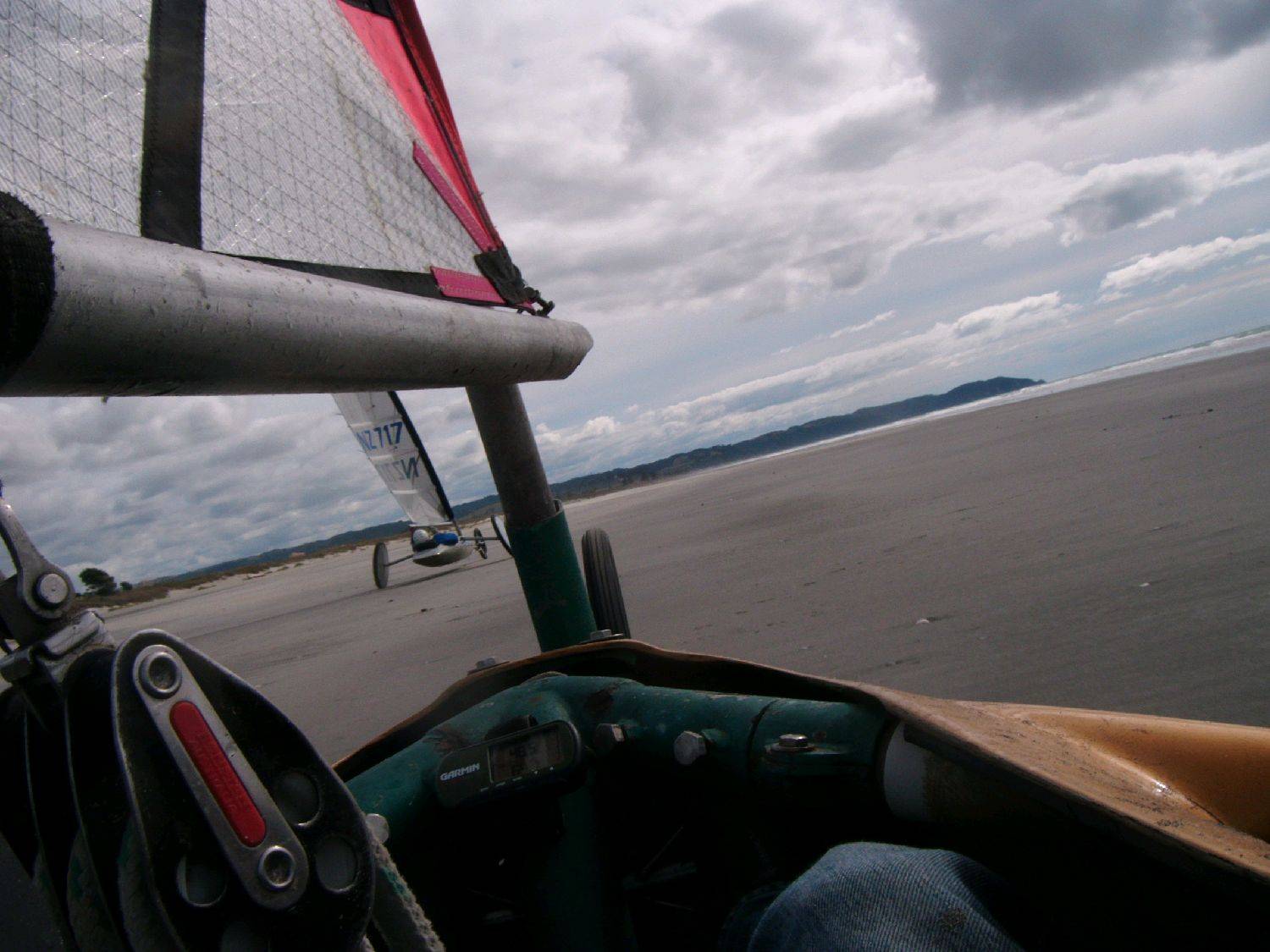
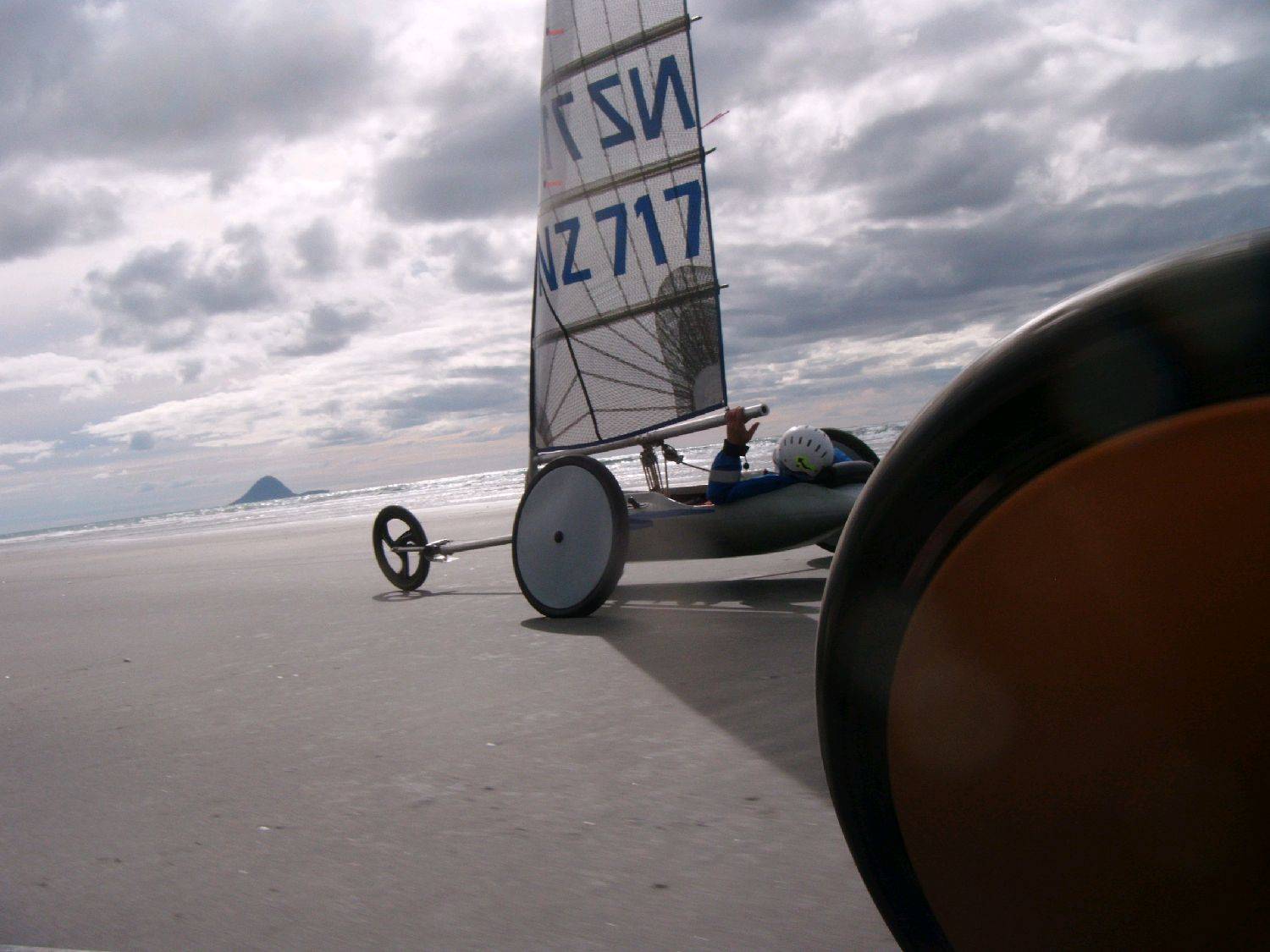
I have always preferred a floating boom. With mid-sheeting it allows you to pull the rear of the boom to windward and increase power and push it away to decrease power without having to sheet out. This is very handy when sailing at maximum speed and you get hit with a slight gust which sends your windward wheel airborne. Instead of panicking and sheeting out you can maintain balance by simply pushing the rear of the boom to leeward (reducing the sails angle of attack) until the wheel comes back to ground without loosing speed. The front of the boom will swing to windward as in the photo I took in Hiko's post above. Once fully sheeted in, I would be holding the main sheet with one hand and the rear of the boom in the other. You give your arm a rest as you take the marks (or at each tack) as you swap sides.
landyacht
landyacht
WA
5921 posts
WA, 5921 posts
28 Apr 2010 8:19pm
you and I might have to get fit for the next international bazl!
kiwi307
kiwi307
488 posts
488 posts
28 Apr 2010 8:29pm
landyacht said...

Promos have a rule regarding the boom being above the head , and that it must extend behind the head.
for class 5 , the lowest point of the boom must never come below
-45cm from the ground
-eye level
whichever is the lowest.ther must be a device that makes it impossible to sheet any part of the boom below this level.
so part of the challenge in designing your yacht is to get your eyes below 45cm, then bring your boom down to your eyes.
it can be tricky and when you do , you can bet there will be somebody with a tape measure checking you .
I dont recall any such life complicating rule for the lefroy mini


Hi Paul, much as you have the guts of the rule, you have a glaring error.
It is 45cm from the ground or
Eye level, whichever is the HIGHEST (not lowest as you said).
Sorry to be picky, but someone will quote you.
I think the reason for which it instituted, being clear vision is a damned good reason!
And now as Vic has requested we all use our names
Rhys
landyacht
landyacht
WA
5921 posts
WA, 5921 posts
28 Apr 2010 8:36pm
OOps , sorry , edited in the original post.
cheers , Mr Paul"The landyacht" Day.
of the landyachting Days.
aus230
aus230
WA
1660 posts
WA, 1660 posts
28 Apr 2010 8:53pm
more worried about the people who are anomous
aus230
aus230
WA
1660 posts
WA, 1660 posts
28 Apr 2010 9:07pm
On another topic while we are in this area. I noticed from some NZ pics and some from argentina that some yachts where using lead weights behind the front wheel. How much of a benifit is this (I imagine it is for stronger winds)
Cheers
aus230
Test pilot 1
Test pilot 1
WA
1430 posts
WA, 1430 posts
28 Apr 2010 9:29pm
The weights behind the front wheel was to maintain as per the rules a minimum of i think 5 kilos on the front wheel. Due to the design of the yachts that we hired, i was unable to sit far enough forward to maintain that 5 kilos and have straight knees( another rule) so i had to tape coke bottle full of sand behind front wheel. This prevented me from moving my weight centre around. If i slid forward the weight would increase too much and if i slid back the weight stayed on the front wheel, a big disadvantage.
landyacht
landyacht
WA
5921 posts
WA, 5921 posts
28 Apr 2010 9:39pm
the promo class has a minimum weight over the front wheel, which was checked on a set of bathroom scales, with the pilot laying in the yacht, legs straight sail fully sheeted. from memory it was 10.5kg?
if you were a tall pilot this became a problem as the seat left you way back in the yacht. Tp1 had to pile heaps of wet sand onto the front end of his rental yacht. the seagull yachts actually had a couple of nuts welded on to take indivually cast lead weights to suit each pilot
in a strong wind the tall narrow sails need lots of sheeting and careful balancing to ensure that the tip of the sail doesnt start to flap. On the upwind leg , or when tacking , a couple of flaps quickly translates to the front wheel bouncing , or even lifting off completely..
this happened to me once in Argentina , I almost landed the front wheel on top of a shiney Hilux 4x4. when I got caught in a willy willy whilst in a tacking duel with a full on class 5 around the upwind mark. We were both impressed with surviving
the tackas the background breeze was just on 25knts with blowing sand.
When testing my new 5 I would go out to the claypan on really windy days and try to replicate the conditions, then alter mast step position, bodyweight location, sheeting postion, upper mast stiffness,etc, till I got it to stop. I even recut the luff of the sail twice to stop the dreaded flapping.

BUT that gave me a class 5 that scares me at just how controllable it is in a blow , but its sadly bad in very light downwind condition , but Im working on that

aus230
aus230
WA
1660 posts
WA, 1660 posts
3 May 2010 9:49pm
I think this post has been interesting , I have another question.
What is the benifit of a centre pull boom compared to a rear and front pulled attachment. I have asked these questions mainly for new comers to the sport to see the different options and why the changes have been made.
Cheers
aus230
Hiko
Hiko
1229 posts
1229 posts
4 May 2010 5:34am
I think Clemco covered this further up in this post I cant add anything much to what he has written Hard to have it in a mini yacht though due to the pilot
being more forward relative to the sail comparing it with a class 5
Clem seems to have managed it but the foot of his sail is very short
That sail would be too small for my weight I think
Cheers Hiko
kiwi307
kiwi307
488 posts
488 posts
4 May 2010 5:37am
aus230 said...

I think this post has been interesting , I have another question.
What is the benifit of a centre pull boom compared to a rear and front pulled attachment. I have asked these questions mainly for new comers to the sport to see the different options and why the changes have been made.
Cheers
aus230


I agree, a bit more interesting than some of the tumbleweed lately!
Often times there have been forgotten reasons for some developments. The "Old" Class 5 rules had a limit of 5 pulley sheeves in total for the mainsheet (another cost saving idea originally) and in order to get more of them putting power into the mainsheet, along with allowing a more dynamic twist in the head of the sail, we tried moving them mid boom. It was soon apparent that this allowed the bigger roaches to do a lot of the work, particularly on the gusty and varying surface beaches. You did not have to work the mainsheet quite the same to keep the whole rig working and prevent flying wheels as often. This translates into speed around the course.
Down side, much harder to get in on the running start which all the rest of the world uses, very easy to tangle your trousers in the bottom pulley.
Rear sheet means a lot more rope to pull in and out, easier to drag the end (as per the strange Aussie rule) and pulls the roach tighter, which may be better in very even wind conditions, as well as the ease of it's physical location. The "whip" on a Blokart does some of the same self correcting.

Test pilot 1
Test pilot 1
WA
1430 posts
WA, 1430 posts
6 May 2010 10:25pm
I find that with the rear sheeting combined with down haul more space is available for body shifting of weight centre to keep windward wheel down.
On the other hand centre sheeted booms can be physically pushed/pulled to windward allowing you to point closer upwind. I used this to good effect in argentina when rounding the bottom marker to aleviate the tendency of the yacht to become air borne.
I also pull or push the boom to effectively aero brake or control the sail around markers on Lefroy. I do this with the sheet slightly slack as I can stop the more violent sail position changes when turning in higher winds.
Test pilot 1
Test pilot 1
WA
1430 posts
WA, 1430 posts
6 May 2010 10:30pm
1 Thing I forgot to mention you need good upper body strength to man handle the centre sheeted boom[}:)]
Clemco
Clemco
430 posts
430 posts
7 May 2010 8:03am
Test pilot 1 said...

1 Thing I forgot to mention you need good upper body strength to man handle the centre sheeted boom[}:)]


If you get rid of the rowlock it gets a hell of a lot easier.
Test pilot 1
Test pilot 1
WA
1430 posts
WA, 1430 posts
8 May 2010 4:08pm
No you need the rowlock to pivot against the mast to keep the shape in the sail
Clemco
Clemco
430 posts
430 posts
8 May 2010 6:09pm


Well this is how we do it at Ohope.
Gizmo
Gizmo
SA
2865 posts
SA, 2865 posts
8 May 2010 7:45pm
A great pic..... the sail shape looks good in the pic.
If you don't hang onto the boom what is the sail shape like then?
The pic Hiko posted on 25/04/2010 in this thread looks like the sail is being pushed to windward.
Clemco
Clemco
430 posts
430 posts
8 May 2010 6:25pm
No. I had to let go of my boom so I could take the photo.

Gizmo
Gizmo
SA
2865 posts
SA, 2865 posts
8 May 2010 7:59pm
what i ment was .... what would the shape be if the pilot of NZ717 let go of his boom, would his sail go to windward?
landyacht
landyacht
WA
5921 posts
WA, 5921 posts
8 May 2010 6:42pm
Test pilot 1 said...

No you need the rowlock to pivot against the mast to keep the shape in the sail

no TP1 YOU need the rowlock,,,,,,,,,,,,, there are landyacht sails and there are LANDYACHT sails

Please Register, or first...
Topics Subscribe Reply

Return To Classic site 😭
Or... let us know if a problem, so we can tweak! 😅