I prepare my post’s or rants as some call them off line, the afternoon of the day before posting. I have no idea of what has been written until I’m ready to post, My reasons for this is so I can keep my phone line open in case I wish to check some point, I do enter into other correspondence with certain party’s that could have some pertinent input or even the power of veto, to a successful outcome , for me. Others may say Hurrah! So what.
Are any of you others doing this type of thing, probably not. When I get return mail from some, at this time flooded stations and businesses, I will post my original letter’s and the reply I receive, if any. I am not relying on mates and hearsay. My own knowledge, and that of people in the forum who can sort the chaff from the wheat, I back that up with real knowledge, scientific and first hand, first person, observations. Of people who know more than I on Lake Eyre and surrounds.
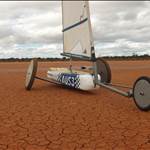
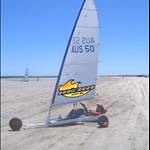
As previously stated this post concerns any definition of land yacht and a bit of history on vehicles that have been used successfully on the lake from around the late 50’s
There were not many people until around 1961 that knew very much about the lake at all. Even the locals didn’t know that the lake held a clear or white salt area that was very, very large. There were no private station aircraft in use. Commercial aircraft also not many. These followed the rail track, lest they get lost. Fuel refills were only available at settlements along the rail.
Why would anyone wish to travel across a big nothing. The lake as the locals said at the time, why bother to even think about it, it is none of their business. When it was rumored that Donald Campbell was to try for the worlds land speed record, for a gearbox driven speedster car on Lake Eyre. They all thought it a bush story, just like the ones I tell, someone was pulling their leg.
Not so, DC turned up with his entourage of road builders and camp managers with support from the good people of Woomera and all sorta government departments, including the PMG who installed towers and a post office, to let the world know how it was all going. I think that was the first Muloorina Station had the luxury of an electricial generator.
They bought with them many different vehicles for jobs on the lake and I would like to list a few. Morris 4x4’s, Mercedes 4x4, Rolls Royce 4x4, Landrover 4x4, Jeep 4x4. Large semi trailers possibly of the Leyland Comet range, to transport Bluebird, Road graders, Bulldozer, Tractors, Towed Road/surface milling machines, Road rollers, Vip cars, more likely Humbers, Holden Hillman, a Customline or two and more, These all went out onto the lake where the course had been selected.
Over the following years many other vehicles were introduced onto the salt for many other purposes including regular station work. Motor Bikes, Mini Mokes, Toyota 4x4, Halfinger, Ute and light trucks, Drilling rigs and on and on.
The Dalhunty’s when they first came with their three wheel Hondas caused a bit of interest as they were the first people in the outback to use them. Of course the flat earth society said, “ They’ll all be doomed !”.. “ that’s for sure “ But it was not to be, these people who had never ridden one before and even had never been upon the lake, spent years there and their largish tires did over 3700 ks upon the lake without so much as one puncture
According to Roma, a lady, they preformed their task admirably and were a joy to ride upon, we may never have succeeded without them.
So to land yachts and the story of the one that went there, nothing written has been found yet. I have written to Muloorina asking if anyone there can shed some light on said unit, paper wize. I suspect that most people accessed the lake thru the station , their web site indicates an interest in what is now called tourism, and they have done much over the years to assist people in good health and in trouble.
Donald Campbell did break the world land speed record on Lake Eyre July 9th 1964, achieving a two way run at over 648.587kph over the measured 1.609km, which must be very close to the old mile. The first known plane landing on the salt was in 1961.
Graige Bredlove an American soon stole the land speed record on Lake Bonneville, U.S.A., I think before Campbell was killed in His boat of the same name
So what I think may be a suitable set up for a landyacht on the lake . There are slush zones, hard wet zones, hard wet and soft zones, there are absolute bogs. And there is rough salt and smooth salt. I personally am going to keep my distance from the bogs, but sometimes the crust may only support one traverse, but not a second. It is/seems best not to follow in someone else’s wheel tracks.
There will be boggy or slippery surfaces that one has to cross or go round, at some times. As landyacht has spoken of, and beachball.
The photographer who shot the short film “SALT “ had a mountain bike with a trailer. Which he pushed over the slush zones. Loaded with food and water and gear, around 100kg I think he said. He stayed out for around a month at a time and did it six years in succession to acquire the footage he wanted. He may have had to partake in portage, as canoeists may be experienced of. I have had to portage motor vehicles, I don’t like it, but.
That sorta stuff is for discussion later. Ones land yacht needs to be able to transport a bit more gear than usual. Your food, water, sleeping gear clothes, etc. around 8x2 liters of water per cart. Extra will be in bigger carts and back up atv’s. depending on a lot of factors as to what these supports can be loaded up with reliability and safely.
It seems from research that around 100mm ground clearance would keep one out of most trouble, with wider rounder tires to spread the weight.
A push type handle like a lawnmower style could be an asset and at all times 20 foot of rope tied handily around the front somewhere, could be good. Easily accessible when needed. One again any canoeist would have this attachment in place.
Your cart needs to be able to be pushed and steered at the same time, try it, not easy eh? Wheels should be at a distance away from any structural part of the cart to allow accumulated mud/slush to not drag or interfere with rolling ability.
Trucks cars and 4x4,s sometimes have to have the wheel arches dug out by shovel, on bush highways after rain, a mongrel job. Push bikes also, it’s not fun. But it only needs doing sometimes. One may strike the lake with none of this required.
Front wheel drive cars seem to do better in these sticky clayey conditions. A 4x4 is not able always to offer the occupants clear sailing.
Donald Campbell’s Bluebird was 9.144 meters long, 2.438 width, 4,358.4 kilograms weight and produced 5,000 horse power. Muloorina is an Aboriginal word said to mean “ pace of plenty “

 isnt that right TP1[}:)]
 ) That needs looking at by the posters.