Going directly downwind faster than the wind?

> 10 years ago
Reply
Register to post, see what you've read, and subscribe to topics.
frant
frant
VIC
1230 posts
VIC, 1230 posts
12 Nov 2010 3:16pm
spork said...

frant said...
Yes, This sounds intuitive, various combinations of friction.inertia and gearing ratios will alter whether it starts upwind or downwind.


If we assume it rolls without slipping it should come down to prop-pitch and gear ratio. I'm pretty sure inertia is not a factor.


Is it possible to go upwind without slipping? eg in the threaded rod example if the craft has a speed of 1 upwind (-1) and the rod a speed of 1 downwind then the nut must be spinning at omega=-2. which means that the wheels will be turning for a speed=-4. As the craft speed is only -1 then the wheels must be slipping effectively 3.

Or do we have to change the gear ratio. If a rotation of 2 gives a speed of 1 that should work?
Answered my own question (I think)
frant
frant
VIC
1230 posts
VIC, 1230 posts
12 Nov 2010 3:24pm
doggie said...

getfunky said...


And just for Doggie

(reckon about 80% of Treckies would pop their phasers when the saw this - the other 20% go more for Kirk)


WOW trekie BOOBS (.)(.) thanks funky I love it WOOF!


And it is Friday after all
doggie
doggie
WA
15849 posts
WA, 15849 posts
12 Nov 2010 12:33pm
^^Frant u da man!!
spork
spork
24 posts
24 posts
12 Nov 2010 1:48pm
frant said...
Is it possible to go upwind without slipping?


Yes. This winter we will modify the cart for upwind operation. We hope to achieve a direct upwind speed of 2X (but that's a bit optimistic - we'll be pretty happy to do more than 1X directly upwind).

Answered my own question (I think)


Look at that - I'm not needed here : )

decrepit
decrepit
WA
12873 posts
WA, 12873 posts
12 Nov 2010 9:57pm
OK I think I'm convinced.
My problem was seeing a wind vehicle with a prop on it and assuming the prop was driving the wheels.
Took me some time to get my head around the wheels driving the prop.

So the prop is actually trying to drive the vehicle backwards when the wind is from behind.
But the wind pressure on the whole vehicle is able to overcome the torque on the wheels from the prop.
Once it starts moving, the thrust from the prop adds to the wind.
At windspeed, there is no longer any force on the vehicle, but the prop is still pushing.
Still sounds a bit "iffy" to me, it's counter intuitive.
saltiest1
saltiest1
NSW
2568 posts
NSW, 2568 posts
13 Nov 2010 2:10am
so why dont they just put up a big sail at the front and turn the fan on?

ThinAirD
ThinAirD
13 posts
13 posts
13 Nov 2010 2:08am
decrepit said...

So the prop is actually trying to drive the vehicle backwards when the wind is from behind. But the wind pressure on the whole vehicle is able to overcome the torque on the wheels from the prop.


Yep.

Once it starts moving, the thrust from the prop adds to the wind.
At windspeed, there is no longer any force on the vehicle, but the prop is still pushing.


Yep.

Still sounds a bit "iffy" to me, it's counter intuitive.


Yep.

Congrats.

JB

Ian K
Ian K
WA
4169 posts
WA, 4169 posts
13 Nov 2010 6:58am
About the third time this topic's been up. Always a good topic for a bit of mental exercise, so many ways of looking at it. Here's another one.

Start off by thinking about the cart in no wind.

Give it a good push up to speed on level ground and release it.

You'll find the propellor is turning in a direction to continue pushing the cart - like a taxiing model aeroplane.

The push of the propellor, thrust using aeroplane terminology, can be turned into power and transmitted through the gear box. The amount of power that is transmitted though the gear box is equal to thrust times the velocity of the cart over the ground.

So the issue of what happens next gets down to how much thrust is generated by a propellor versus how much power is required to turn a propellor.

The thrust of a propellor is proportional to the lift generated by the propellor blade times the cos of the pitch angle of the blade. The power to turn a propellor is proportional to the lift of the blade times the sin of the pitch angle. (no drag in this thought experiment).

When you go through a trial calculation (use a simplified propellor! one that neatly corkscrews through the air) you find that the thrust that can be converted to power is exactly equal to the power required to turn the propellor. Always impressed at how conservation of energy is embedded in all these mechanical calculations where friction is ignored.

So with friction a cart pushed in still air will of course roll to a stop.

Now add wind.

If instead of zero wind we have a slight tail wind then the propellor blades can be run at less pitch and still deliver the same thrust. With less pitch angle it takes less power to turn the propellor. With a bit of power at hand to overcome friction the cart is away.

(All well and good thinking after the event - so impressed with the fellows who came up with the idea in the first place)


spork
spork
24 posts
24 posts
13 Nov 2010 8:28am
Ian K said...
(All well and good thinking after the event - so impressed with the fellows who came up with the idea in the first place)


I thought I came up with it in the first place, but it ends up a student came up with the same idea in the 1940's. Others may have as well.

Ian K
Ian K
WA
4169 posts
WA, 4169 posts
14 Nov 2010 7:12am
[b]spork said...
You actually don't need a ratchet. If the gearing is such that your cart is designed to go downwind (or down threaded rod), and the losses are low enough, it will start in the correct direction. If the gearing is changed such that it starts in up wind (or up rod) direction, it will in fact be an upwind cart. The max speed ratio happens right at that cut-off of gear ratios. In a sense it should do an infinite multiple of wind speed both upwind and downwind at that ratio. Just to either side of that ratio it will either have a high upwind or downwind multiple depending on which side of the ratio you choose.


Hi Spork, great project.

But don't you also have to change the prop for an upwind cart? I'm thinking that; downwind the propellor thrust is driving the cart - the wheels keep the prop turning. Upwind the propellor thrust opposes the motion of the cart, but the rotation of the prop is geared so the wheels overcome the "unwanted" thrust and drive it upwind.

A prop that pushes air must have blades profiled differently to one that is driven by air?


frant
frant
VIC
1230 posts
VIC, 1230 posts
14 Nov 2010 9:00pm
Ian K said...

[b]spork said...
You actually don't need a ratchet. If the gearing is such that your cart is designed to go downwind (or down threaded rod), and the losses are low enough, it will start in the correct direction. If the gearing is changed such that it starts in up wind (or up rod) direction, it will in fact be an upwind cart. The max speed ratio happens right at that cut-off of gear ratios. In a sense it should do an infinite multiple of wind speed both upwind and downwind at that ratio. Just to either side of that ratio it will either have a high upwind or downwind multiple depending on which side of the ratio you choose.


Hi Spork, great project.

But don't you also have to change the prop for an upwind cart? I'm thinking that; downwind the propellor thrust is driving the cart - the wheels keep the prop turning. Upwind the propellor thrust opposes the motion of the cart, but the rotation of the prop is geared so the wheels overcome the "unwanted" thrust and drive it upwind.

A prop that pushes air must have blades profiled differently to one that is driven by air?


I agree, Downwind propeller blades. Upwind turbine blades.
decrepit
decrepit
WA
12873 posts
WA, 12873 posts
14 Nov 2010 8:05pm


[b]spork said...
You actually don't need a ratchet. If the gearing is such that your cart is designed to go downwind (or down threaded rod), and the losses are low enough, it will start in the correct direction. If the gearing is changed such that it starts in up wind (or up rod) direction, it will in fact be an upwind cart. The max speed ratio happens right at that cut-off of gear ratios. In a sense it should do an infinite multiple of wind speed both upwind and downwind at that ratio. Just to either side of that ratio it will either have a high upwind or downwind multiple depending on which side of the ratio you choose.


I'm wondering if you played around with the aerodynamics, so the vehicle was much more slippery with wind from the front than from the back and with very careful gear ratio selection, it would work both ways.
Wind from the back, goes forward, wind from the front goes forward.

And what about a boat?? water prop driving an air prop. Or would the friction be too great.
Ian K
Ian K
WA
4169 posts
WA, 4169 posts
15 Nov 2010 8:47am
frant said...


I agree, Downwind propeller blades. Upwind turbine blades.


Yes that's the terminology I was looking for Frant. Helicopters do both when going from powered flight to autorotation following engine failure. The rotor has adjustable pitch.

With adjustable pitch the "downwind faster than the wind " machine should go both ways. But it would have to reverse upwind.

evlPanda
evlPanda
NSW
9207 posts
NSW, 9207 posts
15 Nov 2010 1:01pm
Ok, that's great. Now somebody design something that will sail dead upwind and all our energy problems are solved.

In my stupid mind I imagine something with two sails, both on close hauls, one starboard the other port. Should work just fine.
Ian K
Ian K
WA
4169 posts
WA, 4169 posts
15 Nov 2010 11:35am
decrepit said...

And what about a boat?? water prop driving an air prop. Or would the friction be too great.


The ideas are morphing. So how close do you have to put gybes together before you can say you're sailing directly downwind? If you wanted to be pedantic you could put a skipper's hat on a smallish monkey and teach him to waterski in a straight line behind a zig zagging formula board. That's sailing directly downwind, faster than the wind using existing technology.

But after a while the monkey's for'ard hand would get to thinking this zig-zagging of the fin and the sail is a bit tiresome. Maybe spiraling the fin & sail downwind would make the job easier. Not much difference between a spiral and a zig zag.

But Formula fins are pretty clean hydrodynamically just stuck on the bottom of a flat hull, constant flow over the length of the foil. Turn the fin into a propellor blade and you have the extra drag of the hub and shaft, got to put twist in it...yes more friction so the VMG might not be as good, may not go faster than the wind.



Gizmo
Gizmo
SA
2865 posts
SA, 2865 posts
15 Nov 2010 2:27pm
evlPanda said...

Ok, that's great. Now somebody design something that will sail dead upwind and all our energy problems are solved.


They have !!!!!!!

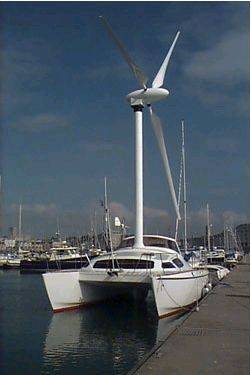
www.treehugger.com/renewable-energy/windmill-sailboat-sailing-against-the-wind.html


www.seabreeze.com.au/forums/Land-Yacht-Sailing/Construction/Quiz-Time/


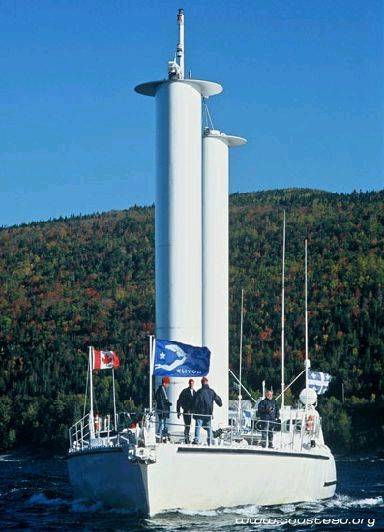
Use of the Magnus effect to power a ship was revived by Jacques Cousteau in 1985 with his famous "Alcyone".

best-breezes.squarespace.com/journal/2006/1/7/rotor-kites-move-from-toy-novelty-to-high-tech-power-generation.html
frant
frant
VIC
1230 posts
VIC, 1230 posts
15 Nov 2010 3:07pm
Gizmo said...

evlPanda said...

Ok, that's great. Now somebody design something that will sail dead upwind and all our energy problems are solved.


They have !!!!!!!

www.treehugger.com/renewable-energy/windmill-sailboat-sailing-against-the-wind.html


www.seabreeze.com.au/forums/Land-Yacht-Sailing/Construction/Quiz-Time/


And that looks like the technology that could go a long way to solving our energy problems,
Please Register, or first...
Topics Subscribe Reply

Return To Classic site 😭
Or... let us know if a problem, so we can tweak! 😅