scheggia forum posts in last 60 days

scheggia
scheggia
100 posts
100 posts
13 Nov 2026 2:59pm
MeonAsh said..
I've also done videos talking about the different jibes and why you would use them - which is mostly about board speed vs wind speed and apparent wind.
Personally if I'm on a smaller sized wing then I'm nearly always going to do a handle pass - because entry speed is as high as you can manage, which gives you maximum time on exit to sort yourself out before dropping off foil.
Large wings I'll avoid handle pass as the chances it doesn't reopen are much higher - might try a tack, down loop or if it's very light a C line gybe.
If there a good bumps I'll often do a stash gybe and just use the bump to carry me while I turn and redeploy.
If it's absolutely hooning wind I'll do a normal gybe, because the wind is just going to keep it in the air, apparent wind no longer matters, it's a simple well balanced gybe and it keeps the wing powered throughout - stability and simplicity over trying to be clever.


Yeah, the handle pass is a lot easier with parawings with short lines — that’s why I’m really happy with my LTX 5.5, the lines are really short for a big parawing.
For me, if it’s borderline rideable I’ll go for the downloop, if there’s a touch of pressure I’ll almost always tack, and if it’s strong I’ll go for the normal jibe. And actually, knowing when to go for the normal jibe is exactly what understanding apparent wind is about — realising that in strong wind it stays in front of you through the whole turn, so the wing keeps pressure without you doing anything special. An experienced rider feels that instinctively, but thinking it through consciously is what lets you make the right call in any condition.


scheggia
scheggia
100 posts
100 posts
12 Nov 2026 2:09am
I've always thought the real challenge in parawing it's managing a wing with no rigid leading edge. Without that frame, the parawing's shape depends entirely on apparent wind. Turn downwind, speed up, and apparent wind drops and the parwing collapses. Which is probably why we all naturally end up moving toward the down loop, the handle pass, and the tack. Each one is a different way to keep the wing moving through the air — maintaining or recovering apparent wind — while you change direction. Not just "easier jibes," but specific answers to the same underlying problem. I tried to put together a breakdown of the physics and all three maneuvers with that idea as the starting point:


Curious what others think — why is this side of it almost never discussed? Is it just assumed knowledge, or does everyone figure it out the hard way?
Reply in Topic: Parawing VMG
scheggia
scheggia
100 posts
100 posts
5 Nov 2026 3:30pm
Had a short session on the AB 5.7 in super light wind, around 10-12 knots. The thing is massive and the lines are really long! My first jibe ended in a massive crash, leaving a complete mess of tangled lines. After that, I decided to just tack, and it worked fine.
I was also really surprised by how well it packs compared to the PRv2. Not smaller, but easier and faster to pack.
My LTX is much more enjoyable to fly in light wind, thanks to the much shorter lines and lighter canopy. It also packs faster and smaller.
Now, the AB is 1 knot faster in VMG!
I had planned to compare it with the Hybrid 5.7, but the wind completely died... However, my friend was riding the Hybrid at the same time (I was on the 1130S and he was on the 960R), and the differences seem smaller here. Still, the AB had the best sustained VMG by 0.3 knots.
I don't know if it makes sense for the bigger sizes and light-wind conditions, where, at the end of the day, I'm unlikely to do long upwind/downwind runs. But the performance difference is starting to become significant...


LTX


AB


Hybrid 5.7

Reply in Topic: Parawing VMG
scheggia
scheggia
100 posts
100 posts
27 Oct 2026 2:29pm
what are you riding there.... 18kts of VMG at 30 degrees is something that goes really really fast....
Reply in Topic: Parawing VMG
scheggia
scheggia
100 posts
100 posts
26 Oct 2026 6:18pm
AnyBoard said..
Very nice. Thanks heaps for supplying so many models. Plenty to digest.
Wow 5m afterburner in 20 knots. What did you think of that?


scheggia said..
I've only had that one session on the AB, and there was still plenty of room at the top end of its range. Really easy to fly! I still need to figure out how to pack it efficiently, but it was a long upwind session and I only packed it a couple of times. We haven't had a decent windy day for an upwind/downwind mission in three months now...
I'm regular-footed, but the shape of our coastline creates a right shift as you go upwind. I think that's why my best VMG is almost always on port tack. The session with the Hybrid 5.7 is the only one with wind coming from the opposite direction, and in that case my best tack was starboard.
That's the problem with using a fixed average wind direction for the entire session: it can really distort the data.
My calculations actually use a moving average for wind direction rather than a fixed value for the whole session, and the results are a bit different.
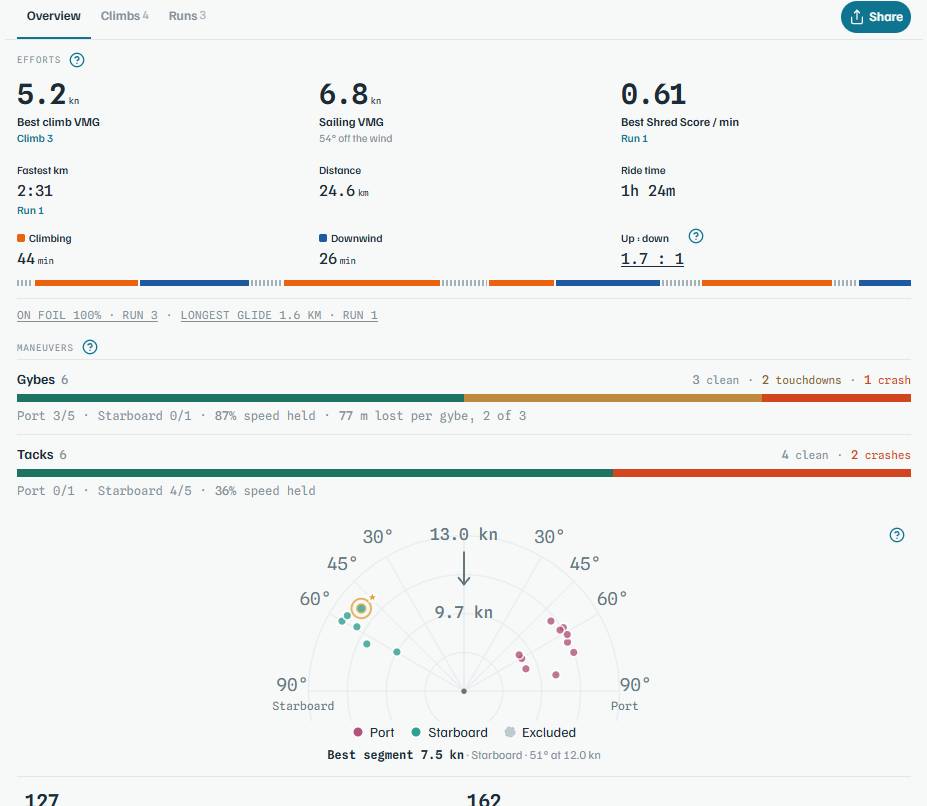
I also like to calculate the 90th percentile of the 5-second moving average VMG. From my experience in sailing, that's a good indicator of the achievable performance. Anything measured over longer periods (like the "Sailing VMG" in Foil Run) takes into account too many other things that can happen during an upwind leg.
I'll try to share some of my calculations in another post and overlay the results from these same sessions to compare them directly.
I just noticed that Jonah uploaded one of his PRv2 sessions through my Google Form, so I'll try to include that one in the comparison too!


You can see on my AB graphic a 10 kt vmg outligher but i know the exact tack and the wind shifted 5 to 10 degrees for a minute. I can see it on the satellite MAP trace view.


I feel like the direction changes average themselves out but the range in wind strength is what has been killing me this week testing the wing. We have had frontal winds all week and in the middle of a very good climb you can see the angle just peel off as the lull comes. I guess that is the reality of climbing upwind with the wind always going up and down to some degree and shifting angles just a little where I live. This analysis is just for interest sake but yesterday i was surprised. I came in from my AB session a little underwhelmed but the angles on the graphic were much better than i realized. It out pointed the orbit sessions so far and i didn't really know but i guess that is the point in that it was doing that pretty easy and fooled me.

I feel like the afterburner for me will do a total effective climb of 8. I think the orbit will sit just below 8 but with much more comfort and can probably be pushed another few knots VMG in that top 15% of its range for those that are game. We will see hopefully.


Wind speed is the key, of course! In sailing, we always associate VMG with a specific wind speed to define a target performance value. As wind speed changes, so does the target VMG. Wind direction isn't really an issue on a sailing boat because you have continuous TWD readings.
But as you pointed out, it's really interesting to play around with these numbers because sometimes the feeling you get when going upwind doesn't tell the whole story. For example, I tend to prefer parawings with a lot of bar pressure because they make me feel like I'm going faster, but that doesn't necessarily show up in the data...


Reply in Topic: Parawing VMG
scheggia
scheggia
100 posts
100 posts
26 Oct 2026 6:05pm


Here's a quick summary of my "Max VMG" calculations. Sessions 2–3 and 4–5 are the only ones that could really be considered valid for a direct comparison, as I was going back and forth with two different parawings in almost identical conditions. Everything else is just for the sake of the analysis.
Reply in Topic: Parawing VMG
scheggia
scheggia
100 posts
100 posts
26 Oct 2026 5:26pm
I've only had that one session on the AB, and there was still plenty of room at the top end of its range. Really easy to fly! I still need to figure out how to pack it efficiently, but it was a long upwind session and I only packed it a couple of times. We haven't had a decent windy day for an upwind/downwind mission in three months now...
I'm regular-footed, but the shape of our coastline creates a right shift as you go upwind. I think that's why my best VMG is almost always on port tack. The session with the Hybrid 5.7 is the only one with wind coming from the opposite direction, and in that case my best tack was starboard.
That's the problem with using a fixed average wind direction for the entire session: it can really distort the data.
My calculations actually use a moving average for wind direction rather than a fixed value for the whole session, and the results are a bit different.
I also like to calculate the 90th percentile of the 5-second moving average VMG. From my experience in sailing, that's a good indicator of the achievable performance. Anything measured over longer periods (like the "Sailing VMG" in Foil Run) takes into account too many other things that can happen during an upwind leg.
I'll try to share some of my calculations in another post and overlay the results from these same sessions to compare them directly.
I just noticed that Jonah uploaded one of his PRv2 sessions through my Google Form, so I'll try to include that one in the comparison too!
Reply in Topic: Parawing VMG
scheggia
scheggia
100 posts
100 posts
26 Oct 2026 4:14pm
777 Hybrid 4.3 (20kts)


Prv2 5.7 (13-15 kts)


777 LTX 5.5 (15-17 kts)


777 Hybrid 5.7 (15-20)


AB 5.0 (20 kts)


I tried to upload sessions where I felt I had roughly the same amount of power across all the parawings — nicely powered, but nowhere near the top end of their wind range. I always used the same foil, the Code 850S, to keep the comparison as consistent as possible.
Where I live, the wind is generally pretty light, so I rarely get the chance to test them in stronger conditions.
Reply in Topic: Parawing VMG
scheggia
scheggia
100 posts
100 posts
26 Oct 2026 3:43am
I have a Google Form where you can upload your session, and I’ll do some VMG performance analysis, similar to what I used to do with sailing boats. Obviously, it’s a lot less precise because we don’t have reliable data on currents or wind speed and direction. That’s why the form has quite a few questions about gear and weather conditions. They’re optional, but the extra information really helps with the overall analysis.
So far, I have almost all my sessions with my 777 parawings, one with an Afterburner (hope for more soon), and a bunch with the PRv2. Unfortunately, I can’t post the link here—I think the forum flags it as spam.
Anyway, if you send me your email address or another way to share files with you, I can send you some of my GPX files.
scheggia
scheggia
100 posts
100 posts
9 Oct 2026 2:57am
I think you’ve got pretty much all the answers here. The LTX has a wider wind range and handles the upper end better. It’s also easier to pack down, with shorter lines and a more compact package.
The PRv2 is generally easier to ride, but the sizes above 3.6 can be a bit of a pain to pack. Since you already have the 5m, though, I’m sure you’ve got the PRv2 packing technique down.
For the range you want to cover, you could also consider selling your PRv2 5m, getting an LTX 5.5 and skipping the 4m size altogether. I’m 70 kg and have used the LTX 5.5 in 25 knots without any issues.
Reply in Topic: Parawing Light Wind Jibe
scheggia
scheggia
100 posts
100 posts
1 Oct 2026 1:19pm
Downloop for me is the most efficient way to jibe in light wind, but don’t discard tacking. At the end of the day, in light wind you just need to find a way to keep the apparent wind up. It could be a downloop, a handle pass, a tack, or whatever else someone comes up with—as long as you can keep that apparent wind going!

scheggia
scheggia
100 posts
100 posts
28 Sep 2026 1:07pm
lobodomar said..
@Scheggia

As already noted by others, the bar pressure on the PR V2 is definitely not light by average standards. I have a 5 and consider it to be heavy, much heavier than I would like it to be (bought it as soon as it was available without trying it out first).

In contrast, the bar pressure on my 777 Hybrid 4.3 is a delight. AoA control and micro adjustments are very "comfortable", both hooked-in and unhooked.

Since I've never flown the LTX, I'd like to ask how you compare its bar pressure to the Hybrid. This might help me understand your frame of reference and the probable impact of having less double-skin chord-wise.

The LTX has more bar pressure than the Hybrid, but it’s still really comfortable and easy to adjust the AoA. Both are really easy to sheet in and out and, in my opinion, much more precise than the PR V2.
I’m always hooked in, and I think part of that difference also comes from the single-point harness, which lets the bar “float” a little more.
scheggia
scheggia
100 posts
100 posts
17 Aug 2026 1:33am
Finally finished editing my back-to-back comparison of the 777 LTX 5.5 and Ozone Pocket Rocket V2 5.7. I tested them in around 15 kts, right in the Pocket Rocket’s range and at the lower end of the LTX’s. I originally went into the comparison focused mainly on upwind performance, but after going through the GPS data and switching between them, I realised the more interesting discussion was actually happening elsewhere. In my opinion, for a big parawing, packability and the whole stow/redeploy workflow can be just as important as pure upwind performance — especially when doing laps and repeated downwind runs. I’ve included GPS analysis, handling impressions, and a side-by-side look at packing/stowing in the video. Curious what you prioritize more in a big parawing: pure flying performance or how easy it is to get it out of the way once you’re on foil?