Carantoc said..
Not sure I really understand that if he estimates the probably is 2% in any one year then it is inevitable in 50 years. Presumably it doesn't compound, so if nuclear war annihilation didn't happen this year that doesn't mean there is a 4% chance next year, 6% the next etc. Every year the chance remains at 2%. Although I guess it all depends on how you chose to look at statistics. Much like, I wonder, the laws of the universe depend on how you look at them.
It appears he used the exponential decay equation to derive 35 years. This is implying that he is assuming independent samples, but I don't know how to interpret it.
The exponential decay formula (wiki "Half Life"). Plug in 1.02 (2% of 1 and add it to make 1.02, 1 is the starting reference, and 1 year is the time. Then solve the half life variable t1/2, which I interpret as the "average time" mentioned in the article. The answer is in years. Pretty much spot on to what the prediction is in the article.
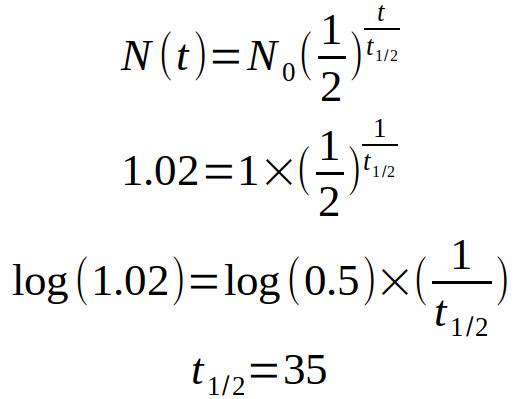
But I still think human behaviour has strong negative feedback. It's like you go surfing, and spot has 7ft whites in it. But, since you don't watch the news or have a smart phone, you go surfing every day. You have a 2% chance of getting chomped. But, then you see one, get scared, and maybe you don't surf there anymore ?.. so then that probability becomes 0%.
PS/ t1/2 is actually -35. Sorry about that. Calculated on paper, then typed up in LibreOffice Math. Forgot the sign.



 &f=1&nofb=1&ipt=b3094d3ab616a17cdc751806e9108ea7df7168d8ebe43dcda6c7e2e25ce4fd3a