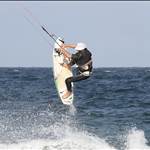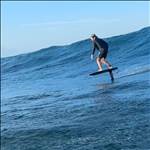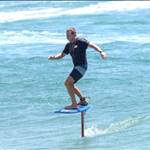


The nose of my 7' light wind wing board has a tendency to dive. It's an older board with modern foil and the tracks are too far back. I'm thinking of attaching some lead to the back to balance the board better. There would be a few people with this problem so I thought I'd put it out there. What do you recon? Why does nobody do this?
Select to expand quoteAUS126 said..
The nose of my 7' light wind wing board has a tendency to dive. It's an older board with modern foil and the tracks are too far back. I'm thinking of attaching some lead to the back to balance the board better. There would be a few people with this problem so I thought I'd put it out there. What do you recon? Why does nobody do this?
Buy a better board.
Extend the tracks. I've put two 8" boxes in front of tracks for people a couple of times. Or just bung in chinook 16" tracks in the right place
Select to expand quoteMark _australia said..
Extend the tracks. I've put two 8" boxes in front of tracks for people a couple of times. Or just bung in chinook 16" tracks in the right place
I did that years ago. Added weight and the balance was still wrong. Board should have the thickness and width in relation to the mast location.
I do not add significant weight. Eg: last ones were longer tracks and moved forward in Kalama DW boards - 300g heavier for far stronger install and more tuning ability.
if the foil has to be mounted further forwards, and we do just that but add a few hundred grams right in the centre of the lift, that does not upset the balance of the board. Having a big breakie or a wee before hitting the water is just as much difference.
And you can't seriously be saying that the board thickness of about 5-10mm difference when the mast is 100mm further forward is actually a consideration.? It wouldn't even be that, board thickness is soooo even in that area.
Select to expand quoteMark _australia said..
I do not add significant weight. Eg: last ones were longer tracks and moved forward in Kalama DW boards - 300g heavier for far stronger install and more tuning ability.
if the foil has to be mounted further forwards, and we do just that but add a few hundred grams right in the centre of the lift, that does not upset the balance of the board. Having a big breakie or a wee before hitting the water is just as much difference.
And you can't seriously be saying that the board thickness of about 5-10mm difference when the mast is 100mm further forward is actually a consideration.? It wouldn't even be that, board thickness is soooo even in that area.
Boards have moved on a fair bit. So yes moving a mast track forward on an old board may not solve the issue.
Mast shim to "lift" the nose of the board relative to you riding angle of attack ?!
If moving the front wing further forward would not help to "fix it" then the board was not that good to begin with. It's the board designer's task to come up with an idea where the rider is supposed to stand on the board, and to distribute the volume and to shape the board accordingly. The foil should then be positioned based on that.
There is not much point to try do it the other way around - i.e.: to place the foil first (wherever you can), and then try to figure out where to stand, to make it work.
Thanks Hilly. I'm surprised you didn't find the magic sweet spot after modifying foilbox. I do appreciate swing weight on longer boards is not ideal and they are not as easy to find the balance point either. I like your thinking Mark and will consider it. First I'll tape some weight to the tail to see if I can make setup more of a beautiful thing. Sometimes it is easier to just go out and buy the next best thing but I do fight this consumerism.
Select to expand quoteAUS126 said..
Thanks Hilly. I'm surprised you didn't find the magic sweet spot after modifying foilbox. I do appreciate swing weight on longer boards is not ideal and they are not as easy to find the balance point either. I like your thinking Mark and will consider it. First I'll tape some weight to the tail to see if I can make setup more of a beautiful thing. Sometimes it is easier to just go out and buy the next best thing but I do fight this consumerism.
MrFish has a point as well. Mast or tail positive shim will add front foot pressure. I did that with one board and then moved the tracks but it was always a compromise. Got a board suited to the foil and it was night and day better.
Select to expand quoteTaavi said..
If moving the front wing further forward would not help to "fix it" then the board was not that good to begin with. It's the board designer's task to come up with an idea where the rider is supposed to stand on the board, and to distribute the volume and to shape the board accordingly. The foil should then be positioned based on that.
There is not much point to try do it the other way around - i.e.: to place the foil first (wherever you can), and then try to figure out where to stand, to make it work.
Different foils suit different placement. GoFoil V2 v Armie mast position would be 300mm at least. How does a designer solve that??
Not sure what brand of foil you are on but if it's a brand like Slingshot , Neil Pryde, Starboard & even Go Foil ect they have Windsurf foils in their range. Their Fuselages are very different which place the front wing much further forward away from the mast (because their have to be so far back) This would help heaps if you can get one or if you have an Alloy fuse you could chop it and extend it. I played around a lot with this in the early days as the Windsurf Foils were much higher HA than the early surf/sup foils which were big fat and slow. (circa 2017)
You can pick up complete Neil Pryde Windsurf kits for $200 or $300 no one wants them. The Tuttle and base plates just bolt on or off. Here is a link to one.
www.seabreeze.com.au/Classifieds/Foiling-Windsurfing-Foilboards/~4u17g/2020-Neil-Pryde-Glide-Wind-Foil-65-cm.aspx?search=fuwpz2%20n4D1M2YXPW8crvA%3D%3D&t=0&ref=sm


Select to expand quotehilly said..Taavi said..
If moving the front wing further forward would not help to "fix it" then the board was not that good to begin with. It's the board designer's task to come up with an idea where the rider is supposed to stand on the board, and to distribute the volume and to shape the board accordingly. The foil should then be positioned based on that.
There is not much point to try do it the other way around - i.e.: to place the foil first (wherever you can), and then try to figure out where to stand, to make it work.
Different foils suit different placement. GoFoil V2 v Armie mast position would be 300mm at least. How does a designer solve that??
Easy. The designer solves that by using tracks that are long enough. For example this Sabfoil setup was even more extreme than Armstrong in that sense - that is, due to the fuselage design, the front wing was even closer to the mast. Yet, since the tracks were long enough and well positioned there was no problem to move the mast further forward, and to get a perfectly dialed setup.

My point was that on any given board there is a sweet spot where you should stand. Only then the board would be in balance, and only then the board would interact with the water as the designer intended. If the tracks are too short then either find out if there is a different fuselage for your foil brand (that positions the front wing further away from the mast), or make the tracks longer, or use another foil with that board.
Select to expand quoteTaavi said..hilly said..Taavi said..
If moving the front wing further forward would not help to "fix it" then the board was not that good to begin with. It's the board designer's task to come up with an idea where the rider is supposed to stand on the board, and to distribute the volume and to shape the board accordingly. The foil should then be positioned based on that.
There is not much point to try do it the other way around - i.e.: to place the foil first (wherever you can), and then try to figure out where to stand, to make it work.
Different foils suit different placement. GoFoil V2 v Armie mast position would be 300mm at least. How does a designer solve that??
Easy. The designer solves that by using tracks that are long enough. For example this Sabfoil setup was even more extreme than Armstrong in that sense - that is, due to the fuselage design, the front wing was even closer to the mast. Yet, since the tracks were long enough and well positioned there was no problem to move the mast further forward, and to get a perfectly dialed setup.
My point was that on any given board there is a sweet spot where you should stand. Only then the board would be in balance, and only then the board would interact with the water as the designer intended. If the tracks are too short then either find out if there is a different fuselage for your foil brand (that positions the front wing further away from the mast), or make the tracks longer, or use another foil with that board.
Or get another board. Boards are cheaper than foils.
Select to expand quotehilly said..
Different foils suit different placement. GoFoil V2 v Armie mast position would be 300mm at least. How does a designer solve that??
Now you're contradicting yourself unless I read that wrong..
if the foil needs radically different position (in the case of the OP is newer style foil in older style board) - move the tracks. You earlier said my suggestion has no merit
if he needs foil forward just a bit more, why not? better than adding weights or buying a new board.
you say a new board is cheaper than foil - but if you're on a budget a $400 job to make an old board work could be the go.
I did. He said new foil in old board doesn't work and needs to be more forward. I said move tracks. you said that's a bad idea.
then later on you say different foils need way different positions
people get me to put tracks in DT boards all the time and are happy. If the OP wants to achieve balance then why not? Shimming to be more nose-up is not quite the same and $1-2k for a board is not an option for some folks.
Select to expand quoteMark _australia said..
I did. He said new foil in old board doesn't work and needs to be more forward. I said move tracks. you said that's a bad idea.
then later on you say different foils need way different positions
So rocker, wide point, tail width, rail shape, profile, deck profile, etc have nothing to do with it.
Feel free to ignore a wind foilers opinion if you want, but the usual quick fix for a nose that wants to dive is what Mr Fish said, shim the stabilizer for more lift.
Not sure if the foil brand you use has there own shim system, but you can use an appropriately sized stainless washer or shaved down piece/s of plastic ice cream container to do the job. Bonus of the ice cream container is you'll have a tub of ice cream that needs eating before you can use the lid.
ultimately longer tracks one way or another are the proper fix.
The way you say dive makes it sound like it's a nose diving at speed. Does it feel like you'll be up and riding and all of a sudden the nose wants to drop and you have to lay on the back foot? That's a foil/tune problem. Very common even on modern surf foils esp uni progressions
If I were unable to move my foil more forward, and had too little pressure under the front foot, I would change something with the rear wing.
Either shim it, put on a more powerful rear wing, or a longer fuselage.
Most easy way that doesn't require any investment is to shim it.
With tuttle box this is usually the way to get things in balance.
Thanks for replies. My light wind wing board is a 7' x 65l litre Naish prone board about 4 years old matched with Code 850 front, 150 rear, 85 mast and long fuse. I appreciate your input on shimming but feel shimming these lower drag foils just kills the performance of a beautiful thing. This is why I thought balancing boards with weights might be a good thing to discuss.
Select to expand quotehilly said..Mark _australia said..
I did. He said new foil in old board doesn't work and needs to be more forward. I said move tracks. you said that's a bad idea.
then later on you say different foils need way different positions
So rocker, wide point, tail width, rail shape, profile, deck profile, etc have nothing to do with it.
Yup
cos it's a specific pitch only issue.
he can't change those cos the board is already made. So he has to move tracks, weight tail or shim. Only.
Select to expand quoteMark _australia said..hilly said..Mark _australia said..
I did. He said new foil in old board doesn't work and needs to be more forward. I said move tracks. you said that's a bad idea.
then later on you say different foils need way different positions
So rocker, wide point, tail width, rail shape, profile, deck profile, etc have nothing to do with it.
Yup
cos it's a specific pitch only issue.
he can't change those cos the board is already made. So he has to move tracks, weight tail or shim. Only.
And what I am saying is moving tracks in a 4 year old board is a waste of money. Plenty of cheap second hand boards out there that will be a huge leap forward.
Well good point. Now I'm hearing prone board hmmm dunno how much I'd persist in trying to fix issues when using it to wing
Maybe I am misunderstanding this whole conversation but why wouldn't you just shim the mast?
Select to expand quoteCH3MTR4IL5 said..
Maybe I am misunderstanding this whole conversation but why wouldn't you just shim the mast?
I am with you.
I feel like this conversation is going in the wrong direction @AUS126 is the problem across the speed range (hard to get on foil, back foot heavy on foil at low speed, and back foot heavy at high speed) OR does it feel fine at low speed but at a certain higher speed the nose wants to drop out? If it is the latter nothing you do involving the board will make a meaningful difference. At the most you'll be more balanced at high speed and less at low speed. It sounds to me like you are going too fast for that front wing! All these setups have an optimal speed range and if you push them too fast almost all of them tend to nosedive at a certain speed esp when pushing them with power