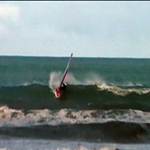
That's crazy offshore - where's that?
I've thought about this more and reckon 45 degrees is about the magic number; but there are too many factors to make a hard and fast rule of thumb....


In lighter winds anyway (I think) it is all about generating enough speed to match wave speed (20 m/s for a 13 s period wave, 26 m/s for a 17 s). Surfers do this by paddling - the smaller the board the closer the peak you need to be (angle theta needs to be greater to get that sliding happening). For really high period waves (e.g., Jaws) you can't generate that much paddle power - hence the tow-ins and sail boards. For us wave sailers we can pick up a wave before it breaks, if there's some wind blowing, dogg along on it until it starts to jack up and we can gain enough velocity to ride it. The wind has got to be coming from the right direction - sideshore is best (but the waves often crumble), 45 degrees is great - still have 7/10ths of our speed in the direction of the wave and nice clean waves, offshore - have speed but in wrong direction (especially in non-planing conditions). I read somewhere we can achieve up to 0.9x wind speed. If you're planing in 20 knots (10 m/s) I guess you'd be doing up to 9 m/s which from experience makes it easy to pick up a 13 s period wave doing 20 m/s. That's enough science for now - there's still plenty of magic in this.
How to optimise the light wind wave sailing experience?
I guess (don't have one myself) multifin boards help you head up wind more and put your speed in the direction of the wave.
Bigger sails? - though I'm not really comfortable out in waves with more than 5.2- too much foot for the wave to catch onto going out - one of the videos has the Pros saying they use up to wave 5.8's and 6.0s.