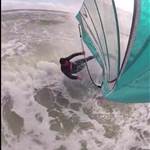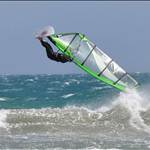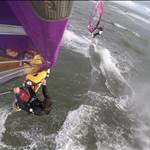


Okay, giving this a go a few times yesterday at Sandringham. Only with the assistance of being chest high in the water did I pull of a psuedo water start a few times... got the right feel a few times of the wind kind of "raking" me out of the water, which was cool, kind of turned me out of the water.... but for the life of me... when I tried it just by treading water I was sinking quick and found it hard to keep my head above the water.... a mate suggested my boom was too high, which could have been one of many factors....
any tips for keeping you sail up and head up out of the water?
I am guessing you need to throw the sail onto the wind, so it is almost hovering a bit... found that a few times yesterday where I could have the sail supporting itself in a sweet spot and only needed a pushing up a little to generate pull.... observed this, but couldn't make use of it 
http://www.boardseekermag.com/technique/water-start-rig-clearing.html
www.iwavesolutions.com/lefebvre/Windsurfing/Articles/starting.html
on lower wind days often need to start 90-120 degrees to wind so a little downwind.
When learning a life-jacket helps and wetsuit for buoyancy.
Start in shallow and work to chest depth. Always practice in both directions.
Good effort trying to get out yesterday and attempt some in that wind !!!
Waterstarting will make life easier and increase on water time.
Thanks H2O, those links are helpful. Like the idea of graduating depths until you are getting it.
Having learnt relatively recently :
i found the biggest thing holding me back was having an old 0% carbon mast and old not-watertight boom (i.e. one with stud buttons inside that push out through holes where the length is adjusted). The boom made the biggest difference, the newer one appears to be filled inside with foam and so has +ve bouyancy.When the old one filled with water it was difficult to get the clew up out of the water, which I tried fixing with a foam float at the clew of the boom (didnt work well) or better is to kick the board tail under the boom clew to raise it from the water.
But it sounds like you're onto the next stage (sails flying but your not up on the board yet). I found this stage much easier, when its not marginal.
As was pointed out to me having your front leg vertical is important to retard your downwind drift and so get more leverage.
Also having your boom low helps you get more leverage, some people hold onto the mast below the boom to get even more leverage.
Your back foot has to on the board so your sole is facing the mastfoot, or else as you come up you'll push the board away. As you come up think about using back foot to pull the tail underneath your arse.

buoyancy vest (like this type: http://www.neilprydewaterwear.com/index.php?option=com_content&view=article&id=265:high-hook-ce&catid=73:vests&Itemid=189) helps alot - especially if you need to spend alot of time in the water. It will reduce your fatigue massively plus keep you a little warmer for the coming winter.
other stuff that I find helps:
-angle of rig to the wind, your rig should be easily "flying" unless it is underpowered.
-kick like hell as flipper said with your other leg that is in the water when you pop out.
It is an awesome feeling once you get it sorted - beats up hauling.
It always surprises me how instructors dont explain the easiest technique first... the second example in the Jem Hall video show this:
1. put the mast track forward and lower the boom a bit.
2. put the mast *parallel* to the board, with the boom on the back of the board.
3. make the board point upwind a bit (about 20 deg upwind).
5. pull the boom your front hand (like when uphauling)
at this point the rig will fly quite easily and you will get lifted out of the water reasonably easily -> step on with your back foot first; if its really windy, put your foot straight into the strap. If the boom doesn't sit on the back of the board, grab the back footstrap with you back hand, and put the boom on your arm.
When learning to waterstart, flying the rig isn't too hard to learn... getting onto the board is. This technique ensures that your hips are close to the board, allowing you to just about "step onto the board". If the board moves away from you, dont try to chase it with your feet... just put the rig on the back of the board again.
The biggest tip that nobody has mentioned is to make yourself really small. By this I mean you want to make it as easy as possible for the rig to pull you out of the water.
So keep your arms straight and up above your head so the sail can catch the wind and tuck your knees up as much as possible. Keep you body weight as close to the centre of the board as possible. Don't pull on the rig . let it pull you. Once you are up on the board then straighten your legs.
If you have you legs too straight and your body too far away from the board the rig can't pull you out ( unless it is really windy)
Keep trying, you will get it.
When the winter northerlies blow up I suggest come down to Rye (heaps of sailors there during a strong winter northerly). Rye has a sometimes annoying amount of sandbanks which is bad when you're screaming along and you hit one, but an excellent place to learn waterstarting as you will rarely be over your head.
Onshore wind, very slow progression to deep and lots of sailors to ask for help, can't go wrong.
You had it right when you said you done it in chest deep water. Thats the way I learnt as it gives you more control over the rig and the board. Trying to control these can come once you can actually get up on the board. It was too frustrating doing all of these at once. Also plenty of wind helps at first, technique for lighter wind can develop later. It took me ages to do water starts on beach chop until i done one on a 9.8 metre sail standing in deep water. After that point I could do them no worries.
One thing that's important to realise is that you're not really using the sail to lift you, like a dead weight, up and onto the board. Yes the sail gives you some lift, but you also have to be proactive and step up onto the board.
As someone once said to me, imagine you are stepping up onto a high table. You put one leg up first, then step up by throwing your body weight over the table and swinging yourself up and on. Thats kind of what you do waterstarting. I think of stepping up (like onto the table) while throwing my head forward (to swing my weight over the board) and my arms up (to get some lift into the sail, which also gives you something to balance against), pretty much all at the same time.
Unlike gybing, a skill which tends to deteriorate over time with no practice, once you get the water start it will be second nature. Only challenges then are to waterstart in lower and lower wind or when way overpowered.
I learnt to waterstart when I was 15, then after a 16 year break I was able to do it first go. Took me a good summer with noone to observe or offer tips. I figure you can cut that time down dramatically if you get an experienced windersurfer to give you a half hour lesson in the right wind conditions.