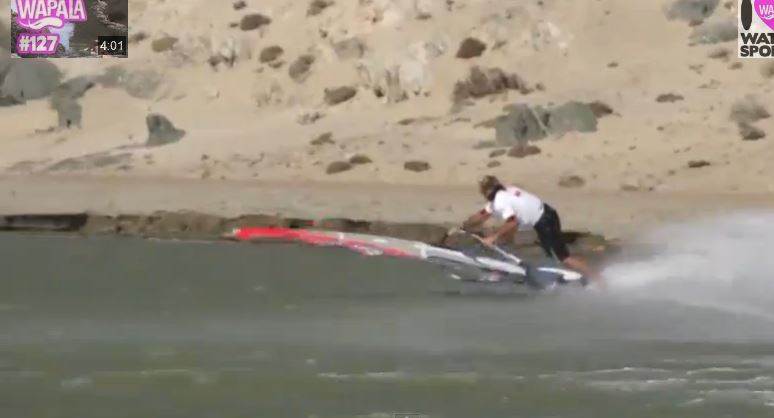
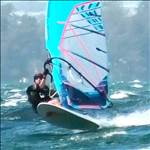
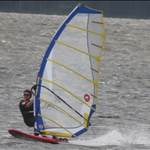
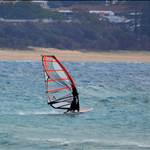
Thr hardest part of gybing in strong winds in the JP slalom is getting the back foot out and into the opisite strap, on these boards your back foot really controlls the the load on the fin that keeps it stable.
In rough conditions you need to bear away and pick a flat section thru a trough and get the foot onto the opisite pad so yout foot is near the strap, pushing down on the edge to initiate the gybe,
At this point your body position should be bent knees and leaning into the gybe, this will keep the tail from sinking and stop the board from losing speed.
Saill wise at the same time pull in back hand push out front hand as mentioned above. what this does is puts a lot of downward pressure onto the board and helps keep the board from bouncing - lets you punch thru the chop rather than bounce over it.
As you rotatate slowly sheet out to maintian pressure in the sail. if you keep the sail too close to you as you rotate you will have a lot harder time when it comes to the flip.
Personally in strong winds i like to flip the sail really early. As you hit about 90 degree off the wind i release and and reaquire the sail on the opposite side before the board turns another 45 degrees. Ideally you want to be sheeting in while still on the reach and keeping speed up. By maintaining speed the apparant wind is very low and makes it A Lot easier to power it up for the exit.
As you sheeting in again you can just rotate your foot into the strap at this point you have both feet in straps and have the leverage you need to pull the sail into position. As soon as you feel comfortable pull youy back foot into the back strap and accelerate!

The biggest mistake most ppl do when learning is lack of commitment. almost never bend the knees enuf and lean forward into the gybe. Learning it is hard becase it really feels like you are going to get catapulted byt this only really happens because you sont commit enuf and the board slows down.
Simply put less speed = more apparent wind = harder to control.

 )
) 

 at the times


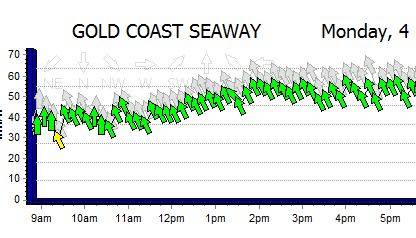
 wind could be even stronger then 35 ktn (??),water seems to be similar quality, definitely have more skills and talent that me
 and I landed knee on the board