

Hi:
I "unboxed" a Tiga from 1990 that I restored this week, and sailed it with 10/15 knots and my modern slalom sail 6,7m and it was a blast. On the plane, in the footstraps and really enjoying it. Then, the same wind, sail and sailor but I tried my secondhand Tabou 105L Rocket 61. I kept drowning the nose at starts, when got planing I tended to go upwind... a crap.
So, I think I KNOW what I should do. But a little conceptual help could solve my issues:
I THINK that I should stand close to where the footstraps are as soon as I get to speed. I think that but I don't do it because from my traditional point of view, the board has a nose... A short board looks like the rear part of a "normal" board (in my universe)... and I guess I should start to just ignore the front and just use the rear as it has an invisible 1,5M nose (as the long boards I was used to really have). In my mind, I think that if I just sheet in in the back, I will automatically steer upwind (as was the case with the long boards if done too early).
How to transition into shorter boards? Forget about water start, I can pathetically uphaul by now.
Thanks!
Good to hear of your board revival, some of those older boards were classics.
The older boards used to be longer and the board produced less sideways movement and more forward movement, so in some ways you don't have to bear away as much to get them planning, and the Tiga's were actually a very quick board especially the 260 slalom which I think had the production board speed record for a while.
Newer boards are more comfortable when riding for sure but you need to bear away a lot more when trying to get them planning and as theres width behind the mast track you can get back much quicker too and push a lot more agains the fin to create that lift.
Ignore the nose, it'll do its own thing, it'll probably catch chop more as its lower but a lower nose causes less drag and makes the board more efficient for a shorter board, just adjust with back and front foot pressure.
I have recently discovered that boards from around 2012 work much better for me and match to my sale a lot more.
Hope that helps and hope you have a blast on that older gear.
Select to expand quoteMadge said..
Good to hear of your board revival, some of those older boards were classics.
The older boards used to be longer and the board produced less sideways movement and more forward movement, so in some ways you don't have to bear away as much to get them planning, and the Tiga's were actually a very quick board especially the 260 slalom which I think had the production board speed record for a while.
Newer boards are more comfortable when riding for sure but you need to bear away a lot more when trying to get them planning and as theres width behind the mast track you can get back much quicker too and push a lot more agains the fin to create that lift.
Ignore the nose, it'll do its own thing, it'll probably catch chop more as its lower but a lower nose causes less drag and makes the board more efficient for a shorter board, just adjust with back and front foot pressure.
I have recently discovered that boards from around 2012 work much better for me and match to my sale a lot more.
Hope that helps and hope you have a blast on that older gear.
Thanks Madge! My Tiga is a "Fuego" model, I can't even find specs online for it. I suspect it is the Aloha but with another name.
As I'm old and my last board in my youth was a Mistral Equipe, those longer boards feel really natural for me. They plan with "elegance". I also have a newer medium board, a Bic Core 148L that I can use with ease once I learnt to understand it, but in my mind it is too wide for the length it has. But... the Tabou 105L is too much a new concept for me :-)
I was looking at some videos, my question is: you have to bear them away a lot so they plane and then... what do you do? In my case I understood I had to bear away so it speeds up, but then I was not as fast as I was supposed to with the existing wind. By the way, I was way faster with the mammoth Tiga! So, I guess the problem is with what I do with the foot and my arms... To sheet in, keep the sail forward and the proper stance, do you have to stretch the arms like something weird? Isn't it unnatural? I hope I'm wrong but, how is the proper stance's shape?
I was looking at this videos and grabbing some concepts.
Something that makes me doubt: the fin should be big as? I bought it secondhand and comes with 2 fins. One is a wave style one, about 24cm long with the curved shape. The other one is 46cm long and straight.
I was surprised comparing it side by side with the one in the Bic Core, this one looks like 30% or more bigger in area than the wave type I have in the Tabou. Maybe this worsens my problem and that's why it oversteers against the wind? I was like really going drifting sideways but I tended to think "if the previous owner used this fin, it should be the correct size"...
Thanks!
JP
yep fins are a big deal, because once planning that's what you are relying on. A wider board needs a longer fin, to help keep the windward rail up.
A 24cm wave fin won't be ideal for a 6.7 sail, I'm around 65Kg and would use a 30 to 35 depending onboard width. If you're closer to 80Kg, the big fin would be better.
I struggle a bit with my short semi sinker in lighter wind. There's plenty enough to plane, but getting there is a struggle. The transition from sail forward sub planning to body weight and sail back, has to be carefully done. But once back in the straps, the sail is racked back and your flying. If the fin is small you have to bear off to get up to speed before heading more upwind. The fin has to be powered up, and for this it needs water flow around it.
So yes you need to get your weight back, but bring the sail with you, and bear away to get up speed, once there everything should become light and effortless.
But you also need to be powered up.
If there's plenty of wind, I can go from water starting to fully planing in one move. Not sure about uphauling, I only do that when underpowered. But I guess you pull the power on gently and move back as you do so, making sure you don't go too far up or downwind.
There should be little difference between small gear and big gear. When they are use within their wind range.
As you realized the fin should match both board and sail size. This gives you the drive and lift.
I have a freewave 77L from 06 and it's an autopilot. Really passive locked down sailing. Yet it's very small.
So check fins, check mast foot setting and concentrate on keeping your rear foot on the center line of the board until you get decent speed.
Select to expand quotedecrepit said..
yep fins are a big deal, because once planning that's what you are relying on. A wider board needs a longer fin, to help keep the windward rail up.
A 24cm wave fin won't be ideal for a 6.7 sail, I'm around 65Kg and would use a 30 to 35 depending onboard width. If you're closer to 80Kg, the big fin would be better.
I struggle a bit with my short semi sinker in lighter wind. There's plenty enough to plane, but getting there is a struggle. The transition from sail forward sub planning to body weight and sail back, has to be carefully done. But once back in the straps, the sail is racked back and your flying. If the fin is small you have to bear off to get up to speed before heading more upwind. The fin has to be powered up, and for this it needs water flow around it.
So yes you need to get your weight back, but bring the sail with you, and bear away to get up speed, once there everything should become light and effortless.
But you also need to be powered up.
If there's plenty of wind, I can go from water starting to fully planing in one move. Not sure about uphauling, I only do that when underpowered. But I guess you pull the power on gently and move back as you do so, making sure you don't go too far up or downwind.
Now I'm understanding a little more because what you describe is just what I feel. If I don't let it bear away it just sinks or gets stuck sideways in the place. What is the first aim? Like an open reach? So I absolutely understand the whys and will try to give it another try today if wind comes. I have a 5.5 sail and a 6.7, I took the big one thinking about wind being not enough for the Tabou as it was 10/15 knots, but in the water I felt that the 5.5 would have driven it enough. Maybe the lighter sail could help me learn faster.
as fin and weight I have another 31cm long and I weight 67KG.
thanks a lot! This will not be easy but I will do it!
In that case I would go with the 31. That's what I'd be using with the 6.7 and we're about the same weight.
In 10/15 I'd probably use my 6.6. A 5.5 may not let you get back in the straps, and that's what you need to concentrate on doing. You need power to get to speed and get the fin working.
I don't rig my 5.7 until it's around 20kts, around 18kts I use a 6.6, a 5.2 when it's 25kts.
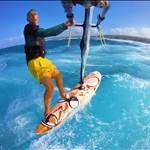
As you start off downwind, you sheet out slightly, as you pick up speed and the apparent wind shifts forward you sheet in more and move back on the board, this lifts the nose, reducing wetted area, so you pick up more speed. This is a natural progression, and the more powered up you are the faster it can happen. On my little board the acceleration, once in the straps and hooked in is exhilarating. Check where the water entry point is on the board. Fastest is behind the front foot strap as long as the board is trimming fairly flat, you don't want to point the nose at the sky to achieve this. That will be something to work towards, optimum trimming is complicated and varies considerably with rider, gear and conditions. If you're getting advice it's best coming from someone around your weight. I've had advice from much heavier guys that just didn't work for me.
Select to expand quotedecrepit said..
In that case I would go with the 31. That's what I'd be using with the 6.7 and we're about the same weight.
In 10/15 I'd probably use my 6.6. A 5.5 may not let you get back in the straps, and that's what you need to concentrate on doing. You need power to get to speed and get the fin working.
I don't rig my 5.7 until it's around 20kts, around 18kts I use a 6.6, a 5.2 when it's 25kts.
As you start off downwind, you sheet out slightly, as you pick up speed and the apparent wind shifts forward you sheet in more and move back on the board, this lifts the nose, reducing wetted area, so you pick up more speed. This is a natural progression, and the more powered up you are the faster it can happen. On my little board the acceleration, once in the straps and hooked in is exhilarating. Check where the water entry point is on the board. Fastest is behind the front foot strap as long as the board is trimming fairly flat, you don't want to point the nose at the sky to achieve this. That will be something to work towards, optimum trimming is complicated and varies considerably with rider, gear and conditions. If you're getting advice it's best coming from someone around your weight. I've had advice from much heavier guys that just didn't work for me.
Haha with that suggestion about advise from similarly weighted sailor you are setting yourself up to be bombarded by questions :-)
But, I will do my duties and try to practice what you say. Just ONE more: when you steer downwind first, in low to medium wind, you set both foot in the back of the mast or not? I have a tendency to leave the front one before the mast but I feel that the board can float the same if I'm towards the back. I've learnt that keeping foot in the centerline while slow is critical, a thing that my dinosaur boards don't care about with their daggers:-)
thanks!
The other thing of course is we're sailing different boards. I have a 65cm 110 litre, that I use in light winds. Sailing that, I would never have my foot in front of the mast, maybe very close behind it, when there is almost no wind, and I have the mast racked forward a long way. As soon as there's enough wind to support the sail, and I don't have to hold it up, I'm in the harness, feet between mast and straps, then as the wind increases and there's enough to support me, I move back into the straps and start planning.
But saying all that, if the mast track is too far back, I would probably have to put a foot in front of the mast to get board trim right. You always want to have the power of the sail close to your centre line, so where the sail needs to be, you need to be there also.
Select to expand quoteJPBARNA said..
Now I'm understanding a little more because what you describe is just what I feel. If I don't let it bear away it just sinks or gets stuck sideways in the place. What is the first aim? Like an open reach? So I absolutely understand the whys and will try to give it another try today if wind comes. I have a 5.5 sail and a 6.7, I took the big one thinking about wind being not enough for the Tabou as it was 10/15 knots, but in the water I felt that the 5.5 would have driven it enough. Maybe the lighter sail could help me learn faster.
as fin and weight I have another 31cm long and I weight 67KG.
thanks a lot! This will not be easy but I will do it!
Older boards you could sort of chug along and they would slowly lift up. Newer, wider boards, lacking the length, don't want to do that. As well, the shorter rocker line means if you stand forward, you are just pushing the rocker (curve of the bottom) into the water instead of letting the back part of the board - the flat part - accelerate.
Yes, bearing off is what makes it work. Bear off and let the fin "hook up" - you'll start to feel when it has enough speed that it's generating enough power/lift to let you go back up to a reach.
The other aspect of newer/wider boards is that your back foot is further from the fin. At lower speeds you'll need to make sure your heels aren't pushing the windward/upwind rail down into the water which both makes the board want to turn upwind and makes planing a lot more difficult. As well, a bigger fin to push against helps. The width allows you to control a bigger fin than you can on a narrower board.
www.windsurf.co.uk/jem-hall-move-on-up-planing-and-getting-in-the-footstraps/
Select to expand quotePaducah said..JPBARNA said..
Now I'm understanding a little more because what you describe is just what I feel. If I don't let it bear away it just sinks or gets stuck sideways in the place. What is the first aim? Like an open reach? So I absolutely understand the whys and will try to give it another try today if wind comes. I have a 5.5 sail and a 6.7, I took the big one thinking about wind being not enough for the Tabou as it was 10/15 knots, but in the water I felt that the 5.5 would have driven it enough. Maybe the lighter sail could help me learn faster.
as fin and weight I have another 31cm long and I weight 67KG.
thanks a lot! This will not be easy but I will do it!
Older boards you could sort of chug along and they would slowly lift up. Newer, wider boards, lacking the length, don't want to do that. As well, the shorter rocker line means if you stand forward, you are just pushing the rocker (curve of the bottom) into the water instead of letting the back part of the board - the flat part - accelerate.
Yes, bearing off is what makes it work. Bear off and let the fin "hook up" - you'll start to feel when it has enough speed that it's generating enough power/lift to let you go back up to a reach.
The other aspect of newer/wider boards is that your back foot is further from the fin. At lower speeds you'll need to make sure your heels aren't pushing the windward/upwind rail down into the water which both makes the board want to turn upwind and makes planing a lot more difficult. As well, a bigger fin to push against helps. The width allows you to control a bigger fin than you can on a narrower board.
www.windsurf.co.uk/jem-hall-move-on-up-planing-and-getting-in-the-footstraps/
Yes! I smiled myself in the sea when looking at the nose submerged like 15cm for a while... With this awesome tips I'm sure I will learn how to do it. I have a compilation of things to avoid, and this would help the most.
@decrepit you say that your 110Litre is for light winds? Is my 105Litre usable by any means in light winds? How strong is the minimum to justify taking it to the water? I read that with a 6.6 sail you could be in 10/15 knots but... is this something you enjoy? In my case, I just have to find the moments to learn to ride this modern thing so I try to go anytime, but what is the minimum normal to learn?
I ask because several days I take 2 or 3 boards to the beach and maybe I can go with the Rocket only but assorted sails (once I learn!)
and last! I think my harness lines u shaped are old and short for what I should use?
Thanks!
JP
I can get planning in about 13 knots, with a lot of pumping, but I can probably stay on the plane until it drops below 10kts.
If the water is flat, it's warm and the sun is out this can be a pleasant cruise. It's certainly good for learning, because you need sensitive subtle movements. In stronger wind you can just blast on to the plane.
I've become a speed junky, so I prefer small gear, strong winds and flat water. Not happening much at the moment so I have to take what I can get. At my age TOW is important because fitness quickly drops of if it's too long between sails. The big gear gets me on the water when the small stuff can't.
Harness lines should be able to take your whole weight with arms fully out stretched. This is fast mode, as much leverage over the sail as possible, but that will come, there's more important things for you to focus on at the moment. But this length will be fine while learning. I use 26cm lines for blasting and 24cm lines for wave sailing, so either of those should be usable
The Rocket 61 105 came with a 34 Freeride Stock Fin. A Fin about this size works well with it, my favourite ist a Drake Freeride 34. Only Go smaller when you're seriously overpowered, which doesn't seem to bei your problem.
Once you get used to it, the board won't disappoint you.
That's funny, I have the same size Rocket and still have my old Tiga 254 Wave/Bump and Jump (bought in 1999 so the last generation of plastic Tigas, I think) which I pull out for the odd super-windy day.
This has been surpassed by the beautiful little Severne Fox 95. But if you're an older sailor you might sail like me and need a big fin to really lean on. I use the same big weed fin (can't recall exact size) on either the Rocket or Fox no matter what the conditions. In light wind, you need the bigger fin to generate lift and hold a bigger sail and in strong wind to stop spinning out. I don't even use the small standard fin the Fox came with as the big fin is much more all-purpose and comfortable to use and a weed fin is great on the river, even if there's no weed, as you can safely come in to shore with less chance of damaging your fin or finbox.
I do also have a bigger Tiga - around a 265 and I would say while it is a comfortable and an indestructable board, the Rocket is 100% easier to get on the plane and get moving and so I spend much more time having fun with it on the water than with the Tiga.
Select to expand quoteTopcatRacing said..
That's funny, I have the same size Rocket and still have my old Tiga 254 Wave/Bump and Jump (bought in 1999 so the last generation of plastic Tigas, I think) which I pull out for the odd super-windy day.
This has been surpassed by the beautiful little Severne Fox 95. But if you're an older sailor you might sail like me and need a big fin to really lean on. I use the same big weed fin (can't recall exact size) on either the Rocket or Fox no matter what the conditions. In light wind, you need the bigger fin to generate lift and hold a bigger sail and in strong wind to stop spinning out. I don't even use the small standard fin the Fox came with as the big fin is much more all-purpose and comfortable to use and a weed fin is great on the river, even if there's no weed, as you can safely come in to shore with less chance of damaging your fin or finbox.
I do also have a bigger Tiga - around a 265 and I would say while it is a comfortable and an indestructable board, the Rocket is 100% easier to get on the plane and get moving and so I spend much more time having fun with it on the water than with the Tiga.
Thanks for your help! I'm glad you keep those boards! I've been offered a Tiga Free X to repair and keep, and I had also got an F2 Comet of similar shape than my current Tiga but much lighter because of construcci?n. I had not been sailing lately because of family and kids but would get back soon and will use all this tips. Thanks!