How to disassemble mast?

> 10 years ago
Reply
Register to post, see what you've read, and subscribe to topics.
Macroscien
Macroscien
QLD
6809 posts
QLD, 6809 posts
22 May 2011 12:54am
Again and again. I have two older stubborn masts that are so easy to jam that I give up and carry on the roof every time now.
The last time we managed to take it to parts was crew of 3 sailors on each side ( windsurfers contra kite surfers) pulling and twisting together.
I imagine there should be possible to invent a tool that attached to the mast joint could twist and pull pieces with force.
-I did try to clam two booms to achieve leverage, but doesn't work
- I didn't try my car tow bar and solid tree on the beach yet , Did you?
-should I grease the joint before assembling? with what?
-or take sand paper and file down mast solidly?
So if we are going to invent a tool to dismount two pieces of jammed mast which is more important ? Twisting or pulling?
It should be possible to do simple pulling assembly with line and block but I am not sure if without twisting motion mast will give up or brake in another place instead first.
Or to do two levers clamped to mast to allow rotation ( similar to that automotive for oil filers replacement) . But if twisting without pulling will be sufficient?
Any other ideas?
Maybe some hydraulic device? To pump water inside after sealing both mast ends?
What it happen first? mast's walls will burst or mast dismount ?

dinsdale
dinsdale
WA
1227 posts
WA, 1227 posts
21 May 2011 11:17pm
Macroscien said...
So if we are going to invent a tool to dismount two pieces of jammed mast which is more important ? Twisting or pulling?

Both!

Macroscien said...
It should be possible to do simple pulling assembly with line and block but I am not sure if without twisting motion mast will give up or brake in another place instead first.
Or to do two levers clamped to mast to allow rotation ( similar to that automotive for oil filers replacement) . But if twisting without pulling will be sufficient?
Any other ideas?
Maybe some hydraulic device? To pump water inside after sealing both mast ends?
What it happen first? mast's walls will burst or mast dismount ?

I matched an odd top to a bottom using valve grinding paste. The trick there was not to go too far. Valve grinding paste is very efficient. You could try it with rubbing compound (the stuff you use on paint - available from Supa-Cheap Autos). That would take off minimal amount of material but just enough to allow it to slip on and off when you wish. Be sure to remove all traces of the abrasive when you've got everything working well enough.

Fieldie
Fieldie
WA
361 posts
WA, 361 posts
22 May 2011 3:24am
I matched an odd top to a bottom using valve grinding paste. The trick there was not to go too far. Valve grinding paste is very efficient. You could try it with rubbing compound (the stuff you use on paint - available from Supa-Cheap Autos). That would take off minimal amount of material but just enough to allow it to slip on and off when you wish. Be sure to remove all traces of the abrasive when you've got everything working well enough.


Some wet & dry paper works well too. If that doesn't work, maybe purchase a newer mast? You my be surprised by the difference in performance...
terminal
terminal
1421 posts
1421 posts
22 May 2011 6:29am
Two people.

A holds the base of the mast.
B puts his foot on the tip.
A whips the base violently up and down to make the joint bend back and forth.
A turns it 90 degrees and repeats.

If they do that well enough/often enough the two of them will eventually be able to twist and pull the joint apart.
joe windsurf
joe windsurf
1482 posts
1482 posts
22 May 2011 7:39am
this topic keeps coming back :-(

on calema forum they put plumbing and used water to push parts apart

if hands are dry and you can plane with no harness - you got the wrist power
just need two(2) guys then !!

joewindsurfer.com
r2908
r2908
NSW
214 posts
NSW, 214 posts
22 May 2011 1:25pm
i bought two Boa Constrictors (its like a oil filter remover) from Bunnings, and it twisted off with ease, and now keep them with my kit in case it ever happens again..

its sand getting in the joint that wreaks it..
jusavina
jusavina
QLD
1505 posts
QLD, 1505 posts
22 May 2011 11:10pm
Use two booms to make leverage. Simply wrap the mast with rubber (like the inner tube you can use for your push bike) where you clamp the boom. That avoid the boom to slide and protect the mast as well. Then when you're turning, you need someone else to pull out in the same time.
ikw777
ikw777
QLD
2995 posts
QLD, 2995 posts
22 May 2011 11:17pm
Macroscien said...

Again and again. I have two older stubborn masts that are so easy to jam that I give up and carry on the roof every time now.
The last time we managed to take it to parts was crew of 3 sailors on each side ( windsurfers contra kite surfers) pulling and twisting together.
I imagine there should be possible to invent a tool that attached to the mast joint could twist and pull pieces with force.
-I did try to clam two booms to achieve leverage, but doesn't work
- I didn't try my car tow bar and solid tree on the beach yet , Did you?
-should I grease the joint before assembling? with what?
-or take sand paper and file down mast solidly?
So if we are going to invent a tool to dismount two pieces of jammed mast which is more important ? Twisting or pulling?
It should be possible to do simple pulling assembly with line and block but I am not sure if without twisting motion mast will give up or brake in another place instead first.
Or to do two levers clamped to mast to allow rotation ( similar to that automotive for oil filers replacement) . But if twisting without pulling will be sufficient?
Any other ideas?
Maybe some hydraulic device? To pump water inside after sealing both mast ends?
What it happen first? mast's walls will burst or mast dismount ?


Do you ever put electrical tape around the join when you rig up?
TerryA
TerryA
WA
101 posts
WA, 101 posts
22 May 2011 9:44pm
Check that there is a bung in the top of the mast. It stops the sand getting in. Most cases it is the sand that is jaming it.
Also use electrical tape on the joint while the mast is in the sail.I do it every time I rig without exception . I broke a mast because one came apart while rigging and I did not notice,
busterwa
busterwa
3782 posts
3782 posts
22 May 2011 9:45pm
Admin should archive it ;-)
Windsurfing FAQ
Macroscien
Macroscien
QLD
6809 posts
QLD, 6809 posts
23 May 2011 1:22am
Can I seal that mast with some sort of plug to prevent water (with sand) from filling up tube completely?
My worry is that if plug in not 100% sealed then water may get in - sucked due to temperature drops when immersing in the cold water and then stay there forever.
Such mast filled with water will weight a tones then.
There is convenient when you can get one mast piece into another but even better will be unsinkable mast filled with air - maybe even prevent sail from sinking?
I have been thinking about using polyurethane foam to make permanent cork one above extension then in thiner piece to block water access.
ikw777
ikw777
QLD
2995 posts
QLD, 2995 posts
23 May 2011 8:03am
Macroscien said...

Can I seal that mast with some sort of plug to prevent water (with sand) from filling up tube completely?
My worry is that if plug in not 100% sealed then water may get in - sucked due to temperature drops when immersing in the cold water and then stay there forever.
Such mast filled with water will weight a tones then.
There is convenient when you can get one mast piece into another but even better will be unsinkable mast filled with air - maybe even prevent sail from sinking?
I have been thinking about using polyurethane foam to make permanent cork one above extension then in thiner piece to block water access.


If there's no plug in the top of the mast there should be. Go to your local store to get a replacement. That and taping the join each time you sail will prevent stuck masts and all the other stuff you are worrying about.
stehsegler
stehsegler
WA
3571 posts
WA, 3571 posts
23 May 2011 8:52am
To separate the masts:
Put an extension into the mast and use a rubber hammer (mullet) against the extension into the direction of the mast. The vibration will slowly separate the top from the bottom.

To prevent this from happening again:
Since this is usually due to small amounts of carbon rubbing off when water gets into the joint use wide electrical tape. You can buy this at every hardware store. It takes seconds to apply and comes off without leaving residue. No more stuck mast regarless how much sand the mast gets exposed to.
KenHo
KenHo
NSW
1353 posts
NSW, 1353 posts
23 May 2011 1:49pm
stehsegler said...

To separate the masts:
Put an extension into the mast and use a rubber hammer (mullet) against the extension into the direction of the mast. The vibration will slowly separate the top from the bottom.

To prevent this from happening again:
Since this is usually due to small amounts of carbon rubbing off when water gets into the joint use wide electrical tape. You can buy this at every hardware store. It takes seconds to apply and comes off without leaving residue. No more stuck mast regarless how much sand the mast gets exposed to.


You do realise that you just told someone for who English does nto seem to be their first language, to go find a "rubber mullet".

I can't wait to see what he comes back with.

Tape the join old mate, no more mast sticky problem.

Macroscien
Macroscien
QLD
6809 posts
QLD, 6809 posts
23 May 2011 2:14pm
Just to clarify that I do this properly.
Do you want me to apply tape on that mast piece that slide into the top socket?
(that will work like a teflon tape to minimize friction)
or
apply tape after joining pieces together to seal that joint from water and sand ?
Macroscien
Macroscien
QLD
6809 posts
QLD, 6809 posts
23 May 2011 2:32pm
Thanks,
I did check this again and indeed my favorite mast 460 that is so prone to jamming doesn't have cork on the top but all other masts have.
I hope new cork plus tape will solve the problem.
Firstly, now I am going to Bunnings to get this Boa Constrictor tool.
dinsdale
dinsdale
WA
1227 posts
WA, 1227 posts
23 May 2011 1:23pm
Macroscien said...

Can I seal that mast with some sort of plug to prevent water (with sand) from filling up tube completely?
My worry is that if plug in not 100% sealed then water may get in - sucked due to temperature drops when immersing in the cold water and then stay there forever.
Such mast filled with water will weight a tones then.
There is convenient when you can get one mast piece into another but even better will be unsinkable mast filled with air - maybe even prevent sail from sinking?
I have been thinking about using polyurethane foam to make permanent cork one above extension then in thiner piece to block water access.

I seal both ends of each mast section with some "pool noodle". I have an old one which I have cut up. I make it a really tight fit and I smear it with silicone grease. That way I can slide a bigger piece in (tighter fit - no chance of leaks) and the silicone also repels water. For the small amount of contraction/expansion due to temp changes I expect that if anything, the plug of pool noodle will move in and out slightly.
stehsegler
stehsegler
WA
3571 posts
WA, 3571 posts
23 May 2011 1:28pm
KenHo said...
You do realise that you just told someone for who English does nto seem to be their first language, to go find a "rubber mullet".


ooops... stupid autocorrection. meant to say mallet of this type.


Mark _australia
Mark _australia
WA
23648 posts
WA, 23648 posts
23 May 2011 1:35pm
As stated in last thread I would never bang anything against the bottom of the mast.

Carbon is brittle and fractures very easily - repeated hits will cause tiny cracks you can't see.

Then upon downhauling, the extension is pushed laterally against the mast wall VERY hard as the mast bends and the extension stays straight. You're just asking for fractures near the base.

ikw777
ikw777
QLD
2995 posts
QLD, 2995 posts
23 May 2011 6:39pm
Macroscien said...

Just to clarify that I do this properly.
Do you want me to apply tape on that mast piece that slide into the top socket?
(that will work like a teflon tape to minimize friction)
or
apply tape after joining pieces together to seal that joint from water and sand ?


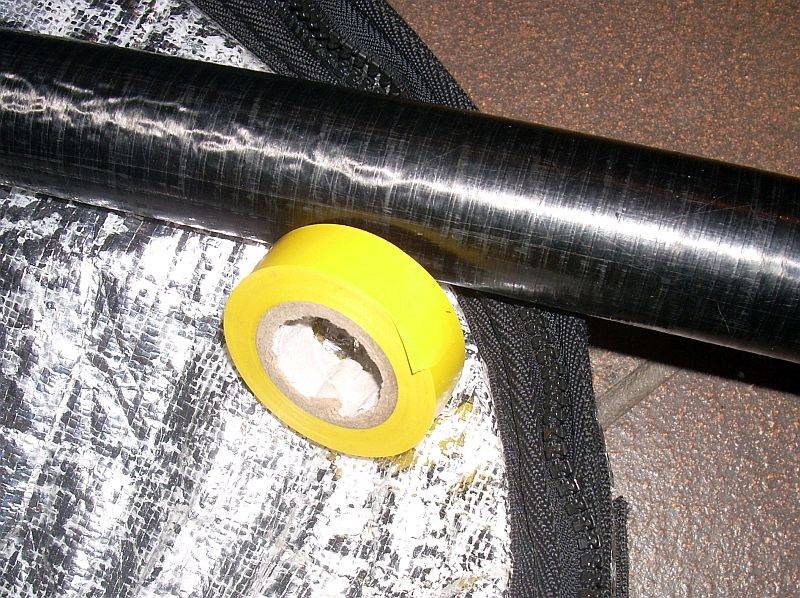
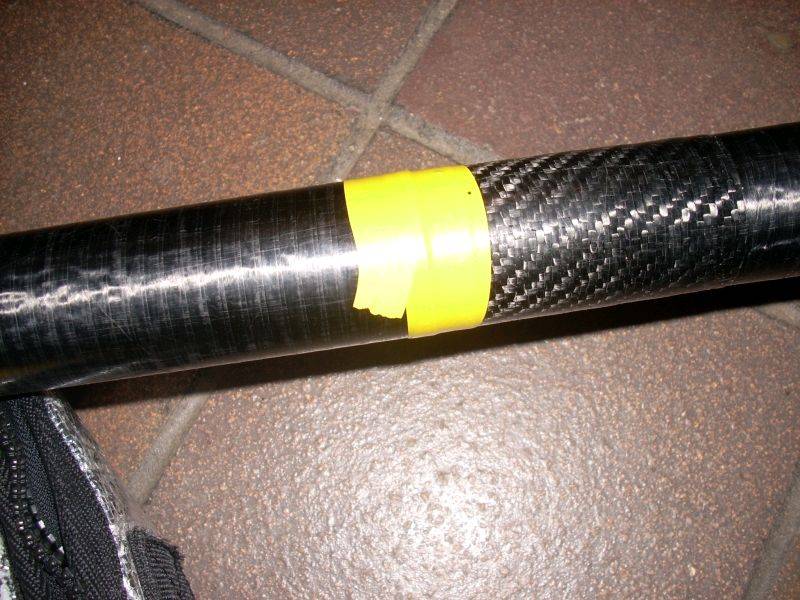
Wrap tape around the join after you have put the two pieces together. Two or three turns around will do it. Eveyone I sail with does this. Everyone should. If still unclear I will take a photo for you.

edit: I did it anyway:

The size tape you need (about $2)


The join taped. No sand will get in now.

stehsegler
stehsegler
WA
3571 posts
WA, 3571 posts
23 May 2011 5:52pm
Mark _australia said...

As stated in last thread I would never bang anything against the bottom of the mast.


I don't think the impact from a rubber hammer against an extension is worse than repeatedly landing a forward or a very high jump. But I might be wrong...

... I guess use it as a last resort. I certainly have had seen stuck masts that even 8 grown men and 4 attached booms couldn't get apart. But the hammer technique worked a treat after 4 or 5 traps.
longwinded
longwinded
WA
347 posts
WA, 347 posts
23 May 2011 7:06pm
ikw777 said...

Macroscien said...

Just to clarify that I do this properly.
Do you want me to apply tape on that mast piece that slide into the top socket?
(that will work like a teflon tape to minimize friction)
or
apply tape after joining pieces together to seal that joint from water and sand ?


Wrap tape around the join after you have put the two pieces together. Two or three turns around will do it. Eveyone I sail with does this. Everyone should. If still unclear I will take a photo for you.

edit: I did it anyway:

The size tape you need (about $2)


The join taped. No sand will get in now.


Spoilsport, was really looking forward to the thread titled "how to pull apart mast with electrical tape inside the join". Now that really would have tested the theories.
Macroscien
Macroscien
QLD
6809 posts
QLD, 6809 posts
12 Jun 2011 9:50pm
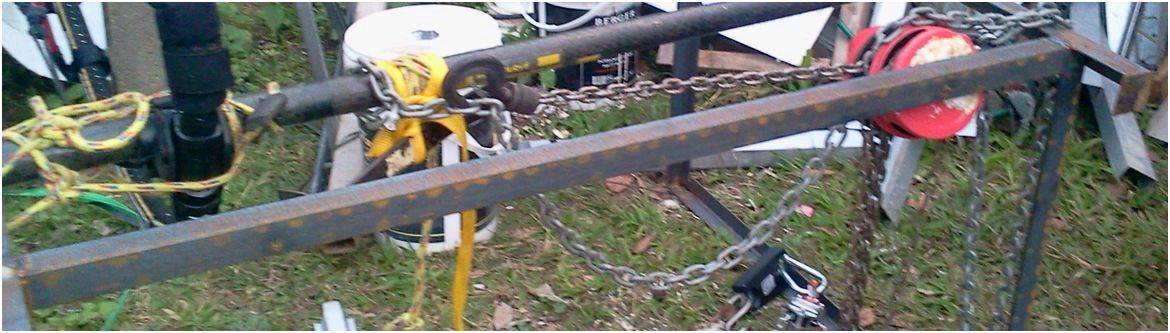
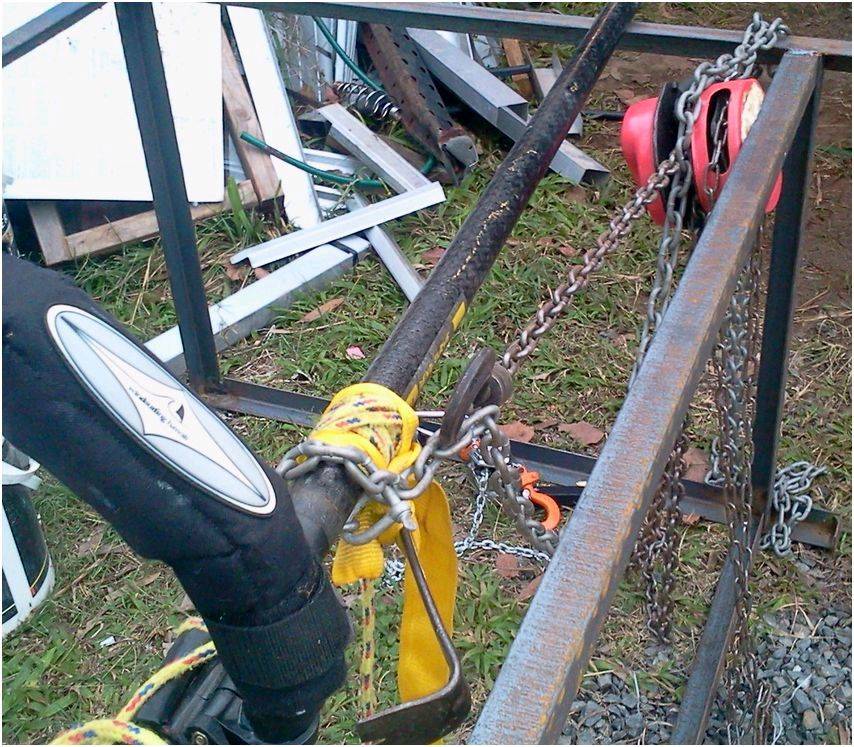
This is example: How...... Not to dissasamble


I tried to use chainblock. When my digital scale reached 400 kg force limit I gave up ( scale ) and tried again stronger. Block is 1 tone rated.

Banging with rubber hummer at the joint same time doesn't help either


But I have now better idea for new tool that I want to create soon.
GavGav
GavGav
VIC
193 posts
VIC, 193 posts
12 Jun 2011 11:03pm
Just a thought, are you sure it is a 2 piece mast?
Macroscien
Macroscien
QLD
6809 posts
QLD, 6809 posts
13 Jun 2011 12:06am
haha for 3 months it is indeed single piece, I carry it always on the roof now, but as I know myself will be in 2 pieces later or sooner.
The problem is the new disconnection point is on the boom level usually.
I broke 3 masts last season....
Please Register, or first...
Topics Subscribe Reply

Return To Classic site 😭
Or... let us know if a problem, so we can tweak! 😅