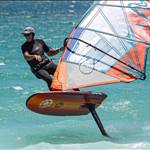
Yep, yep. Got all the pretty pictures. Apparent wind is different at the top and bottom of the sail, and at different tacking angles (and speeds).
___________________________________________________________________
For anyone that doesn't get it:
A) Wind travels
at different speeds the higher off the ground you go. This is the important bit. It goes faster as you go up. Lie on the ground one time; no wind. Fly a kite; heaps of wind up there.
B) If the wind is coming from the North at 15 knots, and I am traveling East at 15 knots,
the apparent wind, where the wind is apparently coming from on my boat, is 15 knots from the North-East.
C) Because of both A) and B) the apparent wind will be at
different angles at the top and bottom of the sail. Oh no! What is a sail designer to do?
Therefore: Sails have "twist" to provide the best trim angle for that part of the sail.
___________________________________________________________________
I am also led to believe the twist
lowers the power in the sail moves most of the power to the lower half or so of the sail, making it easier to sail. Basic leverage.
I'm not denying this works, It does. Definitely!
But it
appears that, for the top panel at least, there is often so much twist that the angle is matching the apparent wind; that is not producing
any power at all. I certainly can't feel anything from the top panel, perhaps even the next down too, and looking up at it it just flops around there.
Are the very top panels actually doing anything?
174 said...
The loose leech is *reducing* drag. Basically avoiding tip vortices you would get from a zero-twist sail. If you look at modern jumbo wings or F1 cars they have end plates to do the same thing.
Is it this oh great sail designers? Seems legit. Looking up...


 Great comments following the article too!