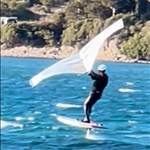
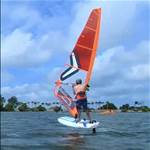
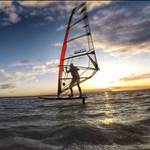
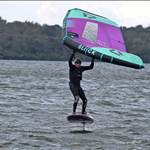
I have seen two beginners getting into foil at our beach. One is using Goya Bolt 137 lt 79 cm wide with Starboard 1100 wing 95 fuse 500 tail and other guy using old Starboard windsurf board with similar dimension board and supercruiser. Both of them had been trying for almost 2 months usually using 6-7 m sails in 15 mph wind but I see them going up up up and suddenly dropping while foiling. In other words they do not sustain their foiling level. Sometimes they turn into the wind which may the main reason for their problem but it is not always the case. I am not so sure what I could tell them to sustain their foiling height rather than dropping like an elevator dropping. It is likely many of the people learning foiling go through this phase and it may help to provide some in sight into this issue.
What helped me most to get steady heights was to use a small sail and a large front wing, and go out in light winds, just enough to get going. This way everything happens slowly and you start building your muscle memory.
Also the first thing to work on is balancing your gear: with front wing between your feet position, move the sail mast base so that the board comes up with a gentle push of the back foot when you gain speed.
Going suddenly upwind usually happens when the board starts to fly, in that moment you need to adjust your stance.
Sudden drops are often the result od sudden wind lulls, or the sailor oversheeting or letting out the sail, both of which lessen the power on the sail.
For me, oversheeting is the tougher to recover, since oversheeting gives a big lull in losing sail pressure, so I oversheet even more, causing a sudden loss of sail power.
Letting the back hand go is a smoother way of depowering for me.
Also, advise them to NOT hook in until smooth flights are achieved.
Sudden drops are most likely from over foiling. This is very comon at the beginning. Time on the water is the answer. As soon as you lift clear you have to start weighting the front foot. Fixing your gaze on the distant horizon is also key. Getting out behind a boat or going to a wake park is a great way to work on the basics when there is not enough wind.
Sounds like both setups might be too back footed. That makes for an unstable foil.
The Supercruiser can be run in forward position to improve the situation.
Yeah hard to diagnose without a video. Not clear if they are overfoiling and what the cause is without seeing it. They could be freaking out and unsheeting the sail, unweighting the mast base and sending them skyward. Or something else entirely.
The hip movement in this video can help them if they watch it. Unsure about the trim of those particular foils with those boards.
Select to expand quoteutcminusfour said..
Getting out behind a boat or going to a wake park is a great way to work on the basics when there is not enough wind.
Having both a foil and a boat, I'm a little intrigued by the notion of working on foil balance behind a boat. OTOH, it seems like perhaps not such a good thing, as I imagine all the forces would be very different while holding onto a tow rope, vs while holding onto a sail, and getting pull through the mast foot. (There's also no boom to hold onto to keep you away from the foil when crashing...) Any tips regarding if/how to work on windsurf foil balance behind a boat?
If it's a sudden drop, they are probably over foiling. If the nose is long enough probably just bounce off and keep going. My short 114 noses in and I go for a swim. BUT, that's in the learning phase. The I76 has an insanely low stall speed (at my <140lbs) once you are flying. What I did find, is tuning is critical to control and comfort. Took me quite a while to get it all sorted. Then it's just fun, fun, fun.
Select to expand quotejims said..utcminusfour said..
Getting out behind a boat or going to a wake park is a great way to work on the basics when there is not enough wind.
Having both a foil and a boat, I'm a little intrigued by the notion of working on foil balance behind a boat. OTOH, it seems like perhaps not such a good thing, as I imagine all the forces would be very different while holding onto a tow rope, vs while holding onto a sail, and getting pull through the mast foot. (There's also no boom to hold onto to keep you away from the foil when crashing...) Any tips regarding if/how to work on windsurf foil balance behind a boat?
Actually the tow rope replicates the boom and provides a steading force. It is astonishingly similar, you lean back to load the tow rope and climb out of the water just as you would lean back against the sail. Then you ease up pressure on the rope and start loading your front foot to level out just like windfoiling. The steady speed of the boat removes a variable and so does the lack mast base pressure. This gives you the opportunity to focus on just foiling. You will learn ride height control quicker this way. When you turn down wind to gybe or when you surf a wave with the sail eased you have little to no mast base pressure so wake foiling directly translates to this. Having a wave next to you all the time gives you the chance to learn how massively the foil reacts to waves. Wake foiling is a great way to learn how to pump the foil and if you ride big enough front wings this skill will Drastically lower you minimum wind and sail size. I still clearly remember when ride height control clicked for me while foiling behind the boat. I went from wild dolphin rides to being able to cruz steady and look around in a few sessions behind the boat. Every time I wake foil I notice a gain on my next windfoil session. I can not recommend it enough for windfoil cross training. Use your windfoil board and foil, you do not want or need anything different at first. Have a peek at my One Slice short of a Pie video for some footage of how to get up to your feet, you start on your belly. As you progress I really recommend the wake/cable park too. The moment when the cable changes direction you are forced to do a tight radius turn with no support from the rope, when I got this at the park I started to make my gybes. There is just no getting around the fact that learning to foil takes time on the water, this is a way to get more time becasue you can go when there is not enough wind for windfoiling. Feel free to reach out to directly If I can help further.
Finding a boat for learning foiling was a thought came to my mind but it was difficult for me to find a buddy with a boat and we do not have any nearby cable park. I feel many of the people in the same situation.
It took me while to find the right foil to learn. For me, Slingshot i99 with a levitator gave me the opportunity to make progress. I realize time on water is critical but I have seen someone started foiling with a Supercruiser and foil dedicated board from Exocet and to my astonishment he was foiling on his second day without any roller coaster ride. I gather from some of your recommendations that overfoiling, oversheeting, footstraps may be something to bring to beginner attention when they are learning.
Select to expand quoteSA_AL said..
I have seen two beginners getting into foil at our beach. One is using Goya Bolt 137 lt 79 cm wide with Starboard 1100 wing 95 fuse 500 tail and other guy using old Starboard windsurf board with similar dimension board and supercruiser. Both of them had been trying for almost 2 months usually using 6-7 m sails in 15 mph wind but I see them going up up up and suddenly dropping while foiling. In other words they do not sustain their foiling level. Sometimes they turn into the wind which may the main reason for their problem but it is not always the case. I am not so sure what I could tell them to sustain their foiling height rather than dropping like an elevator dropping. It is likely many of the people learning foiling go through this phase and it may help to provide some in sight into this issue.
Sounds like they are going along and a gust hits and too much power lifting the foil out of the water, and bang, the board drops like a stone. I've done 15 sessions now and am just getting to the stage where I can anticipate gusts and react. I started with the front footstrap plug in the 2nd hole from the front, moved it back 1 hole to get flying more easily. But then found as my speed increased if a gust hit I breached. So moved it back forward. Plus in stronger gusts, leaning forward, using the hips, and applying more force through the harness using the tips in Jordy Vonk's video posted above. In less strong gusts putting more weight on the front foot to keep the board level, then in the lulls more weight on the back foot. Its just time on the water and working out what is best. Ones persons tips, like Jordy's, are so you can go faster in the gusts with a high aspect wing. Others might be how to depower and survive the gusts, like for a low aspect wing.
I was thinking of getting someone experienced to have a go on my kit to make sure it is balanced, footstraps/mast base/ rigging etc, but the only experienced person I sail with is 20kg heavier than me so that would be a waste of time.
Select to expand quoteSA_AL said..
Finding a boat for learning foiling was a thought came to my mind but it was difficult for me to find a buddy with a boat and we do not have any nearby cable park. I feel many of the people in the same situation.
It took me while to find the right foil to learn. For me, Slingshot i99 with a levitator gave me the opportunity to make progress. I realize time on water is critical but I have seen someone started foiling with a Supercruiser and foil dedicated board from Exocet and to my astonishment he was foiling on his second day without any roller coaster ride. I gather from some of your recommendations that overfoiling, oversheeting, footstraps may be something to bring to beginner attention when they are learning.
I am really fortunate to have access to boats and a cable park and I realize it. I am GRATFUL! I had a boat but sadly ZERO other windfoilers nearby to help. If you can get someone with experience to help with set up DO IT!!
Then you can put those details out of your head and apply full bandwidth to learning this new dance. For those that have to go it alone, set the gear in the middle and get started.
There are so many unique and new skills required to foil that at some point all new foilers with windsurfing experience get frustrated and feel like "it must be the gear". It might be but often there are basic weight movements and sail trimming that still need learning. Constantly changing the settings before one has these skills is not going to help the learning. Lots of Time On The Water with the gear close enough is the answer.
The thing is there is a big range of what can be considered balanced. For instance when I started 5 years my feet were way further forward and so was my mast base, I was set up using the current info at that time on how to balance it. The gear was slow to take off and very pitch stable but due to my skill level I still breached constantly (up up up-down). Now I am set up MUCH further back and it's still balanced just with more of a front foot bias and I rarely breach. It's not the settings, they are personal preferences that are developed with experience. We have good riders on this forum that set identical gear up completely different from each other. They took their lumps and learned and now they know what they want their set up to feel like.
Be careful comparing yourself to others. It took me a couple of years to get to the point where I could ride in control and make my turns. At that time I loaned my starter kit to a really talented windsurfer and on the second day he was riding at my level! I could have given him any gear set anyway and he would have figured out how to ride it. All of a sudden I had someone to learn windfoiling from!
Long story short. Don't overthink the settings just confirm they are in the right time zone. Be patient with yourself. Get out on the water as much as possible. If possible find cross training activities that you can do when you can't windfoil. It's worth the effort! Windfoiling is amazing!
The big elephant in the room is "balance." Have they balanced their gear? Front wing at the mid point between the feet to start out?
Also, towing behind a boat does not simulate windfoiling well. Wing and kite, yes, but wind, no. The reason is that the sail exerts a lot of down force as well as the feet. Boat towing omits the sail and its contribution to the balance.
Thanks Segler  ! Your balance video helped me imensly.
I agree with you wake foilling is missing the sails influence. That's exactly why it helps! Even with a balanced set up and mast base pressure you still HAVE to shift your weight constantly. This can be learned as an isolated skill on days with not enough wind.
I am not advocating ignoring a balanced set up. Just pointing out that many beginners obsess about moving things a half an inch when they don't have the skills yet to notice the difference or determine if its better. I did the same thing at that stage.
I agree with you the first step is to balance the gear by using the method in your video or getting help from experienced riders. Then stop blaming the gear and focus on learning to use it.
Up up up-down is COMPLETELY normal for beginners, let's try and not confuse them with constant discussions on minute technical details. Everyone has just gotta take the lumps untill they can Subconsiously control ride height. Wake foiling helped me with that.
Something that acured to me reading this they might be trying to lift of to soon they need more board speed so get planing first then apply more back foot pressure and as soon as it lifts shift forwards and sheet out slightly
This is the bit that takes practice but it's what you need to do or you will suffer slow speed stall or over foil
Basically preemptive action before it happens
Newbies (well everyone but there are those who won't see it) will be far more stable if their setup starts flying by relaxing some front foot pressure rather than transferring onto the back foot.
Lots of ways to accomplish this: stab size/shimming, sail mast base back, front wing forward.
Tye biggest thing to avoid is having the foil back and the sail forward with rear foot pressure required in flight. That's a dead end road for progression.
Select to expand quoteGrantmac said..
Newbies (well everyone but there are those who won't see it) will be far more stable if their setup starts flying by relaxing some front foot pressure rather than transferring onto the back foot.
Lots of ways to accomplish this: stab size/shimming, sail mast base back, front wing forward.
Tye biggest thing to avoid is having the foil back and the sail forward with rear foot pressure required in flight. That's a dead end road for progression.
So true, thank you Grantmac, I will keep this in mind as I progress
Select to expand quoteGrantmac said..
Newbies (well everyone but there are those who won't see it) will be far more stable if their setup starts flying by relaxing some front foot pressure rather than transferring onto the back foot.
Lots of ways to accomplish this: stab size/shimming, sail mast base back, front wing forward.
Tye biggest thing to avoid is having the foil back and the sail forward with rear foot pressure required in flight. That's a dead end road for progression.
Actually, the biggest thing that helped my progression on my SS Wiz 125 and an i76 wing was moving my sail forward and shimming the rear wing so it had less negative lift.
Tell them not to try & fly. Sail like a windsurfer on the water. When the board lifts, slam it back down. After 20min of doing this fly low for short distance then back onto the water followed by longer low flights. They'll learn how to drop height when they need to and what the board feels like when it's going to take off. But always in control. Then they can fly as often as they want making the decision to land & take off. Baby steps rather than fly high breach crash and zero control over anything. Baby steps
I agree with BSN101. If you just windsurf along at planing speed, then VERY gradually lift into low flight, you can keep things under control. The wave tops will stabilize the board for you until you get the hang of it. I call this training wheel mode. Later you can go higher.
Select to expand quoteBSN101 said..
Tell them not to try & fly. Sail like a windsurfer on the water. When the board lifts, slam it back down. After 20min of doing this fly low for short distance then back onto the water followed by longer low flights. They'll learn how to drop height when they need to and what the board feels like when it's going to take off. But always in control. Then they can fly as often as they want making the decision to land & take off. Baby steps rather than fly high breach crash and zero control over anything. Baby steps
LoL, @CoreAS tried to get me to do this, but I didn't have enough feel for balance to know what was high and what was low, and I'd just come from several days of high-wind (slapper) sailing, so was all about loading up the fin as I got moving. There were some memorable breaches that first day!! <:-)
Select to expand quoteutcminusfour said..
Have a peek at my One Slice short of a Pie video for some footage of how to get up to your feet, you start on your belly. ... Feel free to reach out to directly If I can help further.
Thanks, @utcminusfour - I'll give it a go when I get the boat back in the water next month! I'm still a little unsure of how much direct transfer there'd be w/ rope vs rig, but I totally see your point about just concentrating on weight/balance to keep the board level, which is something I'm still working on when out windsurf foiling. (Getting a little better, but it's a *constant* worry whenever I'm up on the foil, LoL. :o)
Great video, BTW!!
Select to expand quoteaeroegnr said..
Yeah hard to diagnose without a video. Not clear if they are overfoiling and what the cause is without seeing it. They could be freaking out and unsheeting the sail, unweighting the mast base and sending them skyward. Or something else entirely.
Here is a video (low resolution but it may give an idea about technical insight for what may be the cause of this problem)
If those are your early flights, don't complain. You are doing just fine. Keep building experience and muscle memory.
Select to expand quotesegler said..
If those are your early flights, don't complain. You are doing just fine. Keep building experience and muscle memory.
That's situation normal for beginners. Keep CHARGING!
Select to expand quoteutcminusfour said..segler said..
If those are your early flights, don't complain. You are doing just fine. Keep building experience and muscle memory.
That's situation normal for beginners. Keep CHARGING!
Yep,
Its all just time on water.
Select to expand quotesegler said..
If those are your early flights, don't complain. You are doing just fine. Keep building experience and muscle memory.
I am riding fine with my Armstrong foil not having this issue. However, I am having difficulty transitioning to a race foil (Starboard IQ foil95 with 800/115+/255 foil) mostly not getting used to faster speed and not finding the balanced run unlike my Armstrong foils (1550, 1850, 1100 wings). I wanted to provide some ideas for beginners going through this phase in this discussion. It looks like he is sheeting too much and going into the wind as some people suggested earlier.
Select to expand quoteSA_AL said..aeroegnr said..
Yeah hard to diagnose without a video. Not clear if they are overfoiling and what the cause is without seeing it. They could be freaking out and unsheeting the sail, unweighting the mast base and sending them skyward. Or something else entirely.
Here is a video (low resolution but it may give an idea about technical insight for what may be the cause of this problem)
I agree with others that there's breaching going on with the sailworks guy. However, that looks way better than my first foil flights 
Hard to tell from that angle but it also looks like he's hiking out way far (towards the camera) too early and too slow. With the slower foils you need to be more over the board, especially at low speed like that. Race foils are different.Select to expand quoteSA_AL said..segler said..
If those are your early flights, don't complain. You are doing just fine. Keep building experience and muscle memory.
I am riding fine with my Armstrong foil not having this issue. However, I am having difficulty transitioning to a race foil (Starboard IQ foil95 with 800/115+/255 foil) mostly not getting used to faster speed and not finding the balanced run unlike my Armstrong foils (1550, 1850, 1100 wings). I wanted to provide some ideas for beginners going through this phase in this discussion. It looks like he is sheeting too much and going into the wind as some people suggested earlier.
Are you using a cammed HGO race sail as well? The 800 is a fast wing. I've only ridden the 900 and 650 but with the 115+ and that wing you'll need to pick either upwind or downwind to keep from being overpowered, and stay sheeted in. Long harness lines too, but that felt scary/wrong to me at first. I also feel way better in both footstraps, unless pushing deep downwind. At first, downwind scared me, but it doesn't as much because I rise out slower and move my hips forward faster.
This is one of my first real stable foil flights with the infinity 99. Notice how over-the-board I am, not hiked out:
Select to expand quoteaeroegnr said..
Hard to tell from that angle but it also looks like he's hiking out way far (towards the camera) too early and too slow. With the slower foils you need to be more over the board, especially at low speed like that. Race foils are different.
Thats what I thought as well, but its hard to tell from so far away. It was one of the biggest adjustments I had to make from many years of fin windsurfing. The other was sailing with straighter legs. His rear leg looks quite straight, so ok. I'm also wondering that when learning, if you have a touchdown whether its best to stop and reset. That way you are more in control of the board rather than bouncing along touching at more frequent intervals before crashing.