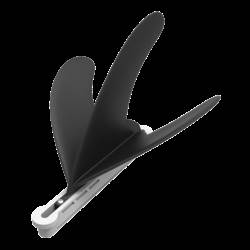
Here's the video explanation of the fin.
The info given has been dumbed down.
Bill Hunter talks about the lift force generated, expressed in kilograms. The problem with that is that lift force is dependent upon speed.
Lift increases by the square as speed increases, so for example an increase in speed from 10mph to 14.1 mph will double the amount of lift generated. Bill doesn't mention this very important fact in his analysis. Instead he talks about the lift generated in '2 to 3 foot waves'. This is ridiculous since the computational fluid dynamics software can't use wave height as a parameter, it doesn't mean anything.
To run the calculations he must have entered a speed ( there would be no lift predicted unless a speed were entered) but he doesn't tell us what the speed is. Furthermore he quotes only one lift force figure for each fin setup. This is also silly, since speed varies over a wide range in surfing.... and he claims that the fin will get the surfer to his feet faster when paddling into a wave... (precisely when speed is at its lowest) without telling us how much lift is generated at that speed.
The Quantum fin website states that the fin is suitable for '2 to 3 foot waves'.... what they are trying to do with that statement is to say that the fin isn't suitable for higher speeds, and the only reason why that would be the case is handling problems which occur as larger amounts of lift are produced. What happens when the lift is greater than the weight of board and rider combined? We know the basic answer: the board will lift out of the water. This will cause catastrophic handling problems unless the fin setup is specifically designed to allow proper control without the rails and bottom of the board coming into play.
The lift force quoted of 60 kg occurs at what speed? Whatever speed generates that lift, it will take only a modest increase in speed of 14% to match the rider's weight ( in the case of the 80kg rider used in the example).
Another problem with the lift production quoted is angle of attack. Lift is typically doubled with a doubling of angle of attack. The fin is of course set at an angle of attack ( described as 'low') but what isn't mentioned is that the angle of attack on the fin is changed by the rider via the pitch or trim angle. This raising and lowering of the angle of attack of the hull ( and the fins) happens constantly and through quite a big range particularly during turns.
So, the fin is going to increase lift dramatically not only with speed but with the board's trim angle. Of course the flow to the fin is partially determined by the hull itself since that directs the flow before it gets to the fins, so the effect of pitch is somewhat mitigated.
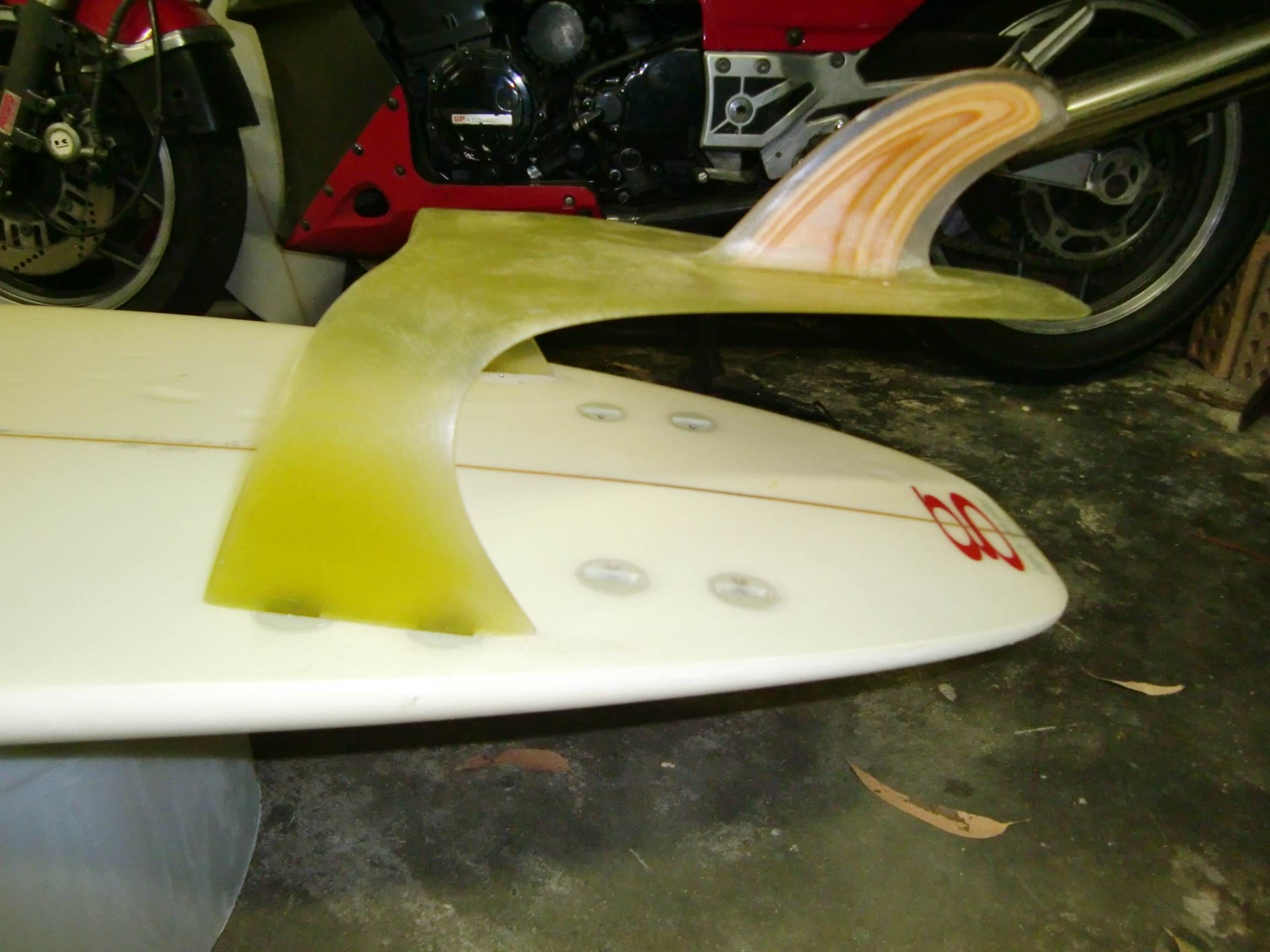
This isn't just 'book learning' I've been making boards with lifting foils since 1998, and as it happened was working next door to a leading multihull and hydrofoil designer the next year, so managed to pick up a lot of useful information in a time when we had no internet or other means of doing research apart from 'Scientific American' back issues and tons of Naval Architecture and boatbuilding manuals.
By the way the drag prediction is hugely oversimplified. There's no induced drag shown, and from the comments on the video it seems that only skin friction drag is being analysed, but it's hard to tell since it's not explained.