

So I took a look at the Storm jib that came with my boat today and I don't really understand a couple of features. Firstly why would they bother extending the Luff rope right up to the top of the track with the top third or more having no sail behind it apart from an inch and a half of tape.
Secondly why does it have a considerable number of what look like maisail reefing nettles through small grommets all the way up the Luff including the aforementioned part with no sail attached?

The grommets on the luff are probably from sail hanks when it was a Hank on sail.
The bolt rope tape going right to the top gives support to the luff and also stops the halyard flapping around as it keeps it short and near the top of the mast and you can furl the sail to without the halyard wrapping the foil.
Jules, it looks like it has a bolt rope to fit in a furler, in case you had taken out the main foresail. I.e. you took out the roller genoa and put in only the storm jib to have less problems. Or secondly, you might want to fly wing-and-wing the storm jib and the original genoa (some furling systems have 2 grooves for 2 sails at once).
If the storm jib were deployed after the genoa was rolled up, then you'd use those short ropes and grommets to tie this sail around the rolled-up genoa, since you couldn't use the bolt rope in the furler.
Some storm jibs can be reefed too. Especially before the days of roller reefing.
In the old days of wire/rope halyards you always wanted the wire on the winch and the rope tail leading off the winch. So extending the halyard was a no no. So we used to have head pendants to get the same hoist as a normal hoist genoa.
These days we just use spectra. I think the storm jib is an old one.
Sounds like a well made storm jib (without the required fluoro). I'll bet its nice and crispy new feeling!
The luff rope is extended up the track to stop it from blowing out in 35+ kts when you need that jib. If it were just a free halyard, it can tear the top of the jib out of the track. Also controls some flapping when you hoist it.
The grommets up the luff are where you fit short pieces of rope (permanently) so you can tie the luff to the track should the track groove fail.
Usually you will have permanently attached sheets on the storm jib, stitched at the clew.
The long luff tape is common on short-luff headsails. It makes it easier to get the tape into the foil in rough conditions, because you don't have to have the whole sail right in the bows as you thread it through the feeder and prefeeder. You put the tape into the prefeeder, the feeder and the foil, and then turn your attention to feeding the actual sail, which can be kept in stops.
The long luff tape will also keep a whipping halyard away from the bowperson during the hoist, and may make it less likely that the halyard will wrap around the forestay or snarl somewhere else. Those who have hoisted a storm jib in Bass Strait will appreciate these touches.
The reefing lines are a rule requirement for storm jibs with luff tapes. Although I haven't heard of it happening for a while, headfoils can be damaged by kite wraps or being hit with the spinnaker pole. If the headfoil is damaged and can't take the luff tape, you can use the reefing nettles or lines to tie the storm jib loosely around the headfoil before hoisting, so you can use your storm jib even if the foil is damaged. I've never had to do it but it would be possible.
With respect, I'd hate to use the nettles aroundf a reefed furling headsai, since the friction as you hoisted would be terrible, as would the chances of something getting snagged aloft. I'm one of the many who is moving towards having a separate inner forestay and a hanked on storm jib.
Incidentally, storm sails now have to have orange high-vis on them.
I just collected my second-hand Hood storm sails for the 36'er today. We also have a three-reef Hood main on that bosty, and I think my 28'ers storm trysail is a Hood sail and a good sail. Hoods may no longer make leading-edge racing sails, but I do like their work for "sea" sails.
The long luff tape is to ensure the halyard is at the correct angle so the sail can be furled. The angle is critical for the correct operation of the top swivel.
Select to expand quotePoodle said..
Sounds like a well made storm jib (without the required fluoro). I'll bet its nice and crispy new feeling!
The luff rope is extended up the track to stop it from blowing out in 35+ kts when you need that jib. If it were just a free halyard, it can tear the top of the jib out of the track. Also controls some flapping when you hoist it.
The grommets up the luff are where you fit short pieces of rope (permanently) so you can tie the luff to the track should the track groove fail.
Usually you will have permanently attached sheets on the storm jib, stitched at the clew.
Exactly right
looks fine save for some high vis colour
Thank you very much for the comprehensive answers once again from our knowledgeable membership. Mystery solved.
Yes I would prefer a storm jib on an inner forestay which would obviously balance the boat much better when using the trysail main but unfortunately there isn't one and I certainly wouldn't use the Spinnaker Pole downhaul attachment point without very significant additional reinforcement down to the hull which isn't that easy and would ruin the front v berth. I do use the V berth as a berth as it has heaps of Headroom on the North Shore 38.
Select to expand quotePoodle said..
Sounds like a well made storm jib (without the required fluoro). I'll bet its nice and crispy new feeling!
The luff rope is extended up the track to stop it from blowing out in 35+ kts when you need that jib. If it were just a free halyard, it can tear the top of the jib out of the track. Also controls some flapping when you hoist it.
The grommets up the luff are where you fit short pieces of rope (permanently) so you can tie the luff to the track should the track groove fail.
Usually you will have permanently attached sheets on the storm jib, stitched at the clew.
Some bug in the system meant I didn't see you'd already given all the info!
Select to expand quotejulesmoto said..
Thank you very much for the comprehensive answers once again from our knowledgeable membership. Mystery solved.
Yes I would prefer a storm jib on an inner forestay which would obviously balance the boat much better when using the trysail main but unfortunately there isn't one and I certainly wouldn't use the Spinnaker Pole downhaul attachment point without very significant additional reinforcement down to the hull which isn't that easy and would ruin the front v berth. I do use the V berth as a berth as it has heaps of Headroom on the North Shore 38.
Now that people are just using halyards as storm jib stays, I tried just running one of the jib halyards down to the aft end of the forestay fitting. The old storm jib, which has hanks, set pretty well on this halyard without excessive amount of sag and without coming in contact with the rolled-up 105% number one. I'm interested in doing more research and testing into this simple system because apart from anything else, the wider angle to the mast will reduce compression strains.
The only fractional sloop I've used a full set of storm gear on, in anger, didn't have balance issues with the storm jib set on the normal forestay in the normal way. I tend to think that it's better in many boats to have the storm jib on the bow so that a quick dump on the mainsheet moves the CLE well forward and gives the boat lee helm (or at least less weather helm as it heels) and allows the boat to bear away very quickly when you feel that the wave has no back on it.
Select to expand quoteChris 249 said..julesmoto said..
Thank you very much for the comprehensive answers once again from our knowledgeable membership. Mystery solved.
Yes I would prefer a storm jib on an inner forestay which would obviously balance the boat much better when using the trysail main but unfortunately there isn't one and I certainly wouldn't use the Spinnaker Pole downhaul attachment point without very significant additional reinforcement down to the hull which isn't that easy and would ruin the front v berth. I do use the V berth as a berth as it has heaps of Headroom on the North Shore 38.
Now that people are just using halyards as storm jib stays, I tried just running one of the jib halyards down to the aft end of the forestay fitting. The old storm jib, which has hanks, set pretty well on this halyard without excessive amount of sag and without coming in contact with the rolled-up 105% number one. I'm interested in doing more research and testing into this simple system because apart from anything else, the wider angle to the mast will reduce compression strains.
The only fractional sloop I've used a full set of storm gear on, in anger, didn't have balance issues with the storm jib set on the normal forestay in the normal way. I tend to think that it's better in many boats to have the storm jib on the bow so that a quick dump on the mainsheet moves the CLE well forward and gives the boat lee helm (or at least less weather helm as it heels) and allows the boat to bear away very quickly when you feel that the wave has no back on it.
All depends on the boat.
Late model IMS design storm jib only is plenty was unbelievably fast.
Earlier late model IOR boat, trysail only was the way to go.
All about the balance.
One thing is for sure, the storm jib will be too big to be used when really fresh.
Usually made to the max of the ORC regulations.
Best Storm jib I ever used on a modern IMS 43 was from a Young 11.
No one complained the storm sails were too small.
Lastly, don't fall foul of the inverted leach syndrome.
Using sails not cut for the application you get the leach angle reversing.
Not very efficient.
Also use a strop to lift the tack clear of the the waves as well usually up above the bowrail if you have hanks.
Change sheeting position accordingly
Select to expand quotelydia said..
Also use a strop to lift the tack clear of the the waves as well usually up above the bowrail if you have hanks.
Change sheeting position accordingly
Good point.
Select to expand quotelydia said..Chris 249 said..julesmoto said..
Thank you very much for the comprehensive answers once again from our knowledgeable membership. Mystery solved.
Yes I would prefer a storm jib on an inner forestay which would obviously balance the boat much better when using the trysail main but unfortunately there isn't one and I certainly wouldn't use the Spinnaker Pole downhaul attachment point without very significant additional reinforcement down to the hull which isn't that easy and would ruin the front v berth. I do use the V berth as a berth as it has heaps of Headroom on the North Shore 38.
Now that people are just using halyards as storm jib stays, I tried just running one of the jib halyards down to the aft end of the forestay fitting. The old storm jib, which has hanks, set pretty well on this halyard without excessive amount of sag and without coming in contact with the rolled-up 105% number one. I'm interested in doing more research and testing into this simple system because apart from anything else, the wider angle to the mast will reduce compression strains.
The only fractional sloop I've used a full set of storm gear on, in anger, didn't have balance issues with the storm jib set on the normal forestay in the normal way. I tend to think that it's better in many boats to have the storm jib on the bow so that a quick dump on the mainsheet moves the CLE well forward and gives the boat lee helm (or at least less weather helm as it heels) and allows the boat to bear away very quickly when you feel that the wave has no back on it.
All depends on the boat.
Late model IMS design storm jib only is plenty was unbelievably fast.
Earlier late model IOR boat, trysail only was the way to go.
All about the balance.
One thing is for sure, the storm jib will be too big to be used when really fresh.
Usually made to the max of the ORC regulations.
Best Storm jib I ever used on a modern IMS 43 was from a Young 11.
No one complained the storm sails were too small.
Lastly, don't fall foul of the inverted leach syndrome.
Using sails not cut for the application you get the leach angle reversing.
Not very efficient.
Also use a strop to lift the tack clear of the the waves as well usually up above the bowrail if you have hanks.
Change sheeting position accordingly
Inverted leach?
Head of sail of further aft than the clew.
Sail never works properly.
Putting this storm jib on a inner forestay with a less steep angle than the forestay can result with this.
Here is a pic of a trysail, much smaller than the Regs say.
Barely goes past the second spreaders on a triple spreader rig.
Foot is less than half of "E".
Will try to find a storm jib pic
Also see the sheets are sewn on the sail.
Should be same for storm jib.

Select to expand quotelydia said..Chris 249 said..julesmoto said..
Thank you very much for the comprehensive answers once again from our knowledgeable membership. Mystery solved.
Yes I would prefer a storm jib on an inner forestay which would obviously balance the boat much better when using the trysail main but unfortunately there isn't one and I certainly wouldn't use the Spinnaker Pole downhaul attachment point without very significant additional reinforcement down to the hull which isn't that easy and would ruin the front v berth. I do use the V berth as a berth as it has heaps of Headroom on the North Shore 38.
Now that people are just using halyards as storm jib stays, I tried just running one of the jib halyards down to the aft end of the forestay fitting. The old storm jib, which has hanks, set pretty well on this halyard without excessive amount of sag and without coming in contact with the rolled-up 105% number one. I'm interested in doing more research and testing into this simple system because apart from anything else, the wider angle to the mast will reduce compression strains.
The only fractional sloop I've used a full set of storm gear on, in anger, didn't have balance issues with the storm jib set on the normal forestay in the normal way. I tend to think that it's better in many boats to have the storm jib on the bow so that a quick dump on the mainsheet moves the CLE well forward and gives the boat lee helm (or at least less weather helm as it heels) and allows the boat to bear away very quickly when you feel that the wave has no back on it.
All depends on the boat.
Late model IMS design storm jib only is plenty was unbelievably fast.
Earlier late model IOR boat, trysail only was the way to go.
All about the balance.
One thing is for sure, the storm jib will be too big to be used when really fresh.
Usually made to the max of the ORC regulations.
Best Storm jib I ever used on a modern IMS 43 was from a Young 11.
No one complained the storm sails were too small.
Lastly, don't fall foul of the inverted leach syndrome.
Using sails not cut for the application you get the leach angle reversing.
Not very efficient.
Also use a strop to lift the tack clear of the the waves as well usually up above the bowrail if you have hanks.
Change sheeting position accordingly
Agree with all that. The common claim that you need to move the storm jib forestay aft to balance the boat seems to come from experience with a minority of boats, but it's often brought up as if it applied to all.
Select to expand quoteChris 249 said..lydia said..Chris 249 said..julesmoto said..
Thank you very much for the comprehensive answers once again from our knowledgeable membership. Mystery solved.
Yes I would prefer a storm jib on an inner forestay which would obviously balance the boat much better when using the trysail main but unfortunately there isn't one and I certainly wouldn't use the Spinnaker Pole downhaul attachment point without very significant additional reinforcement down to the hull which isn't that easy and would ruin the front v berth. I do use the V berth as a berth as it has heaps of Headroom on the North Shore 38.
Now that people are just using halyards as storm jib stays, I tried just running one of the jib halyards down to the aft end of the forestay fitting. The old storm jib, which has hanks, set pretty well on this halyard without excessive amount of sag and without coming in contact with the rolled-up 105% number one. I'm interested in doing more research and testing into this simple system because apart from anything else, the wider angle to the mast will reduce compression strains.
The only fractional sloop I've used a full set of storm gear on, in anger, didn't have balance issues with the storm jib set on the normal forestay in the normal way. I tend to think that it's better in many boats to have the storm jib on the bow so that a quick dump on the mainsheet moves the CLE well forward and gives the boat lee helm (or at least less weather helm as it heels) and allows the boat to bear away very quickly when you feel that the wave has no back on it.
All depends on the boat.
Late model IMS design storm jib only is plenty was unbelievably fast.
Earlier late model IOR boat, trysail only was the way to go.
All about the balance.
One thing is for sure, the storm jib will be too big to be used when really fresh.
Usually made to the max of the ORC regulations.
Best Storm jib I ever used on a modern IMS 43 was from a Young 11.
No one complained the storm sails were too small.
Lastly, don't fall foul of the inverted leach syndrome.
Using sails not cut for the application you get the leach angle reversing.
Not very efficient.
Also use a strop to lift the tack clear of the the waves as well usually up above the bowrail if you have hanks.
Change sheeting position accordingly
Agree with all that. The common claim that you need to move the storm jib forestay aft to balance the boat seems to come from experience with a minority of boats, but it's often brought up as if it applied to all.
All depends on the keel placement.
So you don't know unless you try.
Next time it is 25 knots don't go home, get the storm gear on and go for a sail.
You will be amazed how efficient it can be and how easy the boat is to sail.
Select to expand quoteHoods may no longer make leading-edge racing sails, but I do like their work for "sea" sails.
Depends on the class and the owner.
At least at Hoods, they will actually talk to you, and the customer service is very good
Hood main and light headsail tri-radial from GPX lite-skin

Select to expand quotelydia said..Chris 249 said..lydia said..Chris 249 said..julesmoto said..
Thank you very much for the comprehensive answers once again from our knowledgeable membership. Mystery solved.
Yes I would prefer a storm jib on an inner forestay which would obviously balance the boat much better when using the trysail main but unfortunately there isn't one and I certainly wouldn't use the Spinnaker Pole downhaul attachment point without very significant additional reinforcement down to the hull which isn't that easy and would ruin the front v berth. I do use the V berth as a berth as it has heaps of Headroom on the North Shore 38.
Now that people are just using halyards as storm jib stays, I tried just running one of the jib halyards down to the aft end of the forestay fitting. The old storm jib, which has hanks, set pretty well on this halyard without excessive amount of sag and without coming in contact with the rolled-up 105% number one. I'm interested in doing more research and testing into this simple system because apart from anything else, the wider angle to the mast will reduce compression strains.
The only fractional sloop I've used a full set of storm gear on, in anger, didn't have balance issues with the storm jib set on the normal forestay in the normal way. I tend to think that it's better in many boats to have the storm jib on the bow so that a quick dump on the mainsheet moves the CLE well forward and gives the boat lee helm (or at least less weather helm as it heels) and allows the boat to bear away very quickly when you feel that the wave has no back on it.
All depends on the boat.
Late model IMS design storm jib only is plenty was unbelievably fast.
Earlier late model IOR boat, trysail only was the way to go.
All about the balance.
One thing is for sure, the storm jib will be too big to be used when really fresh.
Usually made to the max of the ORC regulations.
Best Storm jib I ever used on a modern IMS 43 was from a Young 11.
No one complained the storm sails were too small.
Lastly, don't fall foul of the inverted leach syndrome.
Using sails not cut for the application you get the leach angle reversing.
Not very efficient.
Also use a strop to lift the tack clear of the the waves as well usually up above the bowrail if you have hanks.
Change sheeting position accordingly
Agree with all that. The common claim that you need to move the storm jib forestay aft to balance the boat seems to come from experience with a minority of boats, but it's often brought up as if it applied to all.
All depends on the keel placement.
So you don't know unless you try.
Next time it is 25 knots don't go home, get the storm gear on and go for a sail.
You will be amazed how efficient it can be and how easy the boat is to sail.
Duworry, I do.
Select to expand quotelydia said..Hoods may no longer make leading-edge racing sails, but I do like their work for "sea" sails.
Depends on the class and the owner.
At least at Hoods, they will actually talk to you, and the customer service is very good
Hood main and light headsail tri-radial from GPX lite-skin
I just meant that I don't think they've been big in development recently in major international classes like America's Cup, Olympics, Volvo, TP52s etc.
Select to expand quotelydia said..Chris 249 said..lydia said..Chris 249 said..julesmoto said..
Thank you very much for the comprehensive answers once again from our knowledgeable membership. Mystery solved.
Yes I would prefer a storm jib on an inner forestay which would obviously balance the boat much better when using the trysail main but unfortunately there isn't one and I certainly wouldn't use the Spinnaker Pole downhaul attachment point without very significant additional reinforcement down to the hull which isn't that easy and would ruin the front v berth. I do use the V berth as a berth as it has heaps of Headroom on the North Shore 38.
Now that people are just using halyards as storm jib stays, I tried just running one of the jib halyards down to the aft end of the forestay fitting. The old storm jib, which has hanks, set pretty well on this halyard without excessive amount of sag and without coming in contact with the rolled-up 105% number one. I'm interested in doing more research and testing into this simple system because apart from anything else, the wider angle to the mast will reduce compression strains.
The only fractional sloop I've used a full set of storm gear on, in anger, didn't have balance issues with the storm jib set on the normal forestay in the normal way. I tend to think that it's better in many boats to have the storm jib on the bow so that a quick dump on the mainsheet moves the CLE well forward and gives the boat lee helm (or at least less weather helm as it heels) and allows the boat to bear away very quickly when you feel that the wave has no back on it.
All depends on the boat.
Late model IMS design storm jib only is plenty was unbelievably fast.
Earlier late model IOR boat, trysail only was the way to go.
All about the balance.
One thing is for sure, the storm jib will be too big to be used when really fresh.
Usually made to the max of the ORC regulations.
Best Storm jib I ever used on a modern IMS 43 was from a Young 11.
No one complained the storm sails were too small.
Lastly, don't fall foul of the inverted leach syndrome.
Using sails not cut for the application you get the leach angle reversing.
Not very efficient.
Also use a strop to lift the tack clear of the the waves as well usually up above the bowrail if you have hanks.
Change sheeting position accordingly
Agree with all that. The common claim that you need to move the storm jib forestay aft to balance the boat seems to come from experience with a minority of boats, but it's often brought up as if it applied to all.
All depends on the keel placement.
So you don't know unless you try.
Next time it is 25 knots don't go home, get the storm gear on and go for a sail.
You will be amazed how efficient it can be and how easy the boat is to sail.
Yes good plan I will definitely try them when I can finally get back to the boat after Lockdown
Ramona has a storm jib that's very similar to that one. It was used only for the sail past check for the Syd Hob races. Going by the creases I would say that sail has had the same life. In Ramona's case I stitched up a cushion case and stored the sail there on a bunk. Probably would never be used in anger!
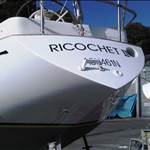
I agree with the other comments. Wait till you go sailing again in one of our fresh North Easters and experiment with your sail plan. I reckon your boat would still go to windward with just a few feet of the headsail unfurled and the mainsail in the stackpack. When I sailed Ricochet down the coast and the wind increased to 35+ Southerly I started with one reef in the main and eventually went to a second. As the wind increased I eventually dropped the main and sailed to windward with half the headsail only. The windvane self steering handled it easily. I would not ever contemplate going forward and changing to a storm sail when just a bit of unfurled headsail would do the same job. If I had a 3rd reef in the main I might have used that with just a couple of feet of headsail out. I was so impressed with the headsails performance I decided to move the inner forestay back to the babystay position where it's less annoying.
Select to expand quoteRamona said..
Ramona has a storm jib that's very similar to that one. It was used only for the sail past check for the Syd Hob races. Going by the creases I would say that sail has had the same life. In Ramona's case I stitched up a cushion case and stored the sail there on a bunk. Probably would never be used in anger!
I agree with the other comments. Wait till you go sailing again in one of our fresh North Easters and experiment with your sail plan. I reckon your boat would still go to windward with just a few feet of the headsail unfurled and the mainsail in the stackpack. When I sailed Ricochet down the coast and the wind increased to 35+ Southerly I started with one reef in the main and eventually went to a second. As the wind increased I eventually dropped the main and sailed to windward with half the headsail only. The windvane self steering handled it easily. I would not ever contemplate going forward and changing to a storm sail when just a bit of unfurled headsail would do the same job. If I had a 3rd reef in the main I might have used that with just a couple of feet of headsail out. I was so impressed with the headsails performance I decided to move the inner forestay back to the babystay position where it's less annoying.
Interesting thank you. Yes a bit of experimentation is definitely in order.
Just as a loose observation: avoid the plastic hanks no matter how big or robust they look.
A boat I sailed on had them and when the storm jib was needed it flogged itself off the forestay and tried to shake the rig out of the boat. Those grommets and ties were put to use.