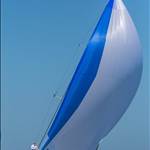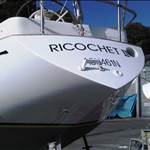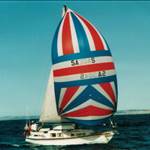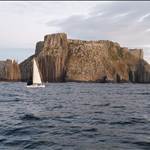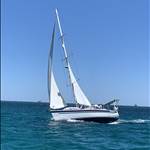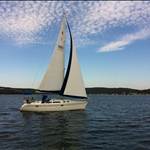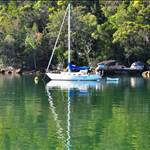


I think this advert is bragging. yachthub.com/list/yachts-for-sale/used/sail-monohulls/currawong-30/271568
I owned Screw Lose for a while (Holland 30, 9.14mtr). Records show she won S2H handicap in 1979. Anyone knows of another 9.14mtr handicap winner, or one < 9.14mtr?
Select to expand quoteBushdog said..
I think this advert is bragging. yachthub.com/list/yachts-for-sale/used/sail-monohulls/currawong-30/271568
I owned Screw Lose for a while (Holland 30, 9.14mtr). Records show she won S2H handicap in 1979. Anyone knows of another 9.14mtr handicap winner, or one < 9.14mtr?
Which is bigger a Currawong or MASH
Phil Y will know
The model is still in the stairwell of the Mersey yacht club btw
Phil y will laugh at this.
In about 1977-8 my father took me to Sydney to buy a new boat ( I was about 13)
At Middle Harbour we looked at MASH (later Screw Loose) but as we sailed out of Mooloolaba in the ocean he thought it was too lightly built.
He brought a Swanson 32 (Rough Red later Maggie McGill)) which we later did many miles on, he sold the boat and I went with it to Capt Johnny Bates. (Check out his book about the Whitsundays)
there should be a book about that.
Once winning a 1oz gold bar in a race and by the end the presentation the bowman had swapped it for a garbage bag of dope.
talk about bringing the sport into disrepute.
Now you have too do is make a Hitler meme!
I'm not sure of the actual LOA of either, both listed as 30'. I do know that the original/ first Currawong ( called Currawong) was owned by a good family friend Bill Burrows out of RPAYC. Another early skipper was Harold Vaughan with the mustard coloured deck, who I'd sailed E22s with around that time. Following those two were Granny Smith and Lollipop then Zeus which is still sailed decades later by Jim Dunstan who won Hobart in her.
last I heard of Screw Loose, was up in Port Moresby late last century. A former owner crewed for me in the 93 Coffs race, name long forgotten however. I can remember the rest though.
Select to expand quotelydia said..Bushdog said..
I think this advert is bragging. yachthub.com/list/yachts-for-sale/used/sail-monohulls/currawong-30/271568
I owned Screw Lose for a while (Holland 30, 9.14mtr). Records show she won S2H handicap in 1979. Anyone knows of another 9.14mtr handicap winner, or one < 9.14mtr?
Which is bigger a Currawong or MASH
Phil Y will know
The model is still in the stairwell of the Mersey yacht club btw
Phil y will laugh at this.
In about 1977-8 my father took me to Sydney to buy a new boat ( I was about 13)
At Middle Harbour we looked at MASH (later Screw Loose) but as we sailed out of Mooloolaba in the ocean he thought it was too lightly built.
He brought a Swanson 32 (Rough Red later Maggie McGill)) which we later did many miles on, he sold the boat and I went with it to Capt Johnny Bates. (Check out his book about the Whitsundays)
there should be a book about that.
Once winning a 1oz gold bar in a race and by the end the presentation the bowman had swapped it for a garbage bag of dope.
talk about bringing the sport into disrepute.
Now you have too do is make a Hitler meme!
Pretty sure Rough Red was owned by Keith LeCompte before he built the Kaufman 1 tonner White Pointer.
Select to expand quotePhilY said..
I'm not sure of the actual LOA of either, both listed as 30'. I do know that the original/ first Currawong ( called Currawong) was owned by a good family friend Bill Burrows out of RPAYC. Another early skipper was Harold Vaughan with the mustard coloured deck, who I'd sailed E22s with around that time. Following those two were Granny Smith and Lollipop then Zeus which is still sailed decades later by Jim Dunstan who won Hobart in her.
last I heard of Screw Loose, was up in Port Moresby late last century. A former owner crewed for me in the 93 Coffs race, name long forgotten however. I can remember the rest though.
The owner previous to me did some work on Screw Loose. I did some more. I sailed her back from PNG late 2003 and sold her at Airlie Beach. Buyer didn't respond to my offer of old documentation including S2H info, early history etc, so I still have it. As Lydia said, MASH (from surname initials of original four owners) was built light. When she didn't initially perform as expected, additional concrete and steel was poured into the keel stub. I guess part of my original query was.. Does anyone know which year a Currawong 30 won the S2H on handicap?
Select to expand quotePhilY said..lydia said..Bushdog said..
I think this advert is bragging. yachthub.com/list/yachts-for-sale/used/sail-monohulls/currawong-30/271568
I owned Screw Lose for a while (Holland 30, 9.14mtr). Records show she won S2H handicap in 1979. Anyone knows of another 9.14mtr handicap winner, or one < 9.14mtr?
Which is bigger a Currawong or MASH
Phil Y will know
The model is still in the stairwell of the Mersey yacht club btw
Phil y will laugh at this.
In about 1977-8 my father took me to Sydney to buy a new boat ( I was about 13)
At Middle Harbour we looked at MASH (later Screw Loose) but as we sailed out of Mooloolaba in the ocean he thought it was too lightly built.
He brought a Swanson 32 (Rough Red later Maggie McGill)) which we later did many miles on, he sold the boat and I went with it to Capt Johnny Bates. (Check out his book about the Whitsundays)
there should be a book about that.
Once winning a 1oz gold bar in a race and by the end the presentation the bowman had swapped it for a garbage bag of dope.
talk about bringing the sport into disrepute.
Now you have too do is make a Hitler meme!
Pretty sure Rough Red was owned by Keith LeCompte before he built the Kaufman 1 tonner White Pointer.
Yep
Select to expand quoteBushdog said..
I think this advert is bragging. yachthub.com/list/yachts-for-sale/used/sail-monohulls/currawong-30/271568
I owned Screw Lose for a while (Holland 30, 9.14mtr). Records show she won S2H handicap in 1979. Anyone knows of another 9.14mtr handicap winner, or one < 9.14mtr?
The Holland 30 and the Currawong 30 are the same length but the Currawong is a much smaller yacht.
Does anyone have information regarding the smallest yacht to compete in the Sydney to Hobart? I recall reading somewhere that a fixed keel Austral 20 competed in the late 70's?
Select to expand quote2Shakey said..
Does anyone have information regarding the smallest yacht to compete in the Sydney to Hobart? I recall reading somewhere that a fixed keel Austral 20 competed in the late 70's?
No , smallest would be Klinger in modern times at 27 and bit feet.
not sure a H 28 ever did it for instance.
Mulberry was a Swanson 27 extended 2 feet
Select to expand quotelydia said..2Shakey said..
Does anyone have information regarding the smallest yacht to compete in the Sydney to Hobart? I recall reading somewhere that a fixed keel Austral 20 competed in the late 70's?
No , smallest would be Klinger in modern times at 27 and bit feet.
not sure a H 28 ever did it for instance.
Mulberry was a Swanson 27 extended 2 feet
I always had in my head that it was a Swanson 27, I just hat the blister cabin version in my minds eye. Mulberry makes much more sense.
Select to expand quote2Shakey said..
Does anyone have information regarding the smallest yacht to compete in the Sydney to Hobart? I recall reading somewhere that a fixed keel Austral 20 competed in the late 70's?
In 1972 a 17 foot Red Jacket was an unoffical competitor.
www.themercury.com.au/news/tasmania/yachties-search-for-long-lost-sydneyhobart-noncompetitive-boat/news-story/d2faa42d54227ca6fbac5442fb944875
Maluka was smaller and won her division acvording to this report.
rolexsydneyhobart.com/the-yachts/2017/maluka/
I remember seeing Maluka on the hard at Noakes around July or August of 2017, just being finished off before the S2H. The restoration/rebuild was absolutely superb, attention to detail was sublime, and even out on the hard she had beautiful lines.
Select to expand quoteAzure305 said..
I remember seeing Maluka on the hard at Noakes around July or August of 2017, just being finished off before the S2H. The restoration/rebuild was absolutely superb, attention to detail was sublime, and even out on the hard she had beautiful lines.
I saw her at Noakes about then. Lovely classic yacht.
Klinger is the smallest ever entrant, at about 27' and 2000kg. MASH was significantly lighter than Zeus but almost identical LOA, beam and LWL.
Four Winds (1), Smilie (Triton 28), and Spiesie's bubble-deck Triton 28 were amongst the shortest yachts to race. Tow Truck (Mumm 30) would have been second lightest, I think, after Klinger, then probably the Hick 30s and the Andreiu, Hick and Humphreys halves Zumdish, Einstien (??) and Half Hour - but two of them retired in the first few miles. Tow Truck, the IMS Hicks and Spiesies 28 were the only ones that performered anywhere near their potential, which seems to indicate that the really radical boats tend to be too hard on crew.
Select to expand quoteChris 249 said..
Klinger is the smallest ever entrant, at about 27' and 2000kg. MASH was significantly lighter than Zeus but almost identical LOA, beam and LWL.
Four Winds (1), Smilie (Triton 28), and Spiesie's bubble-deck Triton 28 were amongst the shortest yachts to race. Tow Truck (Mumm 30) would have been second lightest, I think, after Klinger, then probably the Hick 30s and the Andreiu, Hick and Humphreys halves Zumdish, Einstien (??) and Half Hour - but two of them retired in the first few miles. Tow Truck, the IMS Hicks and Spiesies 28 were the only ones that performered anywhere near their potential, which seems to indicate that the really radical boats tend to be too hard on crew.
Nowadays there is a very simple reason small light boats cannot do well now.
Even looked at building a new 36 footer about 12 years ago and still could not beat these numbers.
The boats are measured empty so say 3200kg for a new 36 footer
There is about 63 kgs of mandatory safety gear/equipment per crew member.
So about 650kg of mandatory equipment.
3200/650 equals about 20% and sailing weight of 3850kgs
A hundred footer weights 30000kg and has say 20 crew
So 4% of weight
As it takes about 25kg to sink a Sydney 38 1mm according to the flotation data you see the problem
Select to expand quotelydia said..Chris 249 said..
Klinger is the smallest ever entrant, at about 27' and 2000kg. MASH was significantly lighter than Zeus but almost identical LOA, beam and LWL.
Four Winds (1), Smilie (Triton 28), and Spiesie's bubble-deck Triton 28 were amongst the shortest yachts to race. Tow Truck (Mumm 30) would have been second lightest, I think, after Klinger, then probably the Hick 30s and the Andreiu, Hick and Humphreys halves Zumdish, Einstien (??) and Half Hour - but two of them retired in the first few miles. Tow Truck, the IMS Hicks and Spiesies 28 were the only ones that performered anywhere near their potential, which seems to indicate that the really radical boats tend to be too hard on crew.
Nowadays there is a very simple reason small light boats cannot do well now.
Even looked at building a new 36 footer about 12 years ago and still could not beat these numbers.
The boats are measured empty so say 3200kg for a new 36 footer
There is about 63 kgs of mandatory safety gear/equipment per crew member.
So about 650kg of mandatory equipment.
3200/650 equals about 20% and sailing weight of 3850kgs
A hundred footer weights 30000kg and has say 20 crew
So 4% of weight
As it takes about 25kg to sink a Sydney 38 1mm according to the flotation data you see the problem
Yep, and no one adjusts the time correction factor to allow for this.
The other thing that is interesting is that since the 1800s, time correction factors have allowed for the fact that big boats go slower, proportionate to their hull speed, than smaller boats in most conditions. From one point of view it's reasonable to allow for this fact - but from another point of view, why should anyone get a "credit" because they CHOOSE to build a bigger boat that is inherently inefficient?
It was quite noticeable when IMS came in that the smaller boats got a reduced time allowance than they did under IOR, using the old 5th root - .96 calculation. Under IOR, half tonners won Hobart and Fastnet and did very well in other races. Since IMS and IRC came in, 30s have struggled to get up there. I remember years ago Robert Hick, who had lots of success with small IOR boats and designed Australia's most successful IMS 30 footers, saying that there was just no way a 30 could be competitive any more.
They've killed small boats and now they wonder why fewer people are sailing. Jeezers, why would the typical competitive youngster want to get into offshore sailing when they know that most of them will never be able to afford to do anything but crew for other people?
However, it was interesting that back in IOR days when the time allowance curve was different and the boats were measured in different trim, very few of the stripped-out low-headroom 30s did well in the Hobart. It seems that four or five days of being exhausted was just too much.
There was a little half tonner at 28ft that did very well in its day, called Tampico II did 1970 Syd/Hob, unfortunately got a bit shy putting gear back on after a battering but very successful otherwise, still around on the harbour somewhere.
Select to expand quotelydia said..Chris 249 said..
Klinger is the smallest ever entrant, at about 27' and 2000kg. MASH was significantly lighter than Zeus but almost identical LOA, beam and LWL.
Four Winds (1), Smilie (Triton 28), and Spiesie's bubble-deck Triton 28 were amongst the shortest yachts to race. Tow Truck (Mumm 30) would have been second lightest, I think, after Klinger, then probably the Hick 30s and the Andreiu, Hick and Humphreys halves Zumdish, Einstien (??) and Half Hour - but two of them retired in the first few miles. Tow Truck, the IMS Hicks and Spiesies 28 were the only ones that performered anywhere near their potential, which seems to indicate that the really radical boats tend to be too hard on crew.
Nowadays there is a very simple reason small light boats cannot do well now.
Even looked at building a new 36 footer about 12 years ago and still could not beat these numbers.
The boats are measured empty so say 3200kg for a new 36 footer
There is about 63 kgs of mandatory safety gear/equipment per crew member.
So about 650kg of mandatory equipment.
3200/650 equals about 20% and sailing weight of 3850kgs
A hundred footer weights 30000kg and has say 20 crew
So 4% of weight
As it takes about 25kg to sink a Sydney 38 1mm according to the flotation data you see the problem
that's an interesting perspective however i'd query 63kg of mandatory safety equipment per crew member.
when i off-shore raced a 36'er, we had 8 crew. 8 x 63kg = 504kg - of safety gear. don't recall ever weighing it, but i'd be surprised it was so much. heaviest item is your raft, at say 65-70kg...plus what, another 100kg (of flares, anchors etc) ? even 200kg and you're still a long way short...
how did you calculate this figure please ?
(NB : i'm mindful that regardless of the actual weight of safety gear, it's going to be a smaller percentage of the vessel displacement for a larger boat, so your point remains valid)
cheers,
Just a quick starter list for a 36 footer for 630 miles
Basic water 145Kg
Harnesses and PFD and attachments 60kg
Anchors/warps 80kg
Raft 45kg
Flares 10kg
Emergency steering requirement 20kg
Diesel 85kg
Storm Sails/sheets 25kg
There is 425kg without trying.
You are measured empty
Select to expand quoteMoocher said..
There was a little half tonner at 28ft that did very well in its day, called Tampico II did 1970 Syd/Hob, unfortunately got a bit shy putting gear back on after a battering but very successful otherwise, still around on the harbour somewhere.
Good call; she was said to be 28'6" but being an early Bob boat she was probably lighter than the other 28 footers. Last time I saw her she was near Gladesville Bridge, about three years ago. She used to live almost under the bridge on a private slipway that was the only one I ever saw that went side-on to the water.
Select to expand quotelydia said..
Just a quick starter list for a 36 footer for 630 miles
Basic water 145Kg
Harnesses and PFD and attachments 60kg
Anchors/warps 80kg
Raft 45kg
Flares 10kg
Emergency steering requirement 20kg
Diesel 85kg
Storm Sails/sheets 25kg
There is 425kg without trying.
You are measured empty
10kg on flares?!? Isn't cat 1 requirement something like 16 flares? Each flare tends to weight well below 300g so even rounding to 300g you would still with less than half you scoped.
60kg for PFDs and harnesses is once again, quite heavy. A spinlock PFD wight less than 1kg. Again, rounding up, you would reach 8 Kg on PFDs. I struggle to think about what harness, connectors and tethers would weight the remaining 52 Kg
Select to expand quotetrixpan said..lydia said..
Just a quick starter list for a 36 footer for 630 miles
Basic water 145Kg
Harnesses and PFD and attachments 60kg
Anchors/warps 80kg
Raft 45kg
Flares 10kg
Emergency steering requirement 20kg
Diesel 85kg
Storm Sails/sheets 25kg
There is 425kg without trying.
You are measured empty
10kg on flares?!? Isn't cat 1 requirement something like 16 flares? Each flare tends to weight well below 300g so even rounding to 300g you would still with less than half you scoped.
60kg for PFDs and harnesses is once again, quite heavy. A spinlock PFD wight less than 1kg. Again, rounding up, you would reach 8 Kg on PFDs. I struggle to think about what harness, connectors and tethers would weight the remaining 52 Kg
Sorry will be more specific I will try to find the original calculation sheets as we actually weighed it all.
Flares included V sheet, container in other words every thing you normally have in the flare container.
The PFD was based on a high end Crewsaver with face cover and includes a mix of tethers with Plastimo hooks (no the lightweight one we have now)and the bum pack, PLB, strobe as required and jacklines.
Also add in the tool kit and engine spares. About 15kg
Select to expand quotelydia said..
Just a quick starter list for a 36 footer for 630 miles
Basic water 145Kg
Harnesses and PFD and attachments 60kg
Anchors/warps 80kg
Raft 45kg
Flares 10kg
Emergency steering requirement 20kg
Diesel 85kg
Storm Sails/sheets 25kg
There is 425kg without trying.
You are measured empty
thanks - can now see where you got the figure from
higher than i would have calculated as eg i would not have included fuel & water in "safety gear" (no food ?)...on the 36'er our aluminium fortress anchor, chain etc weighed no more than 20kg...etc etc
but this is nit picking and as i said, i agree with your basic premise
nb : imho there is another reason why smaller boats are no longer competitive under IRC. this is that unlike IMS, IRC really makes no effort to adjust for different size boats. for all it's faults, IMS did allow different size boats to compete evenly. IRC just does not do that (which is why it's a joke to name an overall winner in race like S2H)
cheers,
From memory we used two 27lb CQR but now we have two Lewmar Racing ones which are very light but I have not used in anger yet.
for Hobart I would go old school especially on the TAS coast where there is a lot of rock and kelp.
agree should should not have called it safety gear but mandatory equipment.
In any event the issue was we could get enough hull buoyancy to carry the weigh at the displacements we wanted.
Simply put the boat sank in the water too far to go fast.
To give an idea a boat almost Sydney 38 size weighing a lot less and Azzurro let alone a standard S&S 34.
interesting to see that the TP 52s going to Hobart no longer take water but run water makers to save weight.
Select to expand quoteRingle said..
A slight digression.
is that Currawong for sale the old Gumblossom?
Nope, Gumblosson was built in 1973. I think Joubert had Billabong, the Magpie, by the time the Currawong in the ad came out.
A "proper" early Currawong would be more lurid - they had Butterscotch (which was butterscotch colour); Granny Smith (apple green); Lollipop (pink, since painted white but with pink coming through last time I saw her) and I think Flamenco was red.
Add Defiance (bright blue); Shenandoah (black); Plum Crazy (purple); Klinger (green); Providence (red) etc etc etc and one can see that in the early days of half tonners a white boat would have stood out!
You are forgetting the burnt orange vinyl bunk cushions or the lime green vinyl.
Freezing when cold and sweaty when not.
As for Currawong, the one I had was originally "baby **** brown"
a few of us often joked about holding a YA YA regatta as in get your YAYa's out, dig out the demin flares, body shirts and the PVC wet weather gear.
Adjust a few IOR ratings and play loud music.
Although Hobart still held IOR regattas until a few years ago.