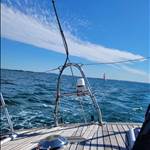


Wapiti has a selden single line reefing system that is supposed to pull the luff and clew down together, it has been completely cleaned with new slide bushing/bearings and lubed up to reduce friction but still not really happy with it. There is still enough friction in the system to warrant going to the mast and pulling lines to assist the sliding cars inside the boom to move. If I have to go to the mast to reef it seems like any advantage in the system is lost, on top of that the system has added complication.
My third reef doesn't use the in boom cars, rather its just a single line pulling down the clew and coming out of the front of the boom onto a winch on the mast. The luff would be held via a cringle over the reefing horn, however currently that is impossible because the batten cars stack to high up the track to allow the cringle to reach the horn.
So thinking I need some sort of strop from the reefing point to loop over the horn for the luff of the third reef. Also thinking of removing the cars inside the boom for the first and second reefs, running the clew lines to the cockpit as per current route and using strops for the luff reef points as well. Thinking spliced dyneema at the correct lengths for each reef as they are all different heights as the batten cars stack up when the main drops and then leave them fixed in place on the main, not much weight aloft, even gives you something to grab to pull the main down, nothing to really go wrong, seems like as simple solution to me just seeking others opinions in case I am missing something or others have better solutions.
HI Cammd,
I had this setup and I liked it. Whether you use one hardpoint for all reef strops or more than one would kinds make itself known just by looking at it. I had three different hardpoints, one for each, but there is no reason why just one or two wouldn't work if the geometry looks right.
The advantage of the strop is you clip it back to its hardpoint which is neat and tidy. You only have a 6/12" loop of dyneema that dangles, so nothing banging on the mast.
The pic is when we were playing around getting the length of the strop right. You can see the hardpoint on the mast which we clip it back to.

This is the hardpoints for reef 2 and 3. The lowest is Reef 2 and highest is 3. As you said, the higher offset for reef 3 is to get over the stack of battens and cars you end up with. My cars were quite tall which made it worse. Reef 1 is on the other side where you can also use the cunningham strop for tensioning.

Cheers,
SB
Select to expand quotecammd said..
Wapiti has a selden single line reefing system that is supposed to pull the luff and clew down together, it has been completely cleaned with new slide bushing/bearings and lubed up to reduce friction but still not really happy with it. There is still enough friction in the system to warrant going to the mast and pulling lines to assist the sliding cars inside the boom to move. If I have to go to the mast to reef it seems like any advantage in the system is lost, on top of that the system has added complication.
My third reef doesn't use the in boom cars, rather its just a single line pulling down the clew and coming out of the front of the boom onto a winch on the mast. The luff would be held via a cringle over the reefing horn, however currently that is impossible because the batten cars stack to high up the track to allow the cringle to reach the horn.
So thinking I need some sort of strop from the reefing point to loop over the horn for the luff of the third reef. Also thinking of removing the cars inside the boom for the first and second reefs, running the clew lines to the cockpit as per current route and using strops for the luff reef points as well. Thinking spliced dyneema at the correct lengths for each reef as they are all different heights as the batten cars stack up when the main drops and then leave them fixed in place on the main, not much weight aloft, even gives you something to grab to pull the main down, nothing to really go wrong, seems like as simple solution to me just seeking others opinions in case I am missing something or others have better solutions.
Do you need a strop? I just have one tack reefing line and when I'm going for the second reef I just dump the line off the cleat, walk to the mast, unhook the reefing line from #1 reef and reach up to put it in #2. The sail doesn't lift up because it's still held down at the clew but if it was really gnarly I can hook the cunningham line on the "old" reef to hold it down.
The nice thing about not having a strop is that you just drop the halyard, wind down the tack reefing line and that's it - you don't need to have to hook up a strop and then hoist the mainsail again. Singlehanded reefing the 36'er can be done in less than a minute with no problems.
Select to expand quoteChris 249 said..cammd said..
Wapiti has a selden single line reefing system that is supposed to pull the luff and clew down together, it has been completely cleaned with new slide bushing/bearings and lubed up to reduce friction but still not really happy with it. There is still enough friction in the system to warrant going to the mast and pulling lines to assist the sliding cars inside the boom to move. If I have to go to the mast to reef it seems like any advantage in the system is lost, on top of that the system has added complication.
My third reef doesn't use the in boom cars, rather its just a single line pulling down the clew and coming out of the front of the boom onto a winch on the mast. The luff would be held via a cringle over the reefing horn, however currently that is impossible because the batten cars stack to high up the track to allow the cringle to reach the horn.
So thinking I need some sort of strop from the reefing point to loop over the horn for the luff of the third reef. Also thinking of removing the cars inside the boom for the first and second reefs, running the clew lines to the cockpit as per current route and using strops for the luff reef points as well. Thinking spliced dyneema at the correct lengths for each reef as they are all different heights as the batten cars stack up when the main drops and then leave them fixed in place on the main, not much weight aloft, even gives you something to grab to pull the main down, nothing to really go wrong, seems like as simple solution to me just seeking others opinions in case I am missing something or others have better solutions.
Do you need a strop? I just have one tack reefing line and when I'm going for the second reef I just dump the line off the cleat, walk to the mast, unhook the reefing line from #1 reef and reach up to put it in #2. The sail doesn't lift up because it's still held down at the clew but if it was really gnarly I can hook the cunningham line on the "old" reef to hold it down.
The nice thing about not having a strop is that you just drop the halyard, wind down the tack reefing line and that's it - you don't need to have to hook up a strop and then hoist the mainsail again. Singlehanded reefing the 36'er can be done in less than a minute with no problems.
I think I need a strop as the current set up has the tack reefing lines going back into the boom and onto the sliding cars, there is no spare hardware to take a tack reef line to a winch either in the cockpit or on the mast.
I don't think I can just drop the halyard, the entire main would come down in 3 seconds flat on those sliding cars, I need to lower it to a predetermined mark on the halyard, secure the tack by whatever means is decided then re tension it. I couldn't reach the no. two reef either it needs to be lowered first.
Just using a strop would be the easiest conversion from the single line system but what worries me about the strop over the reefing horn is the horizontal pull from the clew, could that damage the batten or cars. If its not a good solution I am not opposed to going to more trouble to set up something better, which is why I am asking.
I personally think single line reefing is a dumb idea. Double line reefing however is brilliant and does away with all those niggling problems and you certainly don't have to leave the cockpit.
The major problem with single line reefing is one line tensions the "New Cunninham eye" and the foot tension at the same time. This is never going to be right.
When I drop in a reef I ease the main sheet and let off the halyard to a prescribed mark, bit of thread sewn in that lines up with a mark near the winch. {boom is held up by the strut}. The halyard is cleated off and at this stage the reef cringle is about 200mm above the new tack point. The reefing line which is now the cunningham eye is snugged down with the winch. Then the new clew is winched down hard and the main hauled back in. The boat is being steered by the Aries while this is happening and the heading drops off a few degrees while the main is eased but resumes course as soon as it's hauled in again. As soon as the course is resumed the cunningham eye is then adjusted so the luff is set correctly.
I can reef in about half the time it takes to type this!
The second and third reef marks on the halyard need to be set up at the safety of your mooring and allow plenty of room for the next cunninham eye to be tensioned downwards. In fresh conditions you will never get enough tension hauling up the halyard, the drag on the slides will prohibit this. Tensioning down is easy with the winch on the cunninham eye and when your down to the third reef that nice flat mainsail will make a big difference!
Select to expand quoteRamona said..
I personally think single line reefing is a dumb idea. Double line reefing however is brilliant and does away with all those niggling problems and you certainly don't have to leave the cockpit.
The major problem with single line reefing is one line tensions the "New Cunninham eye" and the foot tension at the same time. This is never going to be right.
When I drop in a reef I ease the main sheet and let off the halyard to a prescribed mark, bit of thread sewn in that lines up with a mark near the winch. {boom is held up by the strut}. The halyard is cleated off and at this stage the reef cringle is about 200mm above the new tack point. The reefing line which is now the cunningham eye is snugged down with the winch. Then the new clew is winched down hard and the main hauled back in. The boat is being steered by the Aries while this is happening and the heading drops off a few degrees while the main is eased but resumes course as soon as it's hauled in again. As soon as the course is resumed the cunningham eye is then adjusted so the luff is set correctly.
I can reef in about half the time it takes to type this!
The second and third reef marks on the halyard need to be set up at the safety of your mooring and allow plenty of room for the next cunninham eye to be tensioned downwards. In fresh conditions you will never get enough tension hauling up the halyard, the drag on the slides will prohibit this. Tensioning down is easy with the winch on the cunninham eye and when your down to the third reef that nice flat mainsail will make a big difference!
Thanks for that. I presume when you talk about the next cunningham eye you are talking about the next reefing cringle which becomes the new tack rather than having an additional cringle as a cunningham eye above each reefing cringle.
If so don't you have to have the tack reefing line lead through something on the side of the mast slightly forward of the tack cringle before going through a deck turning block so as to pull the tack forward a bit to counteract the rearward outhaul pull along the foot exerted by the clew reefing line?
Select to expand quotedon't you have to have the tack reefing line lead through something on the side of the mast slightly forward of the tack cringle before going through a deck turning block s
Yes it does help. How much would depend on the angle you can get, And how far apart the cringle is to the next cars where the car starts taking up the rearward load.
When I tension on the cunningham against the new cringle the strop will go loose so its all cunningham. Admittedly you have a fair bit on it but I never noticed any issue with creep. Select to expand quoteChris 249 said..
Do you need a strop? I just have one tack reefing line and when I'm going for the second reef I just dump the line off the cleat, walk to the mast, unhook the reefing line from #1 reef and reach up to put it in #2. The sail doesn't lift up because it's still held down at the clew but if it was really gnarly I can hook the cunningham line on the "old" reef to hold it down.
The nice thing about not having a strop is that you just drop the halyard, wind down the tack reefing line and that's it - you don't need to have to hook up a strop and then hoist the mainsail again. Singlehanded reefing the 36'er can be done in less than a minute with no problems.
Yes, but now go the other way. Shaking out from a number 2 to 1 is quicker and easier when the #1 is already set.
My double-line system sounds the same as Ramona.
Much quicker and tangle free compared to single-line. Sure, there are more lines, but less rope.
I do not leave the cockpit to reef - always single-handed. Reefed main sets as well as unreefed. Can be done with wind on the beam too. Much, much easier to shake out.
This season I put a reef in when being pressed a little too hard in the middle of the Port Phillip Rip. It took about two minutes max.
Select to expand quotejulesmoto said..Ramona said..
I personally think single line reefing is a dumb idea. Double line reefing however is brilliant and does away with all those niggling problems and you certainly don't have to leave the cockpit.
The major problem with single line reefing is one line tensions the "New Cunninham eye" and the foot tension at the same time. This is never going to be right.
When I drop in a reef I ease the main sheet and let off the halyard to a prescribed mark, bit of thread sewn in that lines up with a mark near the winch. {boom is held up by the strut}. The halyard is cleated off and at this stage the reef cringle is about 200mm above the new tack point. The reefing line which is now the cunningham eye is snugged down with the winch. Then the new clew is winched down hard and the main hauled back in. The boat is being steered by the Aries while this is happening and the heading drops off a few degrees while the main is eased but resumes course as soon as it's hauled in again. As soon as the course is resumed the cunningham eye is then adjusted so the luff is set correctly.
I can reef in about half the time it takes to type this!
The second and third reef marks on the halyard need to be set up at the safety of your mooring and allow plenty of room for the next cunninham eye to be tensioned downwards. In fresh conditions you will never get enough tension hauling up the halyard, the drag on the slides will prohibit this. Tensioning down is easy with the winch on the cunninham eye and when your down to the third reef that nice flat mainsail will make a big difference!
Thanks for that. I presume when you talk about the next cunningham eye you are talking about the next reefing cringle which becomes the new tack rather than having an additional cringle as a cunningham eye above each reefing cringle.
If so don't you have to have the tack reefing line lead through something on the side of the mast slightly forward of the tack cringle before going through a deck turning block so as to pull the tack forward a bit to counteract the rearward outhaul pull along the foot exerted by the clew reefing line?
Yes.
It also helps to have a sail slide cassette so the slides are held captive as low as possible just above the boom.
Select to expand quoteRamona said..julesmoto said..Ramona said..
I personally think single line reefing is a dumb idea. Double line reefing however is brilliant and does away with all those niggling problems and you certainly don't have to leave the cockpit.
The major problem with single line reefing is one line tensions the "New Cunninham eye" and the foot tension at the same time. This is never going to be right.
When I drop in a reef I ease the main sheet and let off the halyard to a prescribed mark, bit of thread sewn in that lines up with a mark near the winch. {boom is held up by the strut}. The halyard is cleated off and at this stage the reef cringle is about 200mm above the new tack point. The reefing line which is now the cunningham eye is snugged down with the winch. Then the new clew is winched down hard and the main hauled back in. The boat is being steered by the Aries while this is happening and the heading drops off a few degrees while the main is eased but resumes course as soon as it's hauled in again. As soon as the course is resumed the cunningham eye is then adjusted so the luff is set correctly.
I can reef in about half the time it takes to type this!
The second and third reef marks on the halyard need to be set up at the safety of your mooring and allow plenty of room for the next cunninham eye to be tensioned downwards. In fresh conditions you will never get enough tension hauling up the halyard, the drag on the slides will prohibit this. Tensioning down is easy with the winch on the cunninham eye and when your down to the third reef that nice flat mainsail will make a big difference!
Thanks for that. I presume when you talk about the next cunningham eye you are talking about the next reefing cringle which becomes the new tack rather than having an additional cringle as a cunningham eye above each reefing cringle.
If so don't you have to have the tack reefing line lead through something on the side of the mast slightly forward of the tack cringle before going through a deck turning block so as to pull the tack forward a bit to counteract the rearward outhaul pull along the foot exerted by the clew reefing line?
Yes.
It also helps to have a sail slide cassette so the slides are held captive as low as possible just above the boom.
So what is a sail slide cassette?
Some are here at some cost and complication but assume Ramona is talking about a mainsail with luff slugs with all the slugs held captive just above the boom when the sail is lowered with a suitable stopper fastened into the mast just above the gooseneck. This can be as basic as a self tapper (use Tefgel to isolate the stainless self tapper from the aluminium of the mast so as to prevent the alum from corroding away) or a short plug of plastic rod to stop the sail slugs from dropping out of the track once the sail is hoisted which would be better as don't need to drill another hole in the mast, or other. The slugs would fall down onto the rod but not come out of the mast groove hence be ready for the next hoist.
support.seldenmast.com/files/1383742136/excerpts/595-808-E-50-51.pdf
www.tidesmarine.com.au/sail-track-slide-systems/
Select to expand quotejulesmoto said..Ramona said..julesmoto said..Ramona said..
I personally think single line reefing is a dumb idea. Double line reefing however is brilliant and does away with all those niggling problems and you certainly don't have to leave the cockpit.
The major problem with single line reefing is one line tensions the "New Cunninham eye" and the foot tension at the same time. This is never going to be right.
When I drop in a reef I ease the main sheet and let off the halyard to a prescribed mark, bit of thread sewn in that lines up with a mark near the winch. {boom is held up by the strut}. The halyard is cleated off and at this stage the reef cringle is about 200mm above the new tack point. The reefing line which is now the cunningham eye is snugged down with the winch. Then the new clew is winched down hard and the main hauled back in. The boat is being steered by the Aries while this is happening and the heading drops off a few degrees while the main is eased but resumes course as soon as it's hauled in again. As soon as the course is resumed the cunningham eye is then adjusted so the luff is set correctly.
I can reef in about half the time it takes to type this!
The second and third reef marks on the halyard need to be set up at the safety of your mooring and allow plenty of room for the next cunninham eye to be tensioned downwards. In fresh conditions you will never get enough tension hauling up the halyard, the drag on the slides will prohibit this. Tensioning down is easy with the winch on the cunninham eye and when your down to the third reef that nice flat mainsail will make a big difference!
Thanks for that. I presume when you talk about the next cunningham eye you are talking about the next reefing cringle which becomes the new tack rather than having an additional cringle as a cunningham eye above each reefing cringle.
If so don't you have to have the tack reefing line lead through something on the side of the mast slightly forward of the tack cringle before going through a deck turning block so as to pull the tack forward a bit to counteract the rearward outhaul pull along the foot exerted by the clew reefing line?
Yes.
It also helps to have a sail slide cassette so the slides are held captive as low as possible just above the boom.
So what is a sail slide cassette?
I made mine like the selden cassette. The sail when lowered sits lower and I can actually reach the halyard just standing on the deck. The pin that retains the bottom slide is probably 30cm lower than what it was. Certainly could not when I first got the boat. The first thing I did when I bought this boat was to take the mini grinder and cut off the reefing hooks in the interests of safety.
I like this strop set up in this clip at the 2.22m mark, should be able to make something similar very easily with dyneema, think I will set up a couple of tack reefing lines at the mast so I can winch the main down if needed and then reset one for the next reef as well.
Select to expand quotecammd said..Chris 249 said..cammd said..
Wapiti has a selden single line reefing system that is supposed to pull the luff and clew down together, it has been completely cleaned with new slide bushing/bearings and lubed up to reduce friction but still not really happy with it. There is still enough friction in the system to warrant going to the mast and pulling lines to assist the sliding cars inside the boom to move. If I have to go to the mast to reef it seems like any advantage in the system is lost, on top of that the system has added complication.
My third reef doesn't use the in boom cars, rather its just a single line pulling down the clew and coming out of the front of the boom onto a winch on the mast. The luff would be held via a cringle over the reefing horn, however currently that is impossible because the batten cars stack to high up the track to allow the cringle to reach the horn.
So thinking I need some sort of strop from the reefing point to loop over the horn for the luff of the third reef. Also thinking of removing the cars inside the boom for the first and second reefs, running the clew lines to the cockpit as per current route and using strops for the luff reef points as well. Thinking spliced dyneema at the correct lengths for each reef as they are all different heights as the batten cars stack up when the main drops and then leave them fixed in place on the main, not much weight aloft, even gives you something to grab to pull the main down, nothing to really go wrong, seems like as simple solution to me just seeking others opinions in case I am missing something or others have better solutions.
Do you need a strop? I just have one tack reefing line and when I'm going for the second reef I just dump the line off the cleat, walk to the mast, unhook the reefing line from #1 reef and reach up to put it in #2. The sail doesn't lift up because it's still held down at the clew but if it was really gnarly I can hook the cunningham line on the "old" reef to hold it down.
The nice thing about not having a strop is that you just drop the halyard, wind down the tack reefing line and that's it - you don't need to have to hook up a strop and then hoist the mainsail again. Singlehanded reefing the 36'er can be done in less than a minute with no problems.
I think I need a strop as the current set up has the tack reefing lines going back into the boom and onto the sliding cars, there is no spare hardware to take a tack reef line to a winch either in the cockpit or on the mast.
I don't think I can just drop the halyard, the entire main would come down in 3 seconds flat on those sliding cars, I need to lower it to a predetermined mark on the halyard, secure the tack by whatever means is decided then re tension it. I couldn't reach the no. two reef either it needs to be lowered first.
Just using a strop would be the easiest conversion from the single line system but what worries me about the strop over the reefing horn is the horizontal pull from the clew, could that damage the batten or cars. If its not a good solution I am not opposed to going to more trouble to set up something better, which is why I am asking.
Sorry, I chose my words poorly; I meant ease the halyard to a predetermined point and then locking it off rather than just dropping it.
I've got Harken cars as well and my main drops beautifully as it sounds like yours does. It does make re-tensioning the halyard easier than if we had luff ropes, but personally I love the slight saving of time and labour, and the fact that it's simple to adjust the luff tension if it's needed.
At least one boat I sailed on had a tack strop that was secured at the front or side of the mast, than ran to the luff reef point horizontally and then down to the mast foot. That gave the line's tension a forward component (sorry, hard to explain) that took the horizontal pull from the clew.
Select to expand quotedshaggybaxter said..Chris 249 said..
Do you need a strop? I just have one tack reefing line and when I'm going for the second reef I just dump the line off the cleat, walk to the mast, unhook the reefing line from #1 reef and reach up to put it in #2. The sail doesn't lift up because it's still held down at the clew but if it was really gnarly I can hook the cunningham line on the "old" reef to hold it down.
The nice thing about not having a strop is that you just drop the halyard, wind down the tack reefing line and that's it - you don't need to have to hook up a strop and then hoist the mainsail again. Singlehanded reefing the 36'er can be done in less than a minute with no problems.
Yes, but now go the other way. Shaking out from a number 2 to 1 is quicker and easier when the #1 is already set.
I don't find much difference, because all you have to do is to chuck the cunningham eye into the #1 reefing eye before you dump the #2 tack line. Basically it's using two lines that can each double as a cunningham or a reefing line.