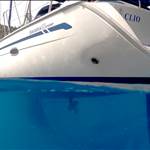


Hi all, have a Bavaria 38 cruiser that my wife and I bought, my wife convinced me to buy her the plan being we would sail as a couple, I was going to buy smaller. Anyway, sadly it ends up she gets panicked when out on the water and she has virtually given up on the idea of sailing. I on the other hand love it, have become a fairly competent inshore skipper, and am very keen to take the next steps to become a coastal and then possibly offshore sailor. So I am left with a Bavaria 38 that has been set up nicely that I either have to learn to sail single-handed (albeit having crew occasionally) or sell her  and buy a smaller one eg 30 - 34 foot. Shis is a 2004 Bavaria 38 cruiser and setup nicely for possible single-handing with all lines all coming back to the cockpit. We are about to move back to Adelaide so I feel under pressure on making a decision as it is much easier to sell her in Sydney (and easier to find a smaller boat) I am also keen for advice re .finding a mentor that can be hired for some hours to come to Pittwater on my yacht to give me some practical skippering and sailing tips I have booked to do the RYA Day Skipper practical certificate.
I'm not particularly familiar with the Bavaria 38, but a 38-footer is not a particularly large vessel to sail single-handed, if properly rigged. I've sailed a Lightwave 38 for decades, single handed hundreds of times.
They key thing is for ALL lines to run the cockpit. In particular, make sure you can reef without going to the mast. After years of single-line reefing failures, these days I prefer two-line reefing, which is bullet proof. Either way, you need to be able to drop the main without going on deck in heavy weather. Lazy jacks help greatly.
Also, your autopilot is the single-handed sailor's best friend. Make sure you have something super reliable. If you have a wheel pilot (such as Raymarine EV-100) consider replacing it with a more durable linear drive (such as Raymarine Evolution).
Consider getting a wireless wearable remote for your autopilot (such as Raymarine RCU-3), which allows you to steer from anywhere on the vessel.
PS Not meant to be an ad for Raymarine, but this is all gear I've personally used. I'm sure B&G and others have excellent gear too.
I agree with lots of what Scruzin says. 38ft is fine to singlehand. I also love a remote for the autopilot. When I singlehand I use the autopilot as my helm with constant corrections as I change trim. Interestingly, my 38ft cat doesn't have reefing lines led to the cockpit, I am not a fan of the singlhander staying in the cockpit and halyards and reefs work much better on my boat worked at the mast. Going to a smaller 32 footer would be reasonable if no one is going to cruise long term with you. A nice 32 ish yacht will have all the amenities you need but with far lower loads. But a 38 ft yacht will cover more miles if you long distance cruise.
As for a tutor. Become a hussy at your local yacht clubs. Sail Saturdays and Sundays and do twilights oon racing boats. You will learn from a range of skippers and be able to choose tips that work for you. Even though it is not single-handed you will learn vast amounts about boat handling.
Hi Bobski,
So, a 2004 Bavaria 38, on first pass they look pretty good for short handing. Question: do you have in the in-mast furler and a furler for the headsail? I'd park the spinnaker pole for a while and stick to white sails, poles are a stage 2 thing if you are learning singlehanding.
Singlehanding and offshore work both use the same skills that are not common in smaller boats/sheltered sailing.
The first skill is learning and managing your boat's systems. You have electrical, plumbing, navigation, hydraulics, iron engines, comms and SAR, Make an effort to understand the fundamental components of these systems and how to operate/maintain/repair them. It will pay for itself tenfold in enjoying your sailing.
The second skill is crew management. Eat, rest, manage the boat, eat, rest, manage the boat. At night, always wear your harness and clip on. Use a three point tether. Have jacklines. Wear a personal EPIRB. That sort of thing.
You don't have to be all muscles to single hand and go offshore. Your best asset is assimilating the knowledge you need to make the right decisions for when, inevitably, everything goes to s^%$#!
Good on you for doing the RYA courses, the best money you'll ever invest in your sailing. In addition to that, look at the SSSC safety course, it will give you a lot in safety and SAR.
Keep the boat, she looks like a good 'un! All the best to you!
Bobski,
Docking and undocking will be the stressful part, particularly getting in and out of marinas in unfavourable winds.
I highly recommend the book 'Stress-free sailing' by Duncan Wells. He has a lot of short or single handed sailing techniques.
Sean
Also, an electric winch (or two), especially for the mainsail halyard, is a nice upgrade for the single-handed sailor.
If your reefing lines come back to the cockpit (as I prefer), you'll want at least two clutches directly in front of that winch, i.e., for main halyard and reefing line.
Most of my sailing has been single handed on boats from 34 to 47ft mostly mono hull.
I learned mostly by myself on how each boat handled but the key was practicing everything on days when weather was favourable rather than jumping into the rough weather and worrying about it then. Be it anchoring, picking up moorings, reefing... practice in gentle stuff first. Ideally yes all lines to cockpit but I've had boats without that too and with a good system in place like autopilot, jack lines, harness etc it has never been a problem in the rough stuff to place a reef in at the mast. Just depends on how your familiarity with the ocean and rough stuff is. The concern from the Mrs is probably lack of understanding on how it all works. It's daunting and 38ft seems big to a novice sailer especially one who just sees tipping and "ropes" everywhere as the default fear setting so maybe a course would help her there or a few club races?
Thaks all for replies Have all been enormously uweful and most of all reassuring. Makes me comfortable in keeping my beautiful boat. Yes she does have a good autopilot, and has AIS, radar, furling foresail but not main, I will get some electiric winches and an autopilot remote as per advice. I am considering bow thrusterss but of two minds. I'm going to do a separate post on mentors though becuase I am not a racer (just no interest in it, just curising) so don't have ths social side of sailing, and am looking to skill up. I'm doino the formal courses but want some tutoring on my own boat. Unfortunately paying for a private tutor through a sailing school is rediculously expensive i.e. $1000 a day. I'm hoping to find say a retired experienced skipper who is looking for some picket money and maybe a challenge!
Hopping down the NSW coast should be OK. The longer legs through Bass Strait could be problematic, to say the least, if you get the weather wrong. Given the reliability of current forecasts you may end up waiting a long time for the right weather system in the right place for the Eden-Wilsons leg and the Portland-Robe (?) leg, but that's a hell of a lot better than getting it wrong.
Furling headsails do not perform properly when reefed, and having done Bass Strait a few times I would not enter it without a No. 4 headsail, storm jib, and either a very well tried system of deep reefing, or a storm trysail that you have used in anger. I knew two guys who singlehanded across the Strait without good storm sails. One put out a Mayday and was towed in as a direct result of lacking storm sails, the other radioed that he had suffered major sail damage and was never heard of again. Finally, I'd say that offshore sailing in those areas is a fairly serious sport, in that it's not something to do if you are unfit and not physically able to move well around all parts of the boat in a true heavy breeze, which is different from the Youtube "40 knot gales" where the boat is happily sitting with a reef and a No. 3.
You may have no interest in racing but for learning how to sail well very quickly there is absolutely nothing so effective. You don't have to get worked up competitively, just listen, do the tasks set and ask questions later. You won't find a better or cheaper way to learn how to cruise your own boat well.
Select to expand quoteBobski said..
Thaks all for replies Have all been enormously uweful and most of all reassuring. Makes me comfortable in keeping my beautiful boat. Yes she does have a good autopilot, and has AIS, radar, furling foresail but not main, I will get some electiric winches and an autopilot remote as per advice. I am considering bow thrusterss but of two minds. I'm going to do a separate post on mentors though becuase I am not a racer (just no interest in it, just curising) so don't have ths social side of sailing, and am looking to skill up. I'm doino the formal courses but want some tutoring on my own boat. Unfortunately paying for a private tutor through a sailing school is rediculously expensive i.e. $1000 a day. I'm hoping to find say a retired experienced skipper who is looking for some picket money and maybe a challenge!
IMHO, the autopilot/windvane is one area where please don't skimp on price. A good pilot is probably the bigges gamechanger in transforming your sailing experience. Being 'trapped' at the helm becomes a distant memory, you can roam around and just flaff about with your boat.
Regards bow thrusters, I'm in two minds. I purposefully opted not to get thrusters because I really wanted to learn how to dock without being reliant on them. Add to that the extra cost and complexity. I don't regret being sans thrusters at all, but man... bow thrusters do make docking sooo much easier!
Select to expand quoteKankama said..
You may have no interest in racing but for learning how to sail well very quickly there is absolutely nothing so effective. You don't have to get worked up competitively, just listen, do the tasks set and ask questions later. You won't find a better or cheaper way to learn how to cruise your own boat well.
Offshore races are particularly useful in this regard.
But even if you don't want to race yourself, consider inviting crew who do race. You're guaranteed to learn a lot from them.
Hi Bobski,
you'll have no trouble single handing a 38. I sail my NS38 solo almost exclusively and it's no harder than soloing my previous 28'er, in fact easier. Just docking is more difficult in a breeze. An AP remote is a nice to have, but not essential. I had it on my 28, but not the 38 and don't miss it terribly.
a good and reliable AP is very important but you can sail without that too. Mine was on the blink for a few weeks and I managed fine.
the secret is to have a plan for every operation, and at least one back up plan for same. Prepare everything in advance like making sure your mainsail slugs are well lubricated when dropping the main and use the friction knob on the helm to hold the course into the wind if only for 30 seconds (enough time to drop it into the lazy jacks).
practice docking and heaving to and other maneuvers in good conditions. Always reef early.
Bow thrusters are nice to have but not essential either if you take the time to learn your boat and practice. hope this helps. Enjoy your sailing.
dm