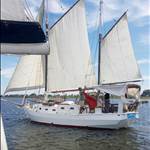


I had the mainsail off for a repair and reefing lines removed. I am renewing all the running rigging and reefing lines are the last step. I could use some advice for the routing of the clew lines on the sail and the boom.


Good plan. Those photos look a tad gnarly the reefing line is not threaded through properly. Looks like the 2 blocks attached to the boom were intended for 2 reef lines not for both to handle 1 reef line. Assuming your main has 2 reef points the lower reef would go through aft block and then the the cleat, while the line for the next reef up would go through the more fwd block and then to the cleat. The system would only allow reefing before leaving the mooring using 1 line for the 2 reef points. Adding a 2nd line would address the 2 reef points. The blocks rivetted to the boom side should be positioned a bit aft of the clew cringle for each reef so as to tension the foot of the sail. Usual to have a 2:1 system in the reef line so lead it from a bowline tied to the boom just aft of the block then up to the reef cringle then down through the block then fwd to the cleat. Or bowline to a saddle rivetted the other side of the boom to the blocks side. The cleat should right fwd on the boom say 0.5m aft of the tack so the person putting the reef in can stand there right next to the mast not have to so far aft where the boom will be flogging sideways and up and down a lot more. The tack fitting for the luff reef cringles is best as a bull horn stainless rod arrangement as part of the goosneck. Ronstan and Harken and some sailmakers do reasonable schematics the below links showing 2 lines per reef one at the clew and one at the tack.
www.ronstan.com.au/marine5/reefing_systems.asp
www.harken.com.au/en/support/selection-tools/system-diagrams/mainsail-reefing-systems/
www.uksailmakers.com/proper-reefing-procedure
The reef line fwd of the block to the cleat can be led inside the boom through neat small cut-outs if wanted - make sure these slots are on the neutral axis of the book section - so about 1/2 vertical depth - so they won't impact the boom bending strength much. Jack stays are a great addition to secure the sail when lowered, helping to flake it onto the boom.
I know that I have it wrong. This was my first attempt. I have one photo that shows the line going around the boom rather than direct to the block.
I have one photo that shows the line going around the boom rather than direct to the block.
That will still probably not be the best route.
I have a single line that pulls the rear reef cringle down and back. Then a rams horn that holds the reef tack at the goosenck.
I lower the halyard, hook the cringle on the horn (at the mast) haul the reef line and cleat off.
Then back in the cockpit hoist up the last bit of the man sail.
Everyone does it slightly differently, but you need to sort out your lines first,
Here is a video I a bloke who went from single line reefing to twin line reefing.
It explains some of the pitfalls (friction)
Gary
Update on the reefing lines. Happier with the 2nd attempt today. I have one line at the mast that works for reef 1 and 2. The harder part was the clew. I now have 2 lines at the clew. One for reef one and a 2nd for reef 2. It looks a bit messy where the rolling bowlines are attached to the boom but quite clean and workable on the other side.


The rolling bowline really only works with a loose footed mainsail. best idea with that sail is a couple of saddles to take the ends of the reefing lines. The cleats for the reefing lines should be right up near the gooseneck if you intend keeping the reefing line on the boom. In unpleasant weather when a reef is required the boom will be out wide and those cleats will be out of reach!
Select to expand quoteRamona said..
The rolling bowline really only works with a loose footed mainsail. best idea with that sail is a couple of saddles to take the ends of the reefing lines. The cleats for the reefing lines should be right up near the gooseneck if you intend keeping the reefing line on the boom. In unpleasant weather when a reef is required the boom will be out wide and those cleats will be out of reach!
That's a very good point about the end of the boom being 'out there' when you need it. Coming in to the Bay once I realised I'd fouled the second reef under the first reef, (it was dark, I was tired, rushed it and I screwed it up). It was a narrow laneway and windy enough that sheeting the boom in was a very bad idea. I flaffed about for ages trying boat hooks, sidling out on the boom and clipping on in all sorts of bizzare ways before I had a moment of clarity. Ever have one of those moments when you realise you are progressively getting stupider and inexorably working your way toward becoming a statistic?
Sanity finally prevailed and I did what I should have done much earlier, dumped everything, brought the whole lot in to the centreline, started from scratch and did it properly. Blew the ETA but parked up and got a good nights sleep and was still alive the next morning (I've found pushing to meet an ETA seems to have a habit of getting you into trouble).
The lesson for me was once the boom is hanging over the side, no matter how tantalisingly close it may appear it might as well be a hundred miles away. Bringing out the internal Macgyver is not the solution. Think things through, take the time to make the end of the boom work properly and it will pay for itself many times over.
Select to expand quoteRamona said..
The rolling bowline really only works with a loose footed mainsail. best idea with that sail is a couple of saddles to take the ends of the reefing lines. The cleats for the reefing lines should be right up near the gooseneck if you intend keeping the reefing line on the boom. In unpleasant weather when a reef is required the boom will be out wide and those cleats will be out of reach!
Oh My Thanks Ramona, I have recently converted from single line reefing and was wondering how I would go hauling in the clew reef when the boom was hanging out there and I had no wiggle room to haul it in which where I sail is probable. Ever since I've had the boat I have wondered why the previous owner had a cleat on the boom a third of the way back from the mast . EASY.

Shaggy your description of progressive stupidity is oh soo familiar !  Back to the op I would also suggest beside having the leech reef lines cleated close to the mast, one either side of the boom helps ease the clutter, they do loop down a bit a couple of saddles help hold up the slack, of course you maybe able to run them inside the boom & exchange clutter for complication
I like the idea of the cleat being closer to the gooseneck, with saddles to carry the lines forward. Also saddles instead of rolling bowlines would be better as well. Looks like I will be drilling some holes in the boom.
I couldn't understand why the cleat was there either. Too close to the block and no room to sweat the line either.
For me a cleat should be on an angle as well. The working part of the line should come to the higher side of the cleat.
When sweating a line on a boom pull down not out. If you think about the block you are trying to pull the line out if the sheave if you pull out. Same with the cleat. Also you don't go flying over the side if something breaks.
And shaggy lots of us have been there too.
It's when you drop the main and sort the problem out and then relise you are not going that much slower and should have done it ages ago and don't put the main back up you feel stupid. Depends on the boat and the conditions.
Arriving late is better than not arriving.
Thought I would try out the two line reefing today. Hoisted full main ,no headsail to start. Wind was 14 gusting to 20 AW at around 150. Much much easier than single line and much quicker . Except for one thing. The cleat near the mast for the clew reef was leeward and although easy to unhitch was impossible for me to tie off once reefed without leaving the cockpit so I improvised and then raised the headsail.
I will try out below.