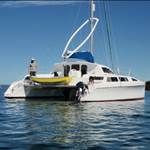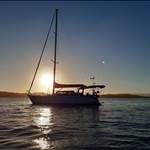


Just a quick note about our new Pypilot autopilot. On its second run it did about 10 miles in a sloppy seaway and it worked beautifully.
My son bought Sean Depaigner's Pypilot
pypilot.org/
and a motor controller. He did all the hard electronic stuff. My job was to make a motor and steering assembly. We used a 70 watt worm drive with toothed belt led to the steering cables. It pivots aft to engage the steering cables.
The system works so much better than my Raymarine X5, it is in a totally different category. The cat was on rails and I am getting a handle on adjusting gains. I couldn't ask for a better autopilot. The motor is so powerful compared to the anaemic Raymarine wheel pilot.
I had an issue with setting the peak current too low for the motor, I changed it from 7 to 12 amps. I also loved using the cheap garage door remote as I was singlehanded and it was a game changer to be able to furl the reacher up front and adjust course with the remote.
The Pypilot steers as well as me, and after 2 hours in a sloppy sea had used only 2 amp hours. I can't quite figure that out but it seems as though it uses little power because it keeps the boat straighter and doesn't struggle all the time like the Raymarine X5. So I get much much better steering and low power use.
We paid about $300-400 for the whole setup and it steers incredibly fast and true. I had been hoping for a great new autopilot and it looks as though this may be a game changer for anyone who can understand small computers and make their own drive system. I can adjust the different gains on the PID controller - it took a while to start getting my head around the gains but they do make sense, especially if you understand some basic maths and calculus (of sorts). Gains and the rest are adjusted on a phone, but I hope to be able to have the whole thing running through OpenCPN soon.
The drive system I built works pretty well. It uses a 70 watt worm drive motor in a swing arm assembly. A toothed belt is attached to the steering cables. To engage, I pull on a small tackle and the arms swings aft and tensions the belt. It all lies under my helm seat in the cockpit.
Kankama is on the slips now and when she comes back home she will have all her electrics and interior redone. I am really glad I got to trial the PyPilot before I redid the electrics as it seems like it will be a super effective autopilot as less than 1/15th of the price for an equivalent one.
It was just a short sail, from Lake Mac to Newcastle to get on the slips, but the sea was sloppy and I was running pretty fine tolerances when running deep angles on the reacher. I could sit inside or up front, with the cheap garage door remote control in one hand adjusting angles 2 or 3 degrees as the wind shifted. We did a few surfs and it was the first time the cat just tracked straight as she surfed - I have never had a really nice autopilot before. There was a TP52 out sailing so we came in together and I could clean the boat up, furling the reacher, hauling it down, putting ropes away, wandering around with the remote in hand adjusting course slightly as the wind changed direction and keep the boat sailing so that the TP didn't overhaul us quickly. I could certainly get used to having a fast, strong autopilot with remote control. For anyone who wants one, take a look at the Pypilot forum. There don't seem to be many setups completed yet, but I am obviously happy we went this way.
Cheers
Phil


So what do you use as the gyro and compass that inputs to the computer and program?
Gday Jules
The beauty of the Pypilot system is that the rate gyros, accelerometers and compass is all in the mini IMU that is part of the Pypilot board. Sean has written the software where the gyros feed and accelerometers feed into the compass course computing. It is really amazing to see how it steers in waves, as it comes back to course the wheel starts winding back onto a more neutral setting. In the lake the course is incredibly straight, I look back and the wake is a long line, unlike the Raymarine X5 where it was a series of s turns.
I haven't been on many fastish boats that have had good autopilots, but I can't ask any more from this one. It has steered amazingly well, totally out of the league of the wheel pilot. I reckon it should be a huge game changer for anyone who can build their own drive system or you can also power a hydraulic pump with the system too.
I just watched Mads on Sail Life obtain 3 different drive units for his upcoming TransAtlantic crossing. The cost for the simplest Raymarine below deck drive unit is $1700. To have even one spare would be $3400, plus the cost of the course computer, that is about $7000 all up. As stated I spent about $300-$400, and can make a spare drive unit for $100 or less. Better yet, if something goes terribly wrong, and lightning destroys the system, I can have a spare Pypilot protected in a Faraday cage and go to an auto wreckers and get an old windscreen wiper motor and get back out there without waiting for special parts to come in.
I have to do a lot more testing, but I would recommend anyone who is thinking of blowing $5000 on a below decks system, to at least read about Pypilot and talk about it with someone who knows simple computing. I will take a video on the trip home and post it in a few days.
cheers
Phil
Select to expand quoteKankama said..
Gday Jules
The beauty of the Pypilot system is that the rate gyros, accelerometers and compass is all in the mini IMU that is part of the Pypilot board. Sean has written the software where the gyros feed and accelerometers feed into the compass course computing. It is really amazing to see how it steers in waves, as it comes back to course the wheel starts winding back onto a more neutral setting. In the lake the course is incredibly straight, I look back and the wake is a long line, unlike the Raymarine X5 where it was a series of s turns.
I haven't been on many fastish boats that have had good autopilots, but I can't ask any more from this one. It has steered amazingly well, totally out of the league of the wheel pilot. I reckon it should be a huge game changer for anyone who can build their own drive system or you can also power a hydraulic pump with the system too.
I just watched Mads on Sail Life obtain 3 different drive units for his upcoming TransAtlantic crossing. The cost for the simplest Raymarine below deck drive unit is $1700. To have even one spare would be $3400, plus the cost of the course computer, that is about $7000 all up. As stated I spent about $300-$400, and can make a spare drive unit for $100 or less. Better yet, if something goes terribly wrong, and lightning destroys the system, I can have a spare Pypilot protected in a Faraday cage and go to an auto wreckers and get an old windscreen wiper motor and get back out there without waiting for special parts to come in.
I have to do a lot more testing, but I would recommend anyone who is thinking of blowing $5000 on a below decks system, to at least read about Pypilot and talk about it with someone who knows simple computing. I will take a video on the trip home and post it in a few days.
cheers
Phil
Wow thanks. Looking forward to that video.
Select to expand quoteKankama said..
Gday Jules
The beauty of the Pypilot system is that the rate gyros, accelerometers and compass is all in the mini IMU that is part of the Pypilot board. Sean has written the software where the gyros feed and accelerometers feed into the compass course computing. It is really amazing to see how it steers in waves, as it comes back to course the wheel starts winding back onto a more neutral setting. In the lake the course is incredibly straight, I look back and the wake is a long line, unlike the Raymarine X5 where it was a series of s turns.
I haven't been on many fastish boats that have had good autopilots, but I can't ask any more from this one. It has steered amazingly well, totally out of the league of the wheel pilot. I reckon it should be a huge game changer for anyone who can build their own drive system or you can also power a hydraulic pump with the system too.
I just watched Mads on Sail Life obtain 3 different drive units for his upcoming TransAtlantic crossing. The cost for the simplest Raymarine below deck drive unit is $1700. To have even one spare would be $3400, plus the cost of the course computer, that is about $7000 all up. As stated I spent about $300-$400, and can make a spare drive unit for $100 or less. Better yet, if something goes terribly wrong, and lightning destroys the system, I can have a spare Pypilot protected in a Faraday cage and go to an auto wreckers and get an old windscreen wiper motor and get back out there without waiting for special parts to come in.
I have to do a lot more testing, but I would recommend anyone who is thinking of blowing $5000 on a below decks system, to at least read about Pypilot and talk about it with someone who knows simple computing. I will take a video on the trip home and post it in a few days.
cheers
Phil
Hi Phil.
Sounds like you can achieve steering with just a windshield wiper motor.
I have forgotten Phil what size and approximate weight is your catamaran?
Thanks
Jules
Gday Jules
The intial setup uses a new windscreen wiper type motor. It works really well, except I had an issue with getting the toothed gear onto the shaft. That is one area where my skills are not up to spec.
I bought this one
www.motiondynamics.com.au/worm-drive-motor-12v-100w-30-55-rpm-8-50nm-torque-right-angle.html
I need to take it to someone to get a proper way to get the alloy toothed cog onto the tapered spline. My quick test setup failed at the cog/spline junction after 5 hours of use. It is certainly worth it, I just need to get the system fool proof now.
Kankama is a 11.6m long and 4000kg cat.
Select to expand quoteKankama said..
Gday Jules
The intial setup uses a new windscreen wiper type motor. It works really well, except I had an issue with getting the toothed gear onto the shaft. That is one area where my skills are not up to spec.
I bought this one
www.motiondynamics.com.au/worm-drive-motor-12v-100w-30-55-rpm-8-50nm-torque-right-angle.html
I need to take it to someone to get a proper way to get the alloy toothed cog onto the tapered spline. My quick test setup failed at the cog/spline junction after 5 hours of use. It is certainly worth it, I just need to get the system fool proof now.
Kankama is a 11.6m long and 4000kg cat.
Thanks again. Can't wait to see the whole setup on your video.
Gday Jules
I have attached a link to a rambling video about the Pypilot. On initial trials Pypilot seems to work really well. Sadly the builder, Sean Depaigner has had some trouble in his life and can't build any at the moment, but he may be able to in the future. I can see someone like Lazz being able to do this with eyes closed, but I needed some help.
Select to expand quoteKankama said..
Gday Jules
I have attached a link to a rambling video about the Pypilot. On initial trials Pypilot seems to work really well. Sadly the builder, Sean Depaigner has had some trouble in his life and can't build any at the moment, but he may be able to in the future. I can see someone like Lazz being able to do this with eyes closed, but I needed some help.
cheers
Phil
Thanks very much Phil. Maybe keep us posted with another vid of all the mechanics and electrics when you get it totally integrated.
Cheers Julian