

atomvoyages.com/articles/the-improved-outboard-well/
Could be a cheap way into a yacht as yachts with dead diesels seem to go for next to nothing. Gain a fair bit of (clean/dry) space inside the yacht too which is valuable in the size range.
That would be OK on slow yachts. Faster boats, 6 knots and above would have water forced into that compartment.
Select to expand quoteRamona said..
That would be OK on slow yachts. Faster boats, 6 knots and above would have water forced into that compartment.
Yes I agree that the compartment would run wet whilst underway and the yacht was digging a hole and pushing/pulling it's wave but I think the idea is that the conversion is usually done on yachts where the area near the transom is a few inches above the water when the yacht is at rest so it would be self draining.


I studied Atom's webpage and a few others, and did the same to my Northerner28 after the diesel died, and a motor on the transom was not fantastic. 
You can see the thought process, progress pictures here on the Compass forum (Northerner is predecessor to C28) : groups.google.com/g/compass-yacht-group/c/4U5qWlntOoo
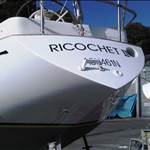
The OB well does not admit water either moored or underway. The OBW is about 4 inches above the waterline and even underway it does not dig a furrow in the water. In either case, that is why the OB well is about 40 cm tall, to prevent wave ingress during winter storms. I have sailed this yacht in excess of 6 knots, and no water came in. It depends on the hull shape and the height above the waterline.
One day I will install better Bombay doors like these: 
and maybe even raise the well to the top of the transom, to make airtight the well, to separate it completely from the rest of the hull.
But all in all, very feasible, it saves a 50 year old yacht from the financial impact of shelling out for a new diesel engine, and it sails better.
Select to expand quoteFabulousPhill said..
I studied Atom's webpage and a few others, and did the same to my Northerner28 after the diesel died, and a motor on the transom was not fantastic.
You can see the thought process, progress pictures here on the Compass forum (Northerner is predecessor to C28) : groups.google.com/g/compass-yacht-group/c/4U5qWlntOoo
The OB well does not admit water either moored or underway. The OBW is about 4 inches above the waterline and even underway it does not dig a furrow in the water. In either case, that is why the OB well is about 40 cm tall, to prevent wave ingress during winter storms. I have sailed this yacht in excess of 6 knots, and no water came in. It depends on the hull shape and the height above the waterline.
One day I will install better Bombay doors like these:
and maybe even raise the well to the top of the transom, to make airtight the well, to separate it completely from the rest of the hull.
But all in all, very feasible, it saves a 50 year old yacht from the financial impact of shelling out for a new diesel engine, and it sails better.
Good on you. Clever solution.