

Hello,
I would love your input please on the pros and cons of open transoms and closed transoms.
Thank you.
You really need to narrow down your question. Racer, cruiser, inshore, offshore, trailerable and so many other variables that inform the question.
Select to expand quoteGrith said..
You really need to narrow down your question. Racer, cruiser, inshore, offshore, trailerable and so many other variables that inform the question.
I am thinking along the lines of bluewater cruiser
Select to expand quoteWazzor said..Grith said..
You really need to narrow down your question. Racer, cruiser, inshore, offshore, trailerable and so many other variables that inform the question.
I am thinking along the lines of bluewater cruiser
Let's see, Bluewater cruiser so you want to impair the structure of the boat and make it more resistant to righting after inversion.
Your call.
Select to expand quotecisco said..
Open transoms are not called "suicide transoms" for no reason. 
Are they? I've never ever heard of that saying, and it's not on Google.
Why would they be dangerous? You can have decent lifelines to stop anyone falling off, they can help pulling people back on board, and they ensure that the cockpit drains immediately.
They may reduce the AVS and can bring structural complications but both of those can be fixed. Ironically, I know of at least one popular design where the only example that capsized with loss of life was one of the rare closed-transom versions.
Pro's of open...
Easy to retrieve people.
You're not sitting in water up to your waist when you bury the nose.
Awesome for getting in and out of the life raft/rib.
Never had a following sea enter the cockpit (personal experience, crap designs may be different)
You can inflate the rib in the cockpit and slide it out (factoring beam and backstay).
Easier to get in/out when inverted.
Depending upon liferaft position, easy access when inverted.
Great for a jackline across the beam, with the benefit that your tether won't strangle you if you go over.
Cons of open.
Winch handles and torches going walky! A low net would be good for bluewater passages.
Select to expand quotelydia said..Wazzor said..Grith said..
You really need to narrow down your question. Racer, cruiser, inshore, offshore, trailerable and so many other variables that inform the question.
I am thinking along the lines of bluewater cruiser
Let's see, Bluewater cruiser so you want to impair the structure of the boat and make it more resistant to righting after inversion.
Your call.
No calls. I made this post to be informed by drawing upon more experienced folks than I. Please kindly inform me how an open transom negates structural integrity and the ability to self right in the event of an inversion.
Select to expand quoteshaggybaxter said..
Pro's of open...
Easy to retrieve people.
You're not sitting in water up to your waist when you bury the nose.
Awesome for getting in and out of the life raft/rib.
Never had a following sea enter the cockpit (personal experience, crap designs may be different)
You can inflate the rib in the cockpit and slide it out (factoring beam and backstay).
Easier to get in/out when inverted.
Depending upon liferaft position, easy access when inverted.
Great for a jackline across the beam, with the benefit that your tether won't strangle you if you go over.
Cons of open.
Winch handles and torches going walky! A low net would be good for bluewater passages.
Cheers Shaggy. I agree with all you said. My main concern was being inundated by following sea yet you and other accounts I have read say this is rare or doesnt happen. Thank you for your input.
Structural integrity compromised as hull is more prone to twist. (Young 11 is a great example)
Open transom means less buoyancy aft when inverted so boat is more stable inverted. (Why IMOCA boats have a minimum coachouse volume)
Going to disagree with my mate Shaggy here,open transom are by far the most dangerous place to get someone back abound in a sea. The reason is the head injury from the MOB getting under the hull as it slams back down a sea.
As for following seas, big enough sea an open transom will make no difference.
Like the net idea if you are stuck with an open transom boat but it would need to be quickly removable yet very sturdy.
Don't like the idea of being thrown against two thin life lines by a tonne of water. 500 mm by 1m by 2 m is a tonne and my cockpit is well over 2m long.
Open transom yachts also tend to have long cockpits. I would think that a large volume of water rushing back out the transom would have a very good chance of taking you with it.
No real life experience of any of this but common-sense might be a good guide.
Didn't fancy the idea of a ton or two of water in my large closed transom cockpit so in addition to the pissy regulation cockpit drains I have added a couple of one hundred mm drains out the back of the cockpit at floor level through the lazarette and transom.
I think there is a good chance a lot of open transom boat's will be a light displacement design and aside from the open transom they may well have some other design features that are more suited to a racer or a coastal cruiser than they would be to a bluewater cruiser.
For example some other features a bluewater cruiser may have could include a skeg hung rudder not a spade, they may have a shaft drive not a sail drive, they may have conservative sail plan on a cutter rig rather than a powerful sail plan designed for speed with lots of things to tweak etc
So nothing against open transom's but I think they are more likely to be found on boats that are not designed for bluewater cruising as their primary function
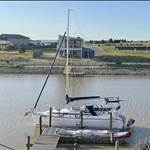
I love the open transom on my Dudley Dix 36. Sure beats the water collectors that I have sailed in the past. A full cockpit, waiting for the next wave to hit is no fun (Bass Strait storm, 1991 S2H delivery from Adelaide). I'd much prefer it to drain out the big hole in the back. And judging by the example in this photo (and many others you can find on the interwebs) I guess open transoms work pretty well for "Bluewater".

Of course my current, preferred approach to my open transom is at anchor, dangling my feet in the water, sipping beer after a swim. Each to their own etc.
Select to expand quoteduncansayers said..
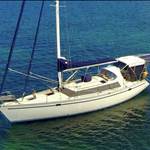
I love the open transom on my Dudley Dix 36. Sure beats the water collectors that I have sailed in the past. A full cockpit, waiting for the next wave to hit is no fun (Bass Strait storm, 1991 S2H delivery from Adelaide). I'd much prefer it to drain out the big hole in the back. And judging by the example in this photo (and many others you can find on the interwebs) I guess open transoms work pretty well for "Bluewater".
Of course my current, preferred approach to my open transom is at anchor, dangling my feet in the water, sipping beer after a swim. Each to their own etc.
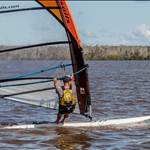
An open transom would also be great for windsurfing off, but there's no way I'm going to expose my D2s to use from the boat. Do you still sail one, Duncan?
Select to expand quoteChris 249 said..duncansayers said..
I love the open transom on my Dudley Dix 36. Sure beats the water collectors that I have sailed in the past. A full cockpit, waiting for the next wave to hit is no fun (Bass Strait storm, 1991 S2H delivery from Adelaide). I'd much prefer it to drain out the big hole in the back. And judging by the example in this photo (and many others you can find on the interwebs) I guess open transoms work pretty well for "Bluewater".
Of course my current, preferred approach to my open transom is at anchor, dangling my feet in the water, sipping beer after a swim. Each to their own etc.
An open transom would also be great for windsurfing off, but there's no way I'm going to expose my D2s to use from the boat. Do you still sail one, Duncan?
Yeah still windsurfing. The windsurfer LT Nationals at Lake Cootharaba had 145 entries. Chaos on the start line ;-)
My vote for closed transom - centre cockpit -  A few years back I sailed around part of NZ with the RORC39 I had at the time, a mate and my gf. They are kind of centre cockpit boats but not quite. There is a small aft deck and lazarette behind the wheel. And it was heavy ferro. perfect for NZ. We had dinghy on davits on the stern. At sea we got hit by a big following wave which smashed the dinghy in half covering the aft deck in water and shrapnel from bits of the dinghy. My gf and mate in the cockpit suffered no impact and got knee deep in water. I got wet waist down. If I was at the stern I would have had wave and dinghy shrapnel all over me but I didn't being further in. If the boat was open stern the cockpit would have drained better afterwards for sure, but I might have outgoing as well and it was cold
  What I remember most was the dinghy floor and its stern disappearing in the distance while its bow was still attached to one davit on board, then my mate called out should we go back for the dinghy!! So I like sitting more inboard with protection.
The ideal is a combination. Open transom with fold down swim deck that provides a closed transom effect when closed.
My current Bluewater 42 has optional open transom or fully enclosed , it has strong fibreglass doors with 2 inch gap for cockpit drainage. I would never buy a yacht without open transom again in my lifetime. Also great for scull dragging tuna up while sailing and whiting fishing which this morning I caught half a dozen in 15 minutes at Flinders island.

Select to expand quotesouthace said..
My current Bluewater 42 ...
Yep definitely best of both world's. Single helm or dual helm?
Select to expand quotejulesmoto said..southace said..
My current Bluewater 42 ...
Yep definitely best of both world's. Single helm or dual helm?
I have single helm which remains on linear drive raymarine latest Autopilot , I only use the wheel for anchoring, berthing and if stuff hits the fan. Real Bluewater yachts in my opinion don't need twin helms unless they are over 4m beam aft.
Select to expand quoteduncansayers said..Chris 249 said..duncansayers said..
I love the open transom on my Dudley Dix 36. Sure beats the water collectors that I have sailed in the past. A full cockpit, waiting for the next wave to hit is no fun (Bass Strait storm, 1991 S2H delivery from Adelaide). I'd much prefer it to drain out the big hole in the back. And judging by the example in this photo (and many others you can find on the interwebs) I guess open transoms work pretty well for "Bluewater".
Of course my current, preferred approach to my open transom is at anchor, dangling my feet in the water, sipping beer after a swim. Each to their own etc.
An open transom would also be great for windsurfing off, but there's no way I'm going to expose my D2s to use from the boat. Do you still sail one, Duncan?
Yeah still windsurfing. The windsurfer LT Nationals at Lake Cootharaba had 145 entries. Chaos on the start line ;-)
Yep, the start lines were often dodgy but for those of us in the Medium Weight division who were, in the light winds, theoretically slowest of the second starting group (Mediums, Light and Women) the problem was that we gave the Heavy/Superheavy/Cruiser bunch five minutes head start. That meant that the front of our fleet caught the back of their fleet at the first mark and from then on, given the fairly steady and light conditions, there was no clear air to be had, even when you were leading your weight division. I went in under-prepared, especially for light winds, and only scored 3-4-5-DNF (back strain) in the four disciplines but the guys who made the podium overall are great guys and fun to sail against.
It was one of the few regattas these days where the problem is too many entries; that is, too many for the tight course in light wind conditions. It's a nice problem to have considering that when my wife and I took over the class years ago it was almost dead and now it's the third-best selling class in the world behind Opti and Laser.
I still have Lars Kleppich's old Lechner next to Robby Naish's old raceboard and my IMCO in the shed, and three of four mates have D2s. I really must drag mine out since they are magic to sail.
The LT is a brilliant design; much easier to sail than the old board, still nippy and tactical to race, but capable of 32 knots at peak. Bruce nailed the shape and Nick and the other guys currently running the class are doing a great job. They're talking 200 Aussies at the worlds in Perth and despite the European economic pain, there could be 100+ of them which, combined with Perth's breezes, will make an amazing regatta.
What the 'F$%K does the above post have to do with the original question from "Wazzor"?
" I would love your input please on the pros and cons of open transoms and closed transoms."
I was quite enjoying the experienced and helpful comments on this post.
Select to expand quotejulesmoto said..
Like the net idea if you are stuck with an open transom boat but it would need to be quickly removable yet very sturdy.
Don't like the idea of being thrown against two thin life lines by a tonne of water. 500 mm by 1m by 2 m is a tonne and my cockpit is well over 2m long.
Open transom yachts also tend to have long cockpits. I would think that a large volume of water rushing back out the transom would have a very good chance of taking you with it.
No real life experience of any of this but common-sense might be a good guide.
Didn't fancy the idea of a ton or two of water in my large closed transom cockpit so in addition to the pissy regulation cockpit drains I have added a couple of one hundred mm drains out the back of the cockpit at floor level through the lazarette and transom.
Some great valid points mentioned and your modification of 100mm drains through the lazerette exiting the transom is quite clever. Does it impede or compromise your lazerette space much? If not, better drainage would definitely trump a little space inconvenience. I like it. If you could...a couple of pics would be great. Thanks again.
Select to expand quoteWindancer said..
What the 'F$%K does the above post have to do with the original question from "Wazzor"?
" I would love your input please on the pros and cons of open transoms and closed transoms."
I was quite enjoying the experienced and helpful comments on this post.
Jeezers...... okay I apologise for the thread drift but even if someone appointed you the thread policeman, you don't have to be so f&^%$ing rude when a quiet comment would do.
Select to expand quoteWazzor said..I like it. If you could...a couple of pics would be great. Thanks again.
I think I posted pictures on here 12 to 18 months ago when I first did it but here are some more pictures.
Essentially I cut two holes equal to the external diameter of 100 mm drainage pipe (with a hole saw) in the back of the cockpit vertical wall just above floor height and a bit separated so that they work when the yacht is heeled over. Two more holes in the transom so that there was fall between the cockpit and the transom. Thankfully this height does not interfere with the quadrant on my boat. I then glassed in about a 40? mm stub of drainage pipe in the lazarette side of each hole being careful to sand the pipe and expose it briefly to flame all the way around so that the fibreglass tabbing actually adhered to it properly. The fittings were all available from Bunnings.
It certainly does stop me putting large things in the lazarette without removing the drains but they are quick release and I try not to store things in the lazarette that won't fit past them or that I need frequently. If the drains should fail for some reason I have ensured that my lazarette is isolated from the rest of the boat as I plugged up all holes and extended the bulkhead which defines the front of the lazarette a bit to span the entire beam. I also did this to give me a watertight compartment about the rudder post so that if the rudder or skeg were ever ripped out the whole area would be isolated.


Select to expand quotejulesmoto said..Wazzor said..I like it. If you could...a couple of pics would be great. Thanks again.
I think I posted pictures on here 12 to 18 months ago when I first did it but here are some more pictures.
Essentially I cut 2 holes equal to the external diameter of 100 mm drainage pipe (with a hole saw) in the back of the cockpit vertical wall just above floor height and in the corners so that they work when the yacht is heeled over. Two more holes in the transom so that there was fall between the cockpit and the transom. Thankfully this height does not interfere with the quadrant on my boat. I then glassed in about a 35 mm stub of drainage pipe in the lazarette side of each hole being careful to sand the pipe and expose it briefly to flame all the way around so that the fibreglass tabbing actually adhered to it properly. The fittings were all available from Bunnings.
It certainly does stop me putting large things in the lazarette without removing the drains but they are quick release and I try not to store things in the lazarette that won't fit past them or that I need frequently. If the drains should fail for some reason I have ensured that my lazarette is isolated from the rest of the boat as I plugged up all holes and extended the bulkhead which defines the front of the lazarette a bit to span the entire beam. I also did this to give me a watertight compartment about the rudder post so that if the rudder or skeg were ever ripped out the whole area would be isolated.
Thank you very much for the further details and pictures. A clever modification idea that you have given some thorough thought. Cheers
I crewed on a half tonner around Cape Otway in a gale. The boat had an open transom. The wind speed was 80 plus knots apparent at the crest of the waves. We were running square and had to run off in the trough,s to avoid pitch poling. We were frequently knocked flat when bearing off with the mast in the water. When the boat righted, the cockpit was at least half full of water. The water drained immediately. We were obviously strapped on. This was a relatively low freeboard race boat and would have been in a far worse predicament had the water not drained so quickly. We pitch poled as we rounded Cape otway. When the boat righted the cockpit emptied immediately and we screamed off with some measure of control. All this was under bare poles. I currently have an older IOR ex race boat with a full transom, it is high sided and rarely gets spray in the cockpit. I appreciate the security, particularly sailing single handed. There are lots of advantages in both options. The structural integrity should be in the hull design and build.