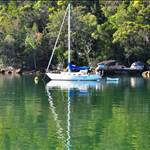


Recently bought a Carter 30, it's my first yacht. Getting it ready to sail from Brisbane Water to Sydney.
My question is: Is the inner forestay required to sail? I want to put a dinghy on the foredeck as don't want to tow it in open water, can't fit it with the inner forestay.
It's a mast head rig with two shrouds each side. Backstay has hydraulic tensioner. Inner forestay is on a track with blocks to move it forward to tighten the inner forestay.
All lines go back to the cockpit so organiser's and jammers will be in the way to put dingy on cabintop.
The fact that the inner forestay is adjustable indicates that it has a primary function of sail shape control. Have you done some sailing with the boat in Brisbane Water? Always good to check out a "new" boat in sheltered water before going out to sea. Also make sure you are familiar with the channel on the way out, tide times, delay, etc.
Is it an inner forestay to stop the mast pumping? The S&S34 has an inner forestay which is not for a sail but to stop the mast bending under the loads of the sails.
A very brief look at the Carter 30 specs doesn't show an inner forestay. If it isn't needed to support the mast, take it off when you want to.
MOst of the time a proper inner forestay will have runners. This is to oppose the forward acting loads the inner forestay produces. I would predict your Carter does not have runners. I think the Carter would have a single spreader rig. If the inner forestay comes from above the spreaders and above where the lowers meet the mast, then it probably is not necessary for most sailing.
Where it may be useful is when reefed. Often reefing will produce an aft acting force from the head of the main. This cam cause a mast invert. So if you don't need to reef then you should be fine. The reason I am not totally sure is because the rig could be safer with the inner forestay.
My mum's cat had a single spreader rig with no inner forestay. Then the mast fell down and everyone started blaming each other with lawyers and everything. The next mast had a small inner forestay, properly called a baby stay to stop the mast form inverting.
It looks like calm sailing on Saturday and a blowy reach on Sunday. It is was me I would check that the mast did not move fore and aft at the mooring and when sailing in Pittwater. Are there lowers fore and aft at the same position as the inner forestay? If so then it is probably just there to help when reefed, or to induce lower mast bend in strong winds.
However, to be sure, and why not be sure, you could also take the inner forestay forward to near the bow, in front of the dinghy. It will be a pain to tack, but you can furl to tack offshore, you won't tack often. Put a length of spectra onto the base of the forestay and tie it off to a strong point near the bow tang. It will work well even with less tension than normal. When you get into flat water, it should be fine to take it off, for quick tacking in the harbour. This technique is like one used by cruisers who use what is called a solent stay - they furl the jib. Then when you get to Sydney, ask a rigger about the need for the inner forestay.
On your mast head rig the back stay tensioner controls the sag in the forestay which relates to draft in the head sail.
Once happy with the forestay sag, the inner stay or baby stay in your case is cranked on to pull a pre load bend in the mast ,,, to hold it at its forward most peak of natural oscillation. This preload can also offset main sheet tension .
Yes you can sail with out it but your mast may become a guitar string or have a inverted bend .
Depends on your point of sail, sea state, deck or keel stepped rig.
A lot ot of cruising rigs have two forward and two aft lower shrouds to take care of these mentioned issues.,, from a racing stand point they don't provide enough flexibility in tuneability,,, where as single inline lowers with an adjustable baby stay and adjustable backstay provide flexibility.
Thanks all, decided to do a dinghy shuffle and not take it on board. I'll wait till I am used to the rig so I know what is normal.
It does appear to be a "baby stay" rather than an inner, it comes from just above the spreaders and (inline) lower shroud and lands on the deck about 1/3+ of the distance to the bow.