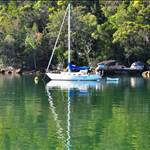


This is the follow on from the yacht hit by lightning , he now finds his bilge alarm is on and he can't keep up with the water.
what he does next is beyond words he goes over the side at night to look for the hole , pitch black you can see bull sharks in the torch light , I'm starting to think do I enjoy sailing this much.
He was dealing with a fairly large hole there. I seem to remember stuff called Kneadit that cures under water. I wonder
if it still exists and whether it would have helped reduce the size of the hole.
Select to expand quotesamsturdy said..
He was dealing with a fairly large hole there. I seem to remember stuff called Kneadit that cures under water. I wonder
if it still exists and whether it would have helped reduce the size of the hole.
Might have but the hull slime would have played havoc with kneadit as well. I carried it and another hole filling product on MB but it was more for dinghy repairs than the hull. I had pieces of an old sail onboard a few feet square I would have put over the hole in the hull. It should get forced in by the force of the water and hopefully would have jammed that hole. Not perfect but it would slow the inflow.
Select to expand quote MorningBird said..samsturdy said..
He was dealing with a fairly large hole there. I seem to remember stuff called Kneadit that cures under water. I wonder
if it still exists and whether it would have helped reduce the size of the hole.
Might have but the hull slime would have played havoc with kneadit as well. I carried it and another hole filling product on MB but it was more for dinghy repairs than the hull. I had pieces of an old sail onboard a few feet square I would have put over the hole in the hull. It should get forced in by the force of the water and hopefully would have jammed that hole. Not perfect but it would slow the inflow.
Fothering John I think Captain Cook also used Dog ****
Select to expand quoteMorningBird said..samsturdy said..
He was dealing with a fairly large hole there. I seem to remember stuff called Kneadit that cures under water. I wonder
if it still exists and whether it would have helped reduce the size of the hole.
Might have but the hull slime would have played havoc with kneadit as well. I carried it and another hole filling product on MB but it was more for dinghy repairs than the hull. I had pieces of an old sail onboard a few feet square I would have put over the hole in the hull. It should get forced in by the force of the water and hopefully would have jammed that hole. Not perfect but it would slow the inflow.
Small jib with rope on the three corners and pull it over the hole.
I have heard of wrapping chain around the shrouds and throwing the loose end into the water when surrounded by lightening. The idea being that this provides a pathway to "ground" (in this case water) for the lightening bolt. This might avoid the charge blasting its way out through the metal fittings in the hull but, at the same time, it may make the boat a more attractive target. But if you're likely to be hit anyway, the added risk might be worth it.
Respect to the guy in the video, he did a very good job to save his boat.
K.
Select to expand quoteZzzzzz said..MorningBird said..samsturdy said..
He was dealing with a fairly large hole there. I seem to remember stuff called Kneadit that cures under water. I wonder
if it still exists and whether it would have helped reduce the size of the hole.
Might have but the hull slime would have played havoc with kneadit as well. I carried it and another hole filling product on MB but it was more for dinghy repairs than the hull. I had pieces of an old sail onboard a few feet square I would have put over the hole in the hull. It should get forced in by the force of the water and hopefully would have jammed that hole. Not perfect but it would slow the inflow.
Fothering John I think Captain Cook also used Dog ****
Yep, not my idea at all. As Ramona says you can use a full sail but I had an old torn No3 which I cut up to have more convenient sizes. I think they were a metre square. The weight of the water should force it into the hole but is was too much to go all the way through.
Select to expand quoteKinora said..
I have heard of wrapping chain around the shrouds and throwing the loose end into the water when surrounded by lightening. The idea being that this provides a pathway to "ground" (in this case water) for the lightening bolt. This might avoid the charge blasting its way out through the metal fittings in the hull but, at the same time, it may make the boat a more attractive target. But if you're likely to be hit anyway, the added risk might be worth it.
Respect to the guy in the video, he did a very good job to save his boat.
K.
I have heard of that tactic. My limited knowledge of lightning tells me it should work.
Select to expand quoteKinora said..
, it may make the boat a more attractive target. But if you're likely to be hit anyway, the added risk might be worth it.
K.
It may even make the boat less of a target if you take into account lightening rod theory
I have heard of wrapping chain around the shrouds and throwing the loose end into the water when surrounded by lightening.
If he was at anchor with chain he would have had a direct line from the anchor chain to the bow fitting, then up the forestay to the masthead.
Apparently lighting is not that predictable.
It doesn't always take the most direct (less resistant) route. Luck plays a huge role in lightning strikes.
gary