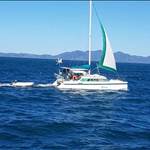


Sitting in Hervey Bay with what we suspected to be a hydraulic lock in 1 engine of a cat.
Firstly the starter relay and some wiring was burnt out probably due to holding the starter circuit engaged in a vain attempt to restart the engine halfway over a very rough bar when the wind and wave conditions made it absolutely impossible to hear whether the engine was turning over or not and it was imperative to get it going.
We have now replaced this relay and wiring but the engine still wouldn't start. As the motor appeared seized we then suspected that perhaps the pinion of the starter motor may have welded onto the flywheel or the starter motor frozen in some other way but removal of the starter motor and attempts to rotate the crankshaft with a bar failed to rotate the engine in either direction in gear or out. The identical engine on the other side can be relatively easily turned over by such means.
Removal of the injectors also failed to facilitate turning the crank although we now believe the engine is not direct injection.
Removal of the rocker cover which also forms the top of the intake manifold reveals the intake valves shut on the front two cylinders and a considerable amount of water sitting above the valves in the intake manifold above this cylinder and the second which also has its intake valve shut. Shaking the air box to which the air filter is attached also disclosed water in the air box. We found this absolutely amazing since there was very little water in the bilge and the intake of the air box is at least 18 inches above the bilge. Tasting the water indicates it is salt so somehow sailing then motoring in very confused seas at 35- 40+ knots of wind for a few days and or crossing Wide Bay Bar (also to a lesser extent Pt Mac bar) in very rough conditions managed to throw/suck water into the intake.
The question now becomes how to relieve what we suspect is a hydraulic lock? As it is indirect injection there does not seem to be a direct path into the combustion chambers apart from via the valves. The position at which the engine is stuck seems to have both rockers of the forward cylinder at the same position and the intake valve can be seen fully closed which of course is what maintained the water above it. We have of course now removed the water with a paper towel.The intake valves of the rear 2 cylinders appear to be open or partially open and by the position of the rocker it appears that the exhaust valve is open on the remaining of the four cylinders but not the front.
Any Ideas about how to get the water out of the combustion chambers without taking the head off?

Is it possible to pry one of the closed valves open a tad by getting a screwdriver under the rocker - you should be able to open a valve a fraction even if the cylinder is full of water. This will tell you if there is water in the cylinder.
Is there any sign of water in the oil??
Select to expand quoteLazzz said..
Is it possible to pry one of the closed valves open a tad by getting a screwdriver under the rocker - you should be able to open a valve a fraction even if the cylinder is full of water. This will tell you if there is water in the cylinder.
Is there any sign of water in the oil??
Thanks Lazzz
Skipper has decided we are taking the head of tomorrow. No water in oil.
Select to expand quoteRamona said..
If all the injectors and glo plugs are out that should rotate.
Thanks mate. I will try and persuade him tomorrow to remove the glow plugs and try to remove any water using an oil change pump as the tubes are pretty thin on those and should go down a glow plug hole. Hope they are flat top pistons.
There is no access to the combustion chamber with indirect injection as the the injectors are in a passage behind valves so removing the injectors doesn't help.
Select to expand quoteCraig66 said..
Remove the spark plugs 


A PO must have removed them and plugged up the holes ;).
Hi, if the injectors are removed the eng should rotate, i think you might need to get a mechanic to check this engine as i think it has seised from over heating, i dont think the intake could suck water from the bilge, more likly to be a split hose or water back feed from the exhaust
Jules,
could it be that with the prolonged turning over of the engine the exhaust system was filled with water and has back flooded into the engine entering through the exhaust valves then been pushed out through the inlet valves and into the air box? Have you had a look at the engine oil?
I'd bight the bullet and get the head off it. if there is saltwater in the bores the longer you leave it the more its going to be painfull $$$$$$.
I hope I'm wrong and there's a cheap and quick fix for you, but why did the engine stall and why wouldnt it restart needs to be answered???
Regards Mike
I agree with Magpiemike. An engine that wont start should have the intake seacock shut off till it fires. Continuing to crank this engine in a seaway has filled a cylinder. Pulling the glow plugs should allow the engine to rotate and squirt out the water.
Select to expand quoteRamona said..
I agree with Magpiemike. An engine that wont start should have the intake seacock shut off till it fires. Continuing to crank this engine in a seaway has filled a cylinder. Pulling the glow plugs should allow the engine to rotate and squirt out the water.
Thanks guys for all the input.
So a bit more info from the skipper. The prop shaft seal was leaking seriously a month ago and spraying water all over the engine compartment whilst under way which would be why the airbox filled up with water. New prop shafts and seals before we left but the half full of water airbox was a time bomb waiting to go off. Surfing down Wide Bay Bar at crazy angles tipped the water out of the air box into the intake manifold all of a sudden causing a hydraulic lock - possibly even at full throttle.
Taking the glow plugs out still did not allow the engine to turn so it's not just the hydraulic lock. Who knows we might have even have thrown a conrod, bottom end or something so that's engine out at a marina.
Still getting the head off because heat exchanger has really bad access. At least we can get water out of the bores before engine out if it is bottom end problems. Still could be bent valve or something but we will hopefully know that by this afternoon.
Ok end of story. Head off. Water in cylinders (although green in number two is from heat exchanger during removal). Rust already started. 2 outboard cylinders near top dead centre at 4 mm different heights below deck so probably a bent conrod.
Crank still won't turn. Might be just the rust but Inox and then deisel then hot oil sitting on pistons along with hitting tops of pistons with a hammer via a piece of wood no help.
Exchange motors available in Brisbane so owner is thinking get one of them and get it put in here in Hervey Bay or at Bundaberg. Either way I'm flying home on Thursday so pretty much end of trip.
Thanks for your help guys.

This seems to be a perfect example of cascade failure.
Leaking shaft gland seal, leads to...
water being thrown around, leads to ...
water entering air filter box, leads to...
water being sucked into the cylinder, leads to...
engine tying to compress water, leads to ....
engine seizure.
Don't let the little things slip past and become big things.
Big things are much more trouble than small things.
My commiserations to you, Jules and to the unfortunate owner.
Gary
Select to expand quotegarymalmgren said..
This seems to be a perfect example of cascade failure.
Leaking shaft gland seal, leads to...
water being thrown around, leads to ...
water entering air filter box, leads to...
water being sucked into the cylinder, leads to...
engine tying to compress water, leads to ....
engine seizure.
Don't let the little things slip past and become big things.
Big things are much more trouble than small things.
My commiserations to you, Jules and to the unfortunate owner.
Gary
Yep.
Good thing he is not short of a buck. He has already spent a fortune preparing the boat over the last 18 months as it's a nine months trip for him.
Both he and I thought he had done everything possible/necessary/foreseeable but no such thing with boats. Actually he
was a bit insulted when I said to him a month ago that it was highly likely that he would suffer some failures over a nine month trip because boats are boats.
That's very unfortunate Jules, for you and the skipper.
Your right, the unpredictable will always happen with boats. Part of the learning process.
I've had a seized engine and it's not a good feeling..
I'm sure your mate will have it all fixed soon and he can continue on journey.
Cheers
Sorry to hear.
A small piece of plastic over the shaft gland seal. Depending on where it is etc. Preferably clear so you can still see the gland. Can be thin bent or just a solid piece of Perspex. Depends on what you can fit. Stops salt water going everywhere and is obvious if it's got salt on it. My dad always told me if you are not a good mechanic stop problems before they happen. Service things regularly.
I thought you must have pushed up water through the exhaust going through the bar.
Can't say from experience but have been told never start and run an engine at idle when in running conditions. Have it started and warmed up before you need it. If your not using it keep the revs up. Helps spit the water out and stops back flooding.
Must have been a lot of water spraying around
I should imagine the constant cranking of the engine with out it firing caused the water exhaust muffler etc to fill. The water then backed up into the exhaust valve of the rear cylinder. Water then pumps out the inlet valve into the manifold and into the aircleaner and other cylinders till it hydraulically locks and bends a conrod.
Select to expand quoteRamona said..
I should imagine the constant cranking of the engine with out it firing caused the water exhaust muffler etc to fill. The water then backed up into the exhaust valve of the rear cylinder. Water then pumps out the inlet valve into the manifold and into the aircleaner and other cylinders till it hydraulically locks and bends a conrod.
A possibility but not likely in this case because what we found was decreasing amounts of water progressing towards the rear cylinder. In fact the rear cylinder hardly had anything whereas the front two had quite a lot as well as quite a lot sitting above the front two valves in the intake manifold and none in the rear.
Anyway no one answers their phone today as I guess it is an undeclared long weekend in light of ANZAC day Tuesday. Not exchange engine mob in Brisbane nor slipway in Hervey bay marina nor any other likely candidates for fixes.