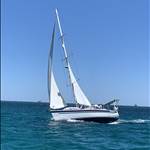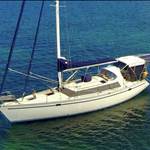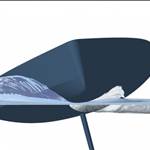


Looks like serial number might be S118556. It's has 3 blades which all rotate perpendicularly to the drive axis.

I would say that is a AUTO STREAM SELF-FEATHERING SHAFT DRIVE. The first part of the serial number is "S1", which is the model number. I installed an S1 on my yacht in 2020. Any other pictures?
Yep it's a Auto stream , made in Victoria from solid stainless steel. Those lock nuts are for adjusting the pitch. Great Aussie made Prop.
www.seahawk.com.au/S1.pdf
Select to expand quotesouthace said..
Yep it's a Auto stream , made in Victoria from solid stainless steel. Those lock nuts are for adjusting the pitch. Great Aussie made Prop.
www.seahawk.com.au/S1.pdf
Thank you :)
Select to expand quoteIlenart said..
I would say that is a AUTO STREAM SELF-FEATHERING SHAFT DRIVE. The first part of the serial number is "S1", which is the model number. I installed an S1 on my yacht in 2020. Any other pictures?
Thanks


Select to expand quotejulesmoto said..Ilenart said..
I would say that is a AUTO STREAM SELF-FEATHERING SHAFT DRIVE. The first part of the serial number is "S1", which is the model number. I installed an S1 on my yacht in 2020. Any other pictures?
Thanks
Yep definetly Autostream S1. I have just completed 3,000nm of sailing anf motoring in tbe last 6 months with an S1 and it has worked fine. A couple of time we had a bit of vibration when first placed into forward gear, which was fixed by slowing down and briefly placing in reverse, which fixed the problem. Suspect it caught a bit of weed, which it shook off when in reverse.
Ilenart
Select to expand quoteIlenart said..julesmoto said..Ilenart said..
I would say that is a AUTO STREAM SELF-FEATHERING SHAFT DRIVE. The first part of the serial number is "S1", which is the model number. I installed an S1 on my yacht in 2020. Any other pictures?
Thanks
Yep definetly Autostream S1. I have just completed 3,000nm of sailing anf motoring in tbe last 6 months with an S1 and it has worked fine. A couple of time we had a bit of vibration when first placed into forward gear, which was fixed by slowing down and briefly placing in reverse, which fixed the problem. Suspect it caught a bit of weed, which it shook off when in reverse.
Ilenart
Yes just pumped quite a bit of grease into the nipple at the rear before putting it back in the water this morning to make sure that each of the blades rotates nicely in the hub. Looks like a quality piece of kit. Just wanted to confirm the make in case I ever need spares. Thanks to all that replied :-)
After you stop the engine, put the gear box in reverse for a couple of seconds. It makes the blades feather so the shaft doesn't keep turning. I used to do this with mine.
Select to expand quotejulesmoto said..Ilenart said..julesmoto said..Ilenart said..
I would say that is a AUTO STREAM SELF-FEATHERING SHAFT DRIVE. The first part of the serial number is "S1", which is the model number. I installed an S1 on my yacht in 2020. Any other pictures?
Thanks
Yep definetly Autostream S1. I have just completed 3,000nm of sailing anf motoring in tbe last 6 months with an S1 and it has worked fine. A couple of time we had a bit of vibration when first placed into forward gear, which was fixed by slowing down and briefly placing in reverse, which fixed the problem. Suspect it caught a bit of weed, which it shook off when in reverse.
Ilenart
Yes just pumped quite a bit of grease into the nipple at the rear before putting it back in the water this morning to make sure that each of the blades rotates nicely in the hub. Looks like a quality piece of kit. Just wanted to confirm the make in case I ever need spares. Thanks to all that replied :-)
My previous yacht had a two blade Autostream that was +10 years on the boat. Never had any issues with it, which is why I went for an Autostream on the new boat.
Ilenart
Select to expand quoteCrusoe said..
After you stop the engine, put the gear box in reverse for a couple of seconds. It makes the blades feather so the shaft doesn't keep turning. I used to do this with mine.
Yes thank you for that. On my first sail a year ago I put it in neutral after I stopped and I could hear the propshaft turning.
Putting it in forward is what I have been doing to stop it turning but I have no way of knowing if this feathers the blades. I assumed it did.
Is putting it in reverse any better?
If you want to avoid damage to certain types of gear boxes, shifting the gear box to forward will cause clutch slippage with a windmilling propeller and it's highly likely that there's not enough shaft resistance to feather the prop.
Shifting to reverse to feather the prop has the opposite effect of shifting to forward and lt can jam the clutch up hard,,, hard enough to stop a windmilling prop,, hard enough to feather a prop and hard enough to break the shift mechanism when trying to shift back to neutral , although it can be unloaded by starting the engine whilst in reverse. If you want to avoid damage to the gear box it's best to feather the prop by grabbing the shaft with the gearbox in neutral if the resistance of the feathering mechanism is greater than the resistance of the turning shaft.
Select to expand quotejulesmoto said..Crusoe said..
After you stop the engine, put the gear box in reverse for a couple of seconds. It makes the blades feather so the shaft doesn't keep turning. I used to do this with mine.
Yes thank you for that. On my first sail a year ago I put it in neutral after I stopped and I could hear the propshaft turning.
Putting it in forward is what I have been doing to stop it turning but I have no way of knowing if this feathers the blades. I assumed it did.
Is putting it in reverse any better?
Hi Julesmoto,
I've always given it a few revs in forward gear, then slow selection to neutral then slot it into reverse gear. A bit of speed helps the prop furl cleanly.
I always leave it in reverse gear when sailing.
This is from the Volva Penta D1-30 manual.

Cheers!
SB
Select to expand quoteshaggybaxter said..julesmoto said..Crusoe said..
After you stop the engine, put the gear box in reverse for a couple of seconds. It makes the blades feather so the shaft doesn't keep turning. I used to do this with mine.
Yes thank you for that. On my first sail a year ago I put it in neutral after I stopped and I could hear the propshaft turning.
Putting it in forward is what I have been doing to stop it turning but I have no way of knowing if this feathers the blades. I assumed it did.
Is putting it in reverse any better?
Hi Julesmoto,
I've always given it a few revs in forward gear, then slow selection to neutral then slot it into reverse gear. A bit of speed helps the prop furl cleanly.
I always leave it in reverse gear when sailing.
This is from the Volva Penta D1-30 manual.
Cheers!
SB
Are we talking feathering or folding props.?
Select to expand quotejulesmoto said..Crusoe said..
After you stop the engine, put the gear box in reverse for a couple of seconds. It makes the blades feather so the shaft doesn't keep turning. I used to do this with mine.
Yes thank you for that. On my first sail a year ago I put it in neutral after I stopped and I could hear the propshaft turning.
Putting it in forward is what I have been doing to stop it turning but I have no way of knowing if this feathers the blades. I assumed it did.
Is putting it in reverse any better?
I always place the engine in reverse after we stopped, otherwise my Autostream S1 will keep on windmilling. This is fine for my engine / gearbox as it is recommended in the engine manual (Volvo Penta D2-55B). Suggest you check your engine manual. It definetly feathers the blades as I can see the shaft stops spinning, plus if I place it in neutral again the shaft will slightly move back and forth without spinning.
Select to expand quoteJolene said..shaggybaxter said..julesmoto said..Crusoe said..
After you stop the engine, put the gear box in reverse for a couple of seconds. It makes the blades feather so the shaft doesn't keep turning. I used to do this with mine.
Yes thank you for that. On my first sail a year ago I put it in neutral after I stopped and I could hear the propshaft turning.
Putting it in forward is what I have been doing to stop it turning but I have no way of knowing if this feathers the blades. I assumed it did.
Is putting it in reverse any better?
Hi Julesmoto,
I've always given it a few revs in forward gear, then slow selection to neutral then slot it into reverse gear. A bit of speed helps the prop furl cleanly.
I always leave it in reverse gear when sailing.
This is from the Volva Penta D1-30 manual.
Cheers!
SB
Are we talking feathering or folding props.?
AUTO STREAM SELF-FEATHERING
Yes they are self feathering but only if the resistance of the feathering mechanism less than that of the spinning shaft. That's why in alot of cases you need a method of stopping the shaft from turning, the resistance in the feathering mechanism can change with use. Pumping it full of grease usually makes it tighter and harder to feather.
If I selected reverse to feather the prop after the motor is shut off, the forces that the windmilling prop initially place on the gear box clutch cause the shift mechanism to jam in reverse,,, (it's like using reverse gear to stop the prop shaft from turning whilst trying to loosen the the prop shaft nut with a big spanner,),, it's no good for the clutch and extra effort is needed to shift the lever back to neutral. Obviously once the prop has feathered, the load is removed but the damage has been done.
If your gear shift is hard to shift back to neutral after you use reverse to feather the prop,, well you should stop doing it.
Select to expand quoteJolene said..shaggybaxter said..julesmoto said..Crusoe said..
After you stop the engine, put the gear box in reverse for a couple of seconds. It makes the blades feather so the shaft doesn't keep turning. I used to do this with mine.
Yes thank you for that. On my first sail a year ago I put it in neutral after I stopped and I could hear the propshaft turning.
Putting it in forward is what I have been doing to stop it turning but I have no way of knowing if this feathers the blades. I assumed it did.
Is putting it in reverse any better?
Hi Julesmoto,
I've always given it a few revs in forward gear, then slow selection to neutral then slot it into reverse gear. A bit of speed helps the prop furl cleanly.
I always leave it in reverse gear when sailing.
This is from the Volva Penta D1-30 manual.
Cheers!
SB
Are we talking feathering or folding props.?
Hi Jolene,
Apologies, I meant to write folding, not enough coffee!
Select to expand quoteIlenart said..Jolene said..
Are we talking feathering or folding props.?
AUTO STREAM SELF-FEATHERING
I was asking shaggy that question because the Volvo reference he gave has nothing to do with feathering props.
If anything a feathering prop is more closely related to a fixed prop and the Volvo reference recommends leaving the gear selector in neutral.,,,,I wonder Why????
Select to expand quoteJolene said..
Yes they are self feathering but only if the resistance of the feathering mechanism less than that of the spinning shaft. That's why in alot of cases you need a method of stopping the shaft from turning, the resistance in the feathering mechanism can change with use. Pumping it full of grease usually makes it tighter and harder to feather.
If I selected reverse to feather the prop after the motor is shut off, the forces that the windmilling prop initially place on the gear box clutch cause the shift mechanism to jam in reverse,,, (it's like using reverse gear to stop the prop shaft from turning whilst trying to loosen the the prop shaft nut with a big spanner,),, it's no good for the clutch and extra effort is needed to shift the lever back to neutral. Obviously once the prop has feathered, the load is removed but the damage has been done.
If your gear shift is hard to shift back to neutral after you use reverse to feather the prop,, well you should stop doing it.
Wow thanks for all the advice guys although now I am worried that I might have been doing damage to my gearbox.
I see the logic in not shifting into either forward or reverse while the shaft is spinning has obviously one can't let the clutch out slowly as can be done in a car.
Grabbing the shaft is not a particularly attractive alternative as of course one has to go below into a confined space and presumably leave a thick glove on hand for this purpose. Certainly it would mitigate any chance of damaging the gearbox.
Presumably when there is plenty of wind I could just turn the motor off in gear and hope that there is enough water resistance against the prop to feather it. Shifting back to Neutral to see if the prop remains stationary would check this.
Interesting point that pumping it full of grease till grease oozes out the joints (seals?) as I have just done may well impede the feathering function although I'm not sure what the alternative is as it is probably worse for the prop to let it run dry and obviously you can't see in there without dismantling it to see how much grease is left at each slip.
Just leave it in neutral. If your motor sailing off your mooring just pull back to neutral and shut off the engine. The amount of blade area aft of the pivot point will make the prop feather the same as a folding prop folds. If the shaft does rotate it will be slow and do no harm, no more pressure on the thrust bearings than using reverse.
Select to expand quoteRamona said..
Just leave it in neutral. If your motor sailing off your mooring just pull back to neutral and shut off the engine. The amount of blade area aft of the pivot point will make the prop feather the same as a folding prop folds. If the shaft does rotate it will be slow and do no harm, no more pressure on the thrust bearings than using reverse.
With an autostream, feathering of the prop is achieved when the whole hub advances in the direction of rotation in relation to a fixed point
on the shaft. The advance of rotation is bought on by the force of blades pivoting. If the shaft is free to spin with the propeller hub, the advance of the hub cant be achieved
Select to expand quoteJolene said..Ramona said..
Just leave it in neutral. If your motor sailing off your mooring just pull back to neutral and shut off the engine. The amount of blade area aft of the pivot point will make the prop feather the same as a folding prop folds. If the shaft does rotate it will be slow and do no harm, no more pressure on the thrust bearings than using reverse.
The advance of rotation is bought on by the force of blades pivoting.
Edit,, the sentence should read
"The advance of rotation is bought on by the force of blades windmilling".
I had a 30hp Yanmar in my boat and had no issues with the gear box from putting it in reverse to feather the prop. This is actually what the prop manufacturer recommended and still recommends. I would imagine if people were damaging their gear boxes from this recommendation then they would be up for a lot of compensation. Anyway, your boat your decision. Happy sailing :)
www.seahawk.com.au/S1.pdf