

Hi,
I'm considering installing a bilge blower to try and remove some of the heat generated by my diesel. More an exhaust fan than a blower. The cabin gets very warm and stays warm, especially in summer. The engine is a Bukh DV24 so its a large lump.
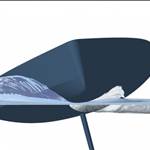
The warm air would exit through the transom and I would like to install a transom vent, something like below, however this is 3", which I'm OK with, and although I've only had a quick look on the net, I cant say I've noticed anything like this in 4". Also if I was to drill a 3" or 4" hole in the Transom of my Cav 32 would I need to reinforce around the hole, something like a collar/flange, installed both sides of the transom and bolted together to keep the structural integrity of the transom. Or am I been over cautious?
I see Whitworths have blowers for various prices and I subscribe to the fact " you get what you pay for".
Anyone been down this track? any advise? blowers to avoid or use? 3" or 4" The blower will be mounted directly under the cockpit sole so I'd like a more quiet blower.
Regards Mike
I've never forgotten this description of a CAV in heavy weather
"Bullet proof"... Andrew Fagan recounts the maiden delivery voyage of Tingara in 1975, skippered by none other than builder Peter Smith himself. The boat was caught in extreme conditions passing Castlepoint; wind speeds were clocked at a sustained 100knots with gusts of 120knots. A nearby 55ft fishing boat floundered with the loss of 2 lives while Tingara, running on bare poles, was broached and rolled multiple times by breaking waves. Remarkably the rig stayed put, and the crew did not send a mayday (the radio quit), and after riding out the rough stuff, the boat made its way into Wellington harbor a little wet inside and a some staved in washboards."
So before you make a 75-100mm hole in the transom, you've got to ask yourself. 'Am I feeling lucky?
The exhaust vent needs to be on the rear deck as high as possible. A couple of seabird vents mounted backwards will do. There is no real need to have an extractor fan. The normal set up in a power vessel is to have scoop forward on the cabin top and direct cold air down to the bilge through a 150mm pvc pipe. The engine airtake should be just above the bilge water so it takes in cold air [dust settles in the water] then the hot air rises and needs to escape at the rear of the engine room. In a yacht as long as you have fresh air entering up the bow somewhere it will sink and run aft in the bilge to the engine and as it warms up it rises and just needs somewhere to escape.
Select to expand quoteRamona said..
The exhaust vent needs to be on the rear deck as high as possible. A couple of seabird vents mounted backwards will do. There is no real need to have an extractor fan. The normal set up in a power vessel is to have scoop forward on the cabin top and direct cold air down to the bilge through a 150mm pvc pipe. The engine airtake should be just above the bilge water so it takes in cold air [dust settles in the water] then the hot air rises and needs to escape at the rear of the engine room. In a yacht as long as you have fresh air entering up the bow somewhere it will sink and run aft in the bilge to the engine and as it warms up it rises and just needs somewhere to escape.
Not that easy with your mid mounted engine :-(
Select to expand quotejulesmoto said..Ramona said..
The exhaust vent needs to be on the rear deck as high as possible. A couple of seabird vents mounted backwards will do. There is no real need to have an extractor fan. The normal set up in a power vessel is to have scoop forward on the cabin top and direct cold air down to the bilge through a 150mm pvc pipe. The engine airtake should be just above the bilge water so it takes in cold air [dust settles in the water] then the hot air rises and needs to escape at the rear of the engine room. In a yacht as long as you have fresh air entering up the bow somewhere it will sink and run aft in the bilge to the engine and as it warms up it rises and just needs somewhere to escape.
Not that easy with your mid mounted engine :-(
The warm air just escapes through the hatchway.
Why cut hole that leads directly to your best means of safe propulsion.
One wave and you flooded it.
Sorry
Hi all, many thanks for your reply's.
Bushdog, I've read that too, cant help feeling they were lucky. They're a solid boat. Had mine 14 years, it wasn't my first choice but the wife liked it and that's half the battle isn't it? Took me a while to learn to love her, she was a bastard to sail when I got her, every gust she'd want to point up, decided to pull the mast as a bit of maintenance, had the rigging reinstalled/tuned by Bryce Edwards at Taren Point, what a different boat, lovely now, so well behaved!
Ramona, I have 2 sea bird vents slightly forward of the mast and the companion way is in front of the engine which is semi enclosed. There is a bulkhead about 1.5 metres behind the engine, then the lazarette. I have tried motoring with the lazarette locker open to allow air to flow, this was impracticable as there there was very little air flow, an increase in engine noise and a hole for me to fall in. There is nowhere for air to exit the boat after the companion way. The engine being semi enclosed, I doubt that there would be enough natural air flow to do as you suggest but thank you anyway.
Lydia, the vent exit would be pointed down, obviously. I intended to have the suction side of the hose behind the engine but above the gearbox and with at least one or more, if possible, "drip legs". Any water that managed to enter the vent and make its way through the the drip leg and the fan, running or not, would deposit on to the gearbox, not ideal I know. If I'm caught in a following sea, slapping onto the transom I'd stuff a rag in the vent . Thank you as well.
As I said in my original post, "I'm considering this", I spent 30 odd years in an industry where you asked yourself "if I do this and things go wrong, what next?" and unfortunately I carry this legacy with me.
I'd still like to hear from anyone who has or has installed a vent blower system on their boat and their thoughts.
Regards Mike
Select to expand quoteBushdog said..
I've never forgotten this description of a CAV in heavy weather
"Bullet proof"... Andrew Fagan recounts the maiden delivery voyage of Tingara in 1975, skippered by none other than builder Peter Smith himself. The boat was caught in extreme conditions passing Castlepoint; wind speeds were clocked at a sustained 100knots with gusts of 120knots. A nearby 55ft fishing boat floundered with the loss of 2 lives while Tingara, running on bare poles, was broached and rolled multiple times by breaking waves. Remarkably the rig stayed put, and the crew did not send a mayday (the radio quit), and after riding out the rough stuff, the boat made its way into Wellington harbor a little wet inside and a some staved in washboards."
So before you make a 75-100mm hole in the transom, you've got to ask yourself. 'Am I feeling lucky?
With great respect, we know Wellington is incredibly windy, but when I looked over breakfast this morning I couldn't find anything remotely like those events recorded at the very detailed NZ weather information site at hwe.niwa.co.nz/search/summary/Startdate/19-12-1974/Enddate/11-11-1976/Regions/all/Hazards/all/Impacts/all/Keywords/none/numberOfEvents/20/page/1
It mentions things like a torn mainsail in the 1975 NZ Half Ton championships (in which Cav 32s had one of their finest hours, almost winning from the Farr design Tituscanby), a girl being electrocuted, traffic accidents, boats blown off moorings and sheep deaths, but it says nothing about a 55 foot trawler being capsized in 1975, nor anything about a storm such as the one allegedly experienced by the Cav.
There was a 42 foot fishing boat that capsized when going over a bar in a storm in 1975, but that was at the far northern tip of the North Island, about 400 miles from Castlepoint.
There's no mention of a 1975 event in this list of the biggest storms to hit nearby Wellington; www.stuff.co.nz/dominion-post/4649819/Seven-biggest-storms-to-hit-Wellington although it mentions events in which Castlepoint copped less wind.
The highest wind gust ever recorded in NZ seems to have been 133 knots, on an exposed ridge 450 m above sea level and therefore probably far windier than anything at sea level. The highest windspeed ever recorded at Castlepoint, which IS very windy, was 100 knots, in 1998. Apparently a 120 knot gust would have been the strongest ever on the national database, so why is there no reference to the event given that there was a well known windstation nearby? And what wind instruments on a 32'er would have gone up to 120 knots?
The Cav's a great boat, but this tale sounds like simple BS. It's sad when people can't seen to tell the truth. And that's NOT aimed at you, Bushdog, since you're just quoting the source.
Select to expand quoteMagpiemike said..
Hi all, many thanks for your reply's.
Bushdog, I've read that too, cant help feeling they were lucky. They're a solid boat. Had mine 14 years, it wasn't my first choice but the wife liked it and that's half the battle isn't it? Took me a while to learn to love her, she was a bastard to sail when I got her, every gust she'd want to point up, decided to pull the mast as a bit of maintenance, had the rigging reinstalled/tuned by Bryce Edwards at Taren Point, what a different boat, lovely now, so well behaved!
Ramona, I have 2 sea bird vents slightly forward of the mast and the companion way is in front of the engine which is semi enclosed. There is a bulkhead about 1.5 metres behind the engine, then the lazarette. I have tried motoring with the lazarette locker open to allow air to flow, this was impracticable as there there was very little air flow, an increase in engine noise and a hole for me to fall in. There is nowhere for air to exit the boat after the companion way. The engine being semi enclosed, I doubt that there would be enough natural air flow to do as you suggest but thank you anyway.
Lydia, the vent exit would be pointed down, obviously. I intended to have the suction side of the hose behind the engine but above the gearbox and with at least one or more, if possible, "drip legs". Any water that managed to enter the vent and make its way through the the drip leg and the fan, running or not, would deposit on to the gearbox, not ideal I know. If I'm caught in a following sea, slapping onto the transom I'd stuff a rag in the vent . Thank you as well.
As I said in my original post, "I'm considering this", I spent 30 odd years in an industry where you asked yourself "if I do this and things go wrong, what next?" and unfortunately I carry this legacy with me.
I'd still like to hear from anyone who has or has installed a vent blower system on their boat and their thoughts.
Regards Mike
G'day Mike,
I had a vent blower system but reversed to your application. The engine bay was sealed so the blower pumped air into the engine bay from an inlet on the aft cockpit wall. I cannot for the life of me remember how it vented though, I'll try and look up my old sketches and see if I can find it, but there was no 4" hole in the transom or hull that's for sure.
Its either that or I have it ass backwards, where the cockpit vent is actually the outlet and the intake is elsewhere. I'll try and find the schematics for it.
It was more likely an outlet aft on the cockpit wall and it was an extractor fan. Air to the engine would have come from the bilge through indirect passageways to muffle the engine noise. Similar set up to Onan sealed diesel generator enclosures.
On my fishing vessel I had an exhaust vent on the rear of the cabin with a computer fan as the extractor fan. I eventually removed the fan because it made no difference apart from restricting the size of the exhaust. The hot air flow out the highest point and the cold air sinking in from the front of the engine room was all that was needed.
Select to expand quoteMagpiemike said..
Ramona, I have 2 sea bird vents slightly forward of the mast and the companion way is in front of the engine which is semi enclosed. There is a bulkhead about 1.5 metres behind the engine, then the lazarette. I have tried motoring with the lazarette locker open to allow air to flow, this was impracticable as there there was very little air flow, an increase in engine noise and a hole for me to fall in. There is nowhere for air to exit the boat after the companion way. The engine being semi enclosed, I doubt that there would be enough natural air flow to do as you suggest but thank you anyway.
Ramona had 4 seabird vents and the SS34 has 5 plus the winch hawse pipe and a small perspex lifting vent. It's surprising how much air comes in the hawse pipe! The Amel 54 next to me has a large turbocharged diesel and a diesel generator plant and heaps of other stuff in its large engine room. As far as I can ascertain the air is extracted out vents on the outside of the cockpit coamings. Similar set-up to what flash game boats have.
On the way home today I checked out the Amel's vents. These are mounted on the outside of the centre cockpit coamings. They stick out about 30mm. On a Cav 32 scaled-down versions would probably fit on the forward end of the coamings.