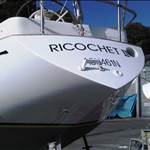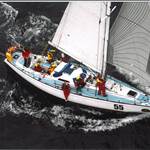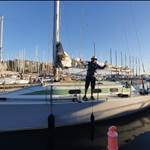


Rob Large of Adelaide who has already campaigned his boat twice in the two-handed Sydney Hobart Division has just set off on his circumnavigation. Anyone can follow his Facebook page below and there is a good little video as the last post regarding the not too drastically altered interior. The existing door to the forward cabin has been replaced with a beefed up one with a couple of massive dead bolts and the dinette table/area has been modified to be a second and bigger chart table plus more storage. There is a hard dodger but other than that the boat looks pretty standard including chainplates...

Six months to circumnavigate! I'm guessing he is not planning to cross the equator and just sail South of the capes.
Select to expand quoteRamona said..
Six months to circumnavigate! I'm guessing he is not planning to cross the equator and just sail South of the capes.
Hey however he chooses to do it hats off to him as long as he enjoys it. Whether it can equate to people leaving from the old world may not be of concern to him. After all it is highly unlikely he is after any record. It's just a personal satisfaction thing. Nevertheless a Northshore is a fast boat compared to boats like Brolgas or those in the Golden Globe.
Be interesting to see how he goes. If it were me I think I would avoid any publicity until I had actually done it as there are so many things that can go wrong and there must be a bit of pressure if you know people with expectations are following you.
Bit more info:
He intends to cross equator.
www.abc.net.au/listen/programs/weekendswithdeb/sailor/102898006?fbclid=IwAR0MsfJ2T_odGJvTJn8u3kN8rdTLaax8z0-xTY5yeJWWDUIpITh7O8fJjS4
Select to expand quotejulesmoto said..
Bit more info:
He intends to cross equator.
www.abc.net.au/listen/programs/weekendswithdeb/sailor/102898006?fbclid=IwAR0MsfJ2T_odGJvTJn8u3kN8rdTLaax8z0-xTY5yeJWWDUIpITh7O8fJjS4
No. He intends to sail South of the Capes. Much shorter trip and all in nasty sea conditions. I watched his video on boat preparation on Facebook. I think he is being very game. Even the stowage of his baked beans would be far better stowed low down.
The boats in the Golden Globe are slightly slower but they are optimized for racing offshore and some of them sailed by dedicated serious offshore professional sailors sailing for gain.
This has always been a goal of mine also, at some point in the future, I wish him godspeed. Whether he crosses the equator or not, this is an amazing personal challenge, if even just to get away from the rat race for 6 months. 
Select to expand quoteRamona said..julesmoto said..
Bit more info:
He intends to cross equator.
www.abc.net.au/listen/programs/weekendswithdeb/sailor/102898006?fbclid=IwAR0MsfJ2T_odGJvTJn8u3kN8rdTLaax8z0-xTY5yeJWWDUIpITh7O8fJjS4
No. He intends to sail South of the Capes. Much shorter trip and all in nasty sea conditions. I watched his video on boat preparation on Facebook. I think he is being very game. Even the stowage of his baked beans would be far better stowed low down.
The boats in the Golden Globe are slightly slower but they are optimized for racing offshore and some of them sailed by dedicated serious offshore professional sailors sailing for gain.
In the ABC audio clip he clearly states that he intends to cross the equator after rounding South of New Zealand and before the horn which might be unusual as I thought this is normally done in the Atlantic.
Select to expand quotep3p4p5 said..
Anyone know the Limit of Positive stability figure for the NS38?
Varies according to whether it has the optional lead boot on the bottom of the standard cast iron keel.
Select to expand quotep3p4p5 said..
Anyone know the Limit of Positive stability figure for the NS38?
Varies from boat to boat. This is Inukshuk:

Select to expand quotesydchris said..p3p4p5 said..
Anyone know the Limit of Positive stability figure for the NS38?
Varies from boat to boat. This is Inukshuk:
Thanks.
They are better than you might think..probably because they aren't excessively beamy?
Select to expand quoteMadmouse said..
They are better than you might think..probably because they aren't excessively beamy?
You might be right, but as any naval architect would tell you the inverted or negative stability curve is just as important. How stable the yacht is upside down and what righting arm is required to re-right the yacht. There are numerous incidents that have been reported where yachts have been inverted with a reasonable stability figure that take some time to re-right. The argument is also that in any conditions that causes a rollover would probably also result in the yacht flipping back up. Its a complex subject matter that goes beyond a single metric like LPS, and I am not a expert in the area My only interest is trying to understand what factors makes a good cruising yacht design when the choices can be limited like here in Australia. In the UK the RYA keeps track of the stability and STOPS numbers for many yachts as a repository. Not many Australian designs are in that database.
Select to expand quotesydchris said..p3p4p5 said..
Anyone know the Limit of Positive stability figure for the NS38?
Varies from boat to boat. This is Inukshuk:
I thought a stability index of 129.6 is actually quite good.
After sheltering/repairing in a bay in South Tassie for 7 days Rob is well on the way again and things are about to hot up again by the looks of it -not that he hasn't already been pooped a number of times.

Select to expand quotep3p4p5 said..
Anyone know the Limit of Positive stability figure for the NS38?Select to expand quotejulesmoto said..p3p4p5 said..
Anyone know the Limit of Positive stability figure for the NS38?
Varies according to whether it has the optional lead boot on the bottom of the standard cast iron keel.
If there wasn't a problem with the standard cast iron keel weight why did they start adding a lead boot?
I may be wrong in my thinking but I would feel confident coastal sailing standard keel but in the southern ocean I would be feeing a little bit more secure with the extra ballast specially after the designer added the extra weight.
Select to expand quote
MAGNESIUM said..
If there wasn't a problem with the standard cast iron keel weight why did they start adding a lead boot?
I may be wrong in my thinking but I would feel confident coastal sailing standard keel but in the southern ocean I would be feeing a little bit more secure with the extra ballast specially after the designer added the extra weight.
If you recall the Rising Farrster case from about 2001, that yacht - a Farr 38 - was modified by the addition of a 145kg shoe on the bottom of the keel to raise the LPS from 113 to 116. No changes were made to the keel bolts or underlying hull structure. During a passage down the East Coast the yacht lost it's keel and rolled over, with loss of life. The Coroners Report goes into some detail about the event, the build, and the likely causes.
I agree that adding weight to the keel may improve stability, but it isn't necessarily as simple as just putting a shoe or bulb on.
For sobering reading, the full Rising Farrster report is here:
www.orcv.org.au/docman-link/safety/3721-2001-nsw-coast-training-vessel-rising-farrster-loss-of-keel-2-fatalities-linda-yarr-and-charlotte-lenas-coroners-report/file
Select to expand quotesydchris said..
MAGNESIUM said..
If there wasn't a problem with the standard cast iron keel weight why did they start adding a lead boot?
I may be wrong in my thinking but I would feel confident coastal sailing standard keel but in the southern ocean I would be feeing a little bit more secure with the extra ballast specially after the designer added the extra weight.
If you recall the Rising Farrster case from about 2001, that yacht - a Farr 38 - was modified by the addition of a 145kg shoe on the bottom of the keel to raise the LPS from 113 to 116. No changes were made to the keel bolts or underlying hull structure. During a passage down the East Coast the yacht lost it's keel and rolled over, with loss of life. The Coroners Report goes into some detail about the event, the build, and the likely causes.
I agree that adding weight to the keel may improve stability, but it isn't necessarily as simple as just putting a shoe or bulb on.
For sobering reading, the full Rising Farrster report is here:
www.orcv.org.au/docman-link/safety/3721-2001-nsw-coast-training-vessel-rising-farrster-loss-of-keel-2-fatalities-linda-yarr-and-charlotte-lenas-coroners-report/file
It's insulting and ignorant to compare a Northshore 38 to a Farr 38 (or Farr 1104,11.6...) when considering seaworthiness. The Northshore 38 is far stronger and has an entirely different hull shape and construction as well as a much bigger keel root with more bolts and paired ones not (ridiculously) centerline.
The 120+ fleet of Northshore 38s have all been going strong - many for 40 years- without event and have previously circumnavigated (rolled right over and quickly righted- Bill Hatfield Cape Horn) as well as had a presence in the vast majority of Hobarts since their introduction including 1998.
The boot is not a bulb and is indistinguishable (except with a magnet or tape measure) from the rest of the cast iron keel to which it is bolted and faired. A large proportion of the fleet have it and it was a factory option. The boat is not a lightweight, flat bottomed, full thin sandwich construction overgrown dingy with notoriously flimsily attached keels like the Farr 38s (and 1104s,11.6s...).
See also:
forums.sailinganarchy.com/threads/farr-38-as-a-liveaboard-cruiser.222146/page-2
plus my own experience of yet another Farr 1104 (a friends) punching the keel up through the piss weak hull off Barranjoey and very nearly sinking.

So that's the Tasman and two capes finished for Rob. Now North to the equator for circumnavigation rules compliance before the big one.
He saw 17.9 knots while sailing as slow as possible surfing large waves many of which came onboard. Lots of rain and grey apparently.
Select to expand quoteLenn said..
waves would have been massive!
I would say he is going to have some big swells on his Beam shortly.
Heading up to the equator and around Kiribati now so things should get easier for quite a while. Said he wanted to get the equator crossing over with whilst the boat was free of barnacles and also so he wasn't tempted after rounding the horn to just head for home.
Interesting to watch the speeds hour by hour even when being sailed super conservatively compared to the antiquated full keels in the Golden Globe race.
forecast.predictwind.com/tracking/display/SV-Inukshuk/

Select to expand quotejulesmoto said..sydchris said..
MAGNESIUM said..
If there wasn't a problem with the standard cast iron keel weight why did they start adding a lead boot?
I may be wrong in my thinking but I would feel confident coastal sailing standard keel but in the southern ocean I would be feeing a little bit more secure with the extra ballast specially after the designer added the extra weight.
If you recall the Rising Farrster case from about 2001, that yacht - a Farr 38 - was modified by the addition of a 145kg shoe on the bottom of the keel to raise the LPS from 113 to 116. No changes were made to the keel bolts or underlying hull structure. During a passage down the East Coast the yacht lost it's keel and rolled over, with loss of life. The Coroners Report goes into some detail about the event, the build, and the likely causes.
I agree that adding weight to the keel may improve stability, but it isn't necessarily as simple as just putting a shoe or bulb on.
For sobering reading, the full Rising Farrster report is here:
www.orcv.org.au/docman-link/safety/3721-2001-nsw-coast-training-vessel-rising-farrster-loss-of-keel-2-fatalities-linda-yarr-and-charlotte-lenas-coroners-report/file
It's insulting and ignorant to compare a Northshore 38 to a Farr 38 (or Farr 1104,11.6...) when considering seaworthiness. The Northshore 38 is far stronger and has an entirely different hull shape and construction as well as a much bigger keel root with more bolts and paired ones not (ridiculously) centerline.
The 120+ fleet of Northshore 38s have all been going strong - many for 40 years- without event and have previously circumnavigated (rolled right over and quickly righted- Bill Hatfield Cape Horn) as well as had a presence in the vast majority of Hobarts since their introduction including 1998.
The boot is not a bulb and is indistinguishable (except with a magnet or tape measure) from the rest of the cast iron keel to which it is bolted and faired. A large proportion of the fleet have it and it was a factory option. The boat is not a lightweight, flat bottomed, full thin sandwich construction overgrown dingy with notoriously flimsily attached keels like the Farr 38s (and 1104s,11.6s...).
See also:
forums.sailinganarchy.com/threads/farr-38-as-a-liveaboard-cruiser.222146/page-2
plus my own experience of yet another Farr 1104 (a friends) punching the keel up through the piss weak hull off Barranjoey and very nearly sinking.
OFFS, that's way over the top IMHO. Have you got any evidence that the Farrs are weaker or less seaworthy by design? Yes, Binks' builds were sometimes dodgy but evidence like the Rising Farrster inquest indicates that there was no problem with the 11.6 design.
The fleet of Farrs has in general being going very well too. They had more builders so some were not as good as they should have been but the same even applies to Northshores - I sailed on one that had a major hull/deck crack after a minor hit. There have also been lots of Farr 1104s in Hobarts and other races and unlike NS38s they have often been pushed hard to win. Even an IOR one design Farr 136, a full-on IOR boat, did a round the world singlehanded race which is probably a far tougher test than any NS38 has been through.
NS 38s also have their critics. They carry a very big mast for a single-spreader rig which is OK in some ways but creates other issues. Same with their narrow beam - it gives them a higher LPS but they have less stability at normal angles than many comparable boats.
I have no real skin in the Farr/NS game since my own (similar) boat is of a different design and I respect the NS, but piling on abuse at another poster (one with a lot more offshore experience than you) and Farrs is not the right thing to do.
As far as not being a "lightweight flat bottomed etc", Inukshuk weighs 6188kg according to her ORC certificate. Of the two Farr 11.6s in the ORC listings, one weighs more than any NS38 should and the other is 38kg lighter than Inukshuk which is 2/5 of FA. The 11.6 also has a higher measured stability at normal angles of heel. The Farr 11.6s and 1104s have been far more widely sailed than NS38s - between them there were production runs in the UK, NZ, South Africa, Australia and I think Germany plus many custom versions - so to slag them all off is rubbish, as is insulting someone with far more experience than you have and who has a different boat entirely so no reason to be biased.
Select to expand quoteChris 249 said..julesmoto said..sydchris said..
MAGNESIUM said..
If there wasn't a problem with the standard cast iron keel weight why did they start adding a lead boot?
I may be wrong in my thinking but I would feel confident coastal sailing standard keel but in the southern ocean I would be feeing a little bit more secure with the extra ballast specially after the designer added the extra weight.
If you recall the Rising Farrster case from about 2001, that yacht - a Farr 38 - was modified by the addition of a 145kg shoe on the bottom of the keel to raise the LPS from 113 to 116. No changes were made to the keel bolts or underlying hull structure. During a passage down the East Coast the yacht lost it's keel and rolled over, with loss of life. The Coroners Report goes into some detail about the event, the build, and the likely causes.
I agree that adding weight to the keel may improve stability, but it isn't necessarily as simple as just putting a shoe or bulb on.
For sobering reading, the full Rising Farrster report is here:
www.orcv.org.au/docman-link/safety/3721-2001-nsw-coast-training-vessel-rising-farrster-loss-of-keel-2-fatalities-linda-yarr-and-charlotte-lenas-coroners-report/file
It's insulting and ignorant to compare a Northshore 38 to a Farr 38 (or Farr 1104,11.6...) when considering seaworthiness. The Northshore 38 is far stronger and has an entirely different hull shape and construction as well as a much bigger keel root with more bolts and paired ones not (ridiculously) centerline.
The 120+ fleet of Northshore 38s have all been going strong - many for 40 years- without event and have previously circumnavigated (rolled right over and quickly righted- Bill Hatfield Cape Horn) as well as had a presence in the vast majority of Hobarts since their introduction including 1998.
The boot is not a bulb and is indistinguishable (except with a magnet or tape measure) from the rest of the cast iron keel to which it is bolted and faired. A large proportion of the fleet have it and it was a factory option. The boat is not a lightweight, flat bottomed, full thin sandwich construction overgrown dingy with notoriously flimsily attached keels like the Farr 38s (and 1104s,11.6s...).
See also:
forums.sailinganarchy.com/threads/farr-38-as-a-liveaboard-cruiser.222146/page-2
plus my own experience of yet another Farr 1104 (a friends) punching the keel up through the piss weak hull off Barranjoey and very nearly sinking.
OFFS, that's way over the top IMHO. Have you got any evidence that the Farrs are weaker or less seaworthy by design? Yes, Binks' builds were sometimes dodgy but evidence like the Rising Farrster inquest indicates that there was no problem with the 11.6 design.
The fleet of Farrs has in general being going very well too. They had more builders so some were not as good as they should have been but the same even applies to Northshores - I sailed on one that had a major hull/deck crack after a minor hit. There have also been lots of Farr 1104s in Hobarts and other races and unlike NS38s they have often been pushed hard to win. Even an IOR one design Farr 136, a full-on IOR boat, did a round the world singlehanded race which is probably a far tougher test than any NS38 has been through.
NS 38s also have their critics. They carry a very big mast for a single-spreader rig which is OK in some ways but creates other issues. Same with their narrow beam - it gives them a higher LPS but they have less stability at normal angles than many comparable boats.
I have no real skin in the Farr/NS game since my own (similar) boat is of a different design and I respect the NS, but piling on abuse at another poster (one with a lot more offshore experience than you) and Farrs is not the right thing to do.
As far as not being a "lightweight flat bottomed etc", Inukshuk weighs 6188kg according to her ORC certificate. Of the two Farr 11.6s in the ORC listings, one weighs more than any NS38 should and the other is 38kg lighter than Inukshuk which is 2/5 of FA. The 11.6 also has a higher measured stability at normal angles of heel. The Farr 11.6s and 1104s have been far more widely sailed than NS38s - between them there were production runs in the UK, NZ, South Africa, Australia and I think Germany plus many custom versions - so to slag them all off is rubbish, as is insulting someone with far more experience than you have and who has a different boat entirely so no reason to be biased.
Hey I'm not the one that started the comparisons but I stand by everything I said.
As for the so-called "stability" at normal angles of heel obviously a wide flat bottomed boat will be initially far more resistant to heel just as is an aluminium punt. This has nothing to do with seaworthiness. Old wine glass shaped hulls like Folkboats initially heel a lot too but they certainly won't remain upside down for as long as a broadbeamed dingy shape and that is the ultimate test.
Anyway this was not the initial purpose of this string and I don't propose to continue the digression further.
Unfortunately the tough Tasman conditions resulted in failure of the self steering and AIS so Rob has had to pull into Dunedin to sort these problems. The glitch in his tracking after Stewart Island which is very apparent is probably when this occurred. The unaided or at least non-stop nature of the trip will not be fulfilled however it may well be a blessing in disguise as if I were sailing around the world I may well want to stop into interesting places that I passed. It's not like he was ever aiming for a record such as oldest or smallest boat or fastest or something.
Select to expand quoteAndrew68 said..

He's got a long way to go
Yes he sure does.
Given that he hasn't got a team or the sort of back up that a lot of guys seem to muster these days and given that this is a first attempt with nothing even remotely like this tried before to my knowledge I can't help feeling that he has put pressure on himself by publicly announcing his attentions.
Anyway good on him for however far he gets. He has already done one of the harder bits.