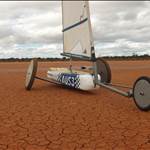
US772,
I do not claim to know all that is to know about Sail Re-Construction but here is what I have learned.. For very hard surfaces ie Tarmac, Concrete etc. The flatter the Sail the better. The Sail Shape comes from Wind Pressure and Battens. (I use mine on Sand surfaces that are as hard as a Dogs Forehead).

I have used 100% Carbon Fiber, Glass and am using 60% CF at present. What I have found is Glass is slower and feels generaly softer than CF, however that mast was very old.
Gaastra 100% is good and I suggest that if you can get them they are a good place to start, however I should look seriously at there construction.
At the moment I am using a Neil Pryde 60% CF Mast and have found it to be a great improvement on the Gaastra. Reason for this turns out (I think) that this particular mast is slightly heavier in construction in that it has a std base dia' but is a deal larger in the head dia which in all has produced a stiffer mast, which in turn produces a more swift reaction to wind gusts. The Gaastra's though softer in action (To use a fishing rod term "Slower") tend to absorb a wind gust and then release it as the gust passes. This then is released back into the Land Yacht making the hold an acceleration less but for a longer period, where as the Heavier head in the Neil Pryde will cause the Craft to tend to Accelerate Heavily, lifting the upwind wheel and possibly falling on its side.
"Horses for Courses"; Conclusion, Your choice of mast in my Humble Opinion should be in keeping with your ability at the time i.e a New-be should lean towards a softer mast .
Sail Cutting.. I haven't used a purpose made sail but it it my guess that there would be very little difference is the Job is Done Properly. Again I used Large Area Sails to start with, this gave more to play with. Going on what I had seen and discussed on the Forum I chose my design by eye and cut the Luff Edge of the sail ( I admit it took a couple of attempts to get it right). Following the Template on the pages below.
 www.seabreeze.com.au/forums/Land-Yacht-Sailing/Sail-making/How-I-recut-sailboard-sails-to-suit-landyachts/
I re-cut my 11sq'm Speed Surfing sail to shape etc and then took it to my local Sail MAKER (The man knows his Onions) and had it sewn together.
In making the decision on Sail Cutting one should look carefully at the type of surface that is going to be sailed and Cut the sail accordingly i.e. Softer surface like Grass, Softer sand etc should be a fuller and larger sail area. Hard surface such as Hard Sand, Tarmac, Concrete etc should be a slender, Flat cut which will make your LY go faster.
Much of the above can seem daunting to the uninitiated BUT if your time is taken and the thought process allowed then common sense should give you your requirements. ABOVE ALL talk to us and hopefully we shall get you on the right track.. I did and I got the very best of advice. Keep in mind these members; Landyacht, TP1, aus230 there are others only too willing to help. There are no Silly Questions just unknown answers. ASK.
When setting up a Mast it is strongly suggested that you should Turn up a Long Plug 750mm to a Meter long from a strong flexible timber like Tassie Oak/Ash, Hickory etc with a good straight grain a wavy grain is also good so long as it is running the axis of the plug. This will support the base of the mast and prevent crushing and snapping ao the mast base. Wind Surfer Masts are not built to be Rigidly Suspended by their base.
Ron
PS; Under the Neil Pryde mast Occum's Razor is a bit faster and more twitchy but a "Hell of a lot of FUN"
PPS.
www.c-f-c.com/specgas_products/so2.htm AUS so2 is also an apt description of man and machine in strong windy conditions



 Ron you need to do some more (a LOT more) study on sail design.


 and helps protect the Mast against Shock Loads.