Landsailing - A brief Tutorial

> 10 years ago
Reply
Register to post, see what you've read, and subscribe to topics.
aus230
aus230
WA
1660 posts
WA, 1660 posts
17 Nov 2014 12:54am
Last season one of our most experienced land sailors gave a presentation before the start of each race day, the aim was to assist new sailors to under stand how to set up there yachts and how to and what to look for while sailing. I was impressed by the presentation and feed back so I asked Graeme If it was OK to share it on here and he was more that happy to help.
The tutorial went over several meetings so I will post a bit at a time as I think it would be to much to observe at one time.

By Graeme Chandler – AUS20’

Enjoying the Challenge by Graeme Chandler AUS20

Chapter 1

I gave up motor racing to join this club in February 1987, Yes that is 27 years… that made me member No 74 since the clubs founding in 1969 as the Safety Bay Yacht Club. Renamed the Sandgropers in March 82. Landsailing should be an enjoyable challenge, the biggest thing in getting to the enjoyable part is to reduce the frustrations the challenge will always be there.

First is the dependence on the wind
we have no control over the wind and we need to accept that and learn to use what we get. To use the wind you need to be aware of the direction and strength at all times AT ALL TIMES That means not only when you are racing, but when you are in the pit area and rigging your yacht.

How long do you take to rig your yacht? Is it hard work? If it is, look at another way. Think about how to use the wind to help rig your sail. If you tip your mast down wind BEING AWARE OF THE WIND DIRECTION stand at the head of the mast and flip the sail out away from you so that when you slide it on to the mast it will not fold back over the mast head. When you take your sail off tip the mast into the wind, pull the sail off and roll it from the head down. Now with the sail on and the yacht laying down – think about whether you fit your sheet now, or stand the yacht up. If you lay the mast directly down wind and fit the sheet, when you stand it up it will be square to the wind and likely to power up the sail. If you can’t turn the yacht head to wind, then don’t fit the sheet, but when you do stand it up DON’T WALK AWAY. Un-maned yachts sail very well.

Still on parking the yacht-, when you come in after a race, or a sail, finish up heading into the wind and not just front on to the car park if you leave the yacht standing disconnect the sheet. And we’re not even out of the parking area yet.

Now the matter of equipment,
Reliability and performance. RELIABILITY for me there is only one rule do all the maintenance before coming to the lake. Then, come early enough to do what you missed or forgot. Wind powered equipment works best with the least DRAG; The tyres being the point of contact contribute a large portion of the drag in the form of ROLLING RESISTANCE what water sailors call FORM RESISTANCE CLUB 88 sailors inherit the 400-8 TYRE -- the rib pattern works better than the diamond or road pattern -- remember these tyres are rated to 220 KG @ 30KPH and NOT FOR HIGHWAY USE. That is a third of the speeds we run them at, and about the same load, and in tyre terms, CONTINUOUS or HIGHWAY USE. From the ground up Tyres are the items requiring most frequent inspection, and attention Are they FLAT? what PRESSURE should they be? is there CANVAS SHOWING? (or close too), do you have a SPARE ready? The 400-8 tyres have a maximum of 42 PSI (3 bar for the metric folk)...I run 30 psi in the rear and 2O psi in the front. (THAT’S A TIP) Although secondary to the tyres the bearings are very important, they need to carry the load with the least resistance. There is a choice of bearings for the ‘88’ wheels; UNGROUND (cheap) wheelbarrow type or DEEP GROOVE BALL The DEEP GROOVE BALL bearings can be SHIELDED or SEALED. SHIELDED is a non-contact steel shield, and SEALED is a rubber contact seal. If you use the SEALED type remove the inner seal, and lubricate with LIGHT OIL, NOT GREASE. What do I use DEEP GROOVE BALL. Moving right along; AXLES;…are your axles straight? The CLUB 88 has no provision for adjustment so straight axles are essential. STEERING; is the cable tension correct? Have you greased the king pin? Is the front wheel vertical when you are running straight? If not you will be better on one tack than the other.

Part One.
aus230
aus230
WA
1660 posts
WA, 1660 posts
17 Nov 2014 6:00pm
Enjoying the Challenge by Graeme Chandler AUS20

NOW FOR THE ENGINE;
… Some fundamentals first. How does it all happen? We use the wind flowing across the sail to create LIFT,The same way as the aircraft wing gets LIFT. with the sail vertical the force produced by the lift is mostly sideways with a small forward component.
Because there is very little FORM RESISTANCE compared to water yachts we are able to convert more of that lift into the foreward component and therefore go faster. A yacht could sail on a flat sheet but would not point as high or go as fast as a CAMBERED sail. So what is the CAMBER?

The CAMBER is the curve built into the sail by the sail-maker. It is created when the panels are cut and is nothing a broad sense, adjustable.

BATTENS have a small influence on the CAMBER NEAR the batten POCKETS, and the general rule is to run stiff battens in high winds and soft battens in light winds. If you change them at all. I don’t. (THAT’S ANOTHER TIP) Check the batten TENSION. There is a lot of suck-it-and-see related to the taper of battens. Trust the sailmaker. Of greater influence, at the foot of the sail, is the OUTHAUL;

OUTHAUL similar to the battens, tighter for high winds than for light winds. You can use a Hyfield lever or simply tie off the CLEW.

What is the CLEW? The CLEW is the point of the sail at the back end of the boom. Opposite to the TACK. The CLUB 88 uses a single point MAINSHEET and without a VANG the sheet must be positioned to apply enough downhaul on the tack to provide the LUFF tension.

The LUFF CURVE is also built into the sail by the sail-maker. The curve should fit the mast curve, or the other way round, your mast should fit the LUFF CURVE. You can change the curve of the mast but a sailmaker has to change the curve in the luff pocket. Time to mention again.

BE AWARE OF THE WIND DIRECTION AND STRENGTH AT ALL TIMES How do you know the wind direction? Do you rely on the feel on your face? Do you wet your finger and stick it in the air? Hard with a helmet on. Do you watch the big flag? The sock on the Starters vehicle? The course flags? Other yachts? Or all of the above. Why not put an indicator on your yacht? Even just a ribbon on a stick. Yachts sail on what is called the APPARENT WIND.

APPARENT WIND That is the combination of the TRUE WIND and the forward movement of the yacht. As you start square to the wind the faster you go the more the wind appears to come to the front of the yacht. Do you know when your sail is working? You can rely on the pull on the sheet, or the feeling of speed, these thing do not really tell you when you are getting the best from the sail. Especially in light winds. The only real way is to use TELLTALES. If you don’t have them – GET THEM. I have wool, and tape, and I will put them on for you. Reading the TELLTALES is not difficult and should be frequent. The aim is to get both tales streaming flat along the sail, if you sheet in too tight or head up too high the LEEWARD tales will flutter, The sail may also BACK WIND behind the mast. What is BACK WIND?

BACK WIND is when the section of the sail just behind the mast curves toward the wind, reducing the efficiency of the sail considerably. If the sheet is not tight enough or you are falling off the wind the WINDWARD tales will flutter. Nothing of how I sail or how I set up my yacht is secret and all will be revealed.

Part two on 1
ledzephyrlin
ledzephyrlin
WA
101 posts
WA, 101 posts
17 Nov 2014 8:52pm
Cheers Vic.
I have NO doubt this information will be of great use to all and sundry.
We are very fortunate that fellas like Graeme and yourself take the time and effort to write up, present and share this info ,as it has the potential to save the average punter a heck of a lot of pain and frustration.
I strongly feel it should be a pinned topic that can be accessed straight off the bat, without risk of third parties muddying the waters so to speak.
aus230
aus230
WA
1660 posts
WA, 1660 posts
19 Nov 2014 10:53pm


Enjoying the Challenge by Graeme Chandler AUS20

Chapter 2

Now we look at the yacht.

Starting at the SAIL. The sail provides all of the driving force, that means it is important. How do we get the best from the sail? There are more critical points in the sail set-up than most people see.

The LUFF POCKET must be free to rotate on the mast. but still less than the 120 layed flat dimension required by the rules.

The SPINNER in the head of the mast must rotate freely.

The TACK needs to be set to keep the strain off the luff pocket at the YOKE.

The LUFF CURVE in the sail should match the mast curve. If not, change the mast curve, or have the sail recut. The ideal set-up would be for the mast curve to be induced by a vang or a downhaul so the MAINSHEET only controls the angle of the sail. We don’t have that advantage. Most CLASS 5 and all ‘CLUB 88’ yachts use a single point MAINSHEET and it must be positioned on the boom to apply enough downhaul on the tack to provide the luff tension and enough tension in the leech to produce the luff curve. We call it a mainsheet, but we only have one. A little nautical trivia, there is only one rope on a sailing ship. And that is on the bell The point of most obvious effect on the sail is the OUTHAUL.

OUTHAUL
There are several methods of securing and/or adjusting the OUTHAUL. Some are designed to be adjustable while you are sailing, and others are pre-set. Your best setting or adjustment of the outhaul may take a little time to establish.

BATTENS;
There are hundreds of batten weights and shapes available. For those with the luxury of a new sail since you have owned the yacht, should have some faith in the sailmaker who supplied the battens. The sailmaker knows what shape he cut into the sail, and has tapered the battens to suit. If you are not that fortunate, see if you can get a look at a set that is working. if not i will show you.

BATTEN TENSION is important and over tension is the worst. Secure is a better word. As mentioned in Chapter 1, the only real way to tell if the sail is working is to use TELLTALES. As mentioned in Chapter 1, reading the telltales is not difficult and should be frequent. The aim is to get both tales streaming flat along the sail, the first task is to get the leeward that is the opposite to windward telltale to stream, this is also the one that is on the side of the sail you can’t see. Fortunately most of our sails are transparent enough to see the other side, or at lest the shadow. If you sheet in too tight or head up too high the leeward tales will flutter, if the sheet is not tight enough or you are falling off the wind the windward tales will flutter.

BLOCKS; Use the best quality blocks that you can. The amount of mechanical advantage you use is a matter of preference. The more advantage you use the longer the sheet and the more you need to let out to ease the sail. My rig is 2 x triple plus 1 x ratchet reeved for a 7:1 advantage. The blocks are Ronstan RF1362, RF1720. In these I run Ø14 low stretch sheet. This is one size above that recommended for the blocks. I also use a light tether on the end of the sheet to prevent trailing it, and pull from the boom down. Enough of what I do , and probably enough about the sail for now.

aus230
aus230
WA
1660 posts
WA, 1660 posts
23 Nov 2014 9:09pm


Enjoying the Challenge by Graeme Chandler AUS20

THE FRAME
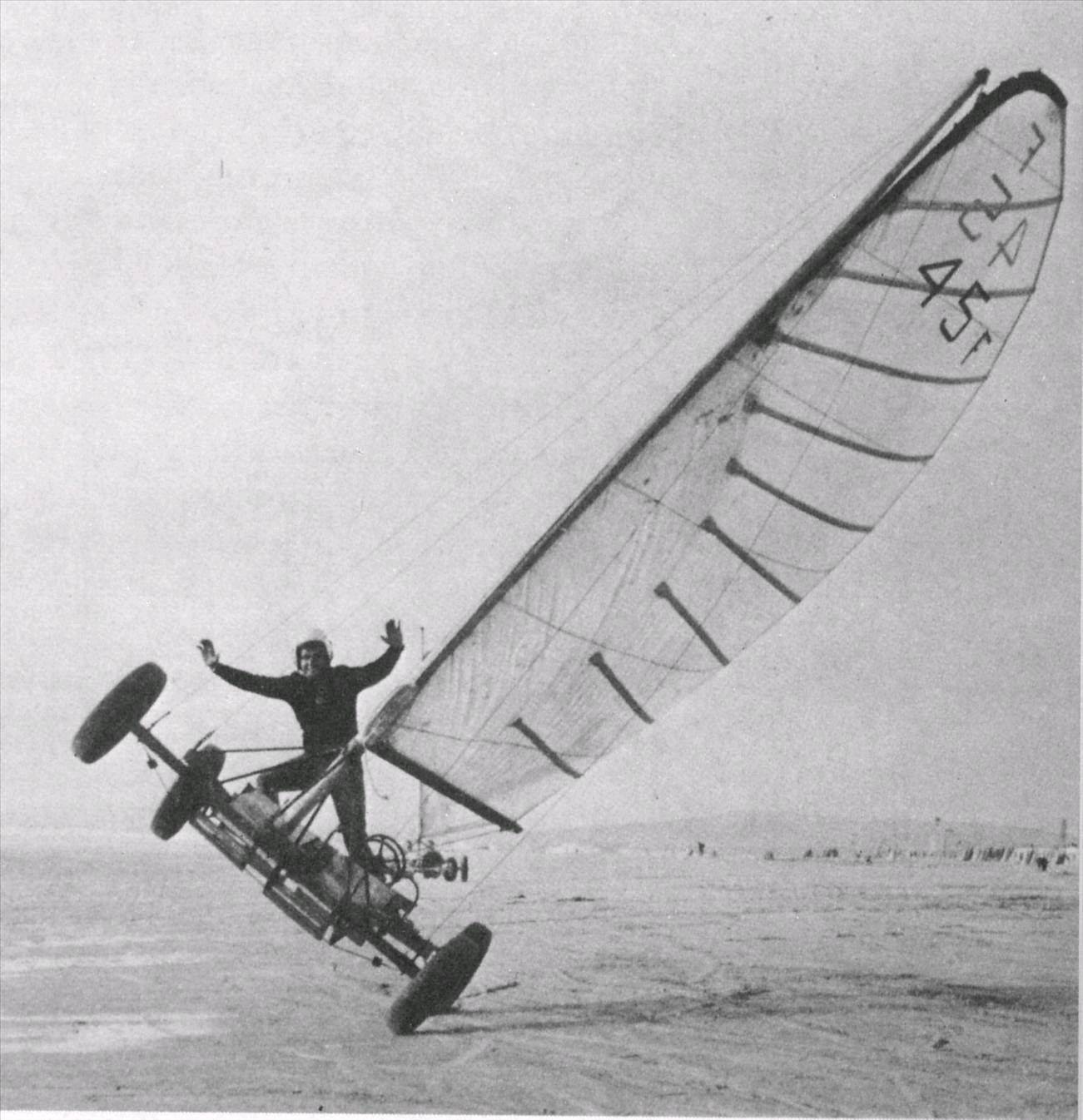
The FRAME provides a rolling platform to keep the sail upright and allow the change of direction. Keeping the sail upright offers the greatest area to the wind.
A 10° HEEL is a 1.5% loss of area and at 30° is 14% less.

ROLLING RESISTANCE I mentioned in Chapter 1.

The other DRAG for land yachts is WIND RESISTANCE.
‘CLASS 5’ excludes ‘STREAMLINING’ but not minimisation. That is reducing the frontal area. STAY LOW AND FLAT. A simple statement that really means keep everything tidy and tucked in. The difference between LAMINAR and TURBULENT flow is really quite small in the wind resistance equation, but critical in the sail performance. For the sail we want LAMINAR FLOW, for the rest of the yacht we have mostly TURBULENT FLOW. CLASS 5 yachts have a forntal area of aprox 0.8M2. that equates to a wind force of 1.5kg at 12N. This is exponential.

Now for the HELM. Did you know you had one?Your yacht may have a WHEATER or LEE HELM. It should be neutral.In motoring terms this is the tendency to under or over steer which depends on the polar centre. When sheeted in on a tack, if the rear wheels slip away with the wind, this is a wheather helm. If the front wheel slips away with the wind, it is a lee helm. The position of the MAST STEP and your body weight determine which of these you have. ‘CLUB 88’s can not move the mast step so it is your body position that can be changed by moving the seat forward or back. For displacement yachts this can be changed by moving the crew or ballast to windward or to lee. For most of us (85th percentile) we should have our hips in line with the rear wheels. It is a good exercise to know what the weight distribution of your yacht actually is. Moving the mast step, or the changing the rake of the mast will move the CENTER OF EFFORT of the sail relative to the yacht and change the helm

The CENTER OF EFFORT is the point that is a result of the forces on the sail. For a ‘CLUB 88’ it is about 2 metres up and 800 back from the mast. On 88’s this point is very close to directly above the mainsheet and not movable.

WHEEL ALIGNMENT can be another contributor to drag.The front wheel should be vertical and aligned with the keel. The rear wheels can have a little toe-in,but no toe-out. The CLUB 88 specification for the rear wheel camber is 2.5°, My yacht is 8°. ‘CLASS 5’ yachts must pass through a 2 metre gate, make the most of this and run close to the maximum. I hope this Chapter has made you consider what you currently do, or reminded you of what you should do, or reinforced what you actually do, or maybe entertained you for a few minutes. My qualification for the preceding information and comments are that I am an Engineering Design Draftsman with 53 years of engineering and 27 years of land sailing experience.
aus230
aus230
WA
1660 posts
WA, 1660 posts
24 Nov 2014 10:52pm


Enjoying the Challenge by Graeme Chandler AUS20

Chapter 3

Now that your yacht is sorted - let’s get down to making it sail - this now depends on you, the SKIPPER.
? DO YOU KNOW THE DIRECTION OF THE WIND?
? DO YOU KNOW HOW CLOSE TO THE WIND YOU CAN SAIL?
? HAVE YOU ESTABLISHED A SET OF TURNING POINTS?
? CAN YOU READ A WIND SHIFT?
? WHAT ANGLE SHOULD YOU SET UP AT ON THE START LINE?
? DO YOU HAVE TELLTALES? CAN YOU READ THEM? DO YOU USE THEM? JUST A FEW QUESTIONS TO START WITH.

In Chapter 1, I emphasised the need to be aware of the wind direction, and again in Chapter 2,MAYBE THIS IS IMPORTANT. How close you can sail into the wind can also be a measure of any improvement in, or loss of performance by, your setup, or modification, and in your ability. To know how close to the wind you are you need a point of measure. I use a simple home made indicator. Making use of this needs practice, and attention to detail. How close was I yesterday? How close am I today? What changes have I made?
For every 1° off your point,you must travel 2% further,and probably tack How much is 1°? Put your thumb up at arms length, your thumb covers about 2° In your yacht the width of the mast covers about 1.5°
I have said previously that we sail on the apparent wind, to realise the difference between the apparent wind and the true wind, sail your yacht pointing as high as you can, stop in a straight line, then take note of where the wind is.

A TURNING POINT…. When to TACK or JIBE. Every time you tack you lose momentum (slow down) so less tacks is best. Our competitions are FLEET RACES, not MATCH RACES, so ‘COVERING TACKS’ are rarely any advantage. This means “MAKE THE NEXT MARK”. Create a TURING POINT like, my rear wheel must be past the mark before I tack. It is like creating a LAY LINE. Water sailor say, ‘NEVER FALL BELOW THE LAY LINE’ A simple staement that involves a number of considerations. Including allowance for wind shifts and changes in wind strength. There is a point of judgement here that is, ‘I am falling below the mark, when do I tack?’ NOW - or do I stay on the falling line hoping for a wind shift or lift only to struggle around the mark. WIND SHIFTS; be aware, we don’t get wind patterns on the surface, look ahead at the marker flags, other yachts, the big flag, wind socks, anything. Be prepared to make adjustments, the wind pattern on any day will dictate how much you over - under shoot your turning point. A JUDGEMENT TO BE LEARNED. Heading up on a wind shift is a decided advantage. The gain is opposite and equal to the loss by falling off the lay line.

MANAGEING DIFERENT WIND STRENGTHS; our rules set the wind speed window for racing at 5-30N (10-55kph) We often continue when the wind falls below 5N or WHEN MORE THAN ¾ OF THE FLEET ARE STOPPED OR PUSHING. The lighter the wind the more important it is to maintain momentum. That may have you sailing well past your set turning points. How to restart after losing the wind; YOU MUST KNOW THE WIND DIRECTION, HAVE I MENTIONED THAT BEFORE? Set your yacht at 70-90° to the wind, now is when your telltales can guide you back under way. Then feel the sheet pressure and watch the telltales, don’t rush it, oversheeting will stop you. Higher winds require greater margins when rounding marks and when close to other yachts. Whatever the wind, your yacht will perform best with the windward wheel just on the ground. Hiking a wheel for any distance will slow you down. If it comes up you can let out the sheet or head-up.Heading-up is most advantageous.

aus230
aus230
WA
1660 posts
WA, 1660 posts
26 Nov 2014 8:00pm


Enjoying the Challenge by Graeme Chandler AUS20


Part two of chapter 3

WHAT ANGLE SHOULD YOU SET UP AT ON THE START LINE?
Getting off the start line clear ahead is the best place to be. You are setting up your yacht to the wind, that may be off the square to the line. Set your yacht so that you can sit on the line with the sheet all out whitout any effort to hold your position.This should allow you to power up the sail to a point that the yacht is almost dragging just before the start signal. More about this in the next Chapter.

DO YOU HAVE TELLTALES? Can you read them? Do you use them? Not much to reading them in good winds, very important in light winds, the only measure of how well the sail is working.

ROUNDING MARKS, in motor racing now the modern style is, stop late, turn in hard, power out. That will not work in land sailing, you need to flow through all roundings, tacks and jibes. Make all your roundings with consideration of the wind direction and the position of the next mark. You may be better continuing past the mark on the same tack to get a better line to the next mark.

Chapter 4
I hope you now understand your yacht a little better - let’s get down to a few tips and prctices for racing. Do you race for the competition, or for fun? The more efficient your technique, the better results for both. My opening remark of Chapter 1 was, “LANDSAILING SHOULD BE AN ENJOYABLE CHALLENGE”. If, you have now removed all the frustrations from before the start, we can get underway and enjoy the challenge. Make sure you understand the starting procedure for scratch, and handicap races. If you sail somewhere else these may be differnent. Such as the Morel starting grid and orange zones at turning marks. Get to the start line as promptly as you can. That will reduce the frustration of others as well. Don’t sail into the starting grid at speed, IT’S DANGEROUS. MARK WEBBER’S POOR STARTS MADE A No.1 QUALIFIER INTO A PROFESSIONAL PLACE GETTER When you practice, practice starting, not just sailing up and back. Practice starting without pushing,feel the power of the sail, sheeting in too quickly will stall the sail. You want to feel the drive as you accelerate. As you get to nearly close hauled most of the pressure on the sheet is actually bending the mast. Have you determined your best start line angle?
DO YOU KNOW THE WIND DIRECTION? There is only one generalisation about the wind, it is always shifting, direction, and strength. How you deal with this is a significant part of your ability to sail competitively.

Back to the START LINE. Set your yacht so that you can sit on the line with the sheet all out whitout any effort to hold your position. This should allow you to power up the sail to a point that the yacht is almost dragging just before the start signal. If you get overpowered on the line, don’t struggle to hold your yacht, you won’t win. go around and set up again at a better angle. If your sail flaps, you are pointing too high, or you need to limit your sheet. Flapping will damage the sail. When I set my yacht on the line I keep my front wheel turned to windward until just before the start signal. That allows me to absorb wind shifts, or lifts, without breaching the line. The diffenence between shifts and lifts; shifts are the change in direction, lifts are the change in strength Be sensitive to a shift ahead and bring your yacht around to it. To a lesser degree for a shift abeam. In fleet racing the first decision is “HOW MUCH DO I GET INVOLVED WITH THE FLEET”. This is most critical on the beat to the first mark in a scratch race when most of the fleet will be together. Stay with the fleet, or break away? The considerations are, wind shadow and right-of-way The courses we sail appear complex but really do not have many track options, this means the fleet will not split to opposite tacks very often. Remember wind shadow is not directly behind other yachts but at the apparent wind angle. Where the dust is. Try to stay out of the wind shadows, but remember everybody else should be trying to do the same. If you break away, will it give you right-of-way at the next mark or put you in conflict with the fleet? When you are on a tack, head up on every advantage shift you get, even if it puts you more above the lay line, the next shift may be against you, if you fall below the lay line that means an extra tack. When you are approaching a port rounding, on a port tack, yachts on a starboard tack, to your right, have right-of-way. If you can’t cross clear ahead you must cross behind. It is very rare that you can tack under the right-of-way yacht that is laying the mark and still make the mark. don’t turn sharply on the marks, or when you tack, that will slow you down considerably. Keep the flow by setting up early for the turn, or run on past the mark. Keep the power as long as you can. On turning a down-wind mark onto a reach, you should be almost on the next lay line before you reach the mark. When you are reaching the same applies as tacking, head up on every advantage shift or lift. Downwind; like catamarans and skiffs we tack downwind to get better than wind speed. Rounding a mark to downwind should be done to put you on what is a broad reach, this may require over-running the mark before you jibe. Rounding any mark should be done with the next mark in consideration and THE WIND DIRECTION. Have i mentioned that before? In any race there will be many judgement calls to be made between the marks as well as at the marks, it is not always best to follow someone else. In my view, you need a good reason to go past your defined turning point. Early tacks need to give you an advantage, either when you tack, or at the next mark. Be ready to change you course depending on the wind, or the fleet, don’t just sail the same as the last lap.

To recap a few of the things I have said in this very short series - Do your maintenance before you get here. Use the wind to set up your yacht don’t fight it. Always park your yacht head to wind. Practice starting. Define a turning point. Use all the wind indicators, and your teltails Stay above the lay line. Head up on every shift or lift. Sail two marks ahead. Keep your momentum. I hope you have gained something from what i have offered in these comments. As I said in Chapter 1, nothing of my yacht setup or how I sail is a secret. just ask. After 27 years I still find land sailing AN ENJOYABLE CHALLENGE.

Many thanks to Graeme for kindly allowing me to share this tutorial , I am sure that it will help a lot of sailors

TeamWally
TeamWally
VIC
47 posts
VIC, 47 posts
27 Nov 2014 10:14am
Thank you to both of you, for the sharing of knowledge.
Test pilot 1
Test pilot 1
WA
1430 posts
WA, 1430 posts
27 Nov 2014 10:35am
The best way to learn something is by teaching others
Please Register, or first...
Topics Subscribe Reply

Return To Classic site 😭
Or... let us know if a problem, so we can tweak! 😅