This article out of the new dirt boating magazine that is talked about in our general section is well worth a read. Excelent work.

http://dirtboating.com/1-1March.htmlTrimmer Primer Tuning, Trimming and SailingTricks and Tips
Manta? Twin and similar
Duncan Harrison
A long time ago (so the goes the myth) on a remote
desert road somewhere east of Barstow, an old dirtboater
wandered, lost, looking for a fabled dry lake, a
playa spoken about in whispers and only around campfires in
cold desert camps. He wandered until he saw what he was sure
was a mirage! It was the most perfect dry lake he had ever seen.
The playa surface was hard packed but with a shiny look to it,
not unlike a glazed donut. He rolled a quarter across the dirt and
it seemed to want to roll out of sight, but he wouldn't let it. You
see, you could buy a lot of glazed donuts for a quarter back then.
Quietly he wondered to himself - was this the fabled dry lake at
AREA 51?
While setting up his Manta Twin, he didn't notice the dust devil as
it sailed across the playa. Tacking this way then jibing that way, the
dust devil blew across the old dirtboater. As it passed, it picked up
a dry old folder of papers and smacked
them against the side of his helmet . . .
Later, after the best day of dirtboating,
the old guy stood by his campfire with
a cold beer and studied the ancient
paperback and dry, yellowed papers.
He discovered they were a book and
notes on the theory and setup of sailing
machines! His sailing machine! They
appeared to be written long ago, by a
cosmic sailor named WALKER -and
when he rubbed the cover on his sleeve
he could just make out a words; Manual
of Sail Trim.* The old dirtboater read on
and found the secrets and techniques to
sailing which he could use to amaze his
friends and defeat his competitors.
To be fast in landsailing requires the ability to
set up the landsailer to convert wind power
into sail power, in order to sail at the maximum
possible speed and best apparent wind
angle, while minimizing drag and resistance.
PILOT POSITIONMedium to heavy wind - keep windward hip and shoulder
tight against the outside frame to get maximum
body weight to windward. Avoid bouncing or throwing
body weight from side to side; this may cause sliding or
spin outs.
Sitting upright - exposes more body surface to apparent
wind (slow); reclining as low as possible reduces this
drag (fast). Accepted practice is to move the steering
bar forward (on the MANTA this requires shortening the
steering tube) to allow pilot to recline lower in the seat.
The Manta Twin seat - it's acceptable to tie the seat
loosely enough to lower the pilot; promotes reclining
and lower center of gravity. But if tied too loose; the pilots
tail bone or lower back may hit the rear axle causing
injury (to be avoided).
TIRE PRESSUREOptimum tire presure is an important factor in speed.
Higher tire pressure - reduces tire rolling resistance
but promotes sliding/spin outs at higher speeds.
"Harder" tires rolling over softer surfaces may "sink"
in (slow).
Lower tire pressure - higher rolling resistance (drag)
but less sliding/spin outs (unless you go too low).
WHEEL BEARINGSThe best advice may be - keep them clean and well
lubricated.
Providing an inner sleeve to fill space between inner
races will help bearings run more smoothly; less friction
from side loading and compression from tightening
axle nuts.
BLOCKS and SHEETSBlocks need to run freely with as little friction as possible.
The sheet must run freely in and out through
the blocks; allowing for instant changes to sail trim
(including very slight changes) at anytime; especially
in light wind.
Set Up Tips (Sailing and Racing)MAST RAKE and YOKE
Setting the yoke between 48 to 52 inches above the
mast step is the suggested range. Setting the mast
with less rake in light wind; adjusting for more rake
in higher wind is accepted practice. Yokes sometimes
slip under pressure; use restraining lines to
stop slippage.
The lower yoke setting (48 inches); less rake to the
mast. Sail draft will be forward and high; side force
and heeling are strongest. The higher yoke setting (52
inches); increases the mast rake aft; sail draft will be aft
and lower; side force and heeling will be less.
Initial Setting - light air; set the mast more upright.
Minimum versus Medium mast rake settings-the
more "upright" the mast rake setting; may provide
a slightly wider range of sail trim adjustment before
the sail is trimmed to maximum effect.
As wind increases - set mast rake farther aft.
Maximum Rake Setting (aft) - increasing sheet
tension may flatten sail sooner and rob it of power
needed to promote acceleration.
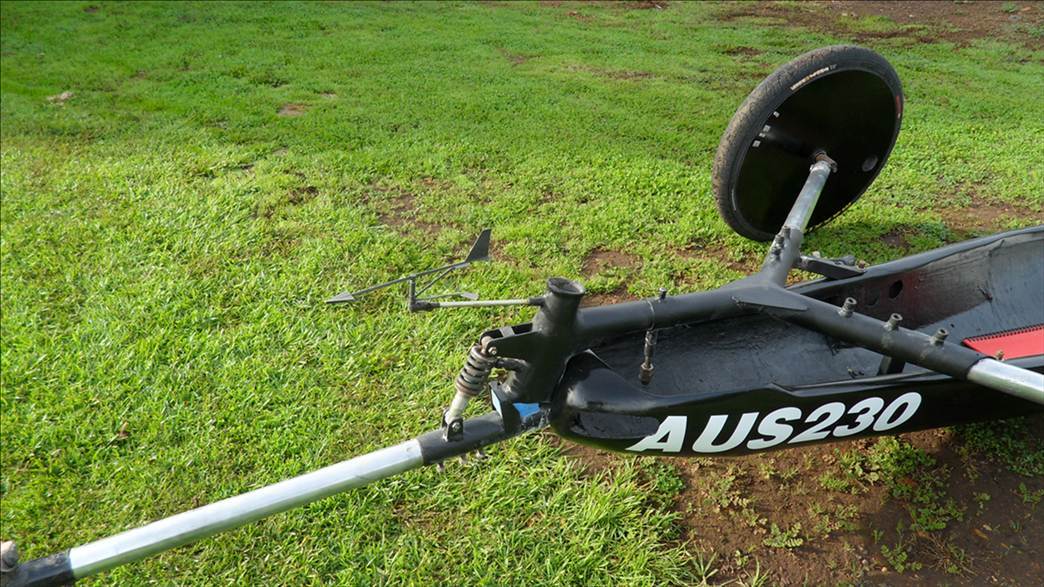
Wind Point Instrument - attached to the lower mast
(projecting forward) where the pilot can see it is
acceptable. Some are mounted to frame above front
tire. Knowing the apparent wind angle is a very important
tool to proper sail trim and steering the landsailer.
MAST BENDFore and aft - flattens the sail; moves draft aft. Mast
bend is affected by sheet tension and yoke position.
Increasing the sheet tension; pulls leech down and aft;
pulls tack down; compresses boom into mast; bends
mast (mid section) forward and flattens the sail.
Mast top bends to leeward - opens leech; increases
twist. Decreases side force and moves draft forward
and down. (See Images next page)
MAST FRICTIONTreat mast surface with lubricant (wax, silicon spray)
to promote rotation of sail sleeve in tacks and jibes.
The mast tip from factory ends in an aluminum
section (tube) with a flat plastic cap inserted into
the tube. The inside of sail sleeve rubs only on the
outside edge of the plastic cap with minimal friction;
some pilots remove this factory cap and replace it
with a golf ball.
BOOM STIFFENERAccepted practice is to stiffen the boom with an inserted
dowel or stiffener.
A stiffer boom - flattens the lower area of the sail
(this adjustment exists in settings mentioned below);
one negative side effect of a stiffener may be that
a stiffer boom robs lower sail of
power.
TACK, OUTHAUL and SAIL
DRAFTOuthaul - flattens lower sail and
moves draft of lower sail forward;
opens lower leech and deceases
side force.
Initial Setting - the TACK can
be adjusted fore and aft on the
boom; it's possible to move the
foot (and draft) toward the mast
or away from the mast an inch or
two. Setting the outhaul requires careful attention.
Always set the tack first.
Setting the TACK - closer to the mast moves draft
slightly forward and slightly "rounds" the entry of the
luff. Setting the tack aft moves draft aft; creating a
"finer" entry to the luff. The rounder entry improves
acceleration and pointing; the finer entry has good
top speed potential but less forgiving. In acceleration
and pointing ability; the rounder entry is considered
more efficient.
Some sailors refer to this rounder entry as the "knuckle"
along leading edge of sail.
Setting the OUTHAUL (CLEW) - after setting the
TACK; setting the CLEW shapes the lower part of the
sail; tighter outhaul flattens lower sail and moves
lower sail draft forward; opens lower leech and deceases
side force.
BATTEN TENSIONBattens control the shape of draft and power in the
sail. Generally; the tighter the batten the deeper the
Photo Duncan Harrison
draft (more power) of a given section of the sail. In
MANTA? CLASS racing; battens cannot be sanded or
shaped to enhance the location of draft.
Batten tensioners come in many types and styles; all
work well if used correctly.
Lower and lower mid battens - the accepted practice
is to set them to the desirable draft before sailing.
Too much batten tension may result in battens
that can hang up during tacks/jibes.
Upper mid batten - this batten is very stiff compared
to the lower battens. Adjusted tight enough to promote
draft in the sail; it may "hang up" when tacking/
jibing in light wind. Carrying it "looser in light wind
and tighter in heavy wind" seems to work.
Lubricating the mast helps reduce battens hanging
up; there is also the technique of sheeting the sail
tightly during tacks/jibes; then releasing the sheet
suddenly which helps "pop" the sail luff and battens
to the new leeward side.
Top batten - not much to work with here; just keep
it tight.
SAIL POWERThe power (aerodynamic force) from the sail is generated
by air flow along the leeward surface of the sail.
Promoting and maintaining attached air flow is the
most important factor in all aspects of sailing and
racing.
TELL TALESMaintaining tell tales in good condition and proper
location on the sail is critical to good sail trim.
SHEET TENSIONSheet tension directly affects the sail's leech; decreasing twist; initially
increasing sail shape (fuller) and increasing total force and side force.
Sheet tension also acts on tack of sail as a Cunningham; pulling down
with increasing force as tension increases.
Medium sheet tension - begins to bend mast significantly; compresses
boom toward mast (increased mast bending) and flattens the sail;
moves draft aft and increases side force; improves pointing ability.
Maximum sheet tension - bends mast midsection to maximum; flattens
mainsail to maximum; causes draft to move significantly aft and
down.
Above maximum sheet tension - MANTA sails tend to invert
from leech toward luff; this is
OVERTRIMMING and to be avoided!
ACCELERATION MODE
During acceleration - increase
sheet tension to match speed
as landsailer accelerates. Avoid
OVERTRIMMING during acceleration.
Easing the sheet slightly - increases
twist and moves draft
forward; helps maintain speed in
lulls (promotes attached air flow
on leeward surface of sail) and improves
acceleration while keeping
landsailer upright (less side force).
As landsailer accelerates bring
sheet tighter to match speed.
In LULLS - easing sheet slightly;
promotes attached air flow to
keep sail powered up until wind
returns.
GUST RESPONSEMain sheet must be used for gust
responses. Slight changes in wind
speed create major changes in
wind force and power to the sail.
In GUSTS - easing the sheet
slightly (opens the leech) reduces
both heeling and side forces; allows
the landsailer to accelerate
efficiently after the gust.
Proper response to gust - allows
landsailer to continue on straight
course with less side force, less
sliding and loss of speed; maintains
maximum speed through
the gust, and sets up for good
acceleration (if needed) after the
event.
MANUEVERSDucking Another Landsailer
(or ducking for any reason)
First responsibilty is to avoid collision
- easing sheet as landsailer
turns down; promotes better steering
control (very important!); speed will increase;
leave plenty of room to pass safely behind the other
yacht; after passing return to original course; increase
sheet tension.
Tacking and Jibing
Easing the sheet slightly - just after completing a
tack or jibe; opens leech (promotes attached air flow
to new leeward surface of sail) for faster acceleration;
reduces side force (keeps landsailer upright); promotes
better steering control. Ease the sheet more
in light wind and less in medium to heavy winds.
Return to maximum sheet tension as boat speed
increases.
Turning a weather mark
Light wind - be careful not to "over steer" or "over
trim" the sail during the manuever. Easing sheet
slightly will help keep attached flow and promote acceleration.
Increase sheet tension as speed increases.
Medium to heavy wind - easing sheet slightly as
landsailer turns down (change in wind speed/direction)
opens leech; promotes air flow across leeward
surface (faster acceleration) and reduces side force
(keeps landsailer upright); promotes better steering
control. Increase sheet tension as speed increases.
Turning a leeward mark
Light wind - initially maintain constant sheet tension
and apparent wind; then while transitioning to
the fastest sailing surface on the planet
up wind mode; increase sheet tension.
Medium to heavy wind - just before turning the
mark; easing sheet (slightly - if necessary) will reduce
side force to allow better control of landsailer as it
transitions to upwind mode. After rounding mark;
increase sheet tension to match speed.
During all maneuvers -Move body smoothly from
side to side in seat. Avoid bouncing or throwing body
weight from side to side; this may cause spin outs.
LOSS OF TRACTION (SLIDING)All sliding during races should be avoided -any
events that cause tires to break traction and slide
(even just a little bit) robs the landsailer of forward
speed; the longer the duration of a slide the more
speed will be lost and must be regained.
To make up lost speed go into ACCELERATION MODE
These instructions have been transcribed
as accurately as possible from those passed
on to the author by the "old guy." Because
of weathering of the hand written pages,
he might have missed something, but his
experience suggests that he has gotten them
mostly correct. ED.
* A Manual of Sail Trim by Stuart H Walker
Editor@dirtboating.com
Available from Amazon.com. Click
the cover.
America's LANDSAILING CUP
March 23-31, 2013
nalsa.org/